Game Changer In Web Development: Vercel’s Guillermo Rauch
In this interview, RJ Lumba talks with Guillermo Rauch, founder and CEO of Vercel, about the company’s mission to provide a "frontend cloud" that combines frameworks, workflows, and infrastructure for building fast, dynamic, and personalized web experiences. Rauch explains Vercel’s core product—Next.js and the serverless platform—highlighting how major customers such as Under Armour, The Washington Post, Nintendo, and Zapier use it to deliver high‑performance, globally distributed sites. He traces his personal journey from an Argentine‑born frontend enthusiast to building open‑source projects, a brief ed‑tech startup, and eventually Vercel, emphasizing the role of open source (React, Next.js) in achieving rapid product‑market fit. The conversation covers Vercel’s growth strategy, the influence of investors (CRV, Accel, GGV, Bedrock) in sharpening focus, avoiding over‑generalization, and shaping executive hiring for long‑term scaling. Rauch describes the platform’s monetization model—real‑time preview URLs, collaborative workflows, and experiment‑driven deployments that let teams iterate like scientists. He also reflects on navigating market cycles, from crypto hype to AI adoption, and how Vercel’s diversified use cases keep it resilient. Finally, he shares personal influences from his engineer parents and his passion for supporting student tech initiatives through Hack Club and similar programs.
Chapters
In this episode, we speak with Guillermo Rauch, founder and CEO of Vercel, the frontend cloud that gives developers the frameworks, workflows, and infrastructure to build a faster, more personalized web. Founded in 2015, the company has raised over $300 million and is backed by GGP Capital, Accel, Bedrock Capital, CRV, and other notable investors. Vercel unlocks developer potential and enables users to go from idea to global application in seconds. Vercel enables customers like Under Armour, Nintendo, The Washington Post, and Zapier to build delightful user experiences on the web. I'm your host, RJ Lumba. We hope you enjoy the show. If you like the episode, click to subscribe.
RJ Lumba is the executive chairman of Market Insight Media and the managing partner of GrowthCap. He is the host of Great Entrepreneurs, a podcast for driven entrepreneurs and business owners. Our podcast covers all topics related to the entrepreneurial journey from ideation to execution to optimization and to reaping the rewards of a well-run business. In the minutes ahead, we'll share with you unique insights and tactics from some of today's most accomplished and inspiring entrepreneurs.
Guillermo, thank you so much for taking the time. It's a delight to be with you.
Thanks for having me.
So where I'd like to kick off is actually what Vercel does. Many in our audience may have heard about the company, but only on a cursory level. So maybe we could set the stage by talking about what Vercel does for its users.
Yeah, for sure. Vercel offers what we call the frontend cloud, which is a set of frameworks, workflows, and infrastructure to power the best, fastest, and dynamic websites on the internet. My litmus test for whether a website is built with Vercel is If it's really fast and the use case really sophisticated, it's ought to be built on the Vercel platform.
Got it. And so who are maybe some of the major customers that we might recognize?
So this idea of the frontend cloud relates to what in engineering we called, of course, the frontend of an application. That's the part of the site or an application that touches the user, the customer experience. And as such, every brand in the world that is concerned with delivering a great user experience on the internet will want to use Vercel. So I'll give you an example on e-commerce. UnderArmor.com is powered by Vercel. They used to be on some legacy monolithic tech stack, and by reinventing their storefront and deploying it on Vercel, with the help of our framework, it's an open source framework we call Next.js, they were able to lift sales, make a more personalized experience for their customers, and overall, and very importantly, make the developer experience really great, meaning both engineers and users are happy as part of the adoption of the Vercel platform.
And does your technology make it easier for maybe those with more design experience versus technical experience make it easier for them to develop sites and have it be functional in a fairly efficient manner?
Yeah, the way to think about us is that you're kind of outsourcing your developer infrastructure, right? So instead of building up with the primitives of the cloud from scratch, meaning you build your own frameworks, you build your own machines, data center infrastructure, whether it's in the cloud or on-prem. You're sort of outsourcing that to us. So you get to focus on what matters to your users. Again, that experience, that brand experience. So really the persona that loves this product is someone that is focused on building product or designing products and delivering them at planet scale. So I mentioned Under Armour as an example in e-commerce. We also have Washington Post in media and news where their demands are they need to build really interactive, immersive, dynamic experiences. For example, when the election happened last year, they wanted to curate this really cool front-end infographics, but they also are under tremendous pressure from a traffic standpoint, right? Like, you announce a candidacy and you get a storm of traffic into your website. So Vercel is answering for both parts of the equation, how you build really awesome experiences that you give to users, but also how you do this at planet scale. Meaning you deploy globally, you personalize per country, currency, whatever dynamic requirement your business has, we can meet.
Now, the, the engineering to actually build your product, to build Vercel, must be quite technical. Are you an engineer by training?
Yeah, my background is precisely in frontend. So I started out when I was 10, 11 years old. I had this like plethora of languages to choose from. JavaScript was sort of a toy language at the time, which is really funny. And of course, all the well-known backend languages like C++, Java, et cetera. So even early in my career, I kind of took a bet, right? Like I wanted to perfect and specialize in the language that could run on the browser and could create this really dynamic real-time experiences. So at the time, my inspiration was Gmail. When Gmail came out, It kind of took the world by storm because it ran desktop-grade software inside the web browser. So that was my bet. Like whatever technologies like the Googles, Metas, Amazons of the world are using to create these awesome experiences, I want to democratize to the world. So I ended up building out Vercel from that idea of, hey, frontend is going to be really important. In fact, it's going to make all the difference. And this is the core of my hypothesis, right? So the vast majority of backend services over the past decade have become APIs that you can reuse and grab off the shelf. So you look at Stripe, Twilio, Auth0, there's all this incredible reusable backend developer infrastructure. Now you look at the world of e-commerce and much of that is going headless and composable. So where's all the alpha in the market, so to speak? Well, it's in that engineer or designer that can assemble all these pieces and deliver an incredible experience. So increasingly that engineer is becoming frontend focused. So if you go to Twitter, if you go to Hacker News, like we have this incredible community of developers that has followed our projects in the open source world. And again, they're finding incredible leverage on the Vercel platform because instead of building undifferentiated infrastructure from scratch, they get to really start from a higher level entry point.
You must be experiencing rapid growth among the developer community, you know, given how quickly it seems like you're scaling, taking in capital and from, you know, some of the best investors you have— Google, CRV, Accel, GGV Capital. Can you tell us a little bit about your path and how you were able to kind of demonstrate the strength of your product and adoption?
Yeah, I mentioned open source a few times and I think it's worth emphasizing, right? Because I think much of the future of enterprise cloud software is increasingly open source rooted, right? So when I started this company, I found an opportunity to create a framework that embedded what I thought were the best practices for building on the web. I mentioned Gmail earlier, like even early in my career, I kind of became obsessed with reverse engineering the great successes on the internet, right? Like I would go to Gmail and like poke around how it's built. I would go to Facebook, I would go to Amazon, I would go to any kind of like really, really, really large web footprint. And I started to find a lot of common patterns. And even this company started to open source a lot of their engines. So one such UI engine that got open sourced that kind of blew my mind at the time was React. Which came out of Meta. So Meta deserves a lot of credit for open sourcing incredible foundational technologies. One is PyTorch in the AI world. The other one is React in the UI world. So when I found React, to me, that was like, I found a V8 engine and I thought, holy crap, every UI in the world will go so fast with this. But what it was missing was— and this is kind of the gap that I answered with this project with Next.js— was a more comprehensive framework to actually build the applications that the world wanted to build. And that part inside of Meta kind of remained closed source because it was too ingrained in their internal systems. So it was like, what if I could give people a framework that even without a ton of expertise, you could create something of the quality performance and complexity of something like the amazon.com mega storefront. And obviously it took me several years, but in some ways the initial release of this Next.js framework was kind of like an overnight success. We started seeing that huge enterprises were adopting this framework, putting it into production right away. So one of the things that we've been seeing a lot in the markets with regards to cloud is that folks are facing a lot of headwinds in terms of optimization, right? Like you look at your productivity software stack and you're like, maybe I have 3 different to-do list apps. I should delete 2 of them, right? One thing that was fascinating with Next.js is that right away it started powering the .com of the largest, most ambitious websites that I know. So I would go to hilton.com, boom, powered by Next.js. I would go to zillow.com, boom, powered by Next.js. So it had this pretty incredible product-market fit almost overnight. And again, in a mission-critical capacity. So I knew right away that there was something here that was worth doubling down on. And I kind of realized that these companies didn't just need developer tools. They needed world-class, planet-scale cloud infrastructure that was optimized for this framework. And that's how the idea of Vercel sort of came about. There's incredible complexity in delivering frontends at the scale of these companies like Amazon, but we can sort of build a very reusable platform that embeds all those best practices and gets presented to the customer as a serverless cloud service where they don't really need to manage the operations. They don't really need to manage the software upgrades, the security lifecycle, and so on.
And when did monetization start occurring? You know, I guess presumably you saw that this was working, you know, it was scaling. And then how did you think about commercialization?
Yeah, you mentioned earlier this idea of a design-oriented persona in our product. I think that's really insightful because right off the bat, what happens when you're focusing on creating this front end or this UI applications is that there's a great need to sort of collaborate and share these artifacts with your colleagues, with your coworkers. Maybe you're a freelancer that is sort of going through a review cycle with your client or an agency. So right off the bat, we saw this opportunity to sort of do for web development what Google Docs did for documents, what Figma did for image or sketch-based collaboration, where every time you work in a frontend on the Vercel platform, you get back this URL that you can share with anyone and sort of keep track of progress on your projects in real time. So there's a very natural fit in terms of a service that you started wanting and you kind of get addicted to when you start developing software this way. So it's a very visual experience. It's very collaborative. You can sort of seek comments and insights from the rest of your team. It's very QA-centric. What I mean by this is that every step of the way, you're sort of able to ensure that the product that you're building is the right product. One of the things that we're democratizing with Vercel that I'm really excited about that really, really large companies do is that almost everything they build is an experiment. Mark Zuckerberg or Tim Cook don't just wake up one day and say like, oh, we're going to change the homepage of the website, or we're going to change the newsfeed to do X or Y. Everything sort of gets internally modeled as an experiment. It has some metric that it needs to satisfy. People can sort of demo or preview the experiment, but it doesn't get necessarily rolled out to the entire user base in a binary form. And if you talk to most tech companies, this sounds like alien technology, the idea of Software doesn't exist in like a binary form under development or fully in production. So Vercel democratizes that as well. The idea that every unit of work that goes into your frontend project is sort of this experiment that you can track, roll back instantly when things don't go well. Again, we have a lot of e-commerce customers with lots and lots of revenue on the line. So you kind of want to take this different approach to software development. Sometimes we call it turning developers into scientists and be more progressive and experimental with how you roll out your software changes. And again, if something goes wrong, have that ability to like instantly roll back and kind of revisit and collaborate again. And so the cycle continues. So to answer your question succinctly, it became very natural with the kind of product that we're building that there would be a platform that sort of answers for most of the needs and requirements that arise for this large-scale frontend projects.
Got it. Got it. Tell us about your background and how you were able to get the company off the ground initially.
So I'm originally from Argentina. I mentioned that I kind of bootstrapped my career off of focusing on frontend. I built a lot of very successful open source projects, and then I got a job at a startup that launched in Silicon Valley. I visited, I kind of fell in love with the ecosystem. Everything about it, just like the innovative spirit and the ability to access venture capital and everyone being open to talk and give advice. And so I was like, okay, I have to start a company. So I started my first startup in the edtech space. We went through a small pivot and then ended up selling that company to the parent company of WordPress. Again, another sort of open source based successful company. And I spent 2 years there and started to notice this shift, as I mentioned, away from monolithic architectures, the rising importance of frontend as opposed to backend, the arrival to the scene of this React UI engine. And I really couldn't wait a day more. I left Automattic and started Vercel. And as I mentioned, because of our focus on open source, Because of the way we build very close to our community, very close to our customers, we've sort of been building out the company ever since, and we've experienced tremendous growth in the process.
I'd like to talk about investors and what they add, you know, the value they add to your company. Maybe what we could do is just pick out certain investors and maybe some of the unexpected ways they have, and maybe material ways they have helped you.
In the early days, so one being CRV, Charles River Ventures, the other one being Accel, something that I look back very fondly on was, as a technologist, as an engineer, there is this sort of curse of generalization that you can fall into. So if you ask a functional programmer, tell me all the merits of a fairly esoteric or academic language like Haskell. They'll tell you about this super abstractions, very complicated things that try to generalize over many, many, many, many patterns. And they have almost like a mathematical beauty to them. In the world of products, in the world of actual like reality, very general solutions don't tend to become very successful in my experience. So you kind of want to be world-class at one thing. I think this is not totally uncommon. I think Paul Graham has also talked about this. With the approach that he takes with Y Combinator. And I think in many conversations that I look fondly back on with both Reid Christian from CRV and Dan Levine from Accel, they would push me on like, are you going too general there? Are you trying to solve every problem? Are you boiling the ocean? Let's go back to like, what is the specific vertical that benefits from this? Who are you competing? Like questions that would force me to sort of think in a more narrow way. And again, like the aspiration is always like you run the entire internet, like that's where we want to go eventually. But how do you map out a more incremental approach where you anchor yourself to specific use cases where you bring tremendous amount of value? Like we're not talking like a product that you deploy and like, oh, it's 10% better. We're talking about a product that again, under tremendous scrutiny from the buyer, from procurement, from IT, from security, from the engineers, from the engineers manager, from the engineer that landed it and then departed. When you jump through all those hoops, the only way to do this is with a product that is truly 10 times better than what they were doing previously. So that's, I think, one angle that with your excellent question just like came up in my mind immediately. I think as the company grew, folks like GGV and Bedrock have very thoughtfully been trying to analyze, okay, who are the right executive team members that we're going to need over the next 10 years? Who are the folks that can actually help take this company through IPO and beyond? And again, being very thoughtful about it and trying to find who are the right leaders, who are the right examples of other companies, right? I think this is also very important. I've always sought investors that participated in companies that I found kind of a spiritual alignment with. There's just so many different ways to build a company and some folks just naturally pay more attention to quality or brand or engineering excellence, or, you know, again, how focused they were in their product lineup instead of, you know, I tend to like companies that have, as Tim Cook said in a 60 Minutes interview, products that fit on this table that were interviewing me right there. Again, the way that you build a company being aligned with companies that these investors have previously been investing in. So those are some things that I think have helped a lot throughout. And generally speaking, there is lots of problem solving that happens. There's lots of tactical stuff, but those I think have made big differences.
You know, from my cursory research, it looks like you've raised like a few hundred million dollars and you've done so sequentially and in increasing amounts over the last several years. You pointed to kind of this next phase and being able to identify the right executives. This must continue to be an incredible journey for you with this rapid scale. What is the most challenging aspect to the building of Vercel?
If I look back on the zero interest rate days, I think the biggest challenge was staying focused, even though there's all this signal and all this noise coming from everywhere, but being focused on the product, being focused on the customer. Know, you don't get extra credit for how big of a team you build. You don't get extra credit for how many big names join your team. And I think even though it was challenging, I think we did a really good job at navigating that, mostly because I had seen, and this is a nice thing about for me being in San Francisco, I've seen so many companies fall for traps that could get really exacerbated in that capital abundant environment. So I would say that was a challenge. I think we navigated it really well. We're not a special Snowflake that is completely inert to market dynamics. So we've seen a lot of ebbs and flows in verticals. So cryptos, crypto companies, NFT companies, those were builders that in 2021, I would hear about a new company being born every day in, in that vertical. The nice thing about Vercel is that we're so diversified in use cases that when that specific vertical started to show some signs of slowdown, then AI emerged. And it turns out Vercel is an incredible platform for building AI products because, as I mentioned earlier, the frontend cloud allows you to plug in any backend that you want. It turns out OpenAI, Google are building these incredible off-the-shelf LLM models that they run at scale. So we're now seeing a tremendous emergence of developers, designers, engineers that are saying, I can create the next big X, you call it email client, support tool, photo editor. And we tend to be a really good platform for this new generations, this new waves of technology sort of come up. So we've navigated that very dynamic environment well, I think, from a product standpoint. And again, we're ready to do that every day. And we're very curious about what are the different innovations that are coming to market and how do we respond to them and staying very focused on the product and the customer along the way.
We're coming up on time. I'd like to close with a couple questions. One is, uh, can you tell us about someone who has influenced you in a material way?
Well, that one is easy for sure. Both my parents in Argentina were trained as engineers, chemical and industrial engineering, and they've always had this incredible passion for two things, I think. So one is like scientific knowledge. That was like the common topic of conversation over dinner at the household. The other one is, especially for my mom, a tremendous respect for just how well companies can create products at scale and offer great services that change people's lives. And she, for many years, worked for American companies that had presence in Argentina. And she would always tell me, like, look at the difference between, like, what some of our companies do here and look at the obsession and care and thoroughness of documentation. We'd actually talk about this. For developers, it's not a secret anymore that quality of documentation corresponds so well with adoption and developer love. And even back in the day, my mom would talk about like, it's amazing, like we're buying, I don't know, this instrumentation device for oil refinement and provider A has excellent documentation specifications and provider B just barely talks about the product. Like things like that are just so timeless, right? Like obviously the landscape now is software, SaaS, tech. High-tech, but some things just remain constant over time, just like the care and for quality and those aspects of what makes something truly great were instilled in me early on.
Fantastic. Last question, can you tell us about a charity, cause, or other endeavor that you feel passionate about?
Great question. Uh, I love helping out and inspiring to the extent that I can students and young people that are getting into tech. So I support Hack Club, which is an initiative to sort of start these hacking clubs in high schools throughout America. Just a couple of days ago, I did the same with high school in Argentina called Ort. The students were creating these incredible AI products. They were all Vercel experts already, so it was amazing to see. So any cause that relates to helping people build products and reach the world with those products, The simple thing that I did was I just like put my work online, help people download it, run it, and it ended up going around the world and ended up in places where I wouldn't have ever dreamed of. So yeah, I will continue to support causes like that. So if anyone who is listening has initiatives like that, I'd love to speak, support, or get involved however I can.
Excellent. Well, Guillermo, thank you again for taking the time. I know our audience will find this very insightful.
Thank you so much.
More from Guillermo
Guillermo Rauch at Founders in Arms Live: Simplicity, Focus, and the Bet That Built Vercel
The Man Who Built a $9B Dev Platform Thinks You're Overcomplicating AI | Guillermo Rauch


Inside v0: How Guillermo Rauch Is Building 100 Million Engineers | Lenny's Podcast - EP.89
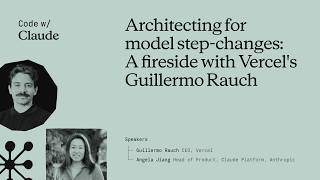
Architecting for model step-changes: A fireside with Vercel's Guillermo Rauch
Keynote Interview: Vercel's Guillermo Rauch on the Agent Era | Azure Cosmos DB Conf 2026
Vercel CEO: 70% of Our Traffic Is Now AI Agents "Nobody Was Prepared" | Anthropic, OpenClaw, OpenAI
Why being "terminally online" is more important than ever, with Vercel CEO Guillermo Rauch
Argentina Week 2026 | Argentine Talent Powering Global AI | Guillermo Rauch & Hernán Kazah