Guillermo Rauch, founder of Vercel: Developer Experience, AI and v0

In this interview, Vercel founder and CEO Guillermo Rauch challenges the notion that developer experience (DX) should be the primary metric for dev‑tools, calling it a "bad fitness function" that can lead to extinction. He explains how AI is becoming a fundamental substrate of modern software, likening it to the CPU or storage layer of the cloud, and describes Vercel’s response: the AI SDK, the v0 product, and a strategy of treating AI as a platform rather than a single monolithic tool. Rauch emphasizes the strategic value of deep, polished integrations, arguing that additive, well‑integrated features outperform attempts to rip‑and‑replace existing ecosystems. He outlines his hiring philosophy, focusing on an individual’s growth curve, full‑stack capability, communication skills, and a "founder DNA" that can operate across design, engineering, and product. The conversation also covers Vercel’s dual identity as a product (Next.js, v0) and a platform (marketplace, primitives like TLS issuance), and how the company balances serving early‑stage startups, large enterprises, and incremental adoption with case studies such as Walmart, Under Armour, Zapier, Notion, and OpenAI. Rauch discusses the emerging role of the "design engineer," the importance of taste cultivated through honest feedback and rapid shipping, and offers advice to dev‑tools founders: keep things simple, embed the product in the marketing experience, and focus on latency and clarity. Finally, he shares excitement about AI‑driven dev‑tools and integrations, mentioning tools like Browserbase, Livekit, Languine.ai, and the broader trend of vector databases, RAG, and AI‑native products.
Chapters
Okay, we finally got the king of DevTools, Guillermo Rauch from Vercel. We talk about why developer experience is the wrong metric.
Developer experience just for its own sake, it's actually a really bad fitness function.
How AI is changing DevTools.
I think every company is going to be an AI company.
Why integrations are underappreciated.
The more we've polished and perfected our integrations, the more our business has grown.
How Guillermo hires.
So I I try to look at as much as I can, the growth curve of an individual.
And how to do business with massive companies as a startup.
I remember thinking like, that is like super extra boss mode, founder mode, advanced level of playing the game. Because it would have been so tempting to say, yes, run it all on us, when you're actually not ready, it could be devastating.
Grab a notepad and enjoy the episode. So I guess like one of the things that I've really wondered is what your actual kind of day-to-day looks like now, because I know like you're known as like a beast dev, but you have to run a company as well now.
Yeah, it's so funny because I do dogfood our products a lot, mostly during the weekends or holidays, etc. Like I literally just went viral with one of my V0s. I don't know if you saw it, Doom Captcha.
I played it.
I will be that person that remains grounded on the mission of the company. I don't want to distance myself from— if our mission is to empower developers and help them ship the best products, I have to have a feeling for, do I love this product? Does it motivate me to create? And can I genuinely recommend it to my friends, to family members, et cetera? So I try to stick to the principle of, you know, you have to understand the technology deeply, you have to stay super grounded, you have to understand the technology very deeply as well, the engineering of the products. But on the other hand, you know, you have to also build a company, a business, a machine. To speak. The way that I think about it is my job is to help grow and create products like Next.js. And also there's another product that's the Vercel company. And the Vercel company is like an invention machine. And our job is to, and I actually use engineering principles to do this. Like how can I streamline Vercel as a product? Meaning that if we hire somebody, they have a great time onboarding themselves to the company. Like is like user onboarding, right? And if they have an idea, you know, what is the path from idea to ship? Like almost like the meta version. What do we do with Vercel is help you go from idea to ship. And if you join Vercel, you probably have ideas around how to improve products, bring new products to life. So there's a whole side of me that optimizes that other meta product, which is Vercel the company.
This episode is brought to you by WorkOS. If you're building a dev tool, at some point your customers are gonna start asking you for enterprise features. WorkOS offers you single sign-on, SCIM provisioning, and audit logs out the box. WorkOS is trusted by Perplexity and Vercel, as well as Workbrew, a homebrew management startup that I recently interviewed. I just told Mike that WorkOS is the sponsor, and this is what Mike said.
Yeah, so WorkOS isn't paying me any money for this. I, I pay WorkOS money for this, but WorkOS is like one of the best developer tools I've like ever used. It's, it's the documentation and the experience with building with them is so, so good. Like I initially was almost like, okay, this seems expensive, but then I built an integration with them in about 20 minutes that I had spent 2 days banging my head off the wall trying to build it directly with Okta. And then with WorkOS, I then have like many, many SSO providers like supported instead of just one. So yeah, like for me, WorkOS is one of the nicest developer experiences I've encountered in the last like 5 years, probably. And it's not surprising because a bunch of the developer team are ex-GitHub and therefore very good at their job.
Go to workos.com to learn more. Yeah. And actually, we didn't talk about this before, but one of the things I was curious about is about kind of how you hire as well, because I know you have a lot of like real insanely talented people at Vercel.
Yeah, I'm a big guy for betting on people, so I try to look at as much as I can the growth curve of an individual. Like, are they, you know, picking up skills in their career fast? Are they hungry? Are they putting themselves out there? Are they shipping? So like, I try to think a lot about like, is this someone that I could see myself collaborating with on shipping stuff, right? And like making an impact in the world. I try to think of every hire as a huge responsibility to myself, even if it's just, you know, we're at over 500 folks now. So if it's the last person that joins in a deeply nested team in the hierarchy, I still feel a huge amount of responsibility to that person because it's like an investment. We are going to make it work together. We're going to grow together. You're going to have amazing tools, resources, et cetera, et cetera, et cetera. But you also have to have that other side of you of like, I really want to make it. I want to push. I want to make myself visible, present. I want to, you know, something that stands out to me about people that no matter what their age, experience, et cetera, is just putting yourself out there. The worst thing you can do is hide, like, you know, have sort of like be paralyzed by not asking the right questions to make progress in whatever you have to do. And so I pay attention to that a fair amount. Communication skills, like ultimately, you know, as AI continues to make progress in making our lives easier and creating things, like actually the actual crafting of things, communication becomes even more important, right? Like on one hand, first of all, you are communicating with AI to get your job done, which means like you are prompting these things and you're also communicating with individuals and mostly I think actually in the form of like shipping things like, hey, like communicating with customers, understanding their pain points, translating those pain points into results. I do believe a lot in people that are very full stack. Like even if your job is not going to be to do every job, like I'm not going to give you the line of like We're a startup, so you have to wear many hats. I think the capability to wear many hats is hugely appreciated because it speaks to flexibility, speaks to like understanding the task and the mission end to end. So I like that idea of like, I'm going to hire someone that is good at speaking with customers, is good at taking feedback, is good at maybe has some design skills and has taste about how they present. The final pixels on the screen. And maybe it has business sense, right? Like, so I have to grow this thing. I have to like make it a fair trade between the sort of like recipient of the product or service and what I get in return, etc. So the more you can complement those skills, and I think probably sound like a broken record, but like, it's probably one prompt away to at least immerse yourself a little bit, even if it's superficial. In other areas of the business or the job that you're maybe not the most used to. So maybe you're a frontend engineer, you're literally today one prompt away with your AI assistants of choice to strengthen your skills in 100 other dimensions. So that ability to be full stack in that manner is hugely appreciated.
Yeah, that makes a lot of sense. And I guess there's like, maybe there's like a, almost like specific example of like, Jared seems like an incredibly capable person.
Yeah, full stack, end to end. So our VP of AI, engineer, designer, marketer, everything like, and I actually call that recursive founder mode. If I can spot the people that have that founder DNA and understand that adverselle you know, it's, it's like Alphabet on steroids where by you joining, you're complementing yourself with a lot of other people and the, and the resulting creation is so much greater than the sum of the parts because it has all this integrations. In fact, Jared runs V0 and we're seeing a lot of traction with V0, especially because of that deep integration with Vercel. And so you have those situations actually where like you might be a super independent thinker, founder, you know, you just want to do your own thing, but then you realize that if the API adapters are right, if like Vercel is actually giving you the right interface to work at and develop your, you know, business tools, skills, products, then it's actually much better to do it at Vercel than do it on your own. So to your point, identifying the Gerrits of the world and empowering them and making sure they have everything they need to succeed is is a big part of what we do.
Yeah, and, uh, and v0, uh, what a product. Um, it's very exciting. I have to say that I thought it'd be fun to just play around with it before, um, the call, and like within like, it was like less than an hour, like I'd made this little, like, little project that I could like send over you all the questions, you could comment, like, and it like not just like a UI, but like with a database integrated with Neon and it's incredibly cool.
Yeah, I was blown away because what you created was actually legitimately useful. My team told me that you'd created it right before the call with v0 and like, it kind of blew me away. Not to, of course, toot our own horn, but legitimately. So what I thought was, first of all, like, I go on a lot of these podcasts and like, this is actually the most useful version of prep that I've gotten. And it looked good and it had your style and your brand on it. So yeah, I think this proof point of software is now becoming this very like fluid thing. It used to be very rigid. And I think chapter 1 of Vercel was make it less rigid, right? Like we have a billboard that says we are the You can deploy on Fridays, cloud, you know, like it's okay. Like you can deploy frequently. I shared a story a lot of what one of my favorite brands in the world that became a Vercel customer. I remember doing this and part of you were asking like what a day-to-day looks like for me. We bring customers in to talk to the company a lot. And this particular case, they were talking to the executive team because they're a very important customer. And one of the things that they talked about was when we asked them, what has Vercel done for you? Like, open-ended question. What good have we brought to you? And of course, we also asked, what bad have we done? And one of the things they pointed out was like, look, we used to deploy once a quarter. And because the holiday season is very big for us, one quarter of the year was actually kind of maybe blocked off because of like code freeze. So We kind of deploy a couple times a quarter, you know, like that's just the normal. And if you heard what this brand was, you would be like, this is actually one of the most iconic technology-rooted companies in the world, but they were paralyzed by their fear to ship software. And so chapter 1 of Vercel was like, you know, now they're deploying several times a week. In fact, that for me is even like, you should be deploying 100 times a day, but like, you know, Everyone has their own sort of journey with that. You know, Google deploys a million times a day and like some companies deploy once a year. So like we need to bridge that gap. And I mentioned that we went from very rigid software and now it's sort of like liquefying because, okay, now that thing that felt fixed in time and space is now constantly being edited. And that was kind of like the initial actually mission of the company or tagline. It was like, I called NOW, our original deployment platform, real-time global deployments. Global in nature because like making things fast everywhere is so important to me, but real-time and because of my background in Socket.IO and real-time communication, real-time, I didn't think people had yet heard of what I could possibly mean of like real-time and deploying, but the idea was you make it so fast and agile that you're constantly editing your product in real time. And lo and behold, to some degree, we've achieved success in that mission. But I think AI is making it even way more fluid because AI is making it such that you don't even have to do that expensive translation process of intent to the data structures, the algorithms, the libraries, the modules. In fact, you were asking about how I talk to the product. I discover a lot of libraries through D0 because the AI knows about every module that exists. And, you know, I, I'm totally online. I spent a lot of time on X. So I, I keep track of like, oh, there's this new library for this. There's this new thing for this, but it's hard. Like you have to actually, you know, like even then, like I might miss out on things. So. Having the AI act as like the expert recommendation system of how to implement my idea. On one hand, actually feels a little like, I'm not going to deny that it does feel a little weird. A lot of people ask me like, what's going to happen to my job and like things like that. And like, you know, I mostly like just chuckle because I believe that jobs are safer than they've ever been because it's the creativity that drives these creations and it's the intent still that drives this creation. So there has to be a human in charge directing the orchestra. But I do think it's a little weird in the sense of like, you have to give up a little bit of like, you're used to like handcrafting every line of code and now you have to let go a bit and realize that like, hey, like I could just tell the AI to do it. And that is, that is a a change for the industry, I think. The one thing that even just popped in my mind was I remember the reception to Prettier. So Prettier is a JavaScript formatter. It used to be that people formatted code and made it look like visually pretty on their own. The pre-automatic formatting days. And a lot of pull requests would be people nitpicking each other like No, no, like this should be, it should be in a different line. It doesn't look clear. And so Frittier came along and just like, it almost seemed like overnight it eliminated all this decision paralysis, all these pointless conversations. I even remember being marginally upset that they added configuration because I was like, you were the one that was supposed to save us from the pointless conversations. Like now we have, now we can have conversations on the configuration.
Nitpick the config.
Exactly. But still, it's done its job, right? It removed, it freed us to think about other things. And I think that's the ultimate value of AI is that it's going to free us to think about other things. And it will take some adapting because yes, we were used to formatting every line of code by hand. We are still largely, I think, industry-wide used to writing every line of code by hand, using every library, like doing all the due diligence and whatnot. And we're going into a world where we can delegate a lot of this. So it's exciting.
Yeah. And, um, actually a kind of related question on v0 is like, kind of who, who is going to use v0 kind of now and in the future? Because, you know, when I use Cursor, I'm kind of, you know, I'm, I feel like I'm to some extent I'm coding still, like, you know, well, I mean, I am generally.
You are. Yeah. Yeah.
But then v0, I'm like, I don't know if I really looked at the code very much when I was creating that.
Yeah, my mindset there is like code first versus code last. So Cursor is a fantastic tool. Everybody loves it, but it's code first to your point. Like you have to like set up the IDE or in your repo and you understand code. What v0 gets me really excited about is that it's still producing code behind the scenes and you even get to see it, which I think is an important property because AIs are not perfect and they do require auditing, right? Like you also don't want to relinquish control so much that like the AI just goes off and like builds the Skynet. But, but it's that idea of like, let's put the design first. Let's put your ideas, creativity. We're building a lot of features to make it a lot easier to like infuse your design system qualities, colors, preferences, you're enriching the context. So that what you create is in a certain style. So we look at it as more— there's actually one of our most popular blog posts on the Vercel blog is about what a design engineer is. It's funny 'cause we've written about so many different things, like awesome technical deep dives, React, Next.js, but I think by sheer traffic, one of our most popular blog posts is what is a design engineer and why is this role so important, why it's changed Vercel and I think the industry so profoundly. And it's a role of a person that infuses both through sort of the design and aesthetic sense, but can actually ship and have influence over the products. And that combination in the industry actually has been traditionally very rare. In fact, I'll tell you what, like when I first came to the Valley, It was rumored that these people existed. It was like, it's spoken of as like, like myths. Oh yeah, there's like Rasmus at Dropbox who is like writing C++ over here, but also like designing every pixel over here. And that to me always felt like the natural end state of software, by the way. Like, yes, it was rare. It's becoming less rare, but it does feel like the end state of software because Like even borrowing from like Steve Jobs, like intersection of like liberal arts and computer science. I think people that really appreciate the quality of products know that design-led is the best way to build, is the most empathetic way to build because you're thinking about the customer, you're thinking about what they're gonna see. You know, the vast majority of people just do not understand code. They do not understand how things are built. But they do understand quality. They want things to be fast. They want things to be intuitive. You know, a huge part of the Vercel business has been built on the fact that customers can prove that ROI for themselves. It's not just that they ship more frequently. They come to us and they show us the receipts. I had a customer show me the other day a chart from Google Webmaster Tools. It's like how many pages are crawled. They switch. To Next.js and like it goes like this. And so literally like they released pent up energy in their business by making it more crawlable, faster for consumers, etc. And I think when you think design-led and when you're thinking about the frontend first, you end up thinking more about what's actually good for your product, for your business, etc. And that's kind of how B0 proposes that you should build software.
Yeah, and I feel like this is quite related to something that You said on another interview that I was listening to, and at first I was kind of like surprised by it, but it makes total sense, where you were saying that like, you are not in the business of like developer experience at all costs.
And exactly, 100%. Yeah, you know, developer experience just in its own, for its own sake, it's actually a really bad fitness function. It's like the kind of thing that makes a species go extinct, right? Like, and I say this as a representative and sort of like hopeful representative of the developer species. If we're just building stuff that is good for us, meaning like, it's pleasurable to like write and whatever, like absolutely critical feature. Like, yes, I want to have a system that's responsive, feels good, etc., but it has to be good for another customer. If you're working on DevTools, the mental model that I use is you have two customers. You have your most direct customer that is your, the developer or whatever. And that developer is building software for somebody else. And so you have to have that somebody else in mind. I would argue it's even more important. I would argue that the way that markets shake out and because ultimately customer is king. It's been proven time and time and time again. Like there's in other domains, we've run the hypothesis with like, hmm, maybe we are more important. No, the children are wrong. Like the customer is more important. So you will find that you might get like the early traction, the early love, et cetera. And yet it's just not self-sustaining because it's not economically self-sustaining to have only that one customer in mind. So Yeah, I think it's a, this is a really good callout. Try to think about the end, end, end, end user as much as you can and work backwards from that.
Yeah, it's, I think, I think this was like one of the most kind of interesting things in, in kind of like reading about how you think about things and what one other thing that you talked a lot about was like kind of integrations. Um, and it kind of at first maybe seems like that's a, I felt people don't talk, at least, you know, I've interviewed 100 people, DevTools founders and integrations doesn't come up that much as like the key thing.
That's good feedback. That's good to know because I do think that there's legitimate alpha there then because I thought, you know, sometimes I'm like, I'm just repeating stuff that everybody knows. Like I want to bring something helpful to people and, uh, I will tell you that the more we've polished and perfected our integrations, the more our business has grown. In that your job is not to solve every problem in the world. I can actually tell you for v0, this is gonna play out even more again, because one, I believe that software is gonna shrink. We're gonna have more software that's smaller, more ephemeral, more personal, meaning you're not gonna create like a gigantic Swiss Army knife software for every problem that you have. And that's a very positive thing because we have come from the Swiss Army knife software approach to the world. I'm actually pointing there because there's a very successful company right next to ours called Salesforce. And Salesforce has made an entire category out of creating vast platforms of doing everything under the sun and solving every kind of problem. And that's going to continue to exist. I think a lot of companies definitely need that. And I think there's also going to be a new wave of like, hmm, maybe I don't need to try and like tame the beast to try to do this simple thing that I need. I can actually just generate the software that does that simple thing that I need more spontaneously. And the two will coexist, you know, but going back to integrations, what's going to happen is a lot of this software will be thin layers of UI on top of vast seas of integrations. And agents will even deepen that. You know, one thing I've observed about LLMs is that LLMs cannot produce a gigantic corpus of coherent software all at once. Most immediate example is it wouldn't be efficient, nor would it actually work with the state of the technology today for the AI to produce both React and the software that you need, right? Like it's just not how the world works. Like the way that we think about building things is like, hmm, what abstraction can I build on top of? What can I reuse? And actually LLMs think very much this way. They try to build on top of infrastructure that already exists. And so what happens is a lot of the alpha with AI is having the AI connect all these dots, bring all these things together. And so for v0, we're working on not only continuing to sort of extend that corpus of infrastructure that the agent can piggyback on, but also bringing in more integrations into sort of Vercel, the database ecosystem, all of the, all of the tools that have already been built that don't have to be reinvented from scratch.
Yeah.
And it seems like this kind of, because you kind of stayed very narrow, you're able to like do really high quality software. And then, um, kind of when people come to you and they say, oh, you know, we use Salesforce for like, uh, run our, we run our entire business through Salesforce. And you're like, Oh yeah, that's fine because you don't need to use, you don't need to replace everything that you do. You can just—
Yeah, there's something to the incremental nature of software that I find fascinating. So if you try and position your, whether it's your product or your infrastructure, as a rip and replace of a thing that has been optimized for 3 decades, you're probably NGMI. However, if you have an additive value to the world, an additive proof point, an insertion point into that ecosystem, and that's why integrations again is so important because if you're not going to rip and replace everything because we've agreed axiomatically that is a bad idea from a sales pitch standpoint, it's horrible. I've tried. Hey, we're about, we're, we're everything for you. Can you please shut down everything? Successful business? No, it's just not going to work. It's energetically very inefficient. It's not my cup of tea because I like quality over quantity. I just like to build things that are like amazing for fewer things than like boil the ocean. And it just, yeah, it just doesn't work. So what does work is you build something that's additive. And by definition, it has to be well integrated into other things because that's actually how you make it relatable. So you, you say, well, I'm going to help automate very intelligent outreach to my most successful customers when they perform certain actions. Like, for example, it's very important to me that if a customer is in e-commerce, but recently they've started to play with the Vercel templates for AI chatbots, I would like to have a conversation there. Actually, I joke, put me in, coach. Like, I love to talk to our existing customers about how they can improve their businesses with more of our products or like with bringing in other things of Vercel. So imagine that you're building that product. The way that I would pitch it to you is not like, we're the replacement for Salesforce, so start shutting down those contracts and turn away all those steak dinners and burn your 3 and 4 tickets. What I would say is, look, we connect into Salesforce, we connect into Snowflake, and we have this very opinionated take on how we solve this problem. We keep the human in the loop, so it's not random acts of AI slop plastered over your users. And here's a case study of how I've already helped this other customer. Oh, and by the way, this is how I use it myself to continue to improve our products, to improve retention, et cetera. So that way of like pitching is just so much more effective. And I think for a lot of people, it takes, it's like an exercise, like it's like doing crunches. Like it's painful to get into that mindset of like, you don't have to do everything for everybody. And like, it's actually it's actually nice to turn down and say like, nope, we don't do that. Nope, we don't do that. Not yet. Not yet. No, no.
This is what we do. So actually, Guillermo Rauch, like, if obviously you have like such a talented team and stuff, right? So like, you must get all the time people like, we need our own vector database. Like, how do you know when, like, you really don't need to build the vector database or you're like, yes, we need, we need to build a vector database? Great question.
Great, great, great question. I'll tell you a couple of mental models that I use. One is feature product platform, feature product platform. That's like sort of the hierarchy of, I'm in the business of building platforms. I'm in the business of eventually solving a wide range of problems for like lots of companies. And of course I have that because of my platform, I have that natural sort of gravitas towards customers see that we solved the hosting piece and the CDN piece and the WAF piece. Okay, why don't you also solve this other problem that I have? Oh, and by the way, I love you guys and here's a bag of money, right? Like there is that conversation. And so, but realistically, because I'm building a platform, there's a distinction between being in the product building mindset and being in the platform building mindset. The product building mindset, which is actually the most helpful when you start a company because you have to prove that you do one thing excellently, is different from I have to create integration hooks, extensibility hooks. I need to, you know, for example, right now we're investing a lot in our marketplace. We're investing a lot in helping startups build on top of Vercel. There's companies like Mintlify or Dub that are creating multi-tenant infrastructure systems by leveraging what we've already built. For example, Vercel can issue TLS certificates to create secure connections to arbitrary domain names faster than anybody in the market. And so we expose that as a platform primitive so that companies can give their own customers their own domain names, extremely fast onboarding experiences, et cetera. And so I'm allocating a lot of time to that sort of platform building side of Vercel and less to like, let's ship a vector database. Now, when I do identify that the platform foundations are changing, and the first thing that I noticed about AI is that AI in itself was going to be a platform. And that's when we started saying, well, it's going to make a lot of sense to create the AI SDK. It's a new product, but in reality, what is, if you think about what the AI SDK is doing, I just shared yesterday, I learned about this from a cardiac surgeon that they use this product, which is like the ChatGPT for medicine. And it's used by, turns out, I didn't even know about this, 250,000 doctors in the USA. That product was created because we created the primitives for AI products. It's kind of, it's one of those things where like, it's emergent behavior. You don't know how people are going to use, what they're going to create, but you do have to facilitate the building blocks. And so we said, AI is going to be so important of a platform that we have to go in once again in product building mode. We created the AI SDK, we created v0. And the hope is that this will also bolster the Vercel platform as a whole. I don't think that there's gonna be one agent in the, in the world of AI. There's not gonna be one v0. There's gonna be probably hundreds of thousands. We're actually open sourcing. We have our AI chatbot template can give, can give you a head start even in code generation. We just added Python support for code interpreting. We have an open source version of v0 essentially. Where you can take pieces of it. I actually just heard also yesterday, an entrepreneur came to our office and he was saying, this product you're looking at, I just took a lot of pieces from that template. And so we're in the business of dogfooding the platform, creating these products. I'm very proud that V0 is like full stack end-to-end Vercel. It uses databases from the Vercel marketplace, like Neon and Upstash. AptX Vector, it uses connectivity into the clouds, it uses products from actually all 3 big clouds. We use AWS Bedrock, we use some things from Azure, we use some things from Gemini. And so creating this process is allowing us to put ourselves in the shoes of a customer. And I think there's going to be a lot of these that are going to create those AI-native products of the future. And that's when like, you know, it's a big deal to your point, like it's a big deal for me to say like, and a new product initiative begins, like, you have to be kind of like, almost like scared in a way. Because if you're extending your product surface endlessly, you might just be shipping a lot of slop. And that's scary.
Yeah, that's, that makes a lot of sense. And it somehow does feel very kind of Vercelli, and it doesn't feel like it's a step away somehow, even though, you know, you weren't, I guess, like, you weren't like an AI company. I don't know if you'd call yourself an AI company now, but I think every company is going to be an AI company.
That's how strongly I believe in. That's why I mentioned the instant that I realized— some people say we realize it early, some people, you know, I don't know, I don't know if it's early or not— the instant that I realized that AI was going to be It's kind of like, I remember back in Argentina when I would assemble my computer. In order to use software, I had to freaking assemble my own computer first and put in the hard drive and put in the motherboard and put in all the cables and the CPU and later the video card. I used Voodoo video card or whatever that was called. And it turns out that AI is now one of those fundamental substrates. If the cloud is like a global computer, There's now the sort of AI processing unit. And if you don't expose that, and if you don't compute on top of that, like, I don't know that you can call yourself a software company in the future. And so right now we're special casing them and we're calling them AI companies because these are the pioneers that said, hmm, I'm not going to build with just the hard drive and the CPU. It actually maps very neatly into when you think about the The big winners of the previous generation of cloud, what were they? They were S3 object storage, like the hard drive of the cloud. EC2 is the CPU of the cloud. The memory, the RAM is ElastiCache, DynamoDB, whatever, right? But now it turns out like, it's like a computer that couldn't run Crysis, you know, to use the meme, like a computer without the capability to run AI. Is a computer, it's kind of useless. And like, it's funny because like over the years I did move on from computer to computer because of chasing software. When I first adopted the Mac, I was actually pursuing, the very first time I got one of these, it was because of an app called TextMate. TextMate was a fast, beautiful editor. And I remember drooling over the screenshots and I was like, I need to replace all of that hardware so that it can run TextMate. And what's going to happen to every company in the world and every cloud hyperscaler in the world is that their customers are going to ditch them if they cannot facilitate being that sort of like AI operating system, if they cannot run the inference, if they cannot facilitate the building of those applications, if they don't have the SDKs, if they don't make it easy too, because like the AI world, like we've already overcomplicated the heck out of it. Right? Like to your point on vector databases and RAG and TAG and whatever, like there's like a new thing every night. And so Vercel has that opportunity in true Vercel sense of like, try and bring simplification to that chaos.
Yeah, that, that, that makes a lot of sense now. Um, and kind of related, um, how do you think that dev tools need to be thinking about AI kind of like going forward?
Yeah, I'll tell you a couple things. When I started Vercel, I realized that there was a type of customer that was better for us. It took me a lot of like trial and error, but I realized early stage startups that were building net new products, obviously a home run. Companies that were building new adjacencies, not the core product, we weren't ready for that. Companies that were building new adjacencies, like the experimental labs and whatnot, amazing customers as well. I realized later on that like, oh, that's not how I get all of Facebook because Facebook uses us for this one division. Like, you know, as entrepreneurs, we're very like, oh yeah, one day I'm gonna be running facebook.com because this team at Facebook uses my thing, but like very good customer to have. And then later on, as you mature a little bit more, I think you have the opportunity to start like biting at chunks of more important workloads. And typically it's going to be companies that are not like Silicon Valley native because they actually, I'm obviously very biased towards San Francisco, but like, it's awesome to be able to partner with the people that are like sweating the details of like Fronth every day and every night. If you're a company that's been a more traditional business and you're now wanting to leapfrog into the future, right? And so there's a very clear mapping to that, to the AI world. If you're building dev tools, you're gonna have startups that are building like net new products that assume that AI is a given. There's gonna be people that are like testing the waters with AI. You have to be careful with those because like some of those are like, they're gonna like define the future of your company. And some of those are actually gonna like, you should have them, but like don't build up unnecessary dreams and hopes of like, oh yeah, there's that AI experimental team at freaking Wells Fargo and they are promising they're going to renew all of banking worldwide with AI and it might as well happen, but it's no secret that every major company in the world has a top-down mandate to go and play with AI. And so I partner with those teams, but it's very important to understand that like it's experimental. And then the other one is actually very, very, very, very exciting because enterprises are not gonna be the, the ones that like move immediately into the most risky thing that, and that's why they're enterprises and that's what they're successful. But at some point they're gonna wanna leapfrog and you have to be ready for that transition. You have to be ready to have the maturity, the sophistication, the ease of use, all of the above, so that you're not just fixated in experimental stuff. And one of the most important, I would guess, like milestones in Vercel was when we started getting that takeoff velocity of like, oh, now we run more of the internet that is less the Wild West, so to speak.
Yeah, so it's like, I think you guys, I think you've publicly said you run walmart.com, right?
So Walmart uses Next.js. We run Under Armour, we run Asics, we run Nintendo, we run some of the biggest retailers in the world, some of the largest grocery stores in the world. And getting those was like a ton of work of maturing the technology. We couldn't have done that in the very, very early days of the company. Another kind of customer is fascinating is when you can run a mission-critical workload of a very, very large scale up. It's also a very exciting sort of for us like Zapier. We run like huge parts of Zapier. We run Notion's entire marketing side. We run OpenAI's marketing side. Like when you get to like very, very large scale, very high traffic,, but it's still sort of like, not like 10 layers of like procurement, legal, and like that kind of work that you have to do.
Yeah. Yeah. That, that, that makes sense. And I guess it's like the point between like experimental, I guess there doesn't need to be like a real strong kind of like use case budget. It's like, people are just happy to play with it. But like the differences is like, you need to be there and you don't necessarily want to run your whole business, make your whole business decision based on like an experiment.
Correct. And I actually see a lot of founders make the mistake. Another anecdote that is really cool is I remember my friend who's the co-founder and CTO of Auth0. We're both excited about—
Auth0, right?
Exactly. We're both excited about this one tool that was coming to market. And I remember he showed me the email that this founder replied with. So he had done the outreach saying, oh, I want to run all of Auth0 on top of this thing. And the founder replied with, we're not ready for that. Message me in, in months. And I remember thinking like, that is like, like super extra boss mode, founder mode, advanced level of playing the game, because it would have been so tempting to say, Yes, run it all on us. When you're actually not ready, it could be devastating. You could let them down. I've, I've now seen this a lot with, there's so many gigantic companies that in our past were like, well, I would love to go all in on Vercel. And my answer to that has been, let's do it incrementally so that we prove ROI for you and for us. We don't boil the ocean and we kind of mastered the expertise of like how to bring massive workloads, even one page at a time, where, for example, Vercel acts as a CDN and like only like the first page is on Vercel and the rest is proxy passed to the existing workload. So having your ability to like modulate your own success and your own ambition is also really important. You have to— the hardest thing about being a founder is that you have to modulate ambition and realism. Realism is how can I actually do an exceptional job for this customer and deliver value today and know that it's going to have the highest degree of availability, security, durability, feature richness, et cetera. And on the other hand, the ambition of like, you know, everyone thinks of like Silicon Valley as the HBO Silicon Valley show of like, sell big, go big or go home, like, like conquer the stars. You have to have that too. And so that's where like good taste and discernment and integrity, these are like the most important values for founders. They're very important values for employees as well when you hire. That balance of like realism and ambition and integrity and ethics and honesty and quality and pride in craft, very important values as well to have in your toolbox.
Yeah, I was almost going to ask you like, how do you, you know, what rule is there to kind of figure this stuff out? It's like It's funny because I spoke to Taylor Otwell as well and I asked him about taste and it's like, it seems like, you know, these kind of like successful DevTools founders like yourself and Taylor, it's like taste is actually quite key.
Yeah, I believe everything can be learned. I remember this from a close partnership with actually one of my first employees that at an older startup, TJ, who taught me that you could be both a phenomenal designer and engineer. Like, you could just do both things. And I remember asking, like, okay, but like, did it just come from the heavens? No, I learned. Like, I inspire myself. I look at a lot of stuff. Another very useful skill to develop taste is Be just super honest with yourself. Invite honesty from customers and peers. Invite them to actually like say exactly what they think. Even catch them in their hesitation of like, oh, that's cool. Like, well, tell me about like, do you actually like love this thing? Like, do you use it? Is like, is it garbage? You're not going to hurt my feelings. Like, and then when you have enough samples in that sample set of like, this is what people actually like, or this is what good looks like, what this, this is what good sounds like. That's how you actually form good taste when it comes to product building. And then on the question of like, how do you hire people where you can assess that they have these values? That was, I think, the hardest one. And you know, like the only recipe is again, like, collecting large sample sets of data. There's heuristics of like the kinds of questions that you can ask. I always tell people when you hire and you hire from big name companies, the tendencies for people to over-embellish their contributions. The reality is that for really successful tech companies, they are legitimately like rocket ships. They're like the Starship. They're rare. When they're successful, they're overwhelmingly successful. When they're successful, they have such market pull that they can even make mistakes. They can like, like product-market fit tends to like repair and replenish and reinvigorate energy into the company and into the mission so naturally that it doesn't mean that these companies can fall asleep at the wheel. But it does mean that when you have somebody that worked there, it's hard sometimes to disentangle what the contribution to the rocket ship was actually about. Like, were they sitting on a stool in the corner of the rocket ship and like, just like watching and like, like, ooh, like, or cheering, like nice launch, or were they freaking like sweating bullets? In the control room and designing the engine, right? Like, and like doing the last minute repairs and like showing up at like, you know, at the incident call when something doesn't go great and like doing the iterations. And so what I've learned is to like try to go very, very deep on understanding that kind of thing and the reality between What you've already done when it comes down to evaluating past work and then evaluating future work is the other important one, which is like, what does that slope look like for future improvement?
Yeah, this is really interesting. And I want to ask you two last questions, but just one thing that just occurred to me while you were saying is at the very beginning you were talking about like how you want people to actually put stuff out there and ship it. And then it's like, You're talking about kind of taste of like, it's actually from the feedback that you get and the patterns you see. And it's like, if you don't actually put stuff out there, then you can't develop that kind of taste.
You really have to put yourself out there. I think the more you can ship and create and make that a part of who you are. Again, I think the expectation with AI is going to be that everybody can cook. Is sort of say like everybody can contribute. And so it's going to be harder, I think, in the future to hide behind that fog of war of contribution, if that makes sense of like, well, it wasn't clear if that person was like, just like got into the rocket ship through the back door and like, or that person like actually like shipped substantial contributions to that and whatnot. And so I think the future looks very transparent from where I see from my vantage point, right? Like even circling back to like the idea of like building products in real time, it does seem like increasingly X and getting feedback from customers in real time and responding with fixes and products and features in real time. Like it does feel like we're creating software as a community together. And all of this is mediated by and modulated by feedback. And like, and so it's gonna, again, it's gonna be hard to say like, oh yeah, yeah. Like I did a ton of work. You can't really see it, but like, it's, it's trust me, bro. Like it exists. So that I've been thinking a lot about that in the context of like that idea of like building as you think almost and building as customers think and in that conversation with them.
Yeah, that's, it makes sense. It's like, I don't know, like imagining like a sushi chef, like at the table, just like doing it in front of you.
Like, how was that? And they're paying attention or tuning into like your reaction. And is the person full or not? Like, is that? Yeah, 100%.
Okay, two last questions. So the first one is gonna be advice that you have for DevTools founders, which are very broad questions.
Yeah, I think I mentioned some of it in the conversation. Something that maybe comes to mind is keep things really simple, integrate your product very deeply into how you present the product. So I recently went to, I'm just gonna say it because they did such a phenomenal job. If you go to browserbase.com, they're creating developer tools and infrastructure for browser automation. And the product is in the marketing. Like literally there's just a big page with a button and then you press that button and you start using this virtual headless web browser that you can talk to with AI. Actually, another company that has done this extremely well is Livekit.io. Livekit also provides infrastructure for AI companies, but in the form of WebRTC and real-time audio video. And if I remember correctly, you can just live test speaking to an agent, and it's the most natural real-time conversation possible. So these are two examples of Well, there's no explaining to do. Like you just go and you feel the product. You're almost signed up to the product. And so that blending of marketing, product, education, documentation, it even speaks to the prior insight of like, this is the job now. Like we're all full stack. We all build experiences and we deeply integrate them and we're responsible for every dimension. Of it. It's not that, oh, I just, I'm, I'm just the guy that built like the super cool, like WebRTC thing. I'm just over here. Like the job is for somebody else. Like, I don't know, like figure it out. And like, oh, we have a shit marketing website, but like, it doesn't matter. There's like, the tech is great. That feels like the 1990s where like software was so scarce that there was one vendor in the world that could do the kind of database that you needed. And they had to ship a mainframe computer to your office or data center, like actually procure the software. Things are moving at such a pace now that you even have to look at your communication with the customer and the way that you present yourself as latency, frankly. Like the page might have loaded faster, but like if I'm not grokking what the hell you're building, then if we actually have a very holistic latency measurement, then your P99 is 2 months. You know what I mean?
That makes so much sense. Yeah.
Yeah.
You could have the fastest website in the world, but if it's just confusing, then—
You're not getting the single through. Yeah.
Okay. And last question is, are there any kind of dev tools that you're really excited about right now?
Oh, I just spoil it with those two because those—
You can have an extra go.
I'm very excited about all the things that I'm seeing being built on top of the AI SDK. So there's this tool that's coming out, like, speaking of real time, like I was literally talking to the founder today. So Languine.ai, so they're doing automatic translation and localization with AI. I was like, it's one of those products where you're like, where were you all my life? Duh, of course someone was going to do it. And by the way, this is why I'm so excited about entrepreneurs building with AI because I legitimately think there's millions of obvious things to be built right now. And this is one that is, and again, to their credit, these two guys are like so cracked. Like it's obvious in retrospect and it's obvious to them, but like why wouldn't I have CI/CD for AI-driven human-in-the-loop localization? Like it's just the most obvious thing in the world. And so these people are very much doing what I was mentioning is the future of building. They build in public, great taste, great communication skills, and easy to understand products and open source. A lot of this is just like out in the open and yeah, I'm just super excited about this one.
Amazing. Amazing. And yeah, thank you so much. That was, that was awesome.
More from Guillermo
Guillermo Rauch at Founders in Arms Live: Simplicity, Focus, and the Bet That Built Vercel
The Man Who Built a $9B Dev Platform Thinks You're Overcomplicating AI | Guillermo Rauch


Inside v0: How Guillermo Rauch Is Building 100 Million Engineers | Lenny's Podcast - EP.89
Architecting for model step-changes: A fireside with Vercel's Guillermo Rauch

Keynote Interview: Vercel's Guillermo Rauch on the Agent Era | Azure Cosmos DB Conf 2026
Vercel CEO: 70% of Our Traffic Is Now AI Agents "Nobody Was Prepared" | Anthropic, OpenClaw, OpenAI
Why being "terminally online" is more important than ever, with Vercel CEO Guillermo Rauch
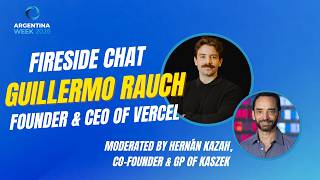
Argentina Week 2026 | Argentine Talent Powering Global AI | Guillermo Rauch & Hernán Kazah