Guillermo Rauch on the Next.js Drama, AI-Driven Dev, Vercel’s v0, and the Future of Frontend.

In this hour‑long interview, Vercel CEO Guillermo Rauch walks listeners through the current state of Vercel and its flagship framework Next.js, the recent security incident involving a potential auth‑bypass vulnerability in Nuxt.js that led to a CVE disclosure and a public spat with Cloudflare, and the broader lessons about coordinated vulnerability handling. He then shifts to Vercel’s AI‑focused product strategy: the AI SDK (a provider‑agnostic JavaScript library for adding generative AI), the v0 coding agent that automatically generates and deploys full‑stack applications, and the vision of “agentic deployment infrastructure” where AI agents orchestrate domain registration, deployment, and scaling. Rauch emphasizes speed as Vercel’s core brand promise, explains how AI‑enhanced edge delivery improves user experience, and argues that AI will reshape the web by unbundling Google‑scale services into specialist, URL‑driven products. He discusses the democratization of development—non‑technical users can now prompt Vercel to build apps—while acknowledging the need for careful AI use in critical infrastructure. The conversation also covers Vercel’s open‑source ethos, partnership with AWS, pricing reductions, and the company’s long‑term focus on growing the “pie” rather than short‑term value capture, positioning Vercel as an infrastructure platform that powers both startups and enterprise customers.
Chapters
Guillermo Rauch, welcome to the show.
How you doing? My man.
Great. Thanks for having me. I've been looking forward to this.
Me too. I think everyone's looking forward to this. There's drama on the timeline. We need to have a TVPN segment. We really appreciate you coming on. Can you just give us like a breakdown of what's happening in the world of Vercel right now?
Well, yeah. Maybe to introduce Vercel too for those that are new to our company. Vercel creates frameworks and infrastructure to deploy great web applications. Uh, we're super invested in open source. We created a framework called Next.js. Yep. That powers a lot of the internet and we're very proud about it. But we also have investments in a bunch of other open source projects. Uh, I have a long history of being involved in the JavaScript ecosystem, TypeScript ecosystem. So if you're building a new application, uh, Vercel and Next.js are, are a, a pretty good choice for people.
Fantastic. And what's going on most recently?
Yeah, I mean, if you go on Nuxt, there's a lot going on. Maybe the thing that started a lot of this was we got a ping from a security researcher about a potential security vulnerability on Nuxt.js. We get lots of this operating at the scale that we're in. We have millions of monthly active developers on Nuxt.js, tens of millions of applications deployed to the Vercel platform.. And so we get, we get a lot of pings, but this one in particular was interesting because it was a potential auth bypass, which, you know, in the security industry, it's as bad of a bug as you could imagine, like bypassing login, signup, things like that. We took a look at it. We, we processed it through the queue. We remediated it. And then when we disclosed it to the world, you know, we, we, we could have done a lot better in how we disclosed it. So, um, we, we filed a CVE in partnership with GitHub, uh, which is the standard mechanism for how you notify every Next.js user on the planet, whether they use Vercel or not, about this, this vulnerability. But the awesome thing about Next.js is that once you use Next.js, you're actually not just getting the open source project Next.js, you're getting a huge ecosystem of, of products with it that you can use that integrate really nicely into Next.js. There are a lot, there are a lot of auth partners. A company like Clerk, StackAuth, BetterAuth, Lucia, and the open source ecosystem. This is awesome products. And I think we should have notified those people before that CVE went out so that they could have had the opportunity to like look at what the impact would have been to their projects and things like that. On the other hand, we did test internally like, okay, Netlify, which is another deployment option for Next.js, affected. Again, we could have done a much better job at partnering with companies like Netlify and Cloudflare who host Next.js as well. But it kind of became like a Twitter thing, you know, that like it got big and then Cloudflare got involved. I think you guys were just talking about it before I joined. And yeah, there's some banger tweets being exchanged here and there.
Yeah, you're— I'm curious to get your read on it. You've been in the game for, you know, you founded Socket. Back in the day. Do you feel like the environment now— there's still a lot of internet to build and there's still a lot of opportunity, but at the same time, we have these sort of scaled businesses like Cloudflare and Vercel and things like that. Do you feel like the environment today is more hostile or emotionally charged than ever before? Because there's now sort of like the market's established in many ways. It's not maybe going quite as quickly as it used to. There's new opportunities, but it's, yeah, it's like it's, it's started, you know, is this sort of more zero-sum environment making things a little bit more charged today?
I think not. I do think that on X people get really spicy. I was very shocked that the CEO of Cloudflare came. I mean, he's, he's the CEO of a public company and he came guns blazing, even putting out like some like cringeworthy memes against Vercel. Which is a company that is very developer-loved. We invest not just in Next.js, but we power, for example, the AI SDK, which is the most popular way today in the JavaScript ecosystem to add AI to your product. It has a million downloads a week. It's provider agnostic, it's deployment platform agnostic. So to come after in such an aggressive way, I was, I was a little taken aback. Our style has always been, if you look at my ex feed, the thing that I love to do is highlight great products. If you create anything great, especially if you use Next.js, I just love to say like, look at this really cool thing. Yeah. I never talk about competitors. I never, especially like in a diminishing way.
Sure.
But in this case, I had to reply because he's saying, oh, if you want security, come to Cloudflare. And the record shows that if you, if you want security protection from the cloud, there's a very mixed bag there, right? There's a mixed bag. And like, I had to recover from the, from the annals of Cloudflare. I did bring up Cloud, Cloudbleed, which legitimately was one of the worst things that has happened to the internet. You could, I don't know if the audience knows, but you could Google and literally find auth tokens of different companies like Uber indexed by Google. So that was an important— and by the way, our bug was bad. I'm not here to say like, oh, like whatever, make excuses for middleware or whatever. Our bug was really bad, but theirs was catastrophic. And you could— and the attack, the impact of the bug was Googling. It's like accessible to everyone. The impact of our bug is actually very, you know, nuanced. And I'm super thankful to the researcher because it takes a lot of like thinking and reverse engineering to arrive to these conclusions. But yeah, to your point, I think that it was uncalled for. We've tried to, I think, and we could get into like the speculation of why he would do such a thing. We tried really hard to use Cloudflare. We were a customer. We tried it out for a new compute product, which coincidentally it was edge middleware, and it didn't work out for a number of reasons. So maybe there was some soured relationships there as well that we had a piece out of the— as a customer, we had to build our own. But I can only speculate.
Let's get into more of the positive and talk about kind of the future and what the biggest opportunities, you know, that you feel like Vercel has in this sort of new— probably the most exciting time of my life. John's, you know, a few decades older than me.
It's a good business to be in the internet and AI.
It really is.
Let's talk about— yeah, let's kind of ignore the drama for a second and I'd love to talk about, uh, the future.
Everyone loves drama, but my message to all the vendors and partners and people in the ecosystem would be the pie is about to get as large as we've ever seen in the history of technology. Mm-hmm. Vercel doubled the number of signups year over year, mostly due to the introduction of v0, which is our coding agent. I, I don't think we've ever seen a technological platform shift of this dimension. Where every piece of software will be rebuilt and reimagined with AI. And the pie is about to get so big that being paranoid about the size of your slice and taking cheap shots at your security competitor, to me, does signal short-sightedness on this AI opportunity. In fact, the AI SDK is powering competitors to v0. So today, we, uh, one of our, one of our partners announced, um, New.email. Is like the v0 for crafting email campaigns, all built on open source technology that we've sort of taken from v0 and given back to the world. And so, and I also had a, you should check it out. I had a banger ideas thread on X the other day. Every single day I'm thinking, here's a bunch of ideas of amazing products that you could create with AI that customers are so willing to buy. I just actually interviewed, uh, we're at a company offsite. Orgbow, and I interviewed one of the greatest public company CEOs of our times. I can't disclose who. And I asked him, what are your priorities for AI? He's like, oh, we're completely reimagining the company across these three dimensions with AI. I want to buy AI for this, AI for this, AI for this. So to your point about the positivity is there is room for everybody. Uh, uh, there's all this amazing open source technology that you can use to create new products and new ideas. I also believe part of my optimism is that in the beginning, 2 years ago, there was maybe a belief that there was gonna be one gigantic chatbot to rule them all. Uh, like a sci-fi movie. You go to one computer or you talk to the room, hey computer, everything is computer. Or what I believed at the time, and we actually, this is why we started creating a lot of open source technology, that there's gonna be expert AIs. Focused products that cater to specific requirements. And that's actually what's ended up happening, right? So on Vercel, we host companies like Open Evidence, which is a ChatGPT for medicine, uh, getgc.ai, which is like the ChatGPT for lawyers, um, amazing products for finance like Hevia. And so what's actually ended up happening is that there is a redistribution of wealth, so to speak, that's happening with AI. There is also, I call it sometimes the unbundling of Google. It's no mystery that a lot of companies or a lot of consumers, sorry, are not going to Google for certain queries and they're going to specialist products to answer. Like when I think knowledge, I might go to Perplexity or I might go to Groq and do a deep search, right? So that unbundling of the, one of the largest companies in information technology services in the world will create massive opportunities for startups and companies of all sizes. So I really do think I share your optimism and positivity beyond the drama that happened.
One thing I always think about with Vercel is just like the focus on speed. I feel like that's almost like the core brand tenet is just like— I mean, Jordy, pull up Vercel.com.
It's so fast.
That's the whole brand. I want to know what's the importance of speed in AI deployments?
Oh, it's dramatic.
I know you're hosting AI. Are you hosting AI at the edge or kind of delivering it like a CDN? How does that work and what impact does faster AI usage happen in like the consumer experience?
There's a couple things if you're running a business that you should know right off the bat. Number 1, a lot of traffic will shift towards answer engines. I reported recently that we see 5% of our Vercel signups that also happen to be some of the highest intent signups coming from ChatGPT, which is up from being like 1% or less than 1% 6 months ago. And it's growing. I didn't share the growth metric, but I'll share it now for you guys since I like you. It's good. It's 30%, month over month.
Wow. That's insane. So walk me through that. It's people going to ChatGPT asking, how should I deploy this? What should I build? It's recommending Next.js.
That's exactly right. Vercel. Sam had a really good take. And, and also, if you wanna see a fast website, I am very proud that we host openai.com. Sam recently shared, you might not wanna learn so much coding or only coding. Mm-hmm. You might just wanna learn how to use AI, which one of the artifacts of that, and I love the Claude artifact name. I think it was one of the most important inventions as it hap— has happened in AI in recent years, is that Coding and writing code is an output of what you ask the AI. So what's happening is people are asking, what is the best way to build a website? What is the best way to deploy? I actually posted, so we have a little tool, a little playground. You can check it out. It's sdk.vercel.ai and you click playground. You can ask a bunch of models what they think about you. Hmm. And that'll give you a glimpse into how the AIs are thinking. Hmm. But not only how they're thinking, how they're directing the world's behavior and choices. I was very proud to share a screenshot that I asked like 4 Frontier models in parallel, what's the best way to deploy? And they all said Vercel. And I actually constrained it to like, you can only, you know, like the classic thing, you can only do one thing or I'll hurt myself. Like, okay, Vercel, Vercel, Vercel, Vercel. And so to me, that was, I actually didn't know at the time, I was just like, like messing around in the weekend with the tool. I think that's the canary in the coal mine of how you should be thinking about AI sending traffic to different places. The consequence to our business is number one, SEO still matters. Sure. So one of our, one of our customers, for example, sponsor this fantastic show, uh, Ramp. Let's go. They're in the business of being found. And so it's going to be through Google searches or it's going to be through these agents. Mm-hmm. And so the agents are still performing a web search. So you still wanna be in good terms, so to speak, with the people that are like retrieving and crawling the internet, right? Mm-hmm. So that's one thing. And Vercel really helps companies with SEO.
That's an interesting thing to think about.
Yeah, sorry.
Like, it's interesting to think about Google over time. If nobody's searching on Google, they just, every link is paid for. Yeah.
And they sort of still have this sort of like, I do wonder, has the train left the station on SEO, or is there still an opportunity for new companies to kind of bootstrap their way into AI recommendations? And I also want to hear your second point.
Sorry for cutting you off. No, no, it's totally fair. So I think what's still relevant is that quality content, facts, truth. These agents will be— I actually like also Elon's truth-seeking AI goal because it really matters that you train a model that is subjective. And it's post-trained on truth-seeking, right? During the pre-training, you throw a bunch of data at it. During post-training, you like sort of like orient its behavior. And this model, so this is why I'm a big fan of OpenAI in the sense of open source and also in giving developers choice. The AI SDK lets you very quickly swap models. I think it's going to be very important as a community, as I'm not talking about entrepreneurs or business people, I'm talking about as citizens of the internet, we have to be very vigilant of the behavior of models, the decentralization of AI. Something that Vercel deeply believes in is, and we have a, we have a template you can, you can clone, you can basically roll your own ChatGPT within 2 clicks. And we recently partnered with xAI to power the default model. So you can go to chat.vercel.ai and you can basically clone and deploy your own ChatGPT in your own domain name. And so what would be great for society is if we all invest in massively decentralizing intelligence so that we're not at the behest of like the one truth center or, or truth, uh, uh, company in the world.
Sure, sure. Yeah, I mean, it's, uh, one kind of question that comes to mind. So you guys are powering openai.com, and openai.com somewhat recently is like very much reoriented around being a sort of like, you know, search bar answer engine. And OpenAI right now is being priced like it's the next Google, right? At $300 billion plus, like that is the next Google.
You talked about sort of— Yeah, and by the way, one comment on that, because it's been super top of mind, I actually think that's a brilliant design. So I talked about how every piece of software will be rethought and rebuilt as an AI product. What people will expect is that when they go to your product, there is an interface like that. And I actually think that's really good design because they blended marketing content, which is what typically we think of as a website. I sometimes dismissively call them e-brochures. Yeah. To remind, remind the team that we're not in this world to take a magazine and plaster it on the internet. Yeah. The whole point of Next.js and Vercel that we bet on 10 years ago was a more dynamic web, a web that powered products. Mm-hmm. And so what's brilliant about that design is that you're immersed immediately into the product experience and it's AI native. I think that's just a sign of things to come. You're going to go to so many other products. I mentioned the email one, but in Open Evidence, there's so many of those where the interface will be, okay, what do you need? What do you want? When you go to v0.dev, the question that we ask is, what do you want to ship? Because we want you to convert an idea into an application.
Talk about the line between developers and non-developers. It seems like it's blurring today. Vercel's entire brand has been around building products for developers. That is the core of the mission. But is there a point in the future where— and you have your coding agent now, right? There's this full sort of like stack. Is there a world in the future where, you know, you land on vercel.com and somebody that's not a developer can just type in—
What do you want to build?
A prompt, right? Because like, it seems like, you know, part of the drama, if you extrapolate it out, it's like there's, you know, real—
whoever becomes the aggregator for building new websites and apps will be incredibly valuable.
Yeah, that was going to be my third point, actually. So the other huge opportunity for us is what we call agentic deployment infrastructure. So there's going to be all of these agents that create for every user on the planet. And also to your question, I think that the TAM of what a developer is, is going to— so I mean, we're already seeing it in the numbers. I'm already seeing it in the customer interviews. I was chatting with a lady yesterday on the xplatform, the everything app. She was reporting feedback about v0, and at one point in the conversation she goes like, by the way, I just want to be very clear, I have no idea how to code. I use v0 and I get stuck and I need some other, like another, another expert's opinion. Like go to another doctor. I ask Groq and she brings it back and forth between the two products and she's creating. The reason that she was giving me feedback is she was saying like the app has gotten so big. What do you recommend? And so people are like just having the best time of their lives being able to create when they couldn't code before. But going back to the agentic infrastructure, think of it this way, v0 is automatically calling out to Vercel to create deployments, to assign domain names in the future, to even buy domains. v0 might even just say, hey, I thought of a banger domain name for your product. What do you think? And so we're very excited to see the growth of this infra. And by the way, there's a defensibility to it that's really interesting, especially for people that are working in infra that are listening to this call. I'm very convinced that vibe coding will eat a lot of the world of creating frontend applications, meaning these AIs are so good at writing React, in Tailwind and Next.js, it's actually shocking to me. And I've been a frontend engineer. I started frontend engineering when I was 11 years old in Argentina. And so I had my ego tied up to this thing of writing frontend code. I contributed to a library called Mood Tools when I was 15 years old. I was like, uh, like the kid that could do frontend. Uh, and now I'm ready to like give up on part of my identity of like, Hey, v0 is creating an opportunity for a lot more people to be like me and experience that joy of creating frontends. Totally. Now, what I'm not so sure about, and you've seen all these conversations on X about security and vibe, you can vibe code, but it's hard to vibe debug. Yeah. I believe that you don't want AI in your infrastructure just yet. We operate in 20 regions worldwide. We reach dozens of cities through our PoPs in our CDN network. We have to maintain uptime for the world's most valuable properties, from, you know, AI companies to cryptocurrency companies, some presidential meme coins, whatever you think of, so much is going on on Vercel. Every second of uptime Everything that can happen to this platform is absolutely mission critical. It's life critical. So many healthcare companies banking on Vercel. And so I don't want AI to necessarily be messing with the foundational sort of infra and software that needs to ensure that these things run perfectly, that the train runs on time. On the other hand, and this is why Karpathy, I think, coined vibe coding, when you're exploring, when you're creating, when you're designing, when you're crafting the interface, that's where AI is completely dominating. Makes sense. And now it's gaining full-stack powers where it can integrate with that infrastructure. So we recently partnered with companies like Supabase and Neon and Upstash that they also hire those fracked infra engineers that, you know, they might be using some AI, but, you know, hopefully for our partnership, they're very careful. And, but, and, and the, and that creator, that new creator is getting the best of both worlds. That you, you vibe code and you're working on rock-solid foundations.
Yeah, that makes sense.
Can you talk a little bit about value accrual in AI? I know that there's been this debate over the model layer or the application layer. You could even abstract that. And now people are just saying, I either want to be the aggregator, the ChatGPT app that's installed on 100 million phones, or I want to be in energy and get me, get me shares in a nuclear company because I think everything else in the middle is going to be commoditized. You don't have hardware yet or your own infrastructure. Correct. Does what you're seeing in AI change any of those decisions over time? How are you thinking about just the different opportunities? It seems like you're obviously going upmarket to be more of an aggregator where you could come to develop apps, but are you thinking about going down the stack further, build training your own models, developing your own chips, or like what does the far future look like for Vercel?
I really believe that the best metaphor for AI is what happened with the cloud. Okay. And mobile, but it's gonna be much bigger. Mm-hmm. And so if you look back at the cloud and we in this room have all studied it, there wasn't a particular player or category that had a lot of upside. It was all over. Mm-hmm. It was the foundational infrastructure and hardware, obviously. And, and we're very proud to partner with AWS to provide sort of that core quote unquote hardware layer to Vercel as a global network, there was a lot of upside for developers that quickly changed their behavior. So this is very important, by the way. When I noticed AWS, I was very quick to dis— luckily for me, I was very quick to dismiss the other DIY options that were available to me because I got so excited by the automation potential. And there's merits to all solutions, but Being an early adopter in writing the right way, it can be transformational to your career. Later on, it happened with React. React was open-sourced by Meta. I believe that's one of their greatest inventions. And I was also quick to adopt, and I noticed its potential as the engine for what later became Next.js. And so I think my advice to people would be, you know, just adopt AI and see where you can add value. I think the application layer is extremely exciting because the interfaces to AI, as I mentioned, will decentralize and unbundle. There's going to be a lot of upside for agentic infrastructure. So companies that know how to work well with not just humans but agents. And that's a very, that's a remarkable shift, right? A lot of products have been so far created for developers, not for the agent. You think of it as a representative of the developer. You have to create products that are good for the representative of the developer. How do you— yeah, go ahead.
Yeah, I was going to say, as a leader, how do you work with your team? A lot of people, the sort of like high-level leadership advice is like the CEO helps the team focus. But then in the case of Vercel, there's so many different areas of the business now. And it seems like you're very focused on serving your customers, the developers and the sort of companies building on Vercel, but at the same time you have like all these different bets. How do you kind of like prioritize internally? And it seems like you're okay with just doing things in the way that Facebook releases React. They've benefited from it, but they haven't nearly captured all the value from it. And so it seems like you're okay with sort of, you're very open to sort of releasing things and not, it's less oriented around we need to capture 100% of the value that we create.
Or yeah, I think short-term obsession over value capture is not the right recipe to build a generational company. And I'm obsessed with growing the size of the pie. My number one allegiance is the web. So when I was in Argentina, I was able to— and this, you know, when you're a kid and you try out lots of different programming languages, the thing that blew my mind is the URL. In fact, if you look at the success of Vercel so far, it really is about the success of A URL is that I thought, holy crap, Kubernetes is so hard. CDNs are so hard. What if people could just deploy with one click or one press of a button and get back a URL of what they're working on that they can share with the world? Look at other companies that have been massively successful, like, or products like Google Docs or Figma. They've essentially done that. Like, a thing that didn't have a URL before, now has a URL. We're doing that for every application on the planet. So it's primarily an infrastructure business. And then on the other hand, we know that in order to cast the widest possible net and attract the widest, the biggest number of people, open source is the only way. It's non-negotiable. And in addition to Next.js, like I mentioned, we created Next.js, sorry, Next.js and AISDK and Turbo. And, uh, we, we acquired a bunch of companies like ChatCN and And so the more we can, you know, cast this message out of the world of the web needs to win and also needs to win because we have the best products. I, you know, I, you can think of our competition as all these other products in the developer ecosystem. Another reframing that is perhaps more interesting is think about Apple. Apple is holding an entire world hostage to a lot of arbitrary rules. They make all the calls. You know, the web that I experienced when I was a kid was a web that is completely permissionless, which is also why I'm crypto-pilled and we could get into that and whatever. But permissionless is actually the most important. It's like freedom of speech is up here. And then right up there is also permissionless, which is also increasingly a form of speech, is that you can get something into a URL without asking Tim Apple. For permission. And so that is the true enemy, so to speak. And I think my message to all these other companies would be like, let's band together and make sure that you can publish without going through an absolute review process. You can launch crypto companies without asking Apple what they think about crypto. Whatever you want, you should be able to. And I write like AI models and you decentralize and get into the hands of developers as quickly as possible so that we build defensibility against the sort of like monolithic AI systems. I think I'm trying to think about like HAL 9000 or whatever that is, like, or Skynet. I just, I don't wanna go to one interface. Vercel needs to decentralize and democratize URLs and interfaces to the world. And by the way, my other point was gonna be, I'll give credit to Apple. They have a culture of quality and they've managed to permeate that culture of quality to that, to their ecosystem. And I want that for the web as well. I wanna make sure— I actually don't even have a particular force in the race. We not only support Next.js, we support another 35 frameworks. Whatever framework allows me to go to a website like a blind tasting and be like, oh, this website is freaking great. You should be able to work backwards to, oh, they use some technology supported by Vercel. That's my fitness function.
I'm curious, did anybody ever come to your office with $5 billion in cash and tell you to, you know, ask you to train a foundation model? And how did that conversation go? Because I'm sure, like, you know, in all the craze of the last couple of years, there could have been an opportunity to just like, you know, I'm sure there's a bunch of people that would have been happy to say, hey, you're really well positioned to build.
Yeah. When's the humanoid robot coming?
Yeah, people seem to be very obsessed with the v0 data. So I'll tell you, I also haven't shared this before, but so many companies have come and asked for, because by the way, like the interesting thing about v0 is, and going back to the design mindset and quality mindset, is we're trying to produce things we're proud of. Mm-hmm. In, in nested, we are proud of, our customers are proud of, end users of the internet say, okay, now there's a better web. I think we should also band against AI slop. Like we shouldn't create a web that has this overly brushed texture images coming out of like, like low quality models and whatever. And so a huge inspiration for me was actually Midjourney. Midjourney, speaking of which, is a Next.js user that self-hosts Next.js, extremely proud of that. And there's something about like the taste that gets embedded into these models. So it's not just the data that you want. It's also infusing your preferences and taste. And it's almost like casting an opinion into the world. Like, This is what I believe products should look like. And by the way, you also want, and this is why the conversational interface is so fantastic, you can still leave the customer to their own creativity. So you can say, you go to v0 and you say, build me a product for travel, like Wander actually, also a Vercel customer. And then you're like, well, I don't like it. Make it more yellow. You know, and like the model will follow. So it's striking that balance between creativity and best practices for a better web.
I have a question. So I'm like completely convinced on the strategy of bringing in new developers, allowing even non-technical folks to build and deploy websites. But some of your companies, some of your clients are absolutely massive. And one of the critiques is like, well, you're abstracting this AWS infrastructure. It can get kind of expensive. What are the conversations like on your side to keep a Nike or an Uber on Vercel long term? And what— how do you see those relationships going? And how important is it to not only enable someone to show up, non-technical, prompt, build an app, but then scale it into that one person, $1 billion company, and they're saying, yeah, you know what, I'm sticking with Vercel forever?
Yeah, yeah. Uh, your question also contains the answer because you said, you know, Vercel has been getting a lot bigger. Yeah. And because we've been getting bigger, which, you know, comes with its challenges like extra money and whatever, but the ultimate privilege is the amount of incredible infrastructure optimization that we can do. When you're starting a company, a little company, like you're not thinking about optimizing. If you're thinking about optimizing, you're probably not doing the, you know, we, we have this motto that we introduced at Next.js Conf that is a famous, there's a famous essay in the software engineering industry of like, you first make it work, you then make it right, and then you make it fast. And I would add a fourth, and then you make it cost efficient. Sure. And actually, from a computer science point of view, fast and cost efficient actually almost come together. We've done so many optimizations to the infrastructure. I think this year we've already announced 8 price decreases, or like last quarter and this year, and we continue to announce price decreases. Because we're passing on the cost savings that we realize in our infrastructure on all sides. That's great. The CDN is getting more efficient. The compute, we just announced Fluid Compute. It's staggering what we've done in terms of compute efficiency. Some customers saw an improvement in efficiency of 85%. Wow. So, so what I would say to the Nikes of the world, the previous story of Vercel, which is still fundamentally awesome, is you won't have to worry so much about DevOps and platform engineering and on-call and those human costs, which are ginormous. And now you'll be fighting for like infrastructure, high-quality infrastructure engineers with all of the AI companies as well. So like the human cost is very real of doing something like Vercel. But then the scale cost of like Vercel actually gets more efficient the more I use it is awesome. And we're committed to continuing to sort of share those, uh, infrastructure savings with our customers. And by the way, the inspiration here is AWS. I think when I started using AWS, it was quite expensive. And then they just announced so many price decreases because, and by the way, that's kind of the dance. We manage Next.js for people. You can also self-host and manage it yourself. And we're actually also partnering with companies that are even competitors of Vercel to help them manage Next.js better when they want to create an offering like that. And we know that there's work to do there. But the nice dance is that if we, if you let up and let us manage your workload, we will be able to optimize it to a level that is sort of unbelievable.
Well, it's noon. We'll let you go. I'm sure you have a bunch more to do today. Great having you on. Great having you on. Please call back in when you have more news.
I love it.
It's a really fun conversation.
I love your show. Thank you so much for having me. Yeah, thanks for coming on. I'll see you on X.
This is fantastic.
See you on X.
See you on X.
More from Guillermo

Guillermo Rauch at Founders in Arms Live: Simplicity, Focus, and the Bet That Built Vercel

The Man Who Built a $9B Dev Platform Thinks You're Overcomplicating AI | Guillermo Rauch


Inside v0: How Guillermo Rauch Is Building 100 Million Engineers | Lenny's Podcast - EP.89
Architecting for model step-changes: A fireside with Vercel's Guillermo Rauch
Keynote Interview: Vercel's Guillermo Rauch on the Agent Era | Azure Cosmos DB Conf 2026

Vercel CEO: 70% of Our Traffic Is Now AI Agents "Nobody Was Prepared" | Anthropic, OpenClaw, OpenAI
Why being "terminally online" is more important than ever, with Vercel CEO Guillermo Rauch
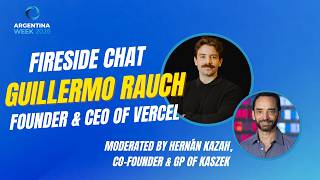
Argentina Week 2026 | Argentine Talent Powering Global AI | Guillermo Rauch & Hernán Kazah