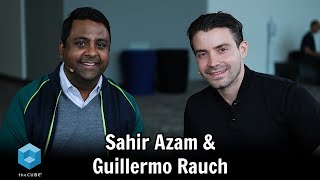
In a panel at MongoDB World 2022, host Dave Vellante interviews Sahir Azam, Chief Product Officer of MongoDB, and Guillermo Rauch, CEO of Vercel. The conversation explores the rise of serverless architecture, contrasting traditional database deployments with MongoDB Atlas Serverless, and how Vercel’s serverless frontend platform (built around Next.js) complements MongoDB’s data services. They discuss the trade‑offs of serverless—cost efficiency, cold‑start elimination, and performance—while acknowledging scenarios where full control over clusters remains valuable. The two companies detail their integration: a MongoDB integration for Vercel that lets developers connect a Git‑hosted Next.js app to a managed Atlas Serverless instance, enabling global deployment in seconds. Observability, real‑time analytics, and cache‑hit monitoring are highlighted as essential for usage‑based billing models. The panel touches on mission‑critical applications, noting that for startups the entire business can be a single app, making reliability as critical as for large enterprises. They examine post‑COVID digital transformation, noting unpredictable traffic spikes in e‑commerce, gaming, and Web3/NFT drops, and how serverless scaling handles such bursts. Sahir explains MongoDB’s evolution from a core NoSQL database to a “developer data platform” with added capabilities (search, analytics, mobile, time‑series) and how product‑market fit is measured through a blend of quantitative metrics (conversion, retention, NPS) and qualitative developer feedback. Guillermo looks ahead to edge computing, AI‑driven personalization, and the need for a globally distributed, low‑latency data layer that respects data sovereignty. He emphasizes the convergence of Web2 and Web3 ideas—decentralization, privacy, encryption—and the role of partnerships (AWS, Verizon, CDNs) in building a unified cloud‑continuum. The discussion ends with optimism about future hardware (NPUs, edge inference) and the disruptive potential of combining serverless, edge, and decentralized architectures.
Chapters
We're back in the Big Apple. TheCUBE's coverage of MongoDB World 2022. Sahira Azam is here. He's the Chief Product Officer of MongoDB and Guillermo Rauch is the CEO of Vercel. Hot off the keynotes from this morning, guys. Good job.
Thank you.
Thank you.
Thank you for joining us here.
Thanks for having us, Guillermo. When it comes to modern web development, you know, the backend, the cloud guys got it kind of sewn up, you know.
Forget about it.
But all the action's in the frontend And that's where you are.
Explain Vercel. Yeah, so Vercel is the company that pioneers frontend development as serverless infrastructure. So we built Next.js, which is the most popular React framework in the world. This is what frontend engineers choose to build innovative UIs, beautiful websites. Companies like Dior and GitHub and TikTok and Twitch, which we mentioned in the keynote, uh, are powering their entire .coms or all of their new parts of their .coms with Next.js. And Vercel is the serverless platform where you can deploy frameworks like Next.js and others like Svelte and Vue to create really fast experiences on the web.
So here, so serverless, I hear that's the hot trend. You guys made some announcements today. I mean, when you look at the— we have spending data with our friends at ETR right down the street. I mean, it's just off the charts, whether it's Amazon, Google, Azure Functions. I mean, it's just exploding.
Yeah, it's a— I think in many ways it's a natural trend. You know, we talk a lot about, whether it be today's keynote or another industry talks you see around our industry, that developers are constantly looking for ways to focus on innovation and the business logic that defines their application, and as opposed to managing the plumbing and management of infrastructure. And we've seen this happen over and over again across every layer of the stack. And so for us, MongoDB, we have a bit of, you know, sort of a lens of a broad spectrum of the market. We certainly have, you know, large enterprises that are modernizing existing kind of core systems. Then we have developers all over the world who are building the next big best thing. And that's what led us to partner with Vercel, is just the bleeding edge of developers building in a new way, in a much more efficient way. And we wanted to make sure we provide a data platform that fits naturally in the way they want to work.
So explain to our audience the trade-offs of serverless. And I want to get into sort of how you resolve that. And then I want to hear from Guillermo what that means for developers.
Yeah, in our case, we don't view it as an either/or. There are certain workloads and definitely certain companies that will gravitate towards a more traditional database infrastructure where they're choosing the configuration of their cluster, they want full control over it. And that provides certain benefits around cost predictability or isolation. Or perceived benefits at least of those things, and customers will gravitate towards that. Now on the flip side, if you're building a new application or you want the ability to scale seamlessly and not have to worry about any of the plumbing, serverless is clearly the easier model. So over the long term, we certainly expect to see as a mix of things, more and more serverless workloads being built on our platform and just generally in the industry, which is why we leaned in so heavily on investing in Atlas Serverless. So the flexibility to not be forced into a particular model, but to get the same database experience across your application, and even switch between them, is an important characteristic for us as we build Go for Go.
And you stressed the cost efficiency, and not having to worry about starting cold. You've architected around that. What does that mean for a developer?
For a developer, it means that you kind of get the best of both worlds, right? Like, you get the best possible performance. Front-end developers are extremely sensitive to this. That's why us pioneering this concept of serverless front-end has put us in a very privileged position, because we have to deliver that really quick time to first byte, that really quick paint. So any of the old trade-offs of serverless are not accepted by the market. You have to be extremely fast, you have to be instant to deliver that front-end content. So what we talked about today, for example, with the Vercel Edge Network, we're removing all of the cost of that, like, first hit. That cold start doesn't really exist. And now we're seeing it all across the board going into the backend where Mongo has also gotten rid of it.
How do you guys collaborate? What's the focus of integration specifically from an engineering resource standpoint?
Yeah, the main idea is idea to global app in seconds. You have your idea, we give you the framework. We don't give you infrastructure primitives. We give you all the necessary tools to start your application. In practice, this means you host it in a Git repo, you import it onto Vercel, you install the Mongo integration. Now your frontend and your data backend are connected, and then your application just goes global in seconds.
So, okay, so you've abstracted away the complexity of those primitives.
Is that correct?
Absolutely. Absolutely. Do developers ever say, "That's awesome, but I'd like to get to them every now and then," or do you not allow that?
Definitely. We expose all the underlying APIs, and the key thing we hear is that, especially with the push for usage-based billing models, observability is of the essence. So at any time, you have to be able to query in real time every data point that the platform is observing. We give you performance analytics in real time. To see how your frontend is performing. We give you statistics about how often you're querying your backend and so on, and your cache hit ratios. So what I talked about today in the keynote is, it's not just about throwing more compute at the problem, but the ability to use the edge to your advantage to memoize computation and reuse it across different visits.
When we think of mission critical historically, you know, you think about going to your ATM, right? I mean, a financial transaction. But Mongo is positioning for mission-critical applications across a variety of industries. Do we need to rethink what mission-critical means?
I think it's all in the eye of the beholder, so to speak. If you're a new business starting up, your software and your application is your entire business. So if you have a cold start latency, or God forbid something actually goes down, you don't have a business. So it's just as mission-critical to that founder of a new business, a new technology, as it is, you know, an established enterprise that's running sort of a more, you know, day-to-day application that we may all interact with. So we treat all of those scenarios with equal fervor and importance, right? And many times it's a lot of those new experiences that are the— become the day-to-day experiences for us globally and are super important. And we power all of those, whether it be an established enterprise all the way to the next big startup.
I often talk about COVID as the forced march to digital. Which was obviously a little bit rushed, but if you weren't a digital business, you were out of business. And so now you're seeing people step back and say, all right, let's be more thoughtful about our digital transformation. We've got some time. We've obviously learned some things, made some mistakes. It's all about the customer experience, though, and that becomes mission critical, right? What are you seeing, Guillermo, in terms of the patterns in digital transformation now that we're sort of exiting the isolation economy?
One thing that comes to mind is we're seeing that it's, it's not always predictable how fast you're going to grow in this digital economy. So we have customers in the e-commerce space, they do a drop and they're piggybacking on serverless to give them that ability to instantly scale. And they couldn't even prepare for some of these events. We see that a lot with the Web3 space and NFT drops where they're building in such a way that they're not sensitive to these massive fluctuations in traffic. They're taking it for granted. We've put in so much work together behind the scenes to support it. But the digital native creator just, oh, things are scaling from one second to the next. Like, I'm hitting like 20,000 requests per second. No problem. Vercel is handling it. But the amount of infrastructure work that's gone behind the scenes to support this has been incredible.
We see that in gaming all the time. You know, it's really hard for a gaming company to necessarily predict where in the globe a game is going to be particularly hot. Games get super popular super fast if they're successful. It's really hard to predict. That's another vertical that's got some more dynamic.
So gaming, crypto, so you're saying that you're able to assist your customers in architecting so that the website doesn't crash, but at the same time, if the business dynamic changes, they can dial down.
Yeah, right, and in many ways, slow is the new down, right? And if somebody has a slow experience, they're going to leave your site just as much as if it's—
I'm outta here.
So, you know, it's really maintaining that really fast performance, that amazing customer customer experience because this is all measured, it's scientific. Anytime there's friction in the process, you're going to lose customers.
So obviously people are excited about your keynote, but what have they been saying? Any specific comments you can share or questions that you got that were really interesting?
I'm already getting links to the apps that people are deploying. Come on! All over the world, yeah. So it's already working.
They were showing off, look what I did. Yeah, on Twitter.
That's amazing. I think from my standpoint, I got a question earlier We were with a bunch of financial analysts and investors, and they said they've been talking to a lot of the customers in the halls, and just to see, you know, from the last time we were all in person, the number of our customers that are using multiple capabilities across this idea of a developer data platform. You know, certainly MongoDB has been a popular core database, open source for a long time, but the new capabilities around search, analytics, mobile being adopted much more broadly to power these experiences is the most exciting thing from our side.
So, okay, so from 2019 to now, you're talking, you're saying substantial uptick in adoption for these features?
Yeah, and many of them are new. So they've—
time series as well, that's pretty new. So yeah.
Yeah, and you know, our philosophy of development at MongoDB is to get capabilities in the hands of customers early, get that feedback to enrich and drive that product market fit. And over the last 3 years especially, we've been transitioning from a single product kind of core, non-relational modern database to a data platform, a developer data platform that adds more and more capabilities to power these modern applications. And a lot of those were released during the pandemic. Certainly we talked about them in our virtual conferences and all the Zoom meetings we had over the years. But to actually go talk to all these customers is the largest conference we've ever put on. And to get a sense of, wow, all the amazing things they're doing with them, it's definitely a different feeling when we're all together.
So that's interesting. When you have such a hot product, product-led growth, which is what Mongo has been, and you add these new features, they're coming from developers who are saying, "Hey, we need this." Okay, so you have a pretty high degree of confidence, but how do you know when you have product market fit? I mean, is it adoption, usage, renewals? What's your metric?
Yeah, I think it's a mix of quantitative measures that, you know, around conversion rates, the size of your funnel, the retention rate, NPS, which obviously can be measured, but also just qualitative. You know, when you're talking to a developer or a technology executive around what their needs are, and then you see how they actually apply it to solve a problem, it's that balance between the qualitative and the quantitative measurement of things. And you can just sort of, frankly, you can feel it. You can see it in the numbers, sure, but you can kind of feel that excitement. You can see that adoption and what it empowers people to do. And so to me, as a product leader, it's always a blend of those things. If you get too obsessed with pure purely the metrics, you can always over-optimize something for the wrong reason. So you have to bring in that qualitative feedback to balance yourself out.
Guillermo, what do you— what's next? What do you not have that you want from, from, from Sair and Mongo?
So the natural next step for serverless computing is the edge. So we have to be— we have to auto-scale, we have to tolerate failures, we have to be available, we have to be easy but we have to be global. And right now we've been doing this by using a lot of techniques like caching and, and replication and things like this. But the future is about personalizing even more to each visitor depending on where they are. So if I'm in New York, I want to get the latest offers for New York on demand just for me, and using AI to continue to personalize that experience. So giving the developer these tools in a way where it feels natural to build an application like this. It doesn't feel like, oh, I'm going to do this year 10 if I make it. I'm going to do it since the very beginning.
Okay, interesting. So that says to me that I'm not going to make a round trip to the cloud necessarily for that experience. I'm going to have some kind— Apple today at the Developer Worldwide Developer Conference announced the M2, right? I'm looking at the M1 Ultra and I'm going, wow, look at that.
And so you were talking about that new one backstage.
It's amazing pace of silicon development, and they're focusing on the NPU. And you look at what Tesla's doing, I mean, it's just incredible. So you're going to have some new hardware architecture that emerges. Most of the AI that's done today is modeling in the cloud. You're going to have real-time inferencing at the edge. So that's not going to do the round trip. There's going to be a data store there. I think it has to be going to persist some of the data, maybe not all of it. So it's a whole new architecture that's developing.
That's exactly right.
That sounds very disruptive. Yeah. How do you think about that and how does Mongo play there?
Guillermo, first. What I spend a lot of time thinking about is obviously the developer experience, giving the programmer a programming model that is natural, intuitive, and produces these great results. So if they have to think about data that's local because of regulatory reasons, for example, how can we let the framework guide them to success? I'm just writing an application, I deploy to the cloud, and then everything else is figured out.
Yeah, or speed of light is another challenge.
How can we overcome the speed of light is our next question.
Yeah, yeah, yeah, we're working on that, aren't you? You got the best engineers on that one.
We can solve a lot of problems, I'm not sure that's one of them.
So Mongo plays in that scenario?
Yeah, so I think absolutely, you know, we've been focused heavily on becoming the globally distributed cloud data layer, the backend data layer that allows you to persist data, to align with performance and move data where it needs to be globally, or deal with data sovereignty, data nationalism that's starting to rise. But absolutely, there is more data being pushed out to the edge, to your point around processing or inference happening at the edge. And there's going to be a globally distributed front-end layer as well, where their data and processing takes apart. And so we're focused on, one, making sure the data connectivity in the layer is all connected into one unified architecture. We do that in combination with technologies that we have that do it mobility or edge distribution and synchronization of data with Realm. And we do it with partnerships. We have edge partnerships with AWS and Verizon. We have partnerships with a lot of CDN players who are building out that edge platform and making sure that MongoDB is either connected to it or just driving that synchronization back and forth.
I call that unified experience super cloud. Robbie Belson from Verizon calls it the cloud continuum. But that consistent experience for developers, whether you're on-prem, whether you're in Azure, Google, AWS, and ultimately the edge. That's the big— That's where it's going. —whitespace right now in hearing. Yeah, that's where it's going. Guillermo Rauch.
I think it'll define the next generation of how software is built. And we're seeing this almost like a collision course between some of the ideas that the Web3 developers are excited about, which is like decentralization almost to the extreme. But the Web2 also needs more decentralization because we're seeing it with like the data needs to be local to me, I need more privacy. I was looking at the latest encryption features in Mongo. Like, I think both Web2 needs to incorporate more of the ideas of Web3 and vice versa to create the best possible consumer experience. Privacy matters more than ever before. Latency for conversion matters more than ever before. And regulations are changing.
And you talked about Web3 earlier, talking about new protocols, a new distributed, you know, system, decentralized system. Emerging, new hardware architectures. I really believe, we really think that new economics are going to bleed back into the data center. And, you know, every 15 years or so this industry gets disrupted. So absolutely, you know, you ain't seen nothing yet, guys.
We all talked about commoditized hardware becoming commoditized 10, 15 years ago because of virtualization. It's like, nope, not at all. It's actually a lot of innovation happening.
The lower the price, the more the consumption. So guys, thanks so much. Great conversation. Really appreciate your time.
Really appreciate it.
Enjoy the conversation. All right, and thanks for watching. Keep it right there. We'll be back with our next segment right after this short break. Dave Vellante for TheCUBE's coverage of MongoDB World 2022.