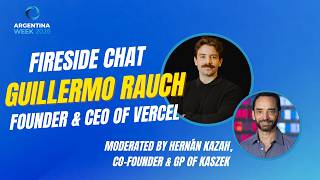
In this interview, Guillermo Rauch shares his personal and professional journey, beginning with his upbringing on the outskirts of Buenos Aires and early remote work as a pre‑teen JavaScript contractor. He recounts the cultural shock of moving to the Bay Area, self‑teaching English, and the entrepreneurial openness that inspired him to start Vercel. Rauch explains Vercel’s mission as a front‑end‑first platform that powers high‑performance, globally‑scaled sites through the open‑source Next.js framework, highlighting its adoption by companies like Hulu and Target. He argues that back‑end infrastructure has become commoditized thanks to services such as Stripe, Twilio, Auth0, and managed Kubernetes, positioning the front‑end as the primary arena for customer experience and innovation. Rauch observes a blurring line between design and code, noting the rise of auto‑generated Next.js code that lets designers deliver functional front‑ends with minimal hand‑coding. He maps the current front‑end framework landscape, contrasting Next.js (React‑based) with Vue’s Nuxt and Svelte’s SvelteKit, emphasizing Next.js’s hybrid static‑dynamic capabilities for large, personalized sites. The conversation shifts to personal life: raising a 6‑month‑old while scaling Vercel, the sleep‑deprived reality of founder‑parents, and the empowering long‑term perspective of building a lasting company. Rauch describes Vercel’s cultural practices, including weekly meditation sessions, to create space for family and reflection, arguing that such practices benefit the business. He concludes with advice for VCs—focus on founders who think long‑term and support them—and for founders—balance obsession with the company with intentional time for self‑care and family.
Chapters
Guillermo, wanted to, you know, invite you to the GV family. You know, we're excited to be part of your journey, excited to work with you. Maybe just to get started, kind of tell us a bit about yourself.
You know, where are you from?
Where'd you grow up? All that kind of good stuff.
Yeah, I'm originally from Argentina. I grew up in the outskirts of Buenos Aires. So right outside the city of Buenos Aires. Most people think Buenos Aires is just the city, but it's a large province and I grew in the outskirts of it. Throughout my entire life, I've been interested in software development since I was a small kid. But what really captivated my heart was when I learned about putting dynamic behavior with JavaScript in the web browser. I started working remotely very early, obviously pre-pandemic. When I was like 11 or 12, I started working as a remote contractor for software development projects. And I would select the projects that had something to do with my ability to put JavaScript in them. I was doing it more for fun than anything else being a kid. And yeah, that's what kind of got my career started, a lot of open source, a lot of frontend development, JavaScript. I developed this love over many, many years for dev tooling. And I was lucky enough that a company hired me, and they opened an office in San Francisco, which is where I live now.
When did you move over to the US, and what was that like coming from Argentina to the US?
It was quite a bit of a shocker. So having that background of working online and working a lot on programming stuff, I was always reading manuals in English, and that's how I taught myself English for the most part. It's just always reading and writing in English. Nowadays, we're lucky that there's so much material for learning programming and so on that's in all languages. There's so many YouTubers and influencers of programming and bootcamps. But back then I had to kind of build myself up from reading whatever manual that was free, 'cause I really didn't have that much money to invest in learning that I could get my hands on. And when I came to the US, the biggest thing for me was a shocker of realizing that I actually didn't know how to speak. Like I was having a really hard time understanding what people were saying and talking back. But the first thing I kind of fell in love with here in the Bay Area was kind of like that openness toward entrepreneurship and new ideas and creating new things and giving everybody a chance to build new things. And that's what really made me stay. One of the first doors that kind of opened for me was this world of startups. And I realized that I wasn't so interested in coming here to work, for another company. I was here to start something new and that there was a lot of opportunities in the space of things that I was interested in. And luckily, you know, made connections. I made a lot of connections of immigrant entrepreneurs as well that kind of showed me it was possible. So that was really helpful. And nowadays I try to do the same. So I try to like invite everybody to, start something new and put forward new ideas.
So, Vercel, what does Vercel do?
So, Vercel is a platform that puts the frontend development first, the frontend developer first, and it gives them comprehensive tools to create very high-performance websites and applications that scale globally. So, we're known for this framework, Next.js, which is completely open source and it's been the framework of choice for companies like Hulu.com and Target.com to reinvent their frontends. It's completely open source and Vercel builds the best platform to deploy. So that means to take your frontend that you're developing and share it with the world and make it scale and make it reach everybody in the world in the fastest possible way.
Is it right to say the backend is kind of becoming commoditized or like, how do I think about that? Um, should I encourage my son to become a backend developer, uh, going forward? Uh, or is, are those days over?
Yeah, obviously we're biased, but, um, I would say, you know, what's more interesting, the, you know, trucks that fulfill orders for a storefront or the actual consumer experience that when you go to a store and increasingly you're doing so online and that's where Vercel and Next.js are seeing a lot of traction in the e-commerce world, but, you know, just go to the store and having that customer experience that is unique to that brand, unique to that company, it's where you first meet your customers. So I think that's where the most opportunities are for businesses and developers alike to create really compelling, really high-performance frontend experiences. And with regards to backend, I think what's happened is that over the past decade with incredible innovations like Kubernetes, and with incredible innovations like the API platforms. So what I mean by this is the companies that already give me pre-made backends like Stripe and Twilio and Auth0 and the CMS APIs, all those backends are now really well built. We learned how to scale them. They're everywhere. There's so much choice there. So that kind of like leaves the most interesting piece of investment for any business in the frontend. That's where you meet your customer and that's where you deliver your information or your goods.
We're moving to a place where designers will increasingly be coders in a kind of way. Totally.
The lines are getting so blurred. Exactly. We see so many interesting integrations on Vercel where people are importing automatically generated code And we're even seeing companies that are automatically generating Next.js code on behalf of their customers. So we have companies that present a very simple UI to their customers and then behind the scenes they generate Next.js code deployed on Vercel. So it's kind of like a strange loop. A lot of this gets abstracted away, gets automatically generated, and really what's left is the creative value or the business requirement. That's an exciting place to be.
Next.js, you mentioned it a couple of times, but just zoom out. There's a bunch of different frameworks on the frontend. Maybe give us the market map of the different frameworks.
Absolutely. Yeah, the frontend world evolved in all these different ways and Next.js, which we created 4 years ago, happens to be winning, we can say, at least in this dimension that I'll call out that is really important, which is websites that have a hybrid static and dynamic need. So a lot of the Jamstack hypothesis is you have lots of static pages that you can push to the edge. Next.js also allows companies to go dynamic, to have billions or trillions of pages, which is something that traditional static site generator solutions have struggled with. And this hybrid nature has made it a win in a particular category, which is websites that again are larger or want to be larger in the future and have lots of dynamic needs, lots of user personalization needs. So in this nascent category of frontend frameworks, we have Next.js, which is powered by React, the component engine that Facebook open-sourced that's sort of like taken over the world. So we have Next sort of representing React, and then we have Vue and Svelte, two very interesting new technologies as well that created their own flavor of component engines. So, and one of the frameworks there is Nuxt. It's very analogical to Next.js but in the Vue.js world. And we have SvelteKit, which is analogical, it builds on top of Svelte. Sorry, one second.
We love to say hi. This is working from home. Hi. How old are you?
Say how old you are. Uh, I'm 4. He's 4.
Your sunglasses are super cool. This is real life here. Any, any second my son's gonna pop his head in here. So, uh, actually, that's a great transition. So, um, your dad, your husband, how's it been being a father and also, you know, a founder at the same time? And a father of young kids, that's not easy. I know because I have a few of these young kids myself.
You know, it's been great. I think I remember reading this quote that a random stranger on the internet said, like, you'll never find the perfect time. There's never a perfect time in your life to have kids. And I took that advice to heart because I had a kid, my first, as I was starting Vercel and Next.js.
You have a 6-month-old. What's it like to go through the process of raising a fund, you know, not a fund, but raising around, you know, kind of while you have a baby at home who's not quite sleeping yet. Hopefully the 6-month-old is sleeping now.
Um, but really, how are you able to manage all that?
Like, just, you know, and by the way, I, I, I think it's important that you talk about it because I think a lot of our founders are pushing off, you know, becoming parents and becoming, you know, whatever, getting married because they feel like it's just impossible to do so. So I don't know, any advice or just tell me about the story.
I think we can't sugarcoat this, that it literally takes away sleep at night. The crying of a baby triggers some sort of like natural response of fight or flight. That's right. Instant awakening in the middle of the night feature activation. But what I'll say is that it's very empowering because you want, I think if you're in this journey like us, you wanna build something that's a company that's gonna be here for the next decades, for the next centuries. So it's empowering to think about the long term. It's empowering to imagine, you know, our children being Next.js developers or Vercel developers in the future. So I would say like for me, it's been motivating and empowering and inspiring, you know, like it is more workload too. But also at the end of the day, it's true that, you know, founders tend to, kind of become super obsessive about their companies and they have to also realize that creating the spaces for family and reflection and meditation and all of those things help the company too. So creating space for family, creating space for meditation. We have a weekly meditation practice at Vercel that we create like this Zoom with someone that helps us guide in our meditation. And so my take there is that creating all these spaces for not being in front of a screen, not reacting to notifications, not reacting to everything immediately, and developing yourself and developing your family will make the company better. That's my— like, these things are not at odds, and I think they complement each other really well.
What advice can you give VCs, and what advice can you give founders?
In a lot of cases, we get tied up in negotiations and in terms and things like that. I think at the end of the day, the human value is incredibly important. Uh, you know, these are people that are going to work with you side by side, just like, you know, uh, in some ways it's like an extended marriage. So having people that you respect, empathize with, um, that you look up to, that again, you, you will take their, their feedback seriously and you'll, you'll entertain their, their ideas and And not an antagonistic relationship, but more of a, we're going to build a lot of value together. It's always easier said than done, but that's worked really well for us. And we've only gotten better ever since we started working with a lot of these folks. So I'm really thankful to have been joined by such amazing people.