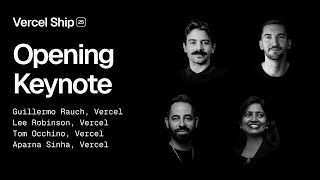
In the Vercel Ship 2025 opening keynote, CEO Guillermo Rauch and senior leaders Lee E. Robinson, Tomo, and Aparna Sinha present the new Vercel AI Cloud. The talk frames a shift in how software is shipped: from manual, multi‑service orchestration to AI‑augmented, agent‑driven development. Rauch highlights Vercel’s scale (32 M active domains, 140 B weekly requests, a trillion Fluid invocations) and argues that AI is redefining the metrics of performance (time‑to‑first‑token, tokens‑per‑second) and the actors who can ship. The team announces a suite of AI‑focused primitives: AI SDK v5, AI Gateway for model‑agnostic routing, Fluid Compute with active‑CPU pricing, Vercel Sandbox for isolated VMs, and back‑end support on Vercel. A live demo of v0.dev shows an AI‑generated full‑stack Slack tax‑filing app built with these primitives. Tomo then details developer‑velocity upgrades—on‑demand concurrent builds, elimination of build queues, immutable deployments with instant rollback, SKU protection, rolling releases, and first‑class micro‑frontend support. Aparna Sinha outlines security upgrades: a global edge firewall (L3/L4), real‑time DDoS mitigation, a configurable web‑application firewall, a comprehensive bot‑management suite, Bot ID (Kasada partnership), and the Vercel Agent AI assistant that can investigate traffic anomalies and suggest mitigations. Throughout the keynote the narrative emphasizes three core principles—flexibility, speed, and security—while positioning the AI Cloud as a developer‑first platform that powers both AI applications and the AI tools that build them.
Chapters
Please welcome to the stage Vercel CEO Guillermo Rauch. Hello, New York City. Have we all melted already? I mean, it's like 900 degrees out there. For those of you watching at home, We're cooking. Welcome to Vercel Ship 2025. For the last 10 years, we've been focused on building the frontend cloud. We wanted a world where you didn't have to spend months, weeks orchestrating 14 different services to build a B2B SaaS. A world where you can just ship things. Because to us, shipping is what it's all about, right? I just wanna ship products. We all just wanna ship products. And it turns out a lot of people wanna ship products. Companies like DoorDash, Peloton, Notion have transformed their workflows and built teams that can just ship the products their users want to see. The frontend cloud was designed to help teams fundamentally change how they build and ship apps. It's 3 ways of building that I recommend to everybody that I talk to. Be flexible. Build with the tools you want and change them out when you need to. Move fast. Who doesn't like fast? Spend time shipping experiments and features. Instead of configuring CDNs, God forbid. And stay secure. Your apps should be secure by default without a bolted-on firewall. This has become the standard for web development. Today, Vercel serves over 32 million active domains, 140 billion weekly requests, and now we've crossed a trillion invocations on Fluid alone. A trillion. But if you look around at the stuff that we're talking about these days, like realistically, we're talking about in boardrooms, on the X platform, the everything app, it's becoming very clear. The bar has raised. AI is now redefining what shipping looks like. It's changing what we ship. We have to optimize for human-to-agent and agent-to-agent interactions. It's changing who can ship. We're seeing more and more people contribute meaningfully to codebases or developing hyper-specific personal apps to solve their problems. And it's changing how fast we ship. Products that didn't exist yesterday now have a trillion dollars in ARR. So we used to talk about exponential growth. Now it's vertical. And this doesn't mean that we're entering a world of AI slop, please, or that the UIs we know are melting. We're getting back to a really cool web. Autonomous infrastructure, new modalities that meet you where you are, interfaces that learn how you work, and the implications are massive. We used to only have to worry about time to first byte or cache hit ratios. Now we optimize for time to first token and tokens per second. Teams used to release released every few weeks here and there. Now, agents release for us continuously on our every thought. We've actually gotten to see this firsthand with our own AI agent, v0. Millions of users, 100 million completions. The v0 team has been cooking. They have the freedom to build where, how, what they want. And guess what? V0 is a full-stack Vercel app. Frontend, backend, everything in between. So, polling the room, why do you think that team used Vercel for everything? It's because I made them. Of course, I told them, like, you have to use Vercel. No, it's because they chose it. They needed to move really fast. They needed infrastructure that's flexible, that's fast. They need to stay secure in a world of very fast-paced model changes and updates. So the team today, frankly, would be in config hell instead of what's basically like 300 days straight of shipping features, shipping bug fixes, shipping model updates. And on the Vercel side, working with v0 and other amazing customers building full-stack AI applications has given Vercel a glimpse of that future. We're previewing where the platform needs to go. So we needed, for example, better building blocks for chat. And streaming UIs. So just like we did with Next.js, we turned to open source, we turned to developer experience, and we created the AI SDK, our open source framework for building AI apps and agents. And just like we did with Vercel CDN, which provides global failover performance and routing for the web and API workloads. Now with the AI Gateway, we can provide the same connectivity benefits, but for models. And again, for self-functions powered by Fluid Compute, run your application code seamlessly and securely. So we're making Fluid an even better experience and even more cost-efficient for AI workloads and are introducing new products today specifically designed for building agents and backends. Woo! That's right, backends. Yes, you've been asking, there's backends today. So Vercel's security layer, on the other hand, has been protecting you for modern web applications and website threats. It's been keeping you secure by default. But as workloads become AI-native and agentic and the threats become more sophisticated, we're leveling up our bot management, our observability, and our protections, and giving you the AI tools to interpret, to actually make sense of it all. And to take action against the new generation of threats. All of this work adds up to a cloud purpose-built for AI with the same developer-first focus we've always had at Vercel. This is the AI Cloud, and it's so freaking exciting. So thank you all for being here today. As we introduce the future of the Vercel platform. This is already the foundation for some of the most ambitious platforms in production today. So it's not only powering AI apps, it's also powering the act of building those apps with AI, a platform for both developers and agents. And it brings together everything we've built, in a world, again, where the bar has moved, where you don't just need to be flexible, you need a toolkit that assumes that the world is changing constantly and the tools don't get in the way. A world where you don't just need to move fast, you need infrastructure that lets you move at the speed of new ideas. There's probably 3 model releases in the time of this presentation. And you don't need just to stay secure, you need to be resilient by default because we're dealing with fundamentally different traffic patterns and new kinds of workloads. So today we'll dig into the core principles of our AI Cloud and introduce new capabilities across the Vercel platform. So in order to build this AI Cloud together, and find out what's next for the web. Let's get started with Lee E. Robinson, the most flexible man alive. Yes, to tell you how to stay flexible.
I'm not sure about most flexible. I feel like I need to do some stretches here to warm up. But thank you, Ji. And thank you, everyone who's here live in New York. And tuning in online. Special shout out to my 9-month-old daughter tuning in. Hi. Yeah, I'm really excited to chat with you all today. AI is changing how we build software, and we've been navigating this platform shift ourselves at Vercel. So I want to talk about what we've learned and why flexibility is so important right now. Like Ji mentioned, the type of UIs we're building are changing. Really, everyone is rethinking best practices. Features or maybe entire products might be totally rethought as an AI agent. Before, in places where we used to have more complicated pixels, now we can stream tokens. But figuring out exactly how to navigate this platform shift is maybe not obvious. How do you build an agent? Do you partner with one of the one specific API or one AI company and build around their platform. You don't want to spend a lot of time and money building your own model and then watch the state of the art get redefined overnight. You need flexibility. It would be incredibly hard to list all of the model launches in just the past 6 months on this slide. I mean, the state of the art gets redefined every day. We started Vercel by making it easy to deploy any framework. Now no one has to think about provisioning infrastructure or configuring their DNS to get their site online. You just push your code and it's done. It's kind of like self-driving infrastructure. But we knew that we needed to support more types of workloads, and some of these required a lot of integrations. Maybe a year ago I wasn't trying to integrate an AI model, but I definitely needed a database. So we built the Vercel Marketplace to give you flexibility to adapt. You don't have to re-platform, you can just grab the next integration, which is pretty nice. We took our managed infrastructure and we enhanced it with integrations from our Marketplace, but we weren't done yet. What you all told us, and your biggest ask, was the ability to talk to and integrate with any large language model. But how do you know which one to use, right? There's so many. That's where our AI Gateway comes in. The AI Gateway lets you switch between almost any model without having to manage API keys or rate limits or provider accounts. And as you can see, we've simplified the AI SDK interface with the v5 beta, just came out yesterday. And now you can use a single string to define both the model and the provider. This supports the Vercel AI Gateway, and in the future, OpenRouter and others through our adapter interface. So you can just use AI anytime, any model. Over the last year, we've been building a new compute platform, Fluid Compute. Fluid always keeps one instance active, kind of like a server, and it can manage thousands of connections, again, kind of like a server. But the best part is that there's no proprietary runtime or APIs that you need to use. It's standard Node.js, Python, and soon custom runtimes. But there was one final challenge. This was a tricky one. Almost all compute infrastructure today is not designed for running AI apps. For example, if you see all of this idle time where we're waiting for an AI model to respond, most providers are going to charge you for that full 30 seconds it could take for, you know, a thinking or reasoning model to respond, when in reality, Maybe it only took about 30 milliseconds of active CPU time. Everything else is just idle. So what if, unlike a server and unlike serverless, you're only charged for the CPU that you use? That seems like it would be pretty difficult. It would probably take our team over a year of R&D to build. Hmm. Well, I'm very excited to announce that today Fluid Compute now has active CPU pricing.
Yes.
I'm very excited for this. This is an across-the-board price reduction for all customers on Fluid Compute. Very big. Fluid can now power backends, API servers, MCP servers, Backends, did I say backends? Backends. Some of our customers are seeing dramatic cost savings by moving to Fluid. This builds on 15+ price improvements that we've made over the past year. I mean, 50% off data transfer, half off domains, 80% off web analytics, 75% off log drains. We're really excited to continue optimizing our infrastructure, and then passing those cost savings back to you all. Now, let's say you're convinced by my talk so far. You, you right now, or in a few minutes, you go and you wanna build an AI agent. So of course you're gonna build your backend on Vercel. You're gonna have your logic, you're gonna talk to a large language model, maybe through the AI Gateway, but you need to generate some code in your agent. Well, you probably don't wanna run that code in a Vercel function. That function has access to secrets or other privileged information, you need a way to isolate that code, something like a sandbox. Hmm. Well, that's why we're also today releasing the Vercel Sandbox as part of our AI Cloud to help you more easily build AI agents. Vercel Sandbox makes it very easy to quickly spin up VMs and run any long-lived code with the same pricing as Fluid. This is the first VM platform with active CPU pricing, and it makes it dramatically more cost-effective and flexible for your needs. Now, I wanna show you all a demo of all of these primitives I've just talked about for the AI Cloud, and what better than our own product, v0.dev? Now, I don't know about you all, but I use Slack all the time. I love Slack. And I thought, what if I could do even more on Slack? What if I could file my taxes in Slack? Kind of fun idea. So I said, let's open up Slack in v0. I rebuilt a little UI with a design system that looks like Slack's beautiful design. And I gave it a prompt. And I said, as I always do, well, hey chief, There we go. I wanna add support for a minimal sleek tax filing in the main part of Slack, in the main part of v0 here. So now I'm gonna submit this generation and v0's gonna go cook. So we get to see some of the reasoning, it's thinking about what it wants to do, and it's gonna start generating code. Now on the right, I see it's making the new files, it's going and talking to the IRS, connecting to my TurboTax account, right? Like we're figuring all this out. And I can go look at the code and see this is a full stack app. We've got routes, we've got components, we've got reusable logic inside of hooks. It's all here. Now, while this is generating, I wanna also talk about Supabase UI, which is built on the same primitives like ShadCN, where I can open up these reusable blocks in v0 and I can have frontend, backend, authentication logic, all built together and just easily reopened and reused. Then I can just integrate with Supabase or other providers and very quickly get a Postgres database built on the Vercel Marketplace. Now it looks like we're done. This looks pretty good, but I think the padding is a little off. It's a little crammed. I wanna give it some more breathing room. So we can use design mode and I can select that outer container, and let's do, yeah, let's do 20 pixels. Yeah, 20 pixels of padding, and I'll save that change. So that looks quite a bit better. I think our app is now ready for me to do my tax filing inside of Slack, which is revolutionary, so, it's pretty good. v0 is built end-to-end on our AI Cloud. We use the AI SDK to stream responses back. We use the AI Gateway to switch between models,, and most importantly, we use fluid compute to run all of the compute in our functions. This helps us stay very flexible, but the best part is that all of these AI cloud primitives work with any cloud provider, even if your backend is not yet on Vercel. Now I'm gonna do my best G impression here, and let's welcome the fastest man in the universe, the F1 driver, Mr. Tomo.
Thank you, everyone. He just added that this morning. Not only am I not a fast driver, I drive the speed limit and I get motion sick, but I love that. Um, it's so great to be back in New York City. Hello everyone. My name is Tomo. Um, I lead engineering, product, and design at Vercel, and I want to talk to you all today about something that is very important to me, is very important to every team I talk to, and that's moving fast. Before Vercel, I spent over a decade at Facebook where our— we had this fairly famous mantra, move fast and break things. Um, we eventually transitioned to move fast on stable infra, but it doesn't have the same ring to it. Um, and we also at Vercel value moving fast on stable infrastructure, but we accept that stable infrastructure is table stakes. So we just say, move fast. There's a reason that this move fast mantra is so sticky. It's because at the end of the day, this is what we all want to do. Every developer wants to just ship things. And this is even more true in an age of AI, with software being developed by agents, and agents deploying on our behalf, and more and more software being created all the time. So that's what today is all about, removing blockers and enabling you to move faster with confidence. But how do we get there? When I break down the development process, I see 3 main sources of slowdowns: waiting for builds, waiting for releases, and working in large codebases. First up, I wanna talk about builds. A slow build is a tax on productivity. I'm sure many of you have seen the famous XKCD comic from Randall Munroe, one of my favorites. But while this comic makes compiling look fun, uh, because you can do other stuff, um, waiting for a build actually completely sucks. I don't want to wait for my build like it's some present I can't open until Christmas. I want to be in production now. So how do we get to production faster? We had to re-architect how builds work at Vercel on top of a completely new foundation from the ground up on Fluid Compute. As Lee mentioned, Fluid is the compute primitive that powers functions, now sandbox, and also it powers builds in an isolated environment at scale. This new foundation is efficient, reliable, and fast, but more importantly, it's a foundation on top of which we can continue to make future performance optimizations. This will help bring in a new era where builds are no longer triggered by just a handful of developers, but where they're also triggered by fleets of coding agents that we're collaborating with. Since rolling it out, teams have seen up to 30% faster build speeds without needing to make any other changes.. But even with faster builds, if members of your team are pushing code at the same time as you, it's still possible that your build will get queued. We have massive teams using Vercel deploying hundreds of times per day. So unfortunately, build queues have become a common occurrence for many teams. And as our teams are increasingly staffed with agentic colleagues, this was only going to become more and more painful, which is why I'm excited that we've finally killed the build queue.
Yeah.
Thank you. Thank you. Yeah. You, your team, and an army of agents can now push as much code as you want, as often as you want, and run your builds in parallel with on-demand concurrent builds. Just like our managed infrastructure scales to meet production demand, our build pipeline based on fluid compute scales exactly the same way. No more waiting in line, no more dreaded build queues. And as our CEO would say, nature is healing. Okay, so we've got our builds fast and we've got them running in parallel. The next slowdown I want to talk about is the release process. But to do that, we've gotta talk about deployments. Deployments are one of the most fundamental atoms of the Vercel platform. They are immutable infrastructure snapshots that are backed by Git. Every time you push code, you get a unique URL with a brand new, globally available, production-ready environment. This primitive unlocks some really powerful capabilities and workflows on the platform. For example, preview, preview deployments. Whenever you push code to a branch, a new staging environment is created with a preview of your changes. These allow you to collaborate and test your changes in production in a production setting without actually affecting your live production deployment. Another capability our immutable deployments unlock is instant rollback. Because Vercel deployments are immutable infrastructure snapshots, If you accidentally push a bad change, you can safely roll back to a previous deployment instantly. No new build required, and reverts happen globally in 300 milliseconds. I really wish this was so easy back in 2009, the first time I took down Facebook.com. We didn't have instant rollback back then. We had to revert my change, wait for a build, then wait for it to be deployed, and it was agonizing. If we had instant rollback back then, I wouldn't have sweat it at all. Another capability immutable deployments unlock is something we call SKU protection. One of the problems with deploying frequently is that it becomes more and more common for the version of your app running on the server and the version of your app running on the client to fall out of sync, and this can cause pretty catastrophic errors for your users. Since we deploy hundreds of times per day, it's really critical that we get this right. But Vercel can prevent version mismatches at the infrastructure layer. This means you don't have to trade off between release velocity and customer experience. You can deploy as frequently as you like, and Vercel will handle the rest. Lastly, I'm excited to finally introduce a feature many of you have been asking for. Many of you I've talked to directly about this. Rolling releases. Rolling releases allow you to gradually roll out changes to production users. And so, you know, whether you call this progressive delivery or blue-green deployments, the objective is the same. We want to minimize risk, we want to catch issues early, and we want to keep shipping with confidence. With rolling releases enabled, when you push a new deployment, we start sending a small amount of traffic to the new version, in this case, deployment B. The rest continues to go to the current production deployment, and then you can choose how the rollout advances. At every step, you get a side-by-side metrics comparison for the current and canary deployments, including error rates, Core Web Vitals, and more, and all telemetry and logs are version-labeled, making it easy to identify regressions. If the canary underperforms or breaks key flows in any way, You can stop the rollout with one click. This pairs really well with our Vercel flags. So now you can capture regressions in both the correctness of your application and the performance of your user experience. Rolling releases help you move fast, but as teams grow, so do their codebases. And when that happens, even the fastest builds and the best release processes, uh, things can start to feel heavy. So this is the final slowdown I want to talk about: working in large codebases. A common solution, and something that we do ourselves at Vercel, is to split your app up into what are called micro-frontends. Now, as a big fan of monorepos, I've historically been pretty skeptical about micro-frontends. It felt like they sacrificed user experience in service of achieving a better developer experience. But thanks to advancements in web standards like speculation rules, with better platform support, we can now split applications without the trade-offs. So today I'm also excited to announce first-class support for micro frontends on Vercel.
Thank you.
This means native support for parent-child relationships between apps. Since our routing system knows which app owns which route, we can provide a seamless, cohesive user experience even across application boundaries. And that same context powers a better DX throughout. In the dashboard, you can manage the relationship between micro-frontends across projects. The Vercel toolbar shows you where you are and lets you easily switch between apps. And with a local-to-live workflow, you can run just one micro-frontend locally while the rest of your app streams in from live production deployments. Micro-frontends come in several different shapes, from multi-zones and vertical micro-frontends like I've been talking about here, to horizontal micro-frontends like module federation. Our goal is to support all established micro-frontend frameworks on the market. The result is faster development, cleaner separation of concerns, and a unified experience for users. We're just getting started here, and we'll be continuing to find ways to help you and your teams move fast. But while being flexible and moving fast are values that we hold dear at Vercel, there's another principle that's perhaps even more important, and that's staying secure. I'm excited to welcome my favorite new Vercelian, Aparna, to tell us how we can keep your sites protected and stay secure.
Thank you.
Hi everyone, I'm Aparna Sinha, and I am going to talk to you today about how Vercel secures the AI cloud. I recently joined Vercel. In a prior life, I was at Google, and I helped to scale Kubernetes to the Fortune 500 enterprises. I've also worked at one of the largest banks in the United States, Capital One, building out the internal generative AI platform. Today, every bank, every company has an AI mandate, and its success depends on security. Developers are shipping faster. They're releasing AI-generated code, and they're using more open-source software than ever before. And at the same time, there are new threat vectors emerging, and the attack surface is growing. So to harness the productivity and speed benefits of AI requires that each of us can stay secure. Here's the good news. On Vercel, we've got you. Every time you deploy your application to Vercel, whether you notice it or not, it's protected by multiple layers of security. Your workspace is secured with SSO and role-based access controls. Your application is secured through our network defenses that allow only legitimate traffic to reach your application and block the latest threats in real time. And your infrastructure is secured through hardened environments, secure-by-design practices, and new AI primitives like the Vercel Sandbox. Vercel's firewall sits at each of our points of presence across the globe, and it protects every application by default regardless of which plan you're on. Our platform firewall provides Layer 3 and Layer 4 protection to stop volumetric attacks like SYN floods, and our web application firewall protects against sophisticated Layer 7 attacks. Here, we recently introduced a proprietary real-time DDoS mitigation engine. This engine, it continuously ingests and analyzes traffic, live signals, mapping complex relationships between fingerprints, user agents, IPs, ASNs, and user behavior., and it pushes these mitigations directly to the regions at the edge for instant enforcement. And this has cut the median time for— to mitigation from 20 seconds to 1.5 seconds. And this real-time DDoS mitigation is on by default, again, on every application. It operates transparently and immediately benefits all deployments without any configuration. So far this year, Vercel's firewall has mitigated over 260 billion threats, and those were coming from over 180 million unique IPs distributed globally. We've seen a real increase in globally distributed threats. And many of these threats were missed by the traditional CDNs. That's the power of Vercel's innovation. So in addition to the always-on mitigation, our web application firewall is configurable by you, the user. And it comes with deep observability. So your teams can implement your own business logic. You can use custom rules. You can do rate limiting, rollback protections. You can use the managed rule sets. Of course, these days it's not just about traditional threats. Increasingly, teams are turning to Vercel for one of the most gnarly problems on the modern web. Bots. Some bots, like search engines or internal agents, are beneficial. But many are harmful. Scrapers, scanners, credential stuffers, all those stolen passwords that these bots can use on your site. They can be very malicious and they can do a lot of damage to your business. So at Vercel, we're focused on helping you stop the bad bots, whether you're a large bank or you're just an emerging AI startup. We're building a comprehensive bot management suite. And our focus here is on separating the signal from the noise, doing it at scale. The first part of our bot management system is to manage rule sets. Bot protection, bot protection intelligently challenges non-browser requests. And there are a lot of non-browser requests on the internet today. We're finding that in just a few weeks, Bot Protection, that rule set has blocked nearly a billion undesired requests. The second piece is AI Bot. The AI Bot filter allows you to optionally block any unwanted AI crawlers that may be coming to your site. And the third part is attack challenge mode. This is a hammer. Attack challenge mode allows you to challenge every new session so that you can ensure that only humans access your site under critical threat scenarios. Now, that's not all. Did you know that not all bots on the internet are noisy? While most bad bots aim for scale, Advanced bots aim for stealth. They mimic human behavior. They use headless browsers, and they keep their traffic hidden amongst your real users to avoid detection. These are really difficult to detect, and they're very real. They often target the highest-value parts of your applications. So think about your— login, your auth, your checkout flow, and some of the actions that trigger expensive backend operations like LLM API calls. These aren't the bots that'll trip a rate limit. They're the ones that slip by unnoticed. So don't let these bots get you. Especially for your high-value workloads, you need sophisticated client and server time real server-side real-time threat detection? Some of you might be thinking that, well, maybe a CAPTCHA could help. Yeah, I'm not so sure. With CAPTCHAs these days, it's not clear that even a human could solve that. And our team actually did some research here. We asked the world to come up with the most advanced, the most ridiculous, sometimes the most hilarious CAPTCHAs that actually capture a human. And here's some of our favorites. So Ji came up with the Doom CAPTCHA. Dan has us drawing little fishies. And the winner, Edwin, is asking, are you a bot or are you a dancer? Well, personally, I love to dance, but that's probably not what you want when I'm on your checkout page. Yeah, we don't really want humans to pay this increasing cognitive tax when they're trying to use your app. And so what these hilarious submissions have shown us is the absurdity of the CAPTCHA, and also that, that the best CAPTCHA is invisible. The truth is that the same AI that helped our community build those CAPTCHAs, well, it can also solve them. So if you're relying on a CAPTCHA to secure your site, it's now an open door for bots. So we've got a better solution. We have partnered with Kasada. Kasada is a world-class bot security company that protects billions of users' interactions every day across sites like Hyatt, Nike, and Twitch. And they deeply understand the adversary. I am really excited to bring this solution to you. Kasada's enterprise-grade defenses, they are already protecting v0 and vercel.com, and now we're enabling the same protection for you. So today we're introducing Bot ID. This is an invisible bot detection engine, and it's now generally available on Vercel and coming soon to other clouds. Bot ID is a lightweight solution. And it combines Vercel's edge defenses with Kasada's machine learning tools. It's a drop-in code that developers can use to run the advanced bot filtering on any endpoint and escalate suspicious traffic to Kasada for deeper analysis. Under the hood, Bot ID counters the most advanced bots by silently collecting thousands of signals that distinguish human users from bots. And it mutates these detections on every page load to evade reverse engineering and sophisticated bypasses. And then it streams all of this attack data into a global machine learning mesh that collectively strengthens protection for all customers. Vercel's security suite works well together, and it's holistic. So we've got the L3, L4 platform firewall that protects against volumetric attacks, and then our proprietary web application firewall that mitigates against sophisticated L7 DDoS attacks in real time and is configurable by users. The bot protection managed rule set that catches shady scrapers and lets good actors through. And now Bot ID that runs quietly behind the scenes to verify that traffic is authentic. No friction, no CAPTCHA. And there's one more thing. We've always provided observability of bot traffic so that you can dig deep and see what's being challenged, what's being allowed in real time, and understand its impact before enforcement. But sometimes all of this data, it requires finding the needle in the haystack and can take a long time. And we really want to reduce the manual burden on developers and security teams to sift through those logs and identify those patterns and figure out, you know, what's the fine-grained rule to write that won't block legitimate traffic. Introducing Vercel Agent. This is a new kind of intelligent assistant. For you and your team to go beyond just monitoring the situation. And it's now in limited beta. As an example, Vercel Agent can run investigations for you. It can help you weed out the signal from the noise using natural language. You can look at a point in time and let the AI dig into the haystack. Behind the scenes, Vercel launches an agentic workflow. And that's using Vercel's AI SDK, our gateway, and various LLMs. This process analyzes traffic, it identifies the meaningful issues, and then it recommends the right course of action, collaborating with your team and giving them superpowers. So let's look at a demo. Now, as a user, I'm here inside the firewall dashboard, and I see that there's a spike. So I can select an area and then kick off an investigation. And Vercel Agent opens this interactive notebook where I can type back and forth with the agent. And it's going to start an initial analysis. And we can see that it's already identified the anomaly in our traffic, and then it starts to reason through the root causes. This is the LLM reasoning through the root causes. It's breaking down the traffic now by ASN and IP address. And it's trying to find the root cause. And digging further into the traffic from that ASN, we see that it's picked up the source. And now it's going to recommend a mitigation. And there we have it. It's recommending a new firewall rule. So Vercel Agent gives us a really nice concise summary of what's going on. It explains the root causes in plain language and then it proposes new defenses like firewall rules or managed rule sets. Vercel Agent brings the power of AI to your suite of defenses, making security even easier by default so that you can accelerate your AI transformation. This is just the start. Later today, our CTO Malte will share how you can start building your own custom agents on Vercel.
More from Guillermo


Guillermo Rauch at Founders in Arms Live: Simplicity, Focus, and the Bet That Built Vercel

The Man Who Built a $9B Dev Platform Thinks You're Overcomplicating AI | Guillermo Rauch


Inside v0: How Guillermo Rauch Is Building 100 Million Engineers | Lenny's Podcast - EP.89
Architecting for model step-changes: A fireside with Vercel's Guillermo Rauch

Keynote Interview: Vercel's Guillermo Rauch on the Agent Era | Azure Cosmos DB Conf 2026

Vercel CEO: 70% of Our Traffic Is Now AI Agents "Nobody Was Prepared" | Anthropic, OpenClaw, OpenAI
Why being "terminally online" is more important than ever, with Vercel CEO Guillermo Rauch

Argentina Week 2026 | Argentine Talent Powering Global AI | Guillermo Rauch & Hernán Kazah