Vercel’s Guillermo Rauch | Bold Visions Delivered Incrementally | S3E13 | Spotlight On | AccelVC

In this Spotlight On podcast episode, host Dan Levine interviews Guillermo Rauch, CEO and founder of Vercel. Rauch recounts his journey from a childhood in the Buenos Aires province, where early exposure to computers sparked a love for making software run, through his teenage contributions to the MooTools JavaScript library and the founding of the ed‑tech startup LearnBoost (later acquired by Automattic). He explains how the pain of deploying web apps led him to create Zeit (now Vercel), the open‑source Next.js framework, and a platform that abstracts deployment, CI/CD, and scaling for developers of any size. Rauch outlines the seven principles that guided Next.js, the concept of progressive disclosure of complexity, and how Vercel’s infrastructure now powers high‑profile customers such as Chick‑fil‑A, Zillow, Stripe, Notion, OpenAI, Nintendo, and many e‑commerce sites, handling 750 million deployments. He discusses recent product lines – the AI‑first V0 builder, the AI SDK (the “Next.js of AI”), Turbopack, and the Svelte team – and how security, AI, and foundational developer experience are the three strategic buckets for the company. Throughout, he shares founder advice: iterate fast, meet developers where they are, maintain thick skin, and never assume any software is immutable. The conversation blends technical anecdotes, product‑market stories, and personal reflections on culture, scaling, and the future of the web.
Chapters
We know that every time that we have a big idea about where the future is going to be, we need to be mindful of how do we meet people where they are today and incrementally bring them to the, to the promised land. Welcome to Spotlight On, a podcast about how companies are built from the people doing the building, one messy, exhilarating decision at a time.
Welcome to Spotlight On. I'm Dan Levine, your host, and I'm here with Guillermo Rauch from Vercel.
It's great to be here.
Okay, so Guillermo, for those who might not be familiar, can you tell us a little bit about Vercel, like how long it's been going, how big it is? And a little bit about what it does.
All right, so Vercel builds frameworks and infrastructure for people to ship amazing products on the web.
Yeah.
From websites to AI agents to the next big thing on the internet.
I don't want you to pick your favorite customer, but what's an example website that everyone here has used?
We were just talking about Chick-fil-A. Chick-fil-A runs the operational logistic backend for 4,000 stores in the US on Vercel. So it's big companies, but it's also startups. Yeah. Like the next big AI agent that might hit on the market.
Very cool, very cool. Okay, and then how long have you guys been doing it for?
About 9 years now, since the first line of code was written till today.
Sure. And then I think Vercelians, right, is the term for employees? How many Vercelians do we have these days?
650. Wow. So I think nearly 700 now. Yeah, it's growing fast.
And you know everyone's name?
Yeah. What? I do. Incredible. We hosted our big offsite this year in person for the first time, everybody. In one place in Monterey. Yeah. And right before, someone built with our AI agent V0. Sure. Someone Vive coded an app so that we would match faces to names.
Oh, the directory.
Yeah. Yeah. So it was a fun game. Just maybe took like 10 prompts and I knew all of them, so I had a perfect score.
That was incredible. That's very cool. Well, thank you so much for joining us. I wanna start kind of at the beginning. You have this incredibly inspiring story from growing up and getting started, and it really is stranger than fiction to me. So first, very briefly, where are you from and when did you first interact with computers?
I'm from Argentina.
Yeah. Where in Argentina?
So most people know about Buenos Aires because of the city of Buenos Aires, but I grew up in the province of Buenos Aires, which is the outskirts of the city. Sure. And it was kind of hard to come by computers, internet infrastructure, but my dad was like a huge nerd for software and he kind of foresaw the big wave of software that was coming. So we got a computer when I was about 7 years old.
And what year is this?
This is 1987.
1997, you're 7 years old. And so like, what is even— I mean, do you have like Netscape? Is that like the internet not yet a thing in Argentina?
No, this is offline. Yeah. So Windows 95. Yeah. The best way to get software was CDs and floppy disks, like super early days.
Did you guys have Minesweeper?
Of course. Yeah, ships with the operating system.
I mean, Minesweeper, Solitaire, right? Hearts. Hearts was a big one.
Yeah, but it was fun. I think one of the big like I don't have a lot of memories from then, but I do remember the joy of getting new software onto the computer. So, getting either the small floppy disk, large floppy disk, and then like being successful at loading something. I mean, Vercel is obsessed with this idea of making it easy to deploy. Because making it easy that something runs is kind of a miracle, I guess. And so getting new software successfully running was orders of magnitude harder back then, and it was a joy just to see it boot up.
Very, very cool. Okay, so you're in the outskirts of Buenos Aires, the city in the province, uh, you have a computer, um, what was your first exposure to writing software?
So one of the challenges my dad would always say, like, okay, it's, it's cool to use software, it'd be even cooler to build software. Sure. So the idea was kind of floating in our heads, but it was hard. I think, you know, maybe this actually also relates to the story of Vercel, but getting the developer tools running was a huge pain.
Yeah.
So especially in Windows. So a big breakthrough for me was when I switched to Linux.
Sure.
And I did that also at a very early age. I was like 11, 12 years old and I successfully switched to Linux. The early days of Windows, there were— there was software like DJGPP.
Yeah.
It was an implementation of the C and C++ compiler for Windows. So I had early starts. Um, we had video games that were trying to simulate coding. Yep. Like the Logo Turtle.
Yeah.
But I think the big breakthrough for me was the web. So the ability to just throw a couple files into a folder, you boot up your web server, it's live, and it gets us close to that idea of a hyperlink that I can share with anybody in the world. That was, that was when I really got hooked. A lot of it was having access to open source. I was a big fan of creating communities around software. I run the first forum for high school. So getting something that kind of already exists and then being able to modify it was, was part of the that learning how to code and ship things.
And what was the first time you traveled outside of Argentina to like visit like Europe or the US? This is later, right?
Yeah, this is much later, but the story is I started contributing to an open source project called MooTools, which became a pretty popular JavaScript-based UI library.
And again, this is a global library. I mean, this is kind of the point I wanted to highlight, which is MooTools is used everywhere. Yeah. I always make fun of you because it was the second most used version of it. There's a thing called jQuery that I use. Yeah, it was—
formative experience to understand what are the things that made jQuery click. And our project didn't so much, but it did create an incredible network. Uh, companies like Facebook picked MooTools as sort of the inspiration for their JavaScript foundations. So it gave me a great network for a, you know, 16-year-old in Argentina.
This is 2006, you're 16 years old, you start meeting these people on the internet, and you're contributing to this open source library, MooTools. Yeah. And that's probably the first way you start to really meet tons of people from around the world.
Tons.
Did they know that you're 16?
Most people didn't, right? Even my clients. So I was really active in a couple freelance communities and I would do jobs all over the internet. I had clients in the Netherlands, US. Yeah. Mood Tools really opened a lot of doors. A lot of startups started adopting it. There was a startup based out of Switzerland and they needed to recruit a Mood Tools expert. So they went to some of the leaders of the project and they were like, okay, where can we hire Mood Tools experts? They were like, well, "We all have jobs now, like we're moving to Silicon Valley, but this one young lad, if you're willing to take a risk on someone that's 17 years old by now." And they did. It was an amazing experience for me, and I dropped out of high school and kind of began my journey as a software engineer.
And this is first to Switzerland?
Yeah.
Right. And so when did you make your move to the Bay Area?
So that's about 2010 to 2012 is when I started coming here more frequently, getting to know people here. Eventually met the co-founders of my startup, LearnBoost.
And you still can't drink alcohol at this point. You do when you first— that was a joke.
Yeah, that, uh, it had to be 21.
Yeah, exactly. That's when I start to learn about more about who you are. There's a retcon later around MooTools that I think is fascinating, but all of a sudden there's this new kind of language framework around Node.js developing, and it's the ability to run JavaScript largely on the server side. It's the most popular way to do that. Oh, there's other alternatives, but And out of nowhere, I notice there are two important libraries that are happening. The first is this thing called Mongoose, which is the Mongo driver for Node.js that gets popular. And the second is Socket.IO. And I realize the same person has written both these libraries, and that's you. You, who's still unclear if you can drink or not at this point. I don't exactly know. That's a very odd thing to be at the forefront of kind of such a new kind of popular, interesting framework and having written two of the most important drivers that everyone's using, right? Mongo is kind of the hot database that would go on to power things like Stripe, amongst others. And WebSockets are how you provide like kind of this real-time interactive in your site. How did you know to go all in on Node and start working on these libraries?
Yeah, this ties a lot of dots of even my formative years because I got excited because JavaScript could do all those awesome things on the client side, which makes pages come alive. But you also need the server side. It's not one or the other. I think programming communities can sometimes be very maximalist. Like, oh, it's all client. Oh, it's all server. It's like a—
Do they ever fight on X about it or does that ever come up?
It's like a false dichotomy ultimately. So, Node, I ended up writing a book about this. I called it Universal Applications that could run both on the server and the client. So, when I saw that potential, I was like, wow, this could be the stack that answers all of my prayers for so many years. I can do the really fast initial snappy page load and then I can bring it alive on the client. So, I kind of went all in on Node. But then I realized this is probably so early, it's like 0.1.100 when I first adopted it. And it was basically a small runtime built on top of the V8 engine that Google created for Google Chrome. It was really fast. I love fast. But it missed all of this, you know, basic things that you need on top. So that's why I created the ORM so that I could access MongoDB to build my applications. But then it also made some things possible that were really hard to do. In real time, web applications were notoriously hard to build. Yep. And what I realized is that there was an opportunity to give developers a chat application in like 7 lines of code and massively abstract away a lot of pain and infrastructure that they would have to build for themselves. So that's, that was kind of like my big breakthrough is that not only did I kind of like fill a missing gap in the market, but it brought something new and empowered developers to create things in a very simple way.
Okay, so LearnBoost happens and eventually gets acquired by Automattic, the makers of WordPress. And then what? You sold this company, uh, you know, it's— what year is it now?
Yeah, so the company was an edtech company, but I was building all of this open source, you know. Yeah. Awesome software. And it was interesting to WordPress because they had that— they were coming from that world of like server-side only PHP, and they realized, hey, like we're gonna need to incorporate a lot more of this like client-side richness and interactivity to our products. But when I was there, what I realized is that in order to innovate, you need really awesome deployment infrastructure. Sure. If you have an idea, you should be able to just convert it into URL as soon as possible. And WordPress has become extremely good at hosting and scaling WordPress.com. Which was a platform that was hosting like millions and millions of websites. But if you needed to deviate from— and this kind of became a pattern across so many companies, right? Like you become very good at hosting the thing that made you successful and popular, but the incremental additions to your platform become really hard. Especially in this world of maybe things will move more from like PHP to JavaScript. So the idea kind of, I'm mentioning it now, it seems so obvious in retrospect. I didn't have it so crystallized at the time, but I realized, okay, I'm gonna leave, I'm gonna start a company. I know that just like WordPress, I wanna start with open source foundations. And I had all of these exciting ideas around real time, making things really fast, the future of web applications. But when I sat down to actually create the website, the company was called Zeit at the time, that's when like the light bulb went off. Because just creating the website and bringing it online, deploying it was terrifyingly difficult. Weeks of work to bring the state of the art online. Of course you could create a website with Squarespace and it's like 3 clicks. But if you wanted to create something that had continuous deployment, CI/CD, all of the best practices of the web, production level readiness and performance optimizations and it could become a platform for future innovations. That was extremely difficult. So Kubernetes and React were sort of the state of the art at the time. Everyone knew that Google and Facebook had open source gems. Yeah. But to actually bring them into prod was literally weeks of work for someone that at this time has been at the forefront of web for many, many years. And it's terminally online. So that's kind of when I realized, hey, there's an asymmetry here. If this is so difficult for me, if I just saw that companies like WordPress would have massively benefited from having this sort of awesome deployment infrastructure, and there is this new waves that are growing of open source infra like React, that kind of coalesced into what Vercel is today, which we built Next.js, one of the most popular frameworks on top of React, and the infrastructure to deploy it and scale it online, which now powers, like we said, companies like Chick-fil-A and some of the most awesome e-commerce services on the planet and AI companies.
Yeah, it's very cool. I want to take a quick pause because I think one of the important parts here that you mentioned but kind of glossed over a little bit is you come to this moment when you decide that the web needs something new. And you have a simultaneous moment of a great piece of technology and also an excellent branding moment.
I have to say.
So when did you I think the first time you talked about Next was maybe in Brazil at a conference or something. Is that right?
It's interesting because— and I now recommend this to founders that are thinking about starting new companies— before I even wrote a line of code for Next, I outlined these are 7 principles of what the ideal state of the art of the web would be. For example, we kind of glossed over it, but making it such that the instant that you press enter to loading that first piece of the website that has to happen instantaneously? What are the underlying rules and guidelines that would make that possible? But also, the fact that data should be alive in real time. And so, I had learned 7 principles and I was going kind of, my formula at the time was, you know, spread the gospel of how awesome the web could be conference by conference. So, the first conference where I introduced this was in Brazil. And then I think looking back, the realization was I could keep spreading the word of all these things that you need to do. It's like giving the world a to-do list, or I could create the technology that automates them all.
And I think this is a commonality for founders. I think frequently founders, they kind of have this moment where, especially in your case, you knew how hard it is to start a company. You know how difficult it is. You're like, here's what should happen.
Yeah.
And then you're like, nobody's doing it though. And you're like, you know what? I'm gonna have to go do it. So then you create Next.js based off of those principles. And you, and exactly as you articulated, you know, React is out there, it's incredible, it's very hard to use. Deploying infrastructure, very hard to use, especially for a typical JavaScript developer. When you first talked about Next at that conference, and when you first kind of released the code, what was the first like initial response? The really like zoomed in, how did you feel it went? How did people respond?
Yeah, I think it's always mixed. One of the things that I always recommend to entrepreneurs is, thick skin. I think Y Combinator recommends that you read every negative comment on hn. It doesn't matter, like take it all in, just take it all in. So with Next, I think there was a huge positive reaction to, oh my god, like React went from being all this boilerplate to now it's you create a folder and you run a command. Like, that's insane. Like, so there was a lot of positive on the like the COVID letter impact of the framework. But sometimes people are not quite tuned in to the problems that they will have. They just don't know yet that they will have them. And so that's where a lot of the craft goes into the product. We call it progressive disclosure of complexity or sophistication. So I think both on the infrastructure platform and the framework, Sometimes there was small periods of time where like we didn't realize that we could in fact bring that progression to the market. And I mean, when we did it, that was just extremely rewarding because people were happy at any time in their evolution and I didn't have to turn business down and I didn't have to see competitors that I was convinced didn't have the fullness of that vision succeed, so I could build together with those customers myself. But yeah, at times, of course, it was hard.
What's it like in the very early days of just company building? What are some of the memories you have or some lessons learned about starting a new company? What were a couple things that stuck out to you?
Oh man, there's so many. One of the reasons that I'm so excited to be investing so heavily in security is the internet can be a nasty place. You know, in the early days we had to learn the hard way that you're gonna be constantly under attack of botnets and scans and people at this scale that we're operating in, people can make a living out of just examining every single aspect of our networks to try to find any point of breakage.
Yeah.
So having embraced that, it's, a huge relief that we can now protect and secure so many workloads at scale. We improve something in the platform and we're immediately impacting millions of customers. 750 million deployments that have been protected by Vercel. Anyways, I think the best mix is to have an optimism about how things will play out. You can't get everything perfect right out of the gate, but also opening services, infrastructure services up to the internet can have, uh, can be a wild environment to be in.
So you launched Next.js in 2015, 2016, late 2016. So Next.js gets launched in 2016. You have Zeit, the company, uh, as it's previously named, which has now become Vercel. Um, and even then though, one of the things that I find fascinating, and I think is a great lesson for people, is initially the company is focused on these two things, but they're not necessarily perfectly aligned, which is Next.js is happening, it's incredible. And you guys started out doing Docker hosting and it's going okay early on, you know, people like the concept. Next.js is doing phenomenally well, but it's early days.
Yeah, it's like I had two independent overly excited groups of people, the ones that wanted simplified deployment. Yeah. And the ones that wanted simplified React and simplified web application building. But really the magic happened once these things were aligned, which a lot of it was realizing by building. So we were customer zero of the framework. We were building things with the framework.
Right.
And wanted to have the most optimal way of shipping them. And over time, these things kind of coalesced together. But it was in a way somewhat accidental. Like it was the desire to solve our own pain points that then became part of the productization and became in service of our mission, which was let's make the web platform the best that it can be.
Yeah, well, I always think one of the things that you're so good at is it's hard to find somebody who better predicts the future of kind of JavaScript and web technology, right? So you live in this world always 5 years in the future, which is an extremely rare characteristic. Um, and then the kind of the more almost in some ways pedestrian thing is like what's happening right now though. And I just remember this because you're kind of like, this is so clearly how it's going to be. This is literally what's next. Um, and then There's this process of take what you know, how the world will be, and find a way to kind of really contort it to where it's gonna actually be part of it.
I do think that's a huge observation because I did struggle in the beginning to how to deliver the vision incrementally, meet the market where it is. The market at the time was very much into static.
Yes, I remember.
This really is the one, that you're, I think, picking on, which was I was so fixated on the web at its best, coming from the principles I had outlined, was highly dynamic. It brought data and personalization instantaneously to the user. And I knew, because I took so much inspiration from reverse engineering how the greatest things on the internet were built. Amazon, Google, Facebook, what these all have in common.
It was so obvious that this is what was gonna happen, yeah.
But if I hadn't, made the enormous effort to bridge the gap to where people were at the time and then deliver incrementally on that. We have a lot of principles today at the company because from those things that are hard to do, you learn and you become, and they become sort of the institutional foundations of the company so that we know that every time that we have a big idea about where the future's gonna be, we need to be mindful of how do we meet people where they are today and incrementally bring them to the promised land. What I think we did well is that we didn't compromise. Of course our job was to make things easy. But because I was banking on that foundation of principles, it was easy and it could scale to the largest things on the internet. So that, you know, maybe to simplify it down to like how people think about startups today is like, hey, is that something that could work for a trial of someone that's working on a side hustle, but could also scale to an enterprise saying, you know, I'm gonna go all in on this technology, for the future of our business. The first realization of that was when we got this email from the VP of engineering of Zillow. Sure. It was like, hey, we're rewriting everything on top of Next.js. We used to use PHP. Actually, in fact, similar story to what I had originally experienced myself. Sure. I was making that movement from PHP to JavaScript, right? And they were also, because what makes Zillow great is that they have this interactive map that you zoom in and they tell you what houses are in that particular section of the map. It's all alive. So when we, when you heard, hey, you're working this thing for yourself, you just open sourced it, but we're going to bet the future of our company on this. That's when I realized like, wow, this, there's, there's something here.
Yeah. And one of my favorite things, by the way, you liken this with the Zillow example where it's really important that somebody can use it when they're kind of a hobbyist and getting started and playing around and growing with it. And one of my favorite things that you do, if I recall correctly, is you run your personal site.
Of course. Okay.
So tell us a little about this. So where do you run your personal site?
It's funny because I was just talking at all hands today to the company about this, of it's so important that there is an aha moment that feels very personal to a new user. And when we put out Next.js and the early versions of Vercel, the obvious use case was I'm gonna create my own website with this platform just to kick the tires. And it was so awesome that so many CTOs and VPs of engineering and just, builders all over the world also felt that need. Oh, who doesn't like to try out a new technology and build something small with it? But the magic was you also have to be able to, with the same technology, be able to scale to really big things. Otherwise you just are answering for a small fraction of the market. So of course I run raucherg.com on Vercel. But the thing I was mentioning to the company today is that I think we always have to be, and the company used to be called Zeit, because I love the word zeitgeist, which is the spirit of the time. Our job is to capture the spirit of the time and understand what's the thing that's around the corner that people are gonna need very soon, and us being ready to provide that aha moment for whatever it is they need. I think the new hello world might just become an AI agent, right? Like maybe instead of just having rougi.com, I have my own RouteGPT. Yeah, that is basically a version of myself, or automate some tasks for myself. So we're always thinking, how can we give you that delightful experience, that 0 to 1, as fast as possible and, uh, with the best developer experience?
It's, it's really unbelievable. Okay, so you have Next.js 1, and then you have, uh, the infrastructure platform. You talk about this a lot. These things work and they're beautifully intertwined and incredible, and you give world-class infrastructure to people. Do you have any like high-level stats you'd like to share about how big the infrastructure of Vercel is?
I checked the other day and I realized we've made— people have made 750 million deployments to date. Wow. And if you were to not do it with Vercel, each of those deployments takes an amount of effort that, you know, and also like the space. Sometimes I tell people like, just imagine visualizing all the data centers that we have not built because it's all virtualized in the cloud to make space for that amount of volume. So anytime you go to a website, whether it's again, your favorite, I don't know, DoorDash. Yep. Also hosted on Vercel. So if you're exploring the internet, you're touching Vercel behind the scenes, hopefully you notice because it's faster and more dynamic than alternatives. But yeah, it's a huge privilege to be behind the scenes of so many great companies.
Yeah, it's really incredible. And one thing I'd call out in particular is, you know, we power a ton of e-commerce businesses. And of course, Black Friday is this huge moment every year for them. And one of the interesting things is, I mean, at least to my memory, I'm sure there's a bunch of people at Vercel broadly working very hard. It was remarkable how much commerce was powered by Vercel on Black Friday with no interruptions. I mean, it was kind of an incredible moment.
It's been amazing that some of my favorite personal brands have moved to Vercel, like Nintendo. Yeah. They recently had a, uh, You know, one of the things that, to your point, where we've sort of become known for is if you have massive amounts of traffic, sort of somewhat unpredictably, and you know, like companies kind of have an idea of when they're gonna hit it big, but in a world of social media and X and Elon retweeting you, you never know, right? So Nintendo did a drop of 200,000 Switch 2 in Europe, and they were telling us like, it's because of Vercel that these things are going without a hitch, right? Like it just, scaling perfectly, or 3 companies had ads on the most recent Super Bowl. And we're talking about going from, I don't know, thousands of requests per second to hundreds of thousands. A scaling effort that done manually would have taken entire teams of people doing load tests and greasing the gears behind the scenes and just preparing for these big things that Vercel kind of makes almost mundane. So there's a huge amount of pride in the amazing effort that infrastructure team has put into to this magic of, yeah, you could have no traffic, no users, or all of the users in the same platform.
For sure. And you're dogfooding it every day. And I hear from your team that they get feedback from you on the regular about the product using Vercel. I think that's super critical. I think, I almost think every founder should like onboard to their product on an ongoing basis. They should be using it.
Oh, I have so many rules about this. So these days I actually vibe code a lot with v0. V0, as the name implies, allows you to go from your first version of your product with just a few English prompts. Think of it as like ChatGPT, but for creating applications, full-stack applications. And this is, for me, amplified the amount of stuff that I can try by an order of magnitude. Because I can just go to V0 and all of the things that I know how to do, I can just do better and faster. So of course I know Next.js. But I don't remember every single little API all the time. I would have to go and check the documentation and whatever. So I can just go to Vizzu and say like, build me an e-commerce website. I can go to Vizzu and say, build me a subscription service. I can go to Vizzu and say, maybe actually let's experiment with a new type of onboarding flow. Maybe I have an idea on how to iron out some friction in the product that I wanna communicate to my team with high fidelity. And so any idea that I have is I challenge myself Instead of just lazily, quote unquote, writing them down, could I instead ship something? Yeah. I give a lot of demos to people. I might walk up to you and be like, hey, like, look at this thing we built. Yeah. And I notice a few things are off in that process. So demos over memos is another one of my principles.
Well, and this is one of the things that I love most about you, but also you're incredibly good at giving detailed feedback. I mean, I don't think there's somebody out here more, the number of people who you slide into their DMs on X or you message them and then they pick up ping me and go, I feel so special, Guillermo, ping me. And I go, you are very special, it's wonderful. But I'm also like, he does ping lots of people.
Um, and no, and you should feel special and also like, don't hate me because you go straight into the— Yeah, that's right.
Because you care and like you give useful feedback. I always thought there's a, there's a big thing in software between people who say there's something wrong, uh, and don't, they're not trying to be helpful, they're not interactive. And then people who provide like a good bug report or a good like thoughtful thing and are trying to be helpful.
And I think going back to like my hello world of an agent is I, I have all of these, uh, the accumulation of all this little best practices that I've picked up over the years that are easy to miss. Yeah, they always— I'm thinking to myself like, how can I automate myself? Yeah, but in the meantime, I just have to tell you, yeah, I have to record a video myself, the GIF, point out the missing frame, the skipped frame, you know, the slow motion camera recording of your animation that is glitchy. So there's that category, and then there is the perspective of like, will people really get this? Like when you're in the weeds of your creation, you're so obsessed with the problem space. I was actually giving feedback to one of our engineers today, like, and it's somewhat provocative, like, do you think people will get this? Like, do you think if you just see this for the first time, like, is it clear what this even is? So there's that other category and like, everything in between.
It's really, really important. Um, one of the things that I think you guys do really well, which is very hard, and so I think it'd be a good lesson for people watching, is, uh, and it's always hard to be perfect at this, but I think better than most companies of your size and scale, you guys do a bunch of different things. Um, so we talked about Next.js, we talked about Vercel infrastructure. Um, you guys also employ the team behind Svelte, and they're doing wonderful work, and people love Svelte. I think it's always like one of the most popular, beloved—
yeah, in fact One of the most exciting moments for Svelte is it now powers Logitech. Incredible. Going back to like powering like really big companies, and it's had a transformative effect on both their happiness as developers and conversion rates for the business.
Yeah, it's unbelievable. That's incredible. And then v0 is great and doing very well. Um, you're also— you have Turbopack on the open source side, you have the AI SDK, which I love. So We'll dig into maybe the ISKN in a second, but first, like, it's really hard to do one thing well in startup land. It's virtually impossible to do two. Um, how do you think about and balance like doing different things? Uh, which is always hard. And like, when do we do another thing? When don't we? How do we hold people accountable? How do we make sure we're trying to build the best thing?
Yeah. So one of the things that I always think about is we have to have a strong foundation to build on. So nothing matters more than the foundations. If there's a crack in the foundation, you can keep adding things, it's gonna exacerbate the problem. So I outline the priorities for the company in 3 buckets, and one of that is foundations. And foundations is developer experience, the fastest deployments in the world, truly for projects at any scale. I just have so much love and respect for that. Yeah. I love great infrastructure. So that's sort of become, and with that also comes the responsibility over amazing uptime, availability, like the celebrating that our customers are getting so big, or like I said, they're in front of hundreds of millions of people and our infrastructure doesn't break a sweat. The next priority for us is AI. So the world's being completely overhauled by AI. That means creating our own AI innovations that make sense in the context of what we're good at. I think we're good at frontend and design and bringing ideas alive with Next.js and React. So we created v0 in the context of that. So the things where we've expanded into new horizons needed to have extreme buy-in from first principles about things that we're excited about, things that our community is excited about, and things that we think we can make meaningful contributions to. But the other thing I mentioned earlier was we like to dogfood a lot. If we're building v0, there's probably something that we're doing that the world can benefit from. Right. This is why we open source Next.js. So you can think of the AI SDK as open sourcing the foundations of v0 so that anybody in the world can create their own agents, their own website builders, whatever it is. We know that it's going to involve AI. And so that's something where we felt, okay, we know how to do this well. We know how to create good developer experiences, and we know that this is essential to the future of the web. So it makes sense to invest.
And then really quickly though, take a sec, tell people what the AI SDK is. I just want to make sure the audience knows.
Yeah, it's— think of it as the Next.js of AI, right? It's a framework that allows you to connect to models. It doesn't lock you into a specific model, which I think is going to be very important for the future. It can be open models, it can be OpenAI, it can be Anthropic, and it gives developers a great experience. So the key unlock is that in order to ship with AI, you don't have to be a machine learning PhD that has used Python their entire life. Quite the opposite. There's a huge amount of upside for application developers that know React or Next really well to incorporate AI into their products or create new ones from what I would call like first AI principles. Sure. But again, it makes sense in the context of what we do. And so I think that's what's allowing us to like make these investments in parallel. Yeah, they make sense to our audience, they make sense to our teams. They're high-quality products. And then, like I said, the third bucket is security because I think a lot of people are rightfully concerned about, you know, bots online scraping, whether, you know, you're protecting your content from AIs that you might not want on your site, the visibility of your traffic, you know, what it's going to look like in the future to serve agents that are basically operating on behalf of people. And so security is also very much tied into AI, but it's in the service of helping our customers to scale and make sense of how their infrastructure is being used. And ultimately delivering the best products online.
So one of the really cool things about Vercel now, we've talked a lot about the scale, which is this huge advantage. You grew up in the suburbs of Buenos Aires in Argentina, which is incredible. And now you have impact globally with tons of customers everywhere. Maybe pick a few of your favorite really large-scale fun stories of big companies using you in transformational ways and maybe some of the fun ways that they use you guys.
I think the innovators using us, the companies that I highly respect, as an example, Stripe. Yeah. In the early days when I would pitch for sale, I would say like, it's like Stripe for deployment. I wanna make it really easy for developers, just like they did for financial infrastructure, for developers to build and ship to the web. And so knowing that we host now stripe.dev, their developer infrastructure online is extremely rewarding. Notion is another company I highly respect because it just massively grew. So hosting their workloads, OpenAI.com, which is now one of the largest sources on the internet. Yeah. The other one that's been super rewarding too is when we conceived v0, it was very much like the early days of a new company. It's like, okay, how does an entrepreneur, someone with an idea, go from zero to one by coding? And recently a Fortune 10 just became the biggest customer of v0 ever. So to see it now succeed in the enterprise, It's really exciting because I think AI for creating products obviously has product-market fit for people that are terminally online, right? Maybe freelancers that want to make their work more efficient, maybe entrepreneurs that are in the early stages of coming up with new products. But seeing companies at massive scale in highly regulated environments also get excited about v0 is highly rewarding.
You've done a great job. Are there any thoughts you would wanna share with founders thinking about building their next company, building an open source company, building a great brand with beautiful design, growing a mustache? What thoughts would you share? I mean, it's very important.
I love the mustache. I mean, that's the main takeaway. No, I would say, I think iteration velocity, it matters more than anything else in this world. I think every, it feels so exciting to be in AI today. Like almost like every idea and every product is up for grabs. Everything is being transformed into a new form factor. So yeah, hopefully Vercel provides the foundations for people to chase those big ideas. And I would— my parting piece of advice would be like, don't take anything for granted. Like, I feel like every piece of software, everything out there today is ripe for disruption. And you just have to go after it.
And do it building with Vercel. Of course. Guillermo, thank you so much for joining us on Spotlight On. We really appreciate it.
Thank you.
More from Guillermo
Guillermo Rauch at Founders in Arms Live: Simplicity, Focus, and the Bet That Built Vercel
The Man Who Built a $9B Dev Platform Thinks You're Overcomplicating AI | Guillermo Rauch


Inside v0: How Guillermo Rauch Is Building 100 Million Engineers | Lenny's Podcast - EP.89
Architecting for model step-changes: A fireside with Vercel's Guillermo Rauch
Keynote Interview: Vercel's Guillermo Rauch on the Agent Era | Azure Cosmos DB Conf 2026
Vercel CEO: 70% of Our Traffic Is Now AI Agents "Nobody Was Prepared" | Anthropic, OpenClaw, OpenAI
Why being "terminally online" is more important than ever, with Vercel CEO Guillermo Rauch
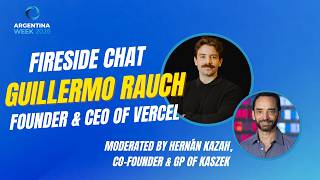
Argentina Week 2026 | Argentine Talent Powering Global AI | Guillermo Rauch & Hernán Kazah