Voice, Evals & Trust in AI | Fireside with Guillermo Rauch (Vercel) & Evalion | SF Tech Week

In this fireside conversation at SF Tech Week, Guillermo Rauch, CEO of Vercel, discusses how AI is reshaping human‑computer interaction. He explains the shift from traditional web pages to conversational and voice‑driven agents, the rise of "agentic commerce" and MCP (Multi‑Channel Protocol) integrations that let companies embed their own AI agents in platforms like ChatGPT, Slack, Zoom, and future AR/VR hardware. Rauch distinguishes foreground agents (user‑triggered) from background or passive agents that operate continuously, surfacing insights without explicit prompts. He emphasizes the importance of owning a direct relationship with customers and warns against over‑reliance on a single dominant bot. Reliability, testing, and evaluation (evals) are highlighted as critical for voice AI, with analogies to WhatsApp’s focus on connectivity in poor networks and the need to manage hallucinations, latency, and ethical behavior. The conversation also covers Vercel’s V0 coding assistant – its origins, how improvements in model quality, latency, and reliability drove adoption, and plans to add voice input. Rauch shares product‑building philosophy: simplify infrastructure, focus on first‑principles, anticipate trends (cloud, front‑end, AI), and continuously iterate via feature flags and rigorous testing. He predicts multimodal, agent‑centric UIs where AI not only answers queries but proactively solves problems, reducing the need for support tickets. Finally, he offers advice to builders: position yourself in growing waves, prioritize simplicity, performance, and reliability, and be ready to disrupt your own product.
Chapters
Hey Guillermo, great to see you. Thank you again for being here. I think as Marcelo said, we're very lucky to have you.
Thanks for inviting me.
Thank you. Absolutely. So to get started, I would love to start by talking about the interaction between human and technology. I think you've been a big promoter of kind of the way we interact with technology nowadays through the web. So I would love to pick your brain. That's what do you think is going to evolve in the future? Thanks to the advent of AI and so on.
It's really funny because on the way here, I was reviewing a post that's about to come out from our blog announcing the ChatGPT and Next.js integration. So the reason I think the question is really timely is that the most common question I get these days is, what does the future of the web look like? What happens to web pages? What happens to SEO? And how is AI going to change the fundamental fabric of software? And so it's very clear that as chat and voice agents proliferate, the world is going to have to adapt to that new way of interaction between humans and computers. My, the way that I, from the Vercel side, we've been trying to help companies make sense of it is you should always think about owning a direct relationship with your customer, meaning, you know, you'll still have your own apps, you'll still have your own websites, but it's very clear that there's many, many, many people and moments that are going to be directly interfacing a human and an agent. And that agent might be an agent that you might not fully control, right? So ChatGPT is a good example. It has 800 million active users, monthly active users, and they're opening it up as a platform so that you can show up there. So if you're in an e-commerce company, you have the opportunity to integrate through the Agentic Commerce protocol. If you are some kind of application that already has data and user interfaces, you'll be able to integrate through MCP. So there's a whole new set of protocols that are emerging so that we can connect agents together. On the other hand, I think it's really important that companies build their own agents. Otherwise, there's a massive risk that you'll be disintermediated by the one bot to rule them all, right? And so on the Vercel side, we've been, you know, helping people deploy MCPs, deploy these integrations to join in on the action where it's happening, but at the same time, you know, be able to create your own agents and your own interfaces. Something I think is particularly unique to this wave of AI is that so much of the interface is conversational. So as an entrepreneur, for example, I think you should be thinking about how can I join in on the conversation where it's happening? I'll be speaking at Dreamforce. Next week talking about the integration between Slack and the Vercel AI SDK. I believe that a lot of great startups and products can be bootstrapped off of, again, joining the conversation. So if you can deploy your agent to be in the room, in the channel, in Slack where the conversation is already happening, I think your odd of success is much higher. But what's becoming clear, I think, is that, you know, you're going to have to show up to all of these places. You can be integrated into Slack, you can be integrated into Zoom, you can be integrated into ChatGPT, and I think you'll have your own AI-native interfaces. And that probably means that if you already have a .com or if you already have a working product, you'll probably have to rethink what is my interface that makes sense in the context of AI. For Vercel, that was v0.
Exactly. Thank you, Guillermo Rauch. So I guess where it gets a bit challenging for people building, and we stay here in terms of interfaces, in a way it feels like, you know, there is Apple coming out with the headphones and Meta with the glasses and OpenAI with the necklace in the future. And it feels like a lot of the, as you mentioned, right, kind of the interaction might be a bit more conversational and they might own a bit of like, at least the last mile kind of with the end user, right? How do you envision basically users, as you say, how do you get into in front of the user if they're owning that piece, that last mile?
Yeah, this has been the perennial front-end problem, right? One of the reasons that we started out ourselves focusing on the front-end is I've always believed that everything starts with the customer interaction and where the customer is. I think the there's going to be new channels like AR and VR. There's going to be headsets. There's going to be a lot of like omnipresent AI. I'm getting like maybe like 3, 5 pitches a week of AI hardware companies that are building devices that are always listening. One of the things that I've been thinking a lot about is there is a bit of a migration of workloads from what I called foreground to background. Where it's not that the AI gets invoked by you specifically. The AI is always working behind the scenes. I was just talking to a startup here, uh, that's working on QA. And one of the ways that you can do QA for a product is, well, the customer comes to you and says, please kick off a QA run. Another way that you can do QA is to continuously be testing a product and then surface the insight to the website owner, for example. And I think in the first phase of AI, we've been thinking a lot about that direct front-end interaction where you go and put in some kind of specific input and then you expect a response that was like chapter 1 was assistants. Chapter 2 has been agents clearly, but they're still very much triggered by the end user. You boot up Claude Code, you boot up v0 and you type in something and you, and you tell the agent, go and cook. And what's happening is that that's where that migration is starting between foreground to background, because now the agent goes off and does a ton of work without your direct interaction. I think the next frontier will clearly be passive agents where there's a ton of triggers that are already happening in the world, whether it's, you know, some event that happens, you get a, you know, sales lead or someone comes to your website that you should be paying attention to. And so agents will be finding us to bring insights to, you know, catch our attention with something we should be, we should be, you know, working on, etc. And this is why I was emphasizing the importance of meeting the customer where they are, like, where can you notify them? Is it that, you know, they're already in some kind of conversational platform where you can notify them. If it's something like wearable glasses, you know, clearly the idea that you're constantly wearing this thing is an opportunity for you to like continuously get insight. And I foresee that being one of the big— if I were to guess, the next opportunity for an iPhone-like device is going to involve this passive mode of AI that enhances your intelligence in a significant way.
All right. And so basically it gets more proactive in the sense that it's always listening and it's helping us without us needing to trigger it. Correct. Correct. Amazing. Maybe just while we're still on this topic very quickly, and you mentioned briefly before, so what do you foresee the future in terms of the Azentic experience? Are we going to be interacting with that? Humongous uber agent that is provided by maybe the OpenAI, the Googles and so on, or you think you foresee more of a constellation, but just to your point, right? So we need to get right there in front of the user with as many, I guess, different agents as possible, each of them tuned to a specific user experience, right?
Yeah, I don't believe that there's going to be a singular interface for every application and every use case. I think there's a little bit of an AI mania that perhaps makes us think, like, you know, there's a new launch of a new AI product and the hive mind tends to respond with like, OMG, this is going to be my everything. And then the hype dies down a bit and nuance sets in, right? And so I believe that the classic chat conversational interface is going to continue to absorb use cases. I think the clear one has been really programming, right? Like the agent part of the IDE is becoming more important than the IDE itself. Meaning the conversation with the agent with diffs, uh, and then subsequently the agent producing a deployment or a code change or whatever is actually more interesting than the code editor part increasingly. And so that's a good example of displacement of a user interface that gives to the chat interface. And now that things like ChatGPT are extensible, I think we're going to see more of that where there might have been like latent opportunities to move something into chat that wasn't in chat before. And that's also true for startups, right? Where you can replace a lot of things that had a very, very complex UI with lots of buttons. You can replace it with a more conversational interface. But I also believe that for a lot of domains, chat is just not efficient enough. A really fun example is we recently redesigned our domain name searching and buying experience. We created the fastest domain name searching experience on the internet. And one of the things that that UI does is it optimizes for showing you a very large volume of information density. Like we show you lots and lots of domains and TLDs, et cetera, because we want to give you as much inspiration as possible., and we don't even want the customer to submit a message. We want to search as they type. And so I think there's gonna be still a need for specialized UIs that are even more real-time than chat. Like, why do I even need to submit a message if I can get information sooner? I think there's a huge amount of opportunity. One guidance that I've been giving my design team is I want you to stop thinking in the world of pixels and buttons. I wanted to think in the world of tokens, of models that can be perceiving input as it's being typed in. I wanted to experiment with models with different levels of performance and capability. Like there's models that are extremely fast, you know, thousands of tokens per second. I wanted to even extrapolate because if, if LLMs have been getting fast at this rate, Just think about when tokens throughput continues to increase, right? And what are the UI opportunities that that creates? Because right now we're kind of working under the assumption of like, well, thinking takes quite a while. Or LLMs, like for example, at Vercel, we have a massive capacity bottleneck in v0. So we're only in 2 regions where we can get enough GPUs to power v0. But imagine, you know, as GPUs and locations continue to proliferate, you know, what opportunities does that open up for you to rethink interfaces? I think this is one of the biggest open opportunities in the ecosystem.
Indeed. I think the future is going to look pretty different, probably. Yes. I think it's going to be highly multimodal, probably a lot of conversational, but that's part of what the reason we're here, a lot of conversational, a lot of voice, hopefully, which is one of the most common interfaces that we have as humans. Right.
I think just like you've seen a lot of things move back to chat where we created very complex interfaces in the past, right? I think you're going to see the same with voice where maybe the most natural thing would have been to just talk. I also think verbalizing your thoughts, right? Like if we move also in a world where like agents are passively processing voice, then there's a lot of insight that can be extracted. Obviously, the most obvious use case of AI for a lot of us has been the meeting transcript generators. I mean, it's a very basic functionality. It does seem that for every wave of AI, we first adopt the most primitive functionality. So there's still a tremendous amount of value being created in the world and just like high fidelity transcription, summarization of meetings, et cetera. And obviously I think in the future, you know, one of the, one of the most clear things that I've seen with AI is people don't enjoy doing the repetitive tasks, whether it's like, if you think about like the, the most obvious use cases of AI have been, um, uh, support clearly. You want to obviously have humans that are devoted to creative endeavors around support, but for the vast majority of tickets that are highly repetitive, people are thinking, how can I replace this with an agent? We're seeing that in engineering as well, right? Because one of the things that's made v0 successful is a lot of engineering is actually repetitive and tedious work. Bootstrapping a project from scratch is repetitive and tedious. So the idea of write down the things that are tedious about your work and extract them into an agent has been a really successful sort of ideation and startup creation strategy.
Absolutely. I think that's up to a large extent part of the reason why it makes, for instance, developers so much more efficient. It takes away a lot of the kind of low-hanging stuff as well.
Yeah.
And Guillermo, maybe just to get a little bit more into the core of the conversation in terms of voice and reliability, evals and trust. Just as we mentioned, right? So I think the future of voice is humongous in terms of kind of how we interact with technology. At the same time, it's difficult. It's difficult to get it right. As you mentioned, we have some initial use cases, maybe customer support, a lot of kind of low-hanging fruit, repetitive stuff. Now to to get the SaaS to work well is proving to be challenging, right? So working with Marcelo hard to help companies succeed in the space, but we're seeing it's difficult. And you can also look outside kind of the startup world in terms of companies like Apple, just trying to get Apple Intelligence into Siri, right? I've been trying for 1 year and a half. They have very intelligent engineers. This is difficult, right? I just love to get your thoughts in terms of Why is it so difficult? What are the new challenges that we get into as you get into voice AI?
Yeah, before I started Vercel, I worked on this space of real-time communication for many years. I built a framework called Socket.IO. And one of the things that I became obsessed with is the, like, how can we minimize latency in a bidirectional real-time communication channel? When I started that project, the web really struggled with real-time. There were only a handful of applications that had been able to at scale ship really high-quality chat applications. One of them was Gmail, which is actually kind of the inspiration for Socket.IO was Gmail one day decided, well, email is too slow and synchronous. What if we added chat on top of Gmail? And it was an And when I saw that working inside the web browser, it blew my mind. Now the problem is that for the vast majority of people, they couldn't create chat applications. The infrastructure was not there. The browser support was not there. The ability to maintain long-lived connections was not there. Dealing with proxies, for example, corporate proxies would shut down real-time connections. So I had to find a lot of clever hacks. And workarounds, et cetera. But what then enabled a huge slew of real-time applications is that I was able to package that into a really easy-to-use infrastructure product, into a really easy-to-use developer experience. And in fact, Socket.IO was the technology that helped Notion get started. Microsoft used it to create Office on the web. So when they launched their competitor to Google Docs, it was powered by Socket.IO. And so I've always been a believer that developer experience and easy to use and scalable infrastructure enables innovation. And my mental model has always been when I can find an example of the technology already working, like even n 1, it inspires me to want to democratize it to the world. Uh, and I think that's kind of where we are. I think if you look at all of the individual pieces, for for voice AI, they're all there. Just before this, we were chatting about, like, I was talking to a group and I was telling them, like, it's just fascinating even how easy it is to clone a voice and create high-fidelity speech. So you take that piece, definitely there. And then, you know, having a conversation that's engaging. Like, if you go on X and you see all the replies from bots, like, sadly, some are really good. And I see a lot of people talking to bots. So clearly the ability to produce engaging dialogue in isolation is also there. And then you look at everything that can be done with context engineering and you could totally create a highly useful and highly intelligent AI agent. Now the problem begins today if you say to a developer, all right, bring all of these pieces together. The global streaming connectivity, the intelligence, the flywheel for improvement, the evals, et cetera. And I feel like right now the zero-to-agent is still a work in progress. Clearly we're all working on this problem. You know, Vercel's AI Cloud, our whole, you know, mission is making the agent as easy to deploy as a Hello World page was on the quote unquote old internet that we're leaving behind. So yeah, infrastructure I think needs to continue to improve. Developer experience needs to continue to improve. And also I think, you know, there's a lot of successful use cases that perhaps people just don't know about. Sometimes there is an asymmetry between the art of the possible and what the average company knows about. You know, for a lot of people, this technology is still science fiction. And sometimes you have to bridge that gap of understanding what's the quality, what can the technology do, and to communicate it in a way that is easily digestible, doesn't feel like you're just consuming papers, machine learning papers, et cetera. So there's an element of go-to-market there that I think is also missing.
Understood. Understood. Thanks, Guillermo. And do you think in terms of more specific, just going deeper into reliability, once you have the pieces as you mentioned, so you have piece of infrastructure, infrastructure, they're coming together, the technology is coming together, latency is improving a lot, but still it feels like it's just checking the reliability and testing and monitoring the sentiment. It's different than back in the day. Back in the day, it felt a lot of it was, you know, up and running. How many 9s is your system running? Now it's just getting to, is your agent, of course, needs to reply. On top of that, it needs to not hallucinate, it needs to follow instructions, it needs to be compliant, it needs to not be needs to be ethical and so on, right? So it feels like there's a bit of a shift in terms of how do we need to actually make sure these entities work.
Yeah, reliability is a favorite topic of mine because I was very deep into this real-time communication world for many years. And then I saw basically the creation and takeoff of WhatsApp happen right in front of my eyes. And if you look at WhatsApp today, it's almost surprising in that it's so basic and fundamental. You go back and like, there's startup ideas that are like quite sophisticated and they have amazing creation stories, but WhatsApp is just chat over phone numbers acting as user IDs. But what they really nailed that I studied for a long time was reliability. Especially reliability in the worst possible networks. So I think we take WhatsApp's success for granted, obviously, because it's so massive, but it wasn't always so popular in the US, for example. We're from Argentina, and in Argentina it took off like wildfire. Why? Because they really sweated the details of reliability. We didn't have good internet, like good LTE or whatever, So they need, they, they used to write, I think some of them you can still find on the Internet Archive. You can find really amazing engineering blog posts of how they overcame a lot of reliability issues in like terrible networks, how they scaled. They were a prolific user of a fairly rare programming language and stack. And so I think we're still in the world of voice AI, we're still in the, there's going to be a killer app that is going to be surprising and that is just basically allowing you to overcome just basic issues. Just, it works. We're still in that phase, but then you saw it happen with WhatsApp. I think there were a lot of people that were naysayers, you know, about VoIP, voice over IP, like, no, no, no, like you're never going to be able to get to the level of reliability of like classic phone lines., and now like the entire world, like it's funny because businesses run on WhatsApp, like we're all talking on WhatsApp all the time, like WhatsApp groups, WhatsApp chat, et cetera. Um, so I think reliability is very important on the connectivity layer and the infrastructure layer. Obviously with AI, we talk about reliability also in terms of the, can you reliably produce true information? But I actually don't think that issue is as big now as it even was, you know, like a year ago. Like People used to be obsessed with the hallucination problem with AI. I don't hear about it so much anymore. And I've always, always— a good mental model to have is that every failure that you can point out is just in competition with a human-based system. One analogy that we always use for v0 is that it's like a self-driving car. Self-driving cars are in competition with cars being driven by humans, and cars being driven by humans have accidents. They stall, the driver, you know, falls asleep, whatever. And yeah, there's also edge cases for Waymo, but we just need those edge cases to be fewer. For v0, same thing, right? Like it does a lot of things that engineers do, but sometimes engineers know better. We're in competition in many ways with like engineers, right? And like at some point, like it gets better at certain functions, et cetera. And I would look at the same, I would look at this through the same lens. When they think about reliability and safety and other elements that you want to nail for voice AI.
That's a good point. Yeah. So humans are also not perfect, right? We fail a certain percentage of times. So it's a matter of getting it to that point, improve it.
A good example is retransmission, right? Like if a human does not hear you correctly or cannot decode your specific accent, the agent on the human agent there or something and say, can you say that again? Right. I think there's going to be a lot fewer. Can you say that again in the world of LLMs? I even find myself, it's really interesting. So I use Granola for like meeting notes and I use their real-time transcript functionality a lot. I actually kind of gave a bunch of feedback to their CEO that you would think that the real-time transcript is not useful to the person in the meeting, but sometimes I don't hear something correctly, so I actually go and look at the real-time transcript so that I don't interrupt the other party. And I feel like I'm getting more intelligent by using this tool. And so clearly humans are not flawless, and so we're always trying to figure out what's faster, what's better, what's more efficient on a holistic sense.
Got it. Got it. And Guillermo, do you think that, and you mentioned the flywheel before, right? Testing, monitoring, getting agents to work better. It does feel in a way like with the event of live coding and all the tooling that we have as engineers, kind of the building phase is becoming a bit faster and then we're spending more time on the kind of the flywheel of testing, monitoring, error analysis and iterating the agents, right? Are you perceiving it similarly?
Yeah, as I mentioned, we're clearly seeing a large platform shift from I used to build web pages to I'm building agents or I'm building AI interfaces. And one of the things that's been interesting about this platform shift is with classic software, the need for a very sound test hardness was more, you know, unclear, I'll say. Obviously, if you ask, you know, a super tenured software engineer and you say like, are tests optional? They'll say, no, no, tests are absolutely fundamental, blah, blah. But then you go and look at software out there in the wild and like, it's not as rigorously tested as you would imagine. Right. And I actually remember this. I was interviewing an engineer working for one of the world's largest databases. And one of his chief complaints was like, oh, I, I'm working on this great project, but I just don't love how much of this infrastructure is just not as pervasively tested as you would imagine. I feel like with AI engineering, the testing part is becoming a lot less optional. And tests can come in two primary flavors. One is obviously evals and getting to ground truth as fast as possible through the, you know, iteration cycle. But the other one is also being highly experimental in the deployment of the technology, meaning that, you know, if we have a hypothesis with v0 that we can make something better through introduction of a new model or something, it immediately becomes a hypothesis. With classic software engineering, it felt like, okay, like I'm going to make this data structure more efficient. I'm shaving off all this latency. I'm removing this exception that's being thrown, et cetera. And like, you're like, okay, like that's decisively better software. So let's ship it decisively better. With AI getting to that world, my new version of my prompt or my context engineering technique or my model, whatever is decisively better, a lot less clear. In fact, a lot of this even comes down to personal preference, right? Like we saw this with like GPT-4.0 and GPT-5. People do talk a lot about the vibes. And so the vibes have to be right. And so one of the things that we do help with on the Vercel side is we looked at this information today. Our heaviest user of our feature flags functionality is v0. So we have a capability that we're actually— so today we have as support for feature flags on Vercel. We're going to be rolling out much more comprehensive support. We've been dogfooding it a lot. Part of our product development philosophy is we build it internally. If it passes the trial of fire, we release it to the world. And so today we're doing a product review and we identified that the heaviest user of this technology is v0. And it's not a coincidence. It's anytime that you're changing something about an AI product is a hypothesis. It might fail. It might need to get reverted. Ideally, this is how all software sharing would work, but it practically doesn't require that level of rigor that I've seen AI does require.
Yeah. And as you say, it's really challenging because to some extent it's also a matter of space sometimes, right? So when, especially when it comes to conversational, uh, there is a certain level of rigorously things that are functioning, but from there on up to some extent, it's like, which one do you like better? I remember back in the day working with one of my colleagues here, building a conversation agent for the mental health space, right? So people, even within the company, we're also kind of dogfooding it. And the CEO would like one version better than the other, and maybe the CEO would like the other one, right? So it's difficult to tell what's best.
Yeah, it does seem that personalized models and personalized AI through better context, uh, is definitely one of the big opportunities out there. Anytime you're onboarded into any of these conversational apps, there's an element of choosing the voice that you like the most, but that can be discovered. I, I've always loved Elon's all input is error. You should not ask me anything. You should just figure it out and you should improve it over time.
I, uh, been a long time user of v0. Sorry. He likes me. I remember it was time where it would catch itself and oops, sometimes where I ask it to do something.
I got it.
And the Umweg, I'm solidly leaning to go Apollo version, that version and v0.
And I'm wondering like, with that bit sample.
Of the models getting better, the edls getting better, or, uh, like, what was the source?
All of the above. I think you would be surprised, right? Like, sometimes people think that everything is in the model layer. It's a very reductive, uh, conception of how AI works at scale, right? You have escalations all the time, right? Like, um, people have been even— there's research on, like, people have been finding tokens that have like neural glitches in AIs. I don't know if you've seen this, like you can, you can create a sequence of tokens that produces garbage always. So models are not flawless. And this is why you have to layer a bunch of other software on top of them to make them truly reliable. And one of the things that we do is that when we hear cases like that, we actually treat it a little bit like traditional product management. Like we bucket them into categories of problems that the software has. And there's a number of tools in our toolbox to address those. So anytime we get, you know, reports from users, obviously there is first an AI pass of trying to understand them, but there's also a lot of triage that we do in like, oh, like let's look at all of these escalations. And hopefully they're indicative of a systemic problem that we can address for large cohorts of users, right? With the agent, that's clearly the case. We're like, we've added a ton of heuristics and technologies and tools for making it better at looping, making it have caps so that it doesn't rabbit hole into problems, giving it better information, giving it better feedback. You know, there are a lot of people that genuinely believe that AGI is already here. It's just that we were mostly running these models statelessly, right? In fact, the agents that have been successful are the ones that are incorporating really good context into the problem and really good verification loops, meaning that the agent goes and does something, but then it reads from the world whether that thing is actually ended up panning out. And you don't get into basically dead ends where it says it works, but it actually didn't verify its own work.
It's like unsupervised verification.
That's right.
Cool. Thanks. While we're in the v0 topic and live coding, I guess a question, two sides of the question here. First, I guess I would love to hear a little bit of the backstory of v0. It's a product that I think many of us have used and love, and it's really at the forefront of what's happening nowadays with backcoding, right? With so many kind of democratizing the software. So I wonder on the one hand, if you saw this coming, you imagine one day kind of LLMs are going to be so much better and will enable people, normal people, non-developers basically to build software. And you prepare for that, or maybe your company was kind of was able to move fast enough to take advantage of this opportunity? One side of the question. The other side of the question, we haven't seen much bytecode in the kind of voice AI building space. Do you think it's coming? Do you think it's a—
Yeah. So on the Genesis story, it's very clear that a lot of the opportunities in building high-quality products involve taking a lot of disjointed pieces that exist in some way, shape, or form. So when you think about like what makes the iPhone so great is that they combined a bunch of innovations into one amazing form factor, right? They took the, um, multi-touch capacitive screen. Uh, they took, you know, the modems were getting better and more efficient. Um, batteries were getting better. So a lot of things had to click in order to deliver a great product experience. And so the interesting thing about v0 is that, you know, one of those key pieces was ChatGPT getting really, really, really good in, in obviously the underlying model at producing React code, at producing Tailwind code. So it felt like you could predict a trajectory of improvement around frontend development. That ended up becoming very true. It's like, obviously you place bets as an innovator, right? And we put a bet, right? This has gotten really good. There's probably a product here and it's going to continue to get better. And lo and behold, right before GPT-5 was released, OpenAI came to us to help them like certify whether the model was actually good at front-end development because front-end development became almost like a self-fulfilling prophecy of this model. It's like they're really good at this thing. So it becomes part of the competition. And now there's a bunch of models that are going after the space. That was also another hypothesis that we had is our customers will always want the best thing possible. Very much like when you buy an iPhone, I have lost track of, you know, what kind of bionic chip, whatever they're using. I just want the best possible product. I want the best possible screen. Are the best possible like video playback technology, et cetera. And so we saw an opportunity in sort of bringing all these pieces together and then making them cohesive with our ecosystem. So making agents highly specialized for a specific task or specific domain, I think has paid a lot of dividends. So making it really good at Next.js, making it deploy in Vercel, making it use our integrations and continuing to do the flywheel of improvement around reliability. I think the things that have given us the highest improvements on retention, adoption, vibes, et cetera, has always been some kind of quantum jump on reliability. I think tying it back to voice, I expect the same thing to happen, that whenever you improve latency, reliability, you're going to see similar things. I've been actually interesting. There is a very interesting tie-in between vibecoding and voice is that I've been listening or I've been watching like a lot of YouTube videos of people that are trying out our tools. I've been talking to a lot of users. Increasingly, people want voice to be the interface because it allows them to plan better. It allows them to give feedback better when they're in an ideative state. We've now actually launched the, or pre-launched the v0 mobile app, and we're making voice input a priority because when you're on the go and you want to start like prototyping your idea or writing down your notes of what will become the spec of your idea, we believe that voice will play a big role there. And another ambition that we have with v0 is that once again, it's not about producing stuff for the old internet. Cause otherwise I think this is a little bit of an irony that's happening with vibe coding today. We're using cutting edge technology to produce the old stuff, right? So a lot of vibe code, a lot of the outputs of vibe coding are like the apps of like 1995 or the websites, which is really cool because those things will continue to exist, right? Like we'll always need classic websites and interfaces and whatever. But our next frontier will be to evolve v0 to become a thing where you could create v0 inside of it, essentially, like super meta, but like you can create voice agents, you can create all kinds of agents by using AI as your software development mechanism.
Amazing. Thank you, Guillermo. And maybe we have a lot of builders, people thinking of building or about to start building. I guess just getting a bit into your experience, right? You've been very successful. You are an engineer. You started programming at a young age. Have had previous companies and Vercel is clearly a huge success. Do you have any advice for folks? And this could be about the space, the mindset, the first principles, what changed, what didn't change for people thinking of building or starting to build.
Yeah. If you look at the birth of Vercel, it was in the context of a lot of interesting waves and trends that were starting to pick up that it put the right bets on. One of them was the cloud, and I had a little bit of an irrational thought that it doesn't matter how powerful the cloud was, that it was too complicated and it could be massively simplified. And I said, I say realistic was a little bit of an irrational thought because obviously the cloud was the hottest space at the time and it's being created by the smartest people in the world. And I was coming in and saying like, you're all wrong. Like it's too hard, too complicated. Right. And so there was a little bit of naivete associated with like, well, I can do better. And it turned out to be true with a lot of different applications and like I had to tune my idea a lot to actually get to better. But then the trends, right? So just like I was mentioning that there's a shift now from foreground to background and from pages to agents, it was actually a very interesting shift at the time from backend to frontend. So backend technologies like Java and, you know, .NET and whatever were giving way to more exciting frontend technologies. Like people were starting to become really excited about React and creating really instantaneous experiences. I mentioned Gmail, right? Like the average company could not create something as snappy and dynamic and real-time as some of the best applications that were being put out by Meta and Google, et cetera. And so I basically capitalized on those waves and trends. And so this is an opportunity for you to place yourself in the right place at the right time. And I think that's very important for any builder, any entrepreneur, is that you have to position yourself in something that you predict will continue to grow. And obviously I think AI will continue to grow. I actually think voice AI is so interesting because right now is it— you called it out yourself and I appreciate the honesty, right? Like it's in that weird, like, glimpses of amazing, but still there's a lot of foundational work that we need to do. And that is actually good space to be because if everything's already easy and done, then where is the entrepreneurship opportunity? Right. And so you have to get into spaces that are a little rugged. Um, and that was certainly the case for me because yeah, the, the cloud was there, but like the average company, if you talk to them, was not really successful with it. Even the average developer that wanted to use it was kind of dissatisfied. So when there is kind of that air of dissatisfaction and like, ah, I think this could be better, I think there's an opportunity for innovation.
Love it. I love also implicit in your message, right? I think the simplicity piece, right? That you mentioned. So I think two things, simplicity when it comes to building things. And I think you have invested a lot also in terms of development tooling. Yeah. And the other side, performance. Yeah. I think always, obviously.
Yeah, it can, things can always be simpler. I think this is the agony of creation is that they can always be simpler. Your own simple solution, it can be simpler. The thing that we're proud of because it was pretty simple and had product market fit, guess what? It can be simpler. There's some guy in a garage planning your demise and he's going to make it 10 times simpler. I'm really impressed when products, companies, entrepreneurs delete stuff. Like the new version has less stuff. I'm very excited that the next version of Next.js would be deleting a bunch of questions when you create a Next.js app. We used to ask you a bunch of questions. We're going to ask you no questions now. We're asking only one question and the default is great. And so you always can catch yourself in these opportunities for And I always believe, I always tell people like, if you're not disrupting yourself, you're cooked. Someone's going to disrupt you. Someone there, we are in a, in an economy, in a competition for finding that alpha. Because I think we all agree, customers want simple. Customers want transparent, simple, efficient. I've always loved the Jeff Bezos thing, like, what can you predict about 10 years from now? Well, what I can predict is people are going to continue to demand simple, cost-efficient, fast. Fast is really important. Right now we are in a weird bit of a weird wave of AI. Like a lot of AI is slow. AI will continue to get fast because guess what? Customers like fast. And so if you stick to like those simple rules and then continue to work on the simplicity, then it's a bit of a magic formula.
Yeah. But back to your example about WhatsApp, right? I think WhatsApp, there were many large companies building. I was at Google at the time to make it work.
We just, it's wild.
It just was 50 people. They focused on the right thing, very simple product, and it just worked.
And they didn't. So I think what you get busy with helps you with that. Because I believe what they got busy with was reliability. They got busy with, you know, let's make sure that everyone can use this thing in all these countries and things are not perfect there and whatever. And so that probably displaced displaced a bunch of shit that they could have added to the product. Like there was someone there was like, but we could add stories. No, no, no, bro. Sit down. Like we're working on sending messages. Like we're pretty sure that that works.
Fill it up.
Uh, yeah. And that can happen to so many things. Yeah. I, this is what I bring to the company sometimes is like, I try to find those nuggets of like, what is, what's broken, slow, inadequate about the core thing and put it front and center so that it immediately displaces whatever excitement you had about the shiny object thing. And that's, you have to work on that like all the time.
First principles, huh? Yeah. Amazing. Let's, I would like to open the mic for a few questions. I think we still have a few minutes to Marcel, right? I'll repeat the question after you ask, so we'll make sure to have it in the video. Yes, go for it.
Nice mustache, by the way. Yeah, true.
Great, Guillermo Rauch. I would just love to pick your brain on your mental model of the current moment that we're hitting. We, you know, you back a year ago, there's so many in the game industry that, you know, are totally different right now.
We fast forward a year, using SyncDiffuser to what we're doing right now?
Still going to see, you know, a rate of improvement and acceleration of change?
I think the rate of improvement will continue in terms of the foundational AI capabilities. I think a lot of what we're going to be doing is going to transfer to the interfaces. So we're starting to see these innovations happening with like ChatGPT and the way to embed new experiences there. I think we still have not cracked the right interfaces for for every problem domain with AI. Interestingly, I was chatting with an entrepreneur today that's working on like better integration with between AI and spreadsheets, right? That's really interesting to me because you're not going to replace a spreadsheet with chat, but we're also not going to leave the spreadsheet as is because now we can bring all of this intelligence to it. So I think there will be— while the models continue to improve, I think people are starting to look for like All right, what are the right product experiences? A very good example with this is video, right? Because we've been able to generate video of all kinds for a while, but clearly there was magic in what Sora did around the combination of @mentioning someone and bringing them into a video. And I think people think that it's just the model, but it's not. It's model plus experience. And so I continue to think there's enormous amounts of alpha in builders doing either of these things. Obviously you can work on the model. I think there's a lot of, uh, you know, good stuff happening there. There's not as good stuff, in my opinion, happening on the application side in creating this delightful experiences, both consumer and enterprise products. That again, bring that intelligence, bring those tokens to more people and make it more engaging.
Thank you. One more?
Yeah.
No, you had a question, right? I was actually just going to ask about that, like UI, where do you see UIs moving forwards?
We went full chats and then we saw that chat is just like infinite possibilities and you know, the average person doesn't know how to prompt. So I actually was going to ask something like very similar, you know, where do you think this is going? Like you saw ChatGPT, like the latest app store that they have kind of hybrid UIs. Yeah. So is it going to evolve somewhere towards there?
Is voice just going to take over?
I think all of the above, clearly multimodal, right? Both on the input and the output. But also what I'm really bullish on is this idea of having the agent do do work for you. I had an interesting experience. I was in, in the UK a couple weeks ago and I met with a CIO that told me, look, there's been like 5 or 6 agent companies that have come to pitch me. We've not been able to use any of them. Uh, they were all pitching like better customer support stuff and whatever. And then he sort of had this epiphany of like, I don't want customer support. I don't want to have the tickets to begin with. I don't want to have the unhappy customers to begin with. Like, why are they calling me? And so can you, can you give me AI that addresses that? And so the journey switched into that, finding the root causes and sort of doing a ton of work, intelligence behind the scenes, and surfacing insights onto what is the top thing they should fix. Imagine an agent that you wake up and tells you like, if you fix this thing, your ticket volume goes down by 10% and I've decided is this thing specifically because I weighed everything. I weighed implementation costs, I weighed urgency, blah, blah, blah. And so the pain doesn't happen to begin with. This is kind of the philosophy that we're approaching the cloud with. A lot of the assumptions of the cloud are built on the fact that like we didn't have agents and therefore we created a lot of things. Even things like observability, like people pay a lot of money for observability, but you don't actually want a plot of errors or whatever. You just don't want to have errors. So imagine a cloud that solves your problems automatically, fixes your errors, sends you a pull request. And so I think it requires that different kind of thinking. It's not that you're just replacing the interface. You might just be replacing the whole problem. All together.
Wow, I'm feeling the vibes.
Thank you.
I think we can all learn from—
For me, Tech Week is every week because I live here.
Thank you. Just thank you very much, Giuseppe. Thank you, Guillermo Rauch.
More from Guillermo

Guillermo Rauch at Founders in Arms Live: Simplicity, Focus, and the Bet That Built Vercel
The Man Who Built a $9B Dev Platform Thinks You're Overcomplicating AI | Guillermo Rauch


Inside v0: How Guillermo Rauch Is Building 100 Million Engineers | Lenny's Podcast - EP.89
Architecting for model step-changes: A fireside with Vercel's Guillermo Rauch

Keynote Interview: Vercel's Guillermo Rauch on the Agent Era | Azure Cosmos DB Conf 2026

Vercel CEO: 70% of Our Traffic Is Now AI Agents "Nobody Was Prepared" | Anthropic, OpenClaw, OpenAI
Why being "terminally online" is more important than ever, with Vercel CEO Guillermo Rauch
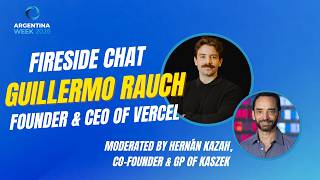
Argentina Week 2026 | Argentine Talent Powering Global AI | Guillermo Rauch & Hernán Kazah