Live Event May 12th Amazon Ads
Ken shares Amazon Ads rules for authors: run two main campaigns per book, target books with under 100,000 BSR and 100-500 reviews, launch for 30-60 days at $50-100/day, and aim for 30-40% ACOS on keyword campaigns. Optimize your book first—cover, reviews, and content matter more than ad spend.
Questions this video answers
Target products with BSR under 100,000 (start broad).
Prefer targets with ~100–500 reviews; avoid targets with >1,000 reviews unless you have 200+ reviews yourself.
Key winning keyword campaign: 30–40% ACOS; winning product campaign: 30–45% ACOS.
Every 1–3 days; usually keep near Amazon's recommended bid and sometimes go $0.05–$0.10 over it.
Usually by $0.05–$0.20; common small adjustments are $0.05–$0.10, larger in high season.
Chapters
So basically I can kind of overview what we're going to be doing here. So basically I'm just going to be going over. I feel like in this slideshow I'm going to focus on kind of what I do and how I optimize over time. I feel like the campaigns itself you guys have a good idea of or what you will have a good idea of when you go through that part of the program. So I'm really going to overview kind of the long term optimization.
I will say I try to keep this as simple as possible because that's kind of my goal with teaching animals and ads is people tend to overcomplicate it. But really the best thing to do is have simple campaigns with books that rank high and sell good organically. Because if you have 10 plus campaigns per book, you have five books, no one wants to, you know, organize and optimize 50 plus campaigns. It's just a complete pain. So I tried to simplify this as much as possible and then we can have some good discourse on it. So let me share my screen here and we can dive in. So there are a few people who did ask some questions on the post. So I will be going over those questions first. And of course if you do have a question throat, I will stop periodically. You can throw it in the chat or as well as you can use the little hand up emoji. If you go to the bottom of the screen you can go to the. Can't remember where it is actually maybe it's under wherever you put reactions. That's right, the reactions. You can put like a hand up and I can see it or you can shout it out. But I will stop periodically to.
Allow for questions.
All right, let's clear the water off my laptop and get started. Okay, so the first few questions we're going to get into is what BSR should product targets be? So this is a good question. When I'm targeting, you know, different products, anything really under a hundred thousand, I don't really go, you know, toward dead books. You can, but they're not going to warrant much results. So anything under a hundred thousand works well. And then of course you're going to find it's going to be the books that have the best, lowest BSRs that perform the best for your campaigns because there's the most traffic.
Like I said, what's this is going to result in probably your best 5 to 10 product targets for your main campaigns to go in the exact ones. And this most likely will be at the best performing books in the topic, start with a hundred thousand with your product targets, anything below that, because we want to go broad. And then you can narrow it down to what's performing the best, but most likely it will be the. The main ones. Something else to note is I also avoid books that have over a thousand reviews. The reason being is because unless you have 200 reviews plus, you're going to be spending a lot and they're going to be unprofitable. I tried this a lot and I just found that if books are, you know, the authority figures with thousands of reviews, unless you have multiple hundred reviews, they're not going to be converting super well. So I just would rather get rid of them. Allocate the budget to the best sellers that are around between 100 to 500 reviews. That's kind of the sweet spot for product targets. And of course, like I said, just go broad, anything under a hundred thousand, and then you'll see what performs the best after you kind of launch your book. All right, moving on to the next one here. So another question was, have you tried video ads and brand ads? So I personally haven't tried video ads. I've been meaning to do it, but I have just haven't done it. That's the thing. I will say I'm very curious about them. However, you know, in terms of video ads and brand ads, brand ads specifically, I have used them. They tend to have a very high a cost. They kind of, it's more, I guess, up for awareness than conversion because you're kind of marketing your main brand. So for anyone who doesn't know what brand ads are, is when you have advertising on Amazon, you can actually get a brand ad which comes up at the main kind of top of the screen that shows like all of your books. And so I find that brand ads, they will be okay, but for me it's more about awareness. So if you have other campaigns running, your books are doing well, maybe run some brand ads and expect the acos to be a bit higher just to kind of do well with that. However, I do think that brand ads will work better when you have an actual brand of, you know, multiple books that have 150 reviews plus and they're all doing well on their own. And then the brand ads are just kind of, you know, taking the bulk of the traffic and sending it to those books and. But if you just kind of, you know, have somewhat of a brand or the reviews aren't super high, I probably would stay away from them. In terms of video ads, I haven't tested them yet. I would like to, and I definitely will get back to you guys once I do that and probably add that as a section into the program in terms of how often I add or remove product targets. So basically when I have a campaign targeting other books, how often do I take away books? Most likely I'm going to be checking them every couple weeks with my, with my longer term campaigns, my exact campaigns. And then I will also kind of keep up to date with my main keyword because as people publish new books, they're going to be launching new books, they're going to be getting them to a hundred reviews and with that launch they're going to be driving a lot of traffic. So normally I will kind of leave them every couple of weeks I will add or remove them. However, if they are my exact campaigns, they most likely will be the best performance and I won't have to take any out.
But.
But I will also add new ones in as kind of new books come out into the topic. Because the new books that kind of are being launched is a great way to capitalize some traffic as well. Because of that, people are driving an insane amount of traffic to it. And you'll actually find that there are some books and popular topics that only have like 50 reviews, but they have like a 5000bsr because it's probably a big publisher who has the budget to drive traffic to it. And so if you have 100 reviews, you know, advertising to these newer books being launched can work very well. So I'd say every couple of weeks I kind of, you know, check my keyword and just stay up to date and then add anything in. Yeah, like I said before, it's most likely going to stay the same in terms of what you're targeting. The main books will be the ones with 150 to 400 reviews that are selling well. And then I'm not necessarily going to remove many because these books will stay established and stay performing. Okay. But I will add some as the books kind of get out. So in terms of seasonal books, what do you do with your seasonal book ads? I would say just to turn them down. Because when books are very seasonal, you know, in. To look at it this way is all the other books are going to be seasonal as well. And so they're all going to die down. So most likely they're also going to be turning their ads down. So I would say just to turn your seasonal ads down, maybe maintain them at like $5 a day to keep something going to your book. But Once the kind of season comes around again, let's say it's Christmas, then you can just do the whole relaunch protocol, drive some reviews, discount your book, kind of reintroduce traffic, and getting back to that ranking will be relatively achievable because everything else has kind of died throughout the year. So I wouldn't just keep them up if they're really not performing, they're really just not bringing in any money. There's no point in keeping them going. So just turn them right down. And then relaunching your book is quite manageable if everything is kind of down for a little bit of a season.
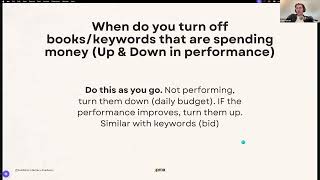
So, going on to the next question here, then we'll get into some other stuff. So when do I turn off books or keywords that are spending money? So basically, if there are campaigns that are doing poorly, what do I do with that? So kind of what I do is I just look at things as I go. So if for some reason I have a campaign that's not performing, I'm just going to turn the daily budget down and that might start performing a bit better and I turn it back up and so don't really, you know, have a reason I do this. It just, to me, it makes sense. When I have a campaign that just isn't doing well, I'm going to, sorry, add somebody from the waiting room here.
If it's not doing well, I'm just going to turn it down. And then I almost think that Amazon sees that you turned it down and so it tries to optimize it a bit more in terms of your spend. And then the ACOS gets a bit better. So I raise it back up. So in terms of the campaign budgets, that's what I do. If it's not performing, I'll just turn the budget down. If it is, I'll turn it up by, let's say, five or ten dollars a day. And then in terms of the keywords I do, I basically will stay up to date with the recommended bid. So as you can see, you know, your campaigns will change over time in terms of the bids, especially in high season. And so I try to just stay, you know, with that recommended bid, you know, in the campaigns itself. Of course, if you are new to a lot of this stuff, when you go through that part of the program and you see inside the campaigns, this will make more sense. But that's kind of what I do. And then we'll get more into optimizing in a second here. But it's really just kind of an up and down game is as things change, I either lower things or raise things in accordance to how much it's changing. So it's nothing super complex, but I will just adjust slightly like that. So in terms of adjusting bids, so how I do it optimally, which is part of the biggest thing that people wonder when your campaigns are live, like, what are you doing to your bids? Basically in high season, going to be very active. Every one to three days, I'm probably going to be checking inside my campaigns on all my keywords. And of course, like I said, based on how the recommended bid changes, I'm going to kind of adjust it there. Sometimes I will also go anywhere from 5 to 10 cents over the adjusted bid. Another rule of thumb, kind of more in depth strategy here is you can always look at the cost per click as well. You can see the cost per click per keywords and, and sometimes that's actually less than the recommended bid. So you can also go with that as well. But to keep it safe to stay near that recommended bid, it should be fine. And the thing about this too is I wouldn't stress about it too much. That's kind of, you know, a big thing with animals and ads is they're never going to feel like this perfect optimized machine. They're always going to feel like something's off. Yeah, Mario, go ahead.
Hey, Ken, thanks. I guess one question I had, and I know in the module for ads you kind of say like, try to stay like 99 cents or a dollar, you know, not necessarily go over that, but like my keyword, like that doesn't get any, any real impression. So I guess is that modify for certain keywords or, you know, because like the recommended is going to be much higher than $0.99 on, you know, several of the words, especially exact phrasing.
Yeah, I definitely would raise it. Actually, I might update that a bit because I think when I did kind of create that slideshow, it was a bit less, but kind of ink prices have been increasing. So I would say the $50 mark is the new kind of dollar. It's the safe spot because you're spending much more than that. They're not going to be profitable at all, really. It's gonna be very difficult. And so $1.50 is kind of, you know, the sweet spot now. So that's perfectly fine. All right. So yeah, that's basically what I do. For high season. I'm fairly active. I'm adjusting the bids up and down based on how the kind of acos is so let's say your acos is at 40%. It jumps to 50%. I'll probably lower my bid by 10 cents. If it's at 40% and goes down to like 25 for some weird reason, I might even raise my bid $0.05 because I'm leaving some on the table there. If it's too less, most likely it will hover around the same thing. And you can adjust it slightly when that recommended bid. But that's kind of, kind of how I do that. Yeah, go ahead, Matt.
Thanks.
Yeah, I thought, yeah, like Maro raised, raised an interesting point that's kind of, it's troubling me is that like, I, I make about a $5 royalty on my books, right. So basically for me, the problem I have with the keywords I'm in is that if I don't convert right on the first click, you know that my royalty is like, gone. Right. And then so what I was finding my sales were more like five clicks or ten clicks, you know, like somewhere in there. So then, you know, I was always losing money.
Right.
So this is where I'm like, I just switched off my ads this month as, as I mentioned to Mike because I figure, well, it's not helping, right? So how do I find that?
Yeah, go ahead.
Yeah, this, this is really where demand comes in. When, when a topic has very high demand, it's way easier. It's just like everything feels different. So it's really hard to explain. But when the topic is high demand, your ads will just get clicks. And as you optimize your book, you'll see the clicks converting more and more and more and very quickly when you have high ranking at the demand's very high, you'll start to see that, okay, my royalties are way higher than my ad spend. And so I find the big thing here is prioritizing that high demand topic. And even if it's a bit competitive, that's okay. I would rather have a bit more competition, but a lot more demand. Then less competition and less demand because then you're relying more on your Amazon ads. And so when you can realistically rank high somewhere and the sales just flood in, for example, like a fitness book in January.
The ad spend is almost irrelevant. You're just trying to spend as much as you possibly can because. Cause it keeps your book ranking and when your book is good, it still converts. But the organic sales is where a lot of the, the profits come in. So I find that when, yeah, that's kind of the big thing with Amazon ads is when you're always trying to optimize the Amazon ads to make sales, it's gonna be very hard to be profitable because that five click per sale is pretty standard. Even when I started, people were telling you that every 10 clicks per sale was like good, a good conversion rate, which nowadays is like, is, is ridiculous. You know, like you have to basically make a sale every three sales to be very profitable. But yeah, I find that the higher demand topics is where this problem almost like fizzles away. Okay, let's keep going here. Let's see. We are. So yeah, in terms of my normal sort of strategy, I'll just kind of leave them. Like I said, I really just want to keep my ads simple. I don't want to spend all my life optimizing them. If it's just a normal slow season, I will check them once a week, the bids and stuff like that. But I really just leave them because honestly, like I said, and they're never going to be perfect. Can always optimize them further. And so if you get too deep into the optimizing, it can be kind of a headache. And so if it's not high season and it's just everything's fairly steady, I'll just leave it how it is. They'll adjust the daily budget, maybe I'll add in some more keywords, but I really will just, just keep it as simple as possible.
And so another kind of thing that people do as well and that you can do is if you do want to kind of optimize for high season is just have like, let's say you're going to sit down to work every, the first five minutes of every little work session, first 10 minutes, just go through your ads, you know, have a cup of coffee, work through your ads, look through your, your bids and have it as more of a ritual. This is kind of what I used to do as well. Like first thing in the morning, that's the first thing I would do, is just sit on my ads for 10 minutes, kind of warm up for the day and just kind of have a look at things and adjust things. This is more manageable than always having it in the back of your head. Just set a time frame every day that you kind of look at them and then just after that you just leave them. You don't even think about them.
So we just answered some questions, but does anybody have any more questions based on that before we keep going?
We're pretty good. So let's dive into. So in terms of, you know, how I adjust Bids optimally, like I already talked about briefly is if the ACOS is high, I'm probably going to lower my bid by 10 cents. If the ACOS is low. So let's say it's 20%, 20 or whatever, I'm going to raise it by maybe 5 cents or 10 cents to get more out of it. But this is what I always do just to keep it simple. If I'm raising and lowering my bids, it's always probably by 20 cents unless it's high season. And like the, the recommended bid jumps up, then I might jump it up a bit more, but it's always that 5 or 10 cents. But I do find that this really isn't, it's not like it going to change drastically. The important thing is your, your recommended bid doesn't change by 30 or 40 cents and now you're not getting any impressions because yours was really low because the season changed. But yeah, if you want to do some little optimizing over time, this kind of helps with that.
And so yeah, like I said before is your ads will always. So it's almost good to get into your mind that they're always not going to feel right. There's always going to be something off. I still feel like that today. But the important thing is, you know, you're kind of continuing to optimize them. And the biggest thing too is you're always going to feel like you should spend more, they should be more profitable, more optimized. But yeah, it's really good to just kind of keep this in your head that they will never feel complete. That's just the Amazon ads game. So moving on from that is my goal per book is if you can hit this, you're going to be in a good, comfortable spot that is sustainable to kind of scale is I just want a key winning keyword campaign that has a 30 to 40% ACOS. I want a winning product campaign that has a 30 to 45% ACOS. And then from there I can scale that daily budget. And so these are going to be the main winning products and keywords. The ACOS is fine because I have organic sales. In the best case scenario, it's still going to be profitable. And then from here, depending on the seasons, I can raise the daily budget and go from there. But this to me is what people should strive for. Because yes, you can optimize further. You can have more campaigns, but if you have 5, 10, 20 books, 2 campaigns per book with 10 books is a lot of campaigns, it really starts to add up. And so if you can kind of strive for this in high demand topics, that to me is the best case scenario because I've tried all the ad strategies. I've tried the ones where you have campaigns that have thousands of keywords in them. You have like 10 of these campaigns. I've done it all. What has worked the best for me is hitting these two marks, hitting two main campaigns that have a 30 to 45% ACOs. The rest of the sales come organically. And to me it's just been the most sustainable. Yes, you're leaving money on the table, but you're also saving a lot of time and kind of mental capacity.
So any questions based on kind of that end goal that we kind of strive to get to?
If not, I'll just keep going. Yeah, Mario, go ahead.
Hey, Ken. So I mean if you kind of go back to maybe that slide, right? What the percentages, right. So I know like other, you know, other times too. Like let's say you have a very successful keyword, right. Or very successful product that gets a lot of clicks. People have said to like kind of isolate those into their own campaign so you can ramp it up and scale and like, what's your thoughts on that?
Yeah, like, I definitely do that too. I guess when I talk about these winning campaigns is this is this will most likely be similar to that. I would say a campaign that looks like this is not going to have more than five things in it. Really. That's my experience over, you know, tons of ads. And so I'm definitely open to that. But I will say that these, having these two main winning campaigns like this is you're probably going to continue to narrow them down. And so even though you make a winning campaign, a bit more time goes by, you're probably going to end up removing more and it will end up being very, very simple campaigns because realistically, you know, the main places that sell are just your main topics, your main keywords. And so you end up be open to that.
But I find that this normally will end up being something similar. And so it's not going to be like there's 40 keywords in these.
Right.
So I will say that, yeah, definitely do that. If you have campaigns that are larger with more keywords and more, you know, products, but these will end up being simple. That answers your question.
Then. Then a quick follow up, right. Do you still run an auto campaign on top of it to kind of like get some maybe additional keywords or products or.
Yes. I will briefly mention this later in the slideshow but I kind of as like a bonus strategy. Yes. I do automatic campaigns and what some people do is you can actually run like multiple auto campaigns. So if you book if let's say you have 200 plus reviews you can set up like two or three extra auto campaigns because sometimes they actually do perform well. When you're in a high demand topic and you have the reviews to kind of back your book then yes, definitely have a few extra of those.
Okay. Yeah. Because I sometimes I see like those auto campaigns like will have a much lower click through rate because of the amount of keywords and the volume they're going against. But then you do produce some that do end up converting over to like hey, that's actually a really good keyword. I should isolate it for example.
No, for sure.
Okay, cool.
Awesome. Krista, go ahead.
Hi Ken, how far back are you looking at the keywords to look at your a cost like one week, one month, all time.
I always do per month. Every month it rolls over because things are changing. So yeah, it's just keep it your ads at like you know each month and that's the best way to go.
Okay. So are you thinking about 30 days? Are you talking about like the first to the seventh? You know may say it's May 7th. Are you doing the first to the seventh? Are you doing 30 days?
I will do like the month itself. So the month of June, I'll be active with the month of June looking at the new month rolls over. I'll do the new month and then I'm always kind of like seeing each month and it kind of is easier to track in my head. Okay, but you can also do the previous 30 days too. That's okay. But I think I find the month makes you, it's easier to kind of see as a whole.
Yeah. Okay. And then as far as words that are not converting or you're spending money, you're not getting any sales. Are you turning those off? Are you just lowering them more or what are you doing there?
Yeah. So if the launch campaigns I definitely kind of let them go. But if these are like your main campaigns. Yeah. If they're really not converting like I'm going to turn them off. And that's why I kind of mentioned here that your campaigns will end up being very simple because you know I've had big campaigns and it always ends up just being where I just want to target these two keywords that are performing the best that are at a 35% ACOS and I can just scale it from there. And so yes, there might be a couple scragglers that can pull more, but I'd rather just keep it simple. So yeah, if they're really just not doing well, you can give it time. But if it's been a few weeks, a few months, and this the 1 keywords just aren't performing even if they were winning at one point, you can just turn them off and focus on what's working.
Okay. All right. Thank you.
Yeah, of course. Okay, let's move on to the next few sections here. I'm just going to remember what the slideshow is. I always forget what I put. Yeah, don't forget. I think the most important thing out of all this is like I said before, your book determines your ad performance. So optimize the best you can. Focus on getting to kind of this point, but then make sure you're continuing to gather reviews. As your Reviews increase to 200 plus in high demand keywords, you will see the ads kind of start to perform better. Of course, optimize your cover. So if click through rate isn't performing, definitely update your cover up to your A content to match. This is super important as well. This can drastically change the performance of your ads. I always say to relaunch every 90 days because relaunching every 90 days, which is kind of there is a post in the program, if you haven't got there yet, will just allow your book to rank better. When your book ranks better, it gets more organic sales and everything just performs better. And so keeping your book relevant is just always the best way to profit. Because if your book drops in the rankings and you just keep your ads running now those organic sales start to trickle off. And so it is important to keep that high ranking and of course just create more books. And so it is nice to have one book that makes two, three, four grand a month, which definitely can happen. But I think we forget that even if you can make two to five hundred bucks a month or even less from one book, just make ten of those and you have a decent income. So it all compounds and so any amount is fine. But the important thing is you continue to optimize and then continue to make more books. And because we have our simpler campaigns, when you have five or ten books, it's way easier to manage than if you're trying to do this whole dance with each individual book. It just is a mess. And so like I said, we have these two main campaigns, which is our end goal. I will go into some other things we can do as well, which is what I do. We of course scale these up and then just slowly adjust the bids and the daily budget as we go. But like I said, it's never going to be perfect. Just kind of do what you feel is right. If things are not performing lower things, things are performing well, raise things. That's really how my brain works with Amazon ads. I just keep it simple. It's not super analytical. So let's go into kind of what I do during a launch, what I do after launch, and just a bit more extra strategies that we can kind of dive into here. So basically, to overview what I do, this isn't the program, of course, but I think it is important to go over. So I'm going to have my launch campaigns. I'm going to have my broad keyword, my broad product. I'm going to have the extra campaigns, like I talk about, where I'm going to have an exact keyword and an exact product. So basically, I'm going to have my broad campaigns. I'm also going to have my targeted campaigns to my main search terms. Because let's say if my book is Wallplies for Women, I know that Wallplies for Women is going to be the main search term. And so I want that to be in its own campaign and allow, allow a lot of the budget to be allocated to that. So I will always have the exact campaigns during my launch.
I'm just gonna have all these other recommended bid, like I said, maybe 5 or 10 cents more, but that's probably fine. Things change so much that changing Your bid by 5 or 10 cents can help, but it's hard to really track. So just keep it simple, don't overcomplicate it and just kind of do what feels right in terms of that. I'm going to let these run basically until I rank on page one. And so it's going to be anywhere from 30 to 60 days, roughly. I might even leave them a bit longer. So after I raise the price, I might leave them continually just to eyeball sales to make sure I am ranking.
Because.
Because when you do rank high on page one, let's say if you only sell there for a day and then you change your price, you change your ads and then your sales drop, you're just gonna drop right down. And so if you can rank high on page one and then keep your book discounted and keep it there for an extra few weeks, it's just gonna stick it to the top. And so the reason why sometimes you see books that are just stuck at that first spot, even if they're not very good, is because at one point they were probably there selling for a long period of time. And so they've told Amazon that they've earned, earn that spot. And so now Amazon keeps them there. So even if you make a better book, you have more reviews, it's going to take a lot to kind of, you know, bump that book out from the top. And so it's important to kind of let your book sink in and stick to the top just by continuing to drive sales. So when you are launching your book, don't switch over to your, you know, longer term campaigns too quickly. Don't raise your price too quickly. Really just let it kind of flow into it and this will change per book. I know I say 30 days is a launch month. Sometimes you have to spend 60 launching your book and that's perfectly fine. Yeah, go ahead, Mario.
Yeah, I guess that that's kind of where I am right now. What the current book is. Like how long do I leave it to get to? You know, like how high do you aim for on page one? You want like probably like the top two rows. Right. And then just leave it for a while. I'm just trying to juggle like, you know, like expectations, I guess.
Yeah, I would say if I can see my book in the top row, I'm going to start to think about raising the price. So what you can do is raise the price, keep the broad launch campaigns running. That's going to allow you to somewhat big profit, but still keep the launch up because you're still getting those sales and then gradually transition to the winning campaigns. How old is your actual paperback book that you're launching?
It is. Okay, so the.
So I had that one problem. So the.
It'S 23 days on the ebook and I think the paperback was a week later. So probably like probably just over two weeks. Ken.
Yeah, so that's like really early. Like now is the time where you start to see your book starting to rank on the page one. And I have been keeping tabs in your book and I actually see that is what's happening. It's kind of creeping its way to the top. Um, but yeah, I would say leave everything how it is. Leave discounted, leave the launch campaigns till about the 30 day mark and then evaluate and that should be more than enough time. If you went from where you are to where you are now in two weeks, another two weeks should be a drastic change. And then I would recommend raising your price. Like I said, I like to raise my Price like right away from 9.99, let's say to 15.99 and then there's a very good chance you'll get a price slash. So if your book is brand new, launching and you immediately raise it, it might go back to 999. And so it almost elongates your launch because your book is still discounted, but you get the royalties for the full price. And I had had a book one time stay like that for like a month and it just, it definitely helps a lot because your, your book is still launching, it's super cheap, but you're getting the full royalties and then you can keep your, your main campaigns running. So let it run for a couple more weeks and then maybe raise the price, but then keep your launch campaigns going for an extra week or two and then see how it goes from there.
Thanks.
But of course, after you finish launching and your book is, you know, full price, it's still launching, it's still continuing to get sales and if the book keeps up and you keep getting reviews, it will continue to rank better and better and stay there. So it's not like you have to get ranking and stick your book there during the launch. It will continue to do that because realistically, if we're creating books properly, they will continue to sell. So basically what I do after launch, so that's kind of, you know, what I do is I let this run for as long as I can. Basically from there I'm going to narrow down to my main campaigns. Like, you know, I'm going to have my exact keyword, my exact product. I will also leave a broad running if performing well. So sometimes your broad campaigns that are, you're launching with do perform well. They have a decent acos. And so I'm just going to go in there and remove anything that's not doing well, remove anything with the high ACOs, but keep it running. If it's not broken, there's no, you know, there's no reason you should try to fix it. So sometimes it is nice to keep things running if there are working. I know that some people have issues where their campaigns are doing well and then they will put their winning keywords in a new campaign and those keywords won't perform the same. I don't know why this is the case, but sometimes the campaigns can have a bit of momentum. So if they are working well, you can always just keep them running and just really refine them down and optimize them.
And so of course, going back, this is kind of a Good end goal to strive for as you have two main campaigns per book. Excuse me. With that 30 to 45% ACOs, which you can scale up as much as you want, but this will come by optimizing your book as well. Ideally, 150 reviews + is where your book kind of starts to settle down and be very, very consistent. But this is also, of course, if your keyword has demand.
So any questions based on kind of that strategy that I do before you move on?
Yeah, Chrissy, you can go ahead.
Just thinking about organizational things because I have so many campaigns that I've tried and haven't worked. But do you do your exact keywords in a separate category or do you do exact keywords for all your books in one campaign?
No, I'll have them all. All separate. All their own.
All separate. Okay, so you'd have a separate exact keyword. Separate exact product for each book. Okay.
Yeah, each thing I'm doing is like its own campaign for me. It's just the easiest to manage. Then you can name them accordingly.
Perfect.
Thank you.
Hey, Ken.
Yeah, go ahead.
So the nut. So I remember from the modules you said like, you know, different markets and stuff too. So you're setting up these campaigns across multiple markets, right?
Good question. I. You can. However, I found that the other markets, like the Canadian market in the UK Specifically, will be very simple. And so you can. But I wouldn't really do the broad and then narrow down. I would just have your. An automatic campaign and then your, like, main two keywords. I found that once you go wider with, you know, other than the US they really don't perform very well or they just don't get any attention at all. And so to keep it simple, I just have an automatic campaign running, let's say in Canada.
And.
And then I will also maybe have a couple winning campaigns with like my main two. And so treat the other countries as if you already have all the data and then just go to your main ones, you know, not any even anything too wide away from those main ones and then just keep it like that and always check them. Sometimes I'll forget to check them and they'll have spent like a ton of money and I didn't realize. So just to make sure you do check your other countries as well, because that does happen. You forget they're there and they're an extra like $500 a month on your ad bill that you didn't account for. Will bring in sales. But something to note.
Okay, thanks.
All right, so let's go dive into a bit what I do to optimize over time. So once those campaigns are launched, they're narrowed down. This will be kind of, you know, like a broken record. But I think it's important to go over my exact process. I launch the campaigns and narrow them down, then from there to optimize them. I'm at one either going to do nothing. If it's a normal time of year, I. I'm just going to check out of my ads for a few weeks. If your book is established, you have 200 reviews, 150 reviews, you're in a consistent topic, they will really maintain themselves relatively. Okay, yes, you can always, you know, optimize them further. But sometimes it's good to just step away when I'm active, like I said, I'm always going to keep them near the recommended bid. This is honestly the most important thing with campaigns. If there's anything to optimize, it's just check that recommended bid because it will change. If it changes by 10 or 15 cents, that's okay. But if it does jump a lot, it does make a difference. I'm also going to raise the lower raise and lower the daily budget, like I said. So if a campaign for me is performing well, I'm going to raise the budget. If I see the acos drop, I'm going to lower the budget. So that's what I mean by performing well is I really only look at the ACOs. That's the main number I look at and I watch that fluctuation. And so I'm not worried about that number being super low, down to 20%, but I'm just going to watch and make sure that it's consistent. And so if it's consistently at 40%, but for some reason it goes up to 55 after a week or so for a little bit, I'm going to lower that daily budget down. And then Amazon is going to reset itself and it starts to optimize, starts to lower, and I can raise it back up. And that's kind of the game I play more, more or less to conserve budget. Because if something is starting to get unprofitable, I don't want to crank the daily budget up, I want to lower it down. And maybe I have another campaign that's doing good, that better and then I'll raise that. And so I will have those two main campaigns. But like I said, I also sometimes will have like a broad campaign running as well. So I can have anywhere from three to four campaigns for a book, maybe the main book that's doing well. And then if some campaigns aren't doing the best, I'll lower them and then raise the daily budget other places. So what you can do as well as have like a budget in your head. So each of your campaigns, let's say, is $10 a day or $20 a day. So you can have, you know, $40 a day per spend. That's a good way to look at it, is what can you spend every day and then allocate that throughout your campaigns. And so if you have to raise a campaign by $5, then lower another campaign by $5 and then it keeps you at that same daily budget. So you know, you're not going to overspend. You're only spending what you realistically budgeted for. And then there always will be campaigns that perform worse than others and just lower those and add the money somewhere else. And so that's kind of a good way to keep organized and optimized is if you have a daily budget in mind, you can have that over your two or three campaigns and then allocate them. Specifically, if you're changing things. If you lower $5 here, add $5 somewhere else to focus on the campaigns that are working. And this is a good way to stay as profitable as you can because you're not just like, you know, raising everything and hoping they work. You're kind of putting the money where it's showing that there's potential, if that makes sense.
And then of course, the final thing I'm doing is every couple weeks I'm going to look at my keyboard and kind of check and see if there's any new products that are being added and launched. And I'm going to add those in because like I said, there will lot lots of times in high demand topics, there's going to be new books that get published. These new publishers are cranking ads to them, they're cranking, you know, sales to them. They're driving reviews. However, they're only going to be at maybe 50 to 100 reviews. And so if you have more, it's a ton of traffic going to these books. So it is good to add in these new books that are coming. But this doesn't happen super often. So every couple of weeks I usually check.
And this does make more sense as well when you're in a specific topic. That's why I like to focus on very specific topics. Wall applies for women over 50 it's very clear when there's a new Wall applies For women over 50 book being launched Instead of being in a broader topic that you're unsure if you should add books or not. So it's really important to have that specific topic not just for performance, but everything makes so much more sense in terms of optimizing everything and just kind of having something that actually makes sense in your head to optimize.
So of course, if anyone has doesn't know what the suggested bid looks like, if you go into your campaigns, you can actually see the targeting spot and it's going to have the suggested bit here. So you'll have your bid here and it will kind of show you that this changes. So this is an example where this suggested it actually went down. And so I was at 125, I think it was actually a bit more, and then I noticed that it actually dropped down quite lower. So now my bids are way higher and that acos was a bit high. And this is probably why, because the suggested bid changed and I could be a bit more profitable. So I lowered it down, but I did keep it about 10 cents above just so I can be a bit more competitive. That's why it's good to check. Because if your ACOs get, you know, raises for a campaign, this might be the reason why as well as because the, the campaigns kind of changed. The, the suggested bids changed.
So like I said before, you don't want to stress you always, you will always leave money on the table with anything you do. But what I want at the end of all this is I want the least amount of campaigns, I want the easiest thing to manage. I want the most profitable campaigns as I can get and I want as many organic sales as I can get. And so this is kind of my, I guess, missing mission statement. It's something doesn't align with this. I'm not going to do it because there is the whole, you know, online business hustle culture, but I'm not about that. I want to work as much as I can, but I also want to chill as much as I can too. So I will happily leave money on the table to just have easier things to manage. But the really, the key with this is high demand topics. This makes way more sense when you're in a topic where there is so much demand that when you rank high, your books just sell. And so if this is hard for you to grasp it probably because your keyword doesn't have the demand you're looking for and you're trying to optimize it further to get more out of it, but you should never have to get more out of it. If anything, you should have to get less out of it. I'm purposefully lowering my daily budget sometimes because they're spending too much and they're still warranting sales even if they're breaking even. And so in good keywords, basically you can just raise your budget as much as you want. It's always going to spend it. And so high demand topics is kind of the key for this to make sense. But this is what I'm really going for. And what I don't want, like I said before, is I don't want to have to manage 10 plus campaigns per book. No one wants this. So think of the long term. If you're only on your first one or two books, think of what your ads are going to be like to optimize if you have 10 more of those. And so we want to set ourselves up so we're happy to make more books. We don't want to be in a situation where we're just so stressed from our Amazon ads that we're not even making more books because we're trying to optimize what we have. That's like the worst place you can be. The best thing you can do is just keep moving forward. Keep your ads as simple as possible. You know, get them so they're profitable or at least breaking even, that are manageable. Your book's ranking high and just move forward and just almost forget about them, come back to them and optimize them. But we don't want to have our head stuck in just optimizing what we have. We need to move forward. And the best way to optimize our business is literally to move forward and to publish more books. You're going to find better topics, find more demand. You're going to see what happens when you publish in those topics. And that's where the optimization comes from. It's not from trying to make something work that we already have, but it's about continuing forward. And then everything else is going to unlock.
If we're good, we can see what else we got. So just kind of an overview of what kind of I do is we have our launch campaigns. We want to get our two main campaigns with our products and our keywords to anywhere from 35 to 45%. This will mainly come from optimizing your book and increasing your reviews from there. That it is very, you know, steady, I would say. We also want an extra broad campaign if it is performing well. So if one of your broad campaigns is working well, or maybe let's Say your, your two main campaigns are doing good and your keyword has demand and you don't want to leave any on the table. You can have a broad campaign running as well that you're a bit more active with just to bring in a bit extra sales. And then of course, we're just going to optimize over time. We're going to check our recommended bids mainly in high season. And we're also going to add and remove products as we go. In terms of keywords, this isn't as common because a lot of the time there's not going to be a new keyword. If it's the main keyword for your book, those will always be the same. I've never had a case where there's randomly just like a new keyword that you have to target now because it's the new thing for that topic very seldomly, but it will happen with your products. So there's constantly people launching books and you just want to stay up to date with those new books. Cause they could become some of your winning campaigns, some of your winning products to target. Now like I said, I was going to go over a bonus. So a bonus thing you can do is when you do get to the mark of, let's say you're in a good topic, you have 200 plus reviews. You can also add in some automatic campaigns. So if you really want to drive traffic, some people will have a few automatic campaigns running. And like I said, if you are in a high demand topic, Amazon will have no problem spending money. So if you really just want to, you know, spend money and make money and you have the budget to allocate to it and you've actually started to figure out where your campaigns can be profitable paired with your organic sales, then definitely just add in small campaigns. Even if they're a few automatic campaigns, there are a few broad campaigns and just go from there. Yeah, like I said, add in a couple broad campaigns as well. But this makes more sense when you have 200 plus reviews in a high demand topic. This will actually work. If not, I would keep it as simple as possible because. Because otherwise you're just going to be constantly optimizing and constantly having, you know, new campaigns and trying to make them work. Unless you have that high demand in the book that warrants all those sales. So that is the final slide. So for the last 10 minutes here, I think we can kind of just go over a few things and chat and go through any questions you may have. But the end goal with all this is Like I said, if you're spending a lot of time trying to optimize your ads and it's just a headache and it's not working, you're not making any money, the best thing to do is just to find a higher demand topic. The higher the man the topic, the better the book. These problems start to go away. And so that's. Honestly, if you have been struggling for a little bit with that, just think of those two things is the best way to improve it is to have a better book and a better topic and these problems just fizzle away. So based on that, does anybody have any extra questions?
Yeah, go ahead, Mario.
Hey, Khan. So is we're getting into these like very competitive keywords where like you're ranking, you know, the rank on page one, you have to be like at a 10 to 20,000 BSR and some other things, like what's a realistic budget to launch? Because like that's like going through the process that seems to be the biggest, I guess surprise for me is like how much more ad spend is needed than I thought. Now books are converting, books are selling, and my BSR is really healthy, but it feels like I'm spending more than I anticipated. You know, instead of like maybe $50 a day budget, it's like, you know, two to three times that much.
I mean, in your case specifically, I would say just to kind of be patient because if you're, if your paperback's only two weeks old, you don't really have to crank your budgets up to rank better. Just give it time. It just needs more time. The book's brand new. Amazon's just testing the waters and seeing where it goes. And so in that case, if you don't want to spend that much, I would just lower it down because it's still going to go to the end result. If you're still continually making sales, you have a desirable book for that keyword. It will get there. But two weeks is basically a brand new book. And so in your specific scenario, I wouldn't think you have to rush and crank all this money toward your book just to get to the spot. You just need more time. And books that sell well consistently, books that are good books, books that have good reviews and you're getting more reviews, will always end up at the top of pitch one. You don't have to force it. It's nice to be aggressive, but you definitely don't have to force it.
I guess. What's a typical ad spend though, for the month? Maybe that's my main question. Is for your launch month.
For my launch month, I like to allocate anywhere from 50 to probably like $50 a day. 50 to $100 a day.
Okay.
Is kind of what I like to look at. That, to me, makes sense. And then of course you can gauge it how. Kind of based on the performance. Of course, that's a high spend. I won't necessarily spend that much, but I will maybe, you know, kind of. Yeah, Just allocate for that.
Okay, thank you.
And that's, I guess to say as well, that is a bit of an aggressive launch. Like if you don't have that budget, just keep it less. Just keep it. Whatever you have and then allocate for that. And then if your book is good, it's a good topic, it's targeted well, has good reviews, you will end up ranking there. And so the makeup for that too is really, you know, hammering the reviews.
Yeah, Krista, you can go ahead.
I missed the beginning of this call. Could you briefly go over what you were saying about products? You said target books under 100k and then avoid books over 100 reviews. Was that sure?
Yeah, I can dive into that.
Thank you.
So, yeah, I just said that when you're doing your product targets, mainly in your launch campaign is I'll just usually do anything under a hundred thousand, roughly. I mean, I'm also not going to go and look for all the BSRs. Like, I might even just look at the top two rows, two or three rows of books and do those from there. Basically, you're going to end up with your five to 10 best performers, which will be anywhere from. It's most likely going to be the. The main books in the topic that have a 20,000 BSR or less. And I will also avoid books that have a thousand plus reviews just because it's really hard to convert unless you have a few hundred. And so, yeah, this is just going to be spending money and not be profitable. I've tested this many times. So Basically anything under 100,000 or good, rule of thumb is the first two to three rows of books that's going to be the main sellers and then narrow it down to whatever's performing the best.
Okay, so you said avoid books over a thousand reviews, not 100 reviews.
No, a thousand reviews.
Okay, perfect. Okay, thank you.
Anywhere from 500 reviews or less is perfectly fine. Which is going to be. Of course, there's the odd exception, but that works perfectly fine.
Okay, great. Thanks.
Matt. Go ahead.
Hi.
Okay. Yeah, so like the narrative I had kind of in my head When I started this is that, you know, I'd launch book, you know, it would make some money and I would take that, like I would take basically royalties from that book, right. To pour into the next book.
Right.
And that's how. That was the idea anyway, right. How I could like handle the budget. Now, unfortunately, like, that wasn't the experience I had, right? Like I launched a book, lost a bunch of money, did it again, lost a bunch of money, did it again, lost a bunch of money, right? So the problem now is like, okay, like I'll have a fourth book coming out soon. It's kind of like that coming back to like Mario's budgeting question. Like when you say 50 to 100 a day on ads and I'm just like, you know, like, it feels like I can't even play the game, right? Like, you know what I mean? Like, like how do I get from, like, maybe I'll have five or ten dollars a day to spend on ads for my next book. So is it even, is it even worth it running ads?
No, that's fine. Honestly, that, that definitely is a higher end. And that's more like what I try to do. But if you have five, if you can do 10 bucks a day, like, that's fine. And the important thing though with that is a high demand topic, a good book and reviews. And so if you have a really good book and high demand topic and you prioritize reviews, $10 a day is more than enough to kind of launch your book. So I think that's perfectly fine. Yeah.
And maybe just a follow up question.
Because I get it.
Like I get it.
I hear reviews, reviews, reviews, reviews. And so like again, I launched and I did like free book promo. So like my best book has got 67 reviews, right? 4.8 star. It's a good book, right? So I'm going to do like a relaunch in three months. So like, maybe I'll be closing in on 100 reviews at that point. And there I'm thinking, well then should I like start spending on ads again? But I'll be like nine months into that book and at that point, you know, should I even bother, right?
This is a question to ask where if you're going to save up a bunch more review currency, is it worthwhile to add it to a new book instead of putting it to an old book? Because if a book is really struggling to sell at 67, I can't say getting into 100 is going to make much of a difference because you'll really See that with high demand topics and when you nail everything right, you can start to sell as little as like 15 reviews. You start to see okay, these sales are starting to pick up. And, and so it's very much once you get going you, you see the potential. And so in my opinion, if it's been that long, unless you can get it to a thousand reviews, it's not going to change much. And so it's just about, which is fine, it's just about allocating now. Save the reviews up and then put it to another book. And of course I know there is budget constraints, but that's where I realized this online business is never as pretty as they tell you it is.
But like kind of what I was told at the beginning was kind of like you get, you get your 15 reviews and then you like switch on ads and you go right. But again my experience was I got to my 15 reviews, I switched on ads and just like my acos went to 150% and I never made the money back.
Right.
So yeah, that it is very common. The biggest thing with that is, is probably the topic. If, if you have a very focused topic, like I always use the example while applies for women over 50 people are those books are flying off the shelves, that trajectory that you were told will happen. And so it's almost like finding that trajectory is difficult. And that's where the hardest thing I was with KDP is finding how that works. But once you feel how that works once, then it's almost like you can do it over and over and over and it just makes sense. And so a lot of the big publishers, they're not re mentioning the wheel, they're just gonna, they're just going to the highest demand. Main keywords, fitness books, cookbooks. And they're just rinse and repeating the same formula, the same style of covers, the same style of titles, the same launches. But the important thing is they're prioritizing the very hyper focused topics but making sure that that hyper focused topic has clear demand and that is kind of the sweet spot. And then they're just rinse and repeating that over and over and over. So I find that yeah, that's just something to consider is you know, is it worth allocating more reviews to the book you have or just putting those in a new book in terms of budget too, AI has never really been better for writing books. So I would even dive into using ChatGPT, using DeepSeek and kind of even dibly create is getting better at this and just start to learn the process of creating your own book with AI and then just paying for an editor to go over it. And so there eventually will be a point where we don't pay ghostwriters anymore. It's going to be either a writer using AI or us using AI. And so I do know people who just have figured out a way to write books with different models that works well and they have somebody just go over it, fact check it, proofread it. And so if you have budget constraints, I would do that. It's the start of that. The end goal will inevitably be that. And so you might as well dive into the rabbit hole now and try to become someone who's good at that. Right. And so that is a possibility as well as AI is good for that. It just takes a bit of proofreading, fact checking, and maybe trying out all these different models. Sorry. And using them in conjunction and maybe pairing that with a tool like Dibli Create, which is an AI tool and kind of working together. But that's something I consider looking into as well, because once you streamline that process, you don't need ghostwriters anymore. You can just kind of go through that.
Do you know what? I can. Because I've actually, I tried that.
Okay.
And I've used Claude Chat GPT and Dibbly Create. And I'll tell you what, There you go. Claude has been the best. Dibbly Create. I. I like, I hired it to do it. And this is a book that I'm doing now. It was so bad, I actually paid more to have one of their writers come in and fix it. So. So, like, where Claude is kind of good. Like, I could probably do a book with Claude Ghibli. Kind of like, I don't think it's quite there.
That's good to know. That's good to know. Yeah, I feel too. It's also, don't be afraid to kind of get in and get your hands dirty too. Like, my first couple, probably the. The first book that really took off for me, I put so much work into it myself, I got it back. I rewrote half that book. Like, I just was so into it and, like, making a super detailed outline. I got the book back, I took out chapters, I added chapters. I really just like, dove in. So don't be afraid to do that either. Outsourcing is good, but sometimes to get to a certain point, you kind of have to put the groundwork yourself. So you'd be surprised if you just try to write something yourself. It actually turns out Pretty good. And in terms of the topics that we're publishing in, they don't have to be. They're not rocket science. They're just teaching somebody a basic concept and relaying that information as clear as possible. And so don't be afraid to dive in yourself with these kind of tools and do a lot of the writing, even yourself, just to get kind of, then you can, I guess with that point, as well as you're not going to be spending money on ghostwriters, so you can be a bit more, you know, you can test out some different topics. You can, you know, maybe get 10 or 15 reviews per book. If you're not spending any money on that book, you're using ChatGPT with the covers and you're, you're just kind of testing and then you can almost feel what the demand feels like and then spend a bit more money on some future books or even optimizing the one that you have out. But definitely kind of, yeah, dive in like that as well. So if anybody else has any other questions, we can kind of dive into them here.
I do hope that kind of outlined Amazon ads a bit better for you. Amazon ads are really the hardest thing to teach. That's why I just try to keep it simple because they're never going to feel optimized. They're always going to feel like something's off. And so I've gone to the point where I kind of just decided like, these aren't going to ever feel perfect. So whatever, as long as they're, they're working and I'm, I'm in the green every month, that's fine. And that's kind of how I get them. And I'll go in and check them and I will have phases as well where maybe one week I'm, I'm deeper into optimizing and adding new products and kind of, you know, doing that, but then leaving them for two months. And then every two months I kind of do that where I go in and revamp them and refresh them and then let them go again rather than this constant kind of buzz. Right. But it's very hard to kind of, to manage them for sure.
Yeah.
I mean, if everyone's good, if anybody doesn't have any more questions, I would say that definitely at the hour mark. So that's good. If there's anything popping into your head, let me know. But yeah, like I said, the key with Amazon ads is a good book, lots of reviews, high demand topics, and they just perform way better. And so the best thing to do, you know, to optimize your ads is just to move on to new books and to, you know, execute those better. And then the analysts will kind of sell them, you know, work of themselves. And then when you do get those organic sales, which is kind of the goal is the profitability doesn't matter. And so that's why I don't spend so much time optimizing them because, of course, I'm busy with other business ventures, as you know, but I find that I don't really need to because they just kind of do fine. And so because I'm in the green every month because of I. Because I have organic sales, do my ads have to be tweaked perfectly to. To pull a bit more out of them? No, they don't. And so, you know, that's kind of where it almost gets worse. They don't need optimizing. They just. I just don't do it because I don't necessarily have to do it. So that's kind of the best place to be, and this is the most sustainable over time.