Iran Picks New Supreme Leader; Toxic Black Rain Falls After Israeli Strikes on Iranian Oil Depots
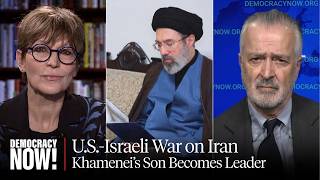
In a Democracy Now! broadcast, host Amy Goodman interviews Iranian‑American analyst Hooman Majd and Amnesty International secretary‑general Agnès Callamard about the escalating U.S.–Israeli war on Iran. The segment opens with a briefing on the war’s tenth day: Israel bombed more than two dozen Iranian fuel depots, creating thick black smoke and toxic black rain over Tehran, which Iran’s foreign ministry called intentional chemical warfare. The war began with a joint U.S.–Israeli airstrike that assassinated Supreme Leader Ayatollah Ali Khamenei. In response, Iran’s Assembly of Experts elected his son, Mojtaba Khamenei, as the new supreme leader – a move portrayed as defiant against U.S. President Trump’s interference and as a signal of IRGC influence. Majd explains Mojtaba’s hard‑line reputation, his close ties to the Revolutionary Guards, and why his selection, though predictable to insiders, was surprising given the wartime context. The conversation then shifts to Iran’s regional retaliation: drone and missile strikes on Gulf facilities, including a Bahrain refinery, and a broader strategy of targeting U.S. bases and economic assets to inflict pain on the United States and Israel. Majd argues the regime’s deep‑rooted power structures enable sustained retaliation despite leadership losses. Callamard is asked to assess the legality of the conflict. She argues that both the initial U.S.–Israeli attacks and Iran’s retaliatory strikes likely violate international law, emphasizing civilian casualties. The panel discusses a controversial bombing of a girls’ school in Minab that killed over 100 children. While President Trump and Defense Secretary Pete Hegseth claim Iran was responsible, a New York Times investigation and Human Rights Watch evidence point to a U.S. Tomahawk strike. Callamard calls for an independent war‑crime investigation, reaffirming the relevance of international law and the ICC despite political attempts to undermine it. The interview concludes with Majd reflecting on his memoir, Minister Without Portfolio: Memoir of a Reluctant Exile, describing his forced exile after the 1979 revolution, his family’s ties to the pre‑revolutionary diplomatic corps, and his skepticism about any near‑term popular uprising in Iran given the war’s devastation. He comments on the legacy of the 1953 coup, the role of the Shah’s son Reza Pahlavi as an opposition figure, and his view that Iran’s regime, while under severe pressure, remains stable for now but will be irrevocably changed by the conflict.
Chapters
The U.S.-Israeli war on Iran has entered its 10th day. On Sunday, Iran's Assembly of Experts selected Mojtaba Khamenei to succeed his slain father to become Iran's third supreme leader. His father, the 86-year-old Ayatollah Ali Khamenei, was assassinated in a joint U.S.-Israeli airstrike at the start of the war 10 days ago. Iran selected Mojtaba Khamenei in defiance of President Trump. Who has repeatedly claimed he can choose Iran's next leader. On Sunday, Trump told ABC News, quote, "If he doesn't get approval from us, he's not going to last long," unquote. Last week, Israel said the next supreme leader would be a, quote, "unequivocal target for elimination," unquote. In other developments, Israel bombed over 2 dozen Iranian fuel depots on Saturday. Thick black smoke engulfed Tehran, with toxic black rain falling from the sky. A spokesperson from Iran's Foreign Ministry described the attacks as, quote, "nothing less than intentional chemical warfare against the Iranian citizens," unquote. Meanwhile, Iranian drones reportedly hit a major oil refinery in Bahrain overnight, as Iran continues to retaliate by striking Israel, as well as U.S. allies in the Gulf. For more, we begin today's show with two guests. Agnès Callamard is is secretary general of Amnesty International. She's joining us in studio. And Hooman Majd, an Iranian-American analyst and author and NBC News contributor, served as an adviser to former Iranian President Mohammad Khatami. Majd's new book is titled Minister Without Portfolio: Memoir of a Reluctant Exile. His recent piece for The Intercept is headlined "The 'Regime Change' President Who Won't—or Can't—Actually Change Anything." regimes. We welcome you both to Democracy Now! Thank you so much for being here. I want to start with Hooman Majd, if you can talk about the selection of the new supreme leader of Iran after the supreme leader, Ali Khamenei, was assassinated—who made the selection, the message it sent and, overall, what is happening in the Gulf right now, with Israel and the United States attacking Iran and Iran retaliating across the Gulf? And on Israel?
Well, good morning, Amy. I think it's what you said in terms of the supreme leader, the Assembly of Experts, which is this body of ayatollahs in Iran, who are elected by the people, actually, who chose Mojtaba Khamenei as the new supreme leader. It was a majority vote. I believe it was a direct vote. Basically reaction against Donald Trump, who had actually name-checked Mojtaba as someone that shouldn't be the new supreme leader. So I think it was a defiant choice, really, more than anything else. Certainly, the IRGC has a lot of influence among those ayatollahs at the Assembly of Experts. Certainly, they would have been in an approval sort of situation with who was going to come out as the new supreme leader. And Mojtaba has very close connections to— has built very close connections to the top leadership of the IRGC, the Revolutionary Guards, over the years that he was in his father's office. Yeah, it was both predictable and surprising. Predictable in the sense that for a couple of years people have talked about him ascending to that role if his father— if and when his father died. And it was going to be anywhere in the next 4 or 5 years, because his father had suffered from cancer. He was not well. And he was 86 years old, as you pointed out. But here, there was this question of wartime and, you know, whether they would immediately choose a new supreme leader or, because of the war, they would wait, the threats against the body of the new supreme leader by Israel and the United States— indirect by the United States, direct by Israel. But I think here they just made the determination, the ayatollahs and the IRGC, I would add, made the determination that it would be the best way to project strength and defiance after, you know, 9 days of war, 8 to 9 days of war, brutal war, that Iran is still standing. I mean, you know, you've got— talk about regime change. You've got killing one Khamenei and replacing him with another Khamenei. So, it's hardly regime change that the United States if the United States was indeed even going for regime change in Iran. In terms of, you know, attacking—
And can you explain, Hooman Majd, can you explain who he is? Is he known widely to the Iranian people, what he represents?
Well, he represents the most hardline of the hardliners in Iran to the Iranian people. He is known. He's widely known, because even though he's been secretive, doesn't appear in public, doesn't give interviews—rarely, I should say, appears in public, only at rallies for like the anniversary of the revolution. But he was considered sort of the closest aide to his father, the most influential of Khamenei's sons, even though he's not the oldest. He's the second-oldest of Khamenei's sons, but considered to be the most influential in Khamenei's outlook on politics, but also closest in terms of his relationship with the Revolutionary Guards, the senior leadership of the Revolutionary Guards. Everybody in Iran knows that. Everyone in Iran knew Mojtaba, knew that he was a potentially—as I said, for the last couple of years, at least, been talked about as a successor, even though he's not qualified from a—was not qualified from a religious standpoint to be the supreme leader supreme religious leader, as well as the supreme political leader in Iran. But it was always talked about. And I think one of the things that is a little bit surprising is that Khamenei himself had rejected having one of his sons be the supreme leader, because they revolted against the monarchy and the hereditary passing down of, you know, power to hereditary of power is something that the revolution was against. Again, the war changed everything. If there hadn't been a war and if Khamenei had died of natural causes, it's less likely—at least Iranians seem to believe that it's much less likely that he would have been chosen as the new supreme leader.
And then, overall, what's happening? And senior Iranian officials reportedly upset with the Iranian president, Pesechkian's Saturday apology to neighboring Gulf nations for attacking them. And then you had a member of the Interim Leadership Council dismissing those remarks, saying, "Evidence from Iran's armed forces shows the geography of some countries in the region is openly and covertly at the disposal of the enemy. The heavy attacks on these targets will continue." Is this indicating a split in the Iranian leadership? And, of course, after Pesechian's apology, you have, among other places, the Bahrain Babco plant attacked.
Yeah, no, it's not a fracture in the— at all. First of all, the apology—the word "apology" is stronger in English than it is in Farsi. There's an element of, you know, regret more than apology, and also to try to soothe the break in relations that have sort of occurred between the Gulf countries. But what he actually said, what Pezeshkian said—and he's one member of the 3-person council that, until Mojtaba was elected, was performing the duties of the supreme leader. And what he really was referring to, according to Iran and himself, the Iranian state media and himself, was referring to attacks—regretting attacks or apologizing for attacks on nonmilitary assets, non-U.S. military assets in the region. But then he went on to say that U.S. bases are fair game. I mean, the strategy in Iran, when you talk about Bahrain and you talk about, you know, desalination plants and just Iran striking out not just at Israel or at U.S. bases even, but everywhere in the region, Iran said this. I mean, I don't know why anybody is really surprised. They said this after the 12-day war in June of 2025. They said, you know, "Next time, no more Mr. Nice Guy." And they're just doing that "no more Mr. Nice Guy." They warned. The Gulf countries. They warned everybody in the region. They warned the United States quite openly—it was written about many times—that if the U.S. and Israel attacked, the next time they wouldn't show restraint, they wouldn't agree to a ceasefire, it would be an all-out war, which is sort of why, if you think about it, the Gulf countries were pressing President Trump to not attack Iran, because they were worried that Iran would do exactly what they said they would do. They're seeing this war as existential, and they didn't see the 12-day war in June as existential. And as an existential war, they will do everything to survive. And everything means attacking anybody and everybody in the region who has any relationship with the U.S. or with Israel, causing oil, as you pointed out, to go over $100 a barrel, causing pain, economic pain, in America at the gas pump. Economic pain for the Emirates, which rely on tourism, rely on all sorts of economic— people buying property there. It's an exile haven. The Monaco of the Middle East is now in danger of not being a safe place anymore, not just now, even after the war ends. It's always going to be under potential threat from Iran, assuming that the regime survives. And so, I don't know why anybody is surprised, including the White House. I mean, they certainly knew this. Perhaps they thought that Iran wouldn't be able to retaliate the way they have been. But let's not forget, this is a regime that has been in power for almost half a century. Its tentacles are deep. It has a lot of very loyal people in the highest positions of power. And you can eliminate, as Israel did on that first day, striking the supreme leader and some 40-plus top military leaders, that they can be replaced. They have many, many more. And that Iran has this capacity to use drones, missiles and cause pain in the region, not just against American soldiers, because when you look at it, it's really sad that—for Americans, it's very sad that 8 American servicemen have died so far, and potentially more will die. But that's not the point for Iran. The point is to make it painful, economically and in many other ways, for the United States and for Israel to continue the war. And same thing goes with Israel. The missiles are going— are getting through. Not all of them, but they're getting through. Enough missiles are getting through to cause death and destruction in Israel, as well. At some point, I think Iran is making the bet, again, after the 12-day war back in June, that both Israel and the United States will tire of this war and will want to stop it.
I want to bring Agnès Callamard into this conversation, secretary-general of Amnesty International, before that the U.N. special rapporteur on extrajudicial, summary or arbitrary executions. Can you start off by responding to this war of choice, Israel and the U.S. first attacking Iran, and now Israel saying that the next leader that Iran has chosen, Supreme came later, is a legitimate target of assassination, the whole issue of what's happening with international law today?
Well, I mean, clearly, the attacks are unlawful. The retaliation, as well, from Iran are probably unlawful, as well. And civilians are paying the highest price. Targeting of state representatives in the context of a war and aggression, of aggression, will be unlawful under international law.
And I wanted to ask you, on this day after International Women's Day, about this issue of the attack on the girls' school. Among the dead in Iran are 175 people, at least, most of them girls, killed when bombs struck a school in the southern city of Minab on the first day of the U.S.-Israeli attacks. On Saturday, President Trump and Defense Secretary Pete Hegseth denied the U.S. is responsible for bombing the girls' school. They spoke to reporters aboard Air Force One.
Did the United States bomb a girls' elementary school in southern Iran on the first day of the war and kill 175 people? In my opinion, and based on what I've seen, that was done by Iran. Is that true, Mr. Hegseth? It was Iran who did that? We're certainly investigating. But the only side that targets civilians is Iran. We think it was done by Iran.
Very interesting response. Trump says done by Iran. Hagseth is more careful. He says there's an investigation going on, and the only side that targets civilians, he says, is Iran. He does not deny. There is, among other news outlets, a New York Times investigation which found direct video evidence contradicting Trump's claims. The video shows a U.S. Tomahawk missile damage the school at the same time as a U.S. attack on an adjacent naval base. Agnès Calamard, if you can respond to this?
Look, there is little question that the school was targeted by the U.S. Our own investigation thus far is pointing to the U.S. You mentioned The New York Times. Human Rights Watch has reached similar conclusion. Let's recall that 150 children were killed in this attack. This is an absolute violation of international law. This is why we have international law. This is why we have normative guardrails to protect against war of aggressions and to protect against attacks of civilians, because we know that But in context such as that happening right now, civilians are going to pay the highest price. They are paying the highest price in Iran. They already did throughout a number of years, targeted by their own government. The Palestinians are paying the highest price right now. People in the Gulf countries are paying the highest price. The Lebanese people are paying the highest price. So, it is maybe meant as a war for a change of regime, with a big question mark. But it is a war against people. It is a war against civilians, against children, against adults going about their business. It is targeting civilian infrastructures. Civilians are paying the highest price of what's happening right now. And we should not forget it.
Are you calling for the attack on the girls' primary school that resulted in the deaths of well over 100,000, we think, children, mainly girls, to be investigated as a war crime? Absolutely.
It has to be independently investigated as a war crime.
But what's happened to international law these days? What does any of this mean?
Look, I think it still means a lot, otherwise we will not talk. About it. We still have those guardrails. We still hold on to them. And we believe that at some point the monitoring, the documentations, will help deliver truth and justice. So, it is very commonplace right now to say, "Oh, there is no more international law, and international law is ineffective." This is not— this is not true. International law is here to protect people. And then, when it doesn't, there should be instruments. To hold people to account. Now, does it happen overnight? No. Does it happen even a month after the fact? No. But it does happen. It does happen. And this is why Donald Trump and Netanyahu and Putin are so eager to go after the International Criminal Court, because they know that it delivers at some point. It may be in 10 years, but it delivers. Look at who is now behind the judge in The Hague: Rodrigo Duterte. I am sure you, at some point, have— have reported on the unbelievable level of violence that this man waged against his own people.
And you're talking about the former president of the Philippines, the thousands who have died there?
Oh, the Philippines. I investigated him as a U.N. special rapporteur. I never—you know, even when you call for justice, you never really think that he will—could be in The Hague in front of ICC judges. And yet he is. So this is why we have international law. In 2025, we have a number of European countries that We came together to set up a tribunal for the crime of aggression of Russia against Ukraine. Why? Because we still believe in international law. And we believe that international law must be applied to everyone, to every country, independently of their power. So, let it be very clear: Right now, it's being violated right, left and center by all parties to the conflict. But there will be reckoning. There will be reckoning.
Hooman Majd, before we go, your book is titled Minister Without Portfolio: Memoir of a Reluctant Exile. You write about being the son of a high-ranking diplomat in pre-revolutionary Iran, which means under the Shah, and how your life suddenly changed after Ayatollah Khomeini's revolution in 1979. Why do you call yourself a reluctant exile? And what do you envision for the future of Iran?
Well, reluctant because I was studying in university here when the revolution happened, had every intention of going to Iran to, you know, follow in my father's footsteps, if you will, and join the Foreign Ministry—this was during the shah's time—become a diplomat, hopefully rise to ambassadorship somewhere at some point in my life. I didn't want to be in exile. I didn't want to live in America for the rest of my life, which is what has happened. But I also couldn't go back to Iran, so I was reluctant in that sense. When I say I couldn't go back to Iran, my father lost his job. It was a very dangerous time for people who were associated with the previous regime. I would have had to serve in the military, potentially, if I didn't get into trouble otherwise. So, there were reasons that I couldn't really go back. To Iran in those early days of the revolution. And so, you know, one thing leads to another. And, you know, you think it's going to be—a lot of Iranian exiles thought it was going to be a year, 2 years before things settled down or the regime collapsed and went back to being a democracy of sorts or a constitutional monarchy—not back to, but become a constitutional monarchy. And, of course, that never happened. And so, you know? And 47 years later, I'm here. What happens for the future of Iran? It's really hard to say. Right now, people in Iran are not rising up against the government the way that Donald Trump has asked them to, the way that— there hasn't been any real— there was some celebration when Khamenei was killed, was assassinated, by people who held him responsible for the brutal crackdown in January of the protesters. But those celebrations have stopped, at least stopped inside Iran. People are now worried. As you pointed out, Amy, infrastructure is being bombed. It's, you know, a war, a full-on war on Iran, on the country, which means on the people. The toxic rain from yesterday, Saturday and Sunday, in Tehran, black rain from the soot and from the oil refineries being blown up—I mean, this is going to have long-lasting health effects. The U.S.—the Iranian government has told people to not go outside unless they're with an N95 mask. I don't know how many people have N95 masks in Iran. And just, you know, in general, Iran is going to be pummeled. It appears that Iran is going to be pummeled. And it's just going to make the population even more miserable than they already are. For them to be able to rise up and take control of the government is just a pipe dream. I mean, how are they supposed to do that when they're being killed? Or are running away from missiles almost on a daily basis. Predicting the future is impossible for Iran. I believe, at this point, it seems to be that the Iranian regime is relatively stable, despite what's happening, in terms of being in power, and that the Iranian people have no real ability to bring about change at this point. The longer-term future, I think Iran is going to be changed forever.
After this war. And very quickly, as you were— your father was an official under the Shah, well known for his brutal SAVAK secret police. I just came from Savannah, Georgia, where they were showing the film Coup 53, for people to understand that in 1953 the U.S. overtly and covertly overthrew the democratically elected leader of Iran, Mohammad Mosaddegh, many say together with Britain on behalf of BP. British Petroleum. That would lead to the shah being installed. And now his son, Reza Pahlavi, is leading a movement to be the next, what he calls, interim leader of Iran. Your thoughts on that, since you, too, and your family are directly connected to this? He's the son of the shah.
He's the son of the shah, correct. And he has spent the last 45 years, at least, being relatively ineffective in being an opposition leader. To the regime. In the last 2 years, certainly in 3 years since the Mahsa Amini protests, he has emerged as a potential—for a lot of Iranians—a potential leader to take power. Again, there's a nostalgia for the time of the Shah, where there were a lot of social freedoms, even though there were no political freedoms. And I think a lot of Iranians who are now—let's not forget, this is 50 years ago. A lot of the Iranians who support him now weren't even born. At the time of the shah, so they have no idea what SAVAK was, or they might have heard of it, but they have no idea what their— what the Iranian system was under the shah. He has not really been able to put together any organization on the ground in Iran. He's been dismissed by most people as— most analysts and experts and intelligence agencies, Western intelligence agencies. As a potential leader. He certainly wants to be a leader. He certainly sounds like he wants to be king. But it's a very unlikely proposition right now. Hooman— His support inside Iran—
Yeah? We have to leave it there, but I want to thank you for being with us. Hooman Majd is an Iranian-American analyst whose new book is titled Minister Without Portfolio: Memoir of a Reluctant Exile.
More from Hooman



Protests and Power Plays: From Tehran to the Arctic Circle | The Intercept Briefing
Episode 64 - Why Iranians Now Want the Bomb: Hooman Majd on Israel’s Strikes and Nuclear Ambitions