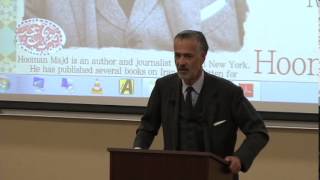
Seriously Entertaining: Hooman Majd on "No Satisfaction"

In this talk, Hooman Majd reflects on the elusive notion of "home" through the lens of his own life as the son of an Iranian diplomat. He recounts a childhood spent shuttling between Iran, the United States, England, India, and North Africa, describing how his father's rejection of his own desert hometown and a career that constantly moved the family prevented the formation of a stable sense of place. Majd describes cultural dislocation in American schools abroad, the clash of identities in English boarding school, and the paradox of being labeled both a "Yank" and a "wog". He narrates his attempts to reconnect with Iran—first as a university student before the 1979 revolution, then as a journalist and author after exile, and finally by living there with his American family—only to discover that the physical home he sought (his grandfather’s house) no longer exists. The experience leads him to accept that the cliché "you can't go home again" is true, and that the search for satisfaction in a singular home is ultimately futile. Majd concludes that New York has become his chosen home, while acknowledging the lingering ambiguity of identity that many immigrants share, especially in a city that embraces hyphenated Americans.
Chapters
I was gonna talk about satisfaction in a slightly different vein than the previous speakers have. Last week I was on Twitter, actually I'm on Twitter every day, but last week on Twitter, you know, you get all these ads, sponsored ads on Twitter, and generally you try not to read them, but somehow it's It's like a habit you can't, you know, it's like worse than nicotine. Twitter is actually worse than nicotine, I think. You end up reading the ads too, which is kind of disgraceful. And British Airways ran an ad saying, take a pic, or no, not take a pic, send us a pic that reminds you of home and we'll send you there. So it's a competition. You like send a picture of something that reminds you of home or of your home. And British Airways will send you there. Well, it was very presumptuous, the fact that you might even like the home that you came from, which in my family's case is not true, at least on my father's side. And also presumptuous in that you have a home. I grew up not understanding what the concept of home was. I was born in Iran, Iranian, which is why I wrote about ayatollahs, but left when I was very, very young, when I was actually an infant, unaware of leaving a country. My father, who I just mentioned, despised his home. Not Iran, he didn't despise Iran. He despised the little town he came from in the middle of the desert in Iran. Left when he was 16, went to boarding school in Tehran, and never looked back. Never took his kids there, never took even his wife there, refused absolutely to even talk about it until he was much, much, much older. And he instilled in his kids this idea of not having a home inadvertently. He joined the Foreign Service, the Iranian Foreign Service under the Shah after a stint as a communist, which didn't work out very well because of the coup that we initiated in 1953, decided that Iran was never going to have its own destiny, but would be subservient to the United States. So anyway, he joined the foreign ministry. He said, "If you can't beat 'em, join 'em." He joined them and left his home forever, and left Iran for pretty much the rest of his life. Never bought a house, never bought an apartment, didn't talk about his home. I grew up going to American schools in various countries, including in the United States in San Francisco and Washington, and then being thrown into boarding school in England for high school where I met my very best friend to this day, a fellow American from New York whose home was New York and was actually quite happy to call it home, but whose father had escaped, sort of like my father, had escaped the Oklahoma Dust Bowl and actually never returned and refused to talk about Oklahoma, refused to even acknowledge that he was from Oklahoma. So this idea of home for my father and for my friend's father, oddly enough, was not a concept that gave them any satisfaction. In my father's case, he even refused to make a home anywhere else. As a diplomat, he tried to constantly be posted somewhere new. So rather than give us the standard 4 years, most diplomatic postings for most countries are 4 years at a time. You get sent abroad for 4 years, you come home, if you have a home, for a year or two, and then you get sent abroad again. My father often would get tired after a year and a half. I was in San Francisco for first grade, and then he got bored of San Francisco, was like, requested a transfer, but not back to Iran, went to India. So I went to the American school there. After a year there, wasn't happy there, requested a change, not to Iran, this time to North Africa, again American schools. So I was going to these American schools with fellow diplo-brats, as we called them, but they were American diplo-brats, not Iranian diplomats. This was a time in the '60s when there weren't a lot of Iranians outside of Iran. Today we hear about Iranians all the time, and because of the mass immigration, particularly to the United States after the Iranian Revolution, almost everybody knows an Iranian. Now all of you know me, so you can say you know an Iranian. But back then there were no Iranians. And as a kid, if you're in grade school, other kids don't care that your name is Hooman. Nobody asks you where you're from. Kind of not relevant, especially if you're going to an American school in North Africa, for example, where they're all also foreign in the environment, and they come from all over the place— California, Washington, New York, the South, Chicago. But all those kids had a reference point. Their reference point was a home that they knew was there, was always going to be there. I didn't have that, and I didn't realize I didn't have that. I sort of realized I didn't have some of the cultural references that they had. I'd never been to a football game, even though back then in the age before video and before the internet, the American Embassy would have film, NFL film sent, you know, a week later so you could watch a game that you already knew the result of. But I'd never been to a football game. I'd never been to a baseball game. I'd never been to a basketball game because when I lived in San Francisco, in first grade, I was too young to go. So I didn't have a lot of the cultural references, and yet I was culturally more American than I was Iranian because even though my parents were Iranian and we spoke Farsi at home, so I kind of learned Farsi, there weren't any other Iranians in Tunis, Tunisia in 1964. There were very few Americans, let alone Iranians. Or in New Delhi, India in 1963, there were no Iranians. At least no Iranians that I knew of. And in San Francisco in 1962, there were maybe 3 Iranians, and they were university students that my father knew, but I didn't know. So I had, but I did have this cultural awareness of America. You were taught by American teachers abroad, and if you're taught by substitute teachers who are Peace Corps volunteers, you have an idea of America. If your friends are American and you go to their houses and you talk about football and baseball, without really knowing very much about it, but you talk about it, you have this cultural reference. And then I go to England. I get sent to England for boarding school because my parents finally got tired of dragging us from one school to another. And the very first day at school, which reminds me of Philip's story, schoolyard bullies come up to me and say, "Okay, you fucking Yank." I said, "Yank? Okay. I'm American with a name like Hooman in London, England. Yeah, that really makes sense. Okay, you fucking yank. Who do you support?" "What do you mean who do you support?" "Who the fuck do you support?" Or words to that effect. "Who do you fucking support?" And I said, "I don't know. I don't support anybody." You know, the same thing as concept of not having a home. I don't support anybody. I got a really hard punch in the stomach. The guy said, "If anybody ever fucking asks you who do you support, you say Arsenal." I said, "Okay." I was 10 years old at the time, and I swear to God, the next day, a guy came up to me in the schoolyard, and I didn't even know what Arsenal was, and I basically didn't know what soccer was, even though it was the national game in Iran, but having not lived in Iran, I didn't know what it was. Swear to God, the next day a kid comes up to me and says, "Who do you support?" And I say, "Arsenal." Whack, again, right in the stomach. "No, next time anybody asks you, you say fucking Chelsea." I thought Chelsea was a neighborhood in England, you know, because I had a friend who lived there, or my parents had a friend who lived there. So it was a very quick education, and from that day on, It was 1968, I decided I would not accept any British cultural influence on me. There would be none whatsoever. I would leave boarding school, and even though my school insisted on all of us applying to Oxford or Cambridge, because if you didn't go to Oxford or Cambridge, the school that I was at, you were considered a nobody. I absolutely refused to even take the exam. I said, I'm going back to the States with not a hint of a British accent. Although I think I may have just unconsciously had one. But I was gonna have no British cultural influences. It was enough to have this sort of American fucking yank influence and to also be Persian or Iranian because I also subsequently got called, "You fucking wog," in England too. So at one point I wanted to say, "Make up your fucking minds. I'm either a wog or a yank. I can't be both." But to them I was both because I spoke with an American accent, I had American cultural baggage, and— but I was dark. I didn't look like an American to them, I guess. Anyway, so long story short, I do come back to America because I refuse to stay in England, and I'm not an England hater anymore, but at the time I was culturally resistant to English culture. And I sort of felt more American than anything else. At this point in my life, I spent less than a year in Iran total. There had been summers when we had gone home, my mother's home really, because my father didn't consider it home anymore. And as I said, we didn't own anything in Iran. My fellow diplomat Americans, diplomat Americans, when they went home, they went to a home that they owned, a place where they had come from. I never, we never did that, but my mom was very proud of her home and her father was an ayatollah and was a famous ayatollah in Tehran and not that I knew what an ayatollah was except that he wore a turban and, you know, had a beard. And so the summer home that my mom longed for, that was a place that had some semblance of home to me. But I didn't really feel very Iranian. So anyway, I go to university here and thinking somewhere along the line, thinking, you know, there's this nagging thing about, you know, where am I going to call home? Am I going to stay in America for the rest of my life? Am I going to call this home? Am I going to try to make this my home? Or am I going to try to go to my roots? Because I do know my roots are in Iran. And I decided I was gonna go back to Iran. This is before the revolution. So I was all getting ready and my father said, "Well, you can go back." He wasn't really keen on it. He was keen on being a citizen of the world or just making your place wherever you could. Better not to go to Iran, it was his view. But I said, "No, no, I wanna do that. I wanna learn about my culture. I wanna be culturally immersed." He said, "Well, you're gonna have to read and write Farsi, so you're gonna have to go to school." So I said, "Okay, I'll do all that and then I'm gonna," apply to the Foreign Ministry, and then I'm gonna become just like you and never live in Iran. Which made a lot of sense, right? But I thought I was gonna at least have a home if I did that. And then 1979 happened, and I was in university, and the revolution, and that kind of put an end to that. So my father was fired from his job. He was an ambassador. He had to leave. He wasn't in Iran at the time. He was an ambassador in Japan. He left. Was in exile. No satisfaction for him because he just, you know, lived the rest of his life in exile, always knowing that he was in exile, happy not to be in his home, but also unhappy that he was in exile. And I think that's true of all exiles. It wasn't unique to my family. I decided I couldn't go back. Actually, I couldn't go back to Iran at the time. Family was a little iffy with the new regime. So I stayed. I stayed and immersed myself in the most American culture possible. So I went into the music business. So many years in the music business where I had virtually no connection to Iran. But I always followed the news and I always was curious. And I had family in Iran. I was curious about them. And whenever I talked to my dad or visited him and my mom, I'd always ask about Iran and I was always, you know, what's this place like? And then I would have these dreams that I would go to Iran. I'd get on a plane and go, 'cause they can't stop me from going as a natural-born Iranian citizen, and I wouldn't be allowed to leave. And then I'd panic that I couldn't come home, this home that was now America. And then I would other times panic that I couldn't go home, that home that was Iran. So somehow I just have these dreams where I could not get any satisfaction of this concept of home. So searching for that concept led me to write about Iran, and finally when I was allowed to go to Iran, go there and do some journalism for various media, but also to write a book, which is the book that that I think is in the bio here. And then I got caught up with Iran and wrote another book on Iran about the Green Revolution in 2009, because I spent a lot of time there. And all this time I realized when I was there that I was looking for something more than just a career in writing about Iran. I was looking for this home. I was looking for that satisfaction of being able to say I either hate my home or I love my home. And so I decided in 2011 to go again, but this time to go and like try to live there and get an apartment and live as an Iranian with my family, my American wife and kid. And we did that. And over time I realized that there was something that drew me to the place. There was some element of home. Even driving by the hospital that, you know, my mom tells me I was born in. She hasn't been back for 40 years. It was interesting to me in that time I was there for an extended period of time, I went to my father's hometown. My aunt, my older aunt, long deceased, her husband who's still alive at 95 years old took me to where my father grew up, the house he grew up. We knocked on the door, some lady said, Who the fuck are you? And he said, well, this is the grandson of so-and-so and the son of so-and-so. You wouldn't know the son, but you probably heard of the grandson. His father used to play in the backyard here. I want to show him the house. And I'd always imagined this huge yard and beautiful palm trees in the middle of the desert. It was a tiny little dirt strip, and I sort of realized why my dad hated it. But I did all those things. And then my mom would call me from London and say, Did you find your grandfather's house? And I said, well, what's the address? And she said, well, the address must have changed by now. It's this, this, and this, and this. But, you know, various people will know where it is. And so I searched and searched for it. And Tehran is unrecognizable from when she was last there. Basically, the city's been paved over with high-rise buildings and multiplexes and superhighways. So I tried. I tried really hard to find this house. That I had spent summers in as a kid and that my mom loved, the house she was actually born in, and it's been razed to the ground, but I couldn't even find the— I found the neighborhood, but I couldn't even find the street 'cause the street is unrecognizable, and then I realized it's actually better that I didn't find that house because that was the actual only reference I had, only memory I had of Iran as a child was that house. I can remember the mud walls. I can remember the door. I can remember the cellar, the backyard, which is probably also tiny, but was tiny, but I thought was very big when I was a kid. But that was the only reference I had to home, and I was kind of happy that I couldn't find it or that it didn't exist anymore. And it's better that way. And I finally, I think after coming back from Iran on that trip, and I wrote about that trip in my last book, Ministry of Guidance, I realized that, you know, it's not just that the cliché, you can't go home again, is true. It's also that it almost doesn't matter anymore. It doesn't matter to me that I don't have that satisfaction of a home. I know I never will. I consider New York my home. Yeah. And I think in this audience, just in any audience, in any club in New York City or any venue in New York City, you're going to find a lot of people like me. Who maybe don't have a home, don't like the home they came from, are immigrants, or for whatever reason have decided to move here. New York is one of the few places where you'll find that, and you can still call yourself a New Yorker. Somehow though, there's still, that question sometimes does come up, where you're from, and I find it very difficult to answer. I feel like I'm lying if I say, I'm from New York because I'm not. I've lived here for 35 years, but I'm not from New York. I wasn't born here. My kid has been born here and he'll be from New York for the rest of his life. My wife is from Wisconsin, even though she hated it for a long time. She'll always be from Wisconsin. She actually likes it now. And then you find that a lot with people as they get older. Homes they hated, they suddenly have this nostalgia for it. It's like, yeah, but it was kind of cool. Yeah, but you hated it. No, no, it was kind of cool. Yeah, I liked it, you know, so I feel like I'm lying if I say that, but I also feel like I'm lying if I say I'm from Iran. It's true that I'm from Iran. It's true that I'm, that's where I was born. It's true that my heritage is Iranian. But when you say you're from somewhere, it means something. It means something to you if I say I'm from Iran, and you assume certain things about me if I say I'm from Iran. And only some of those things are true. Back to the English thing, the satisfaction I've always had as an American, as a hyphenated American, first-generation hyphenated American, Iranian-American, is that people don't really care where you're from. They may wonder where you're from, but they ultimately don't really care. It doesn't matter where you're from because you're American. Even if you don't have all the cultural references, even if you don't sound American, you can be American. Going back to England, that's not true of England. I remember when I was in the music business one time, some discussion with a band came up, and somehow the Middle East came up, and I said something about Iran, and the drummer, of course, it would have been the drummer, said to me, "How do you know that about Iran?" I said, "Well, what do you think? I mean, what do you think the name Hooman comes from?" I don't know, California? He had assumed I'd been a child of the hippies, named oddly, and then of course last names don't matter in America, as we know. But in England, at the same time I was in the music business, I was in England and I was at a dinner party, a very posh dinner party, and I was seated next to a very nice lady, I won't name, but from the upper classes in England. And she said, oh, so where are you from? And I hesitated for a minute and I said, "New York." She said, "No, no, no, but I mean where you're from." Well, I said, "That's where I come from. I just came from New York actually yesterday." She said, "No, no, no, but where are you really from?" And I said, "What do you mean?" She said, "With a name like Hooman, you can't be American." Well, I said, "Well, my passport's American, but you're right. I was born in Iran." So that confusion will still be there for me Everywhere in the world except the United States. So no satisfaction there, satisfaction here. Thank you very much.
More from Hooman


Iran Picks New Supreme Leader; Toxic Black Rain Falls After Israeli Strikes on Iranian Oil Depots




Protests and Power Plays: From Tehran to the Arctic Circle | The Intercept Briefing


Episode 64 - Why Iranians Now Want the Bomb: Hooman Majd on Israel’s Strikes and Nuclear Ambitions