Iran: Should Trump Intervene, and How?
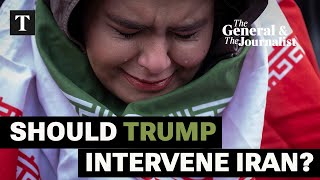
In this episode of The General and the Journalist (recorded 2026‑01‑17), hosts Tom and Patrick interview Iranian exile and author Hooman Majd, a cousin of former reformist President Mohammad Khatami. The conversation begins by contrasting the Western image of Iran – bearded clerics, chadors, and revolutionary rhetoric – with the vibrant cultural life that many Iranians still experience, a duality Majd calls the "two Irans." He then maps Iran’s fragmented power structure, describing the Revolutionary Guard (IRGC), the Basij militia, various clerical factions, the parliament speaker, the Larijani family, and other competing elites, emphasizing that the Supreme Leader’s authority is mediated through these centers. The hosts move to the recent nationwide protests, which began over soaring mobile‑phone prices and quickly expanded into broader anti‑regime demonstrations driven by a youthful, urban population. Majd explains why the protests have not yet succeeded: the regime’s security apparatus remains intact, the protests lack unified leadership, and the Iranian diaspora’s influence is limited. He compares Iran’s situation to Egypt’s 2011 revolution and North Korea’s entrenched dictatorship, arguing that Iran’s relative openness and global connectivity make a prolonged, brutal crackdown less sustainable. A large portion of the interview is devoted to possible U.S. responses under President Trump. The panel outlines a spectrum of options: non‑kinetic measures such as cyber attacks, restoring internet access, and covert information operations; kinetic options including targeted decapitation strikes against senior IRGC or Supreme Leader figures; and full‑scale military action. Both Majd and Patrick argue that kinetic actions are risky, lack clear political objectives, and could backfire by providing the regime with a propaganda tool. They also discuss the diminishing utility of Iran’s regional proxies (Quds Force, Hezbollah, Houthis, etc.) after recent setbacks, and how this weakening may affect the regime’s internal legitimacy. Finally, the conversation turns to diplomatic pathways. Majd suggests a negotiated deal could involve a zero‑enrichment nuclear arrangement, limited missile constraints, and easing of sanctions to address Iran’s economic crisis, but he doubts the existence of a viable alternative political coalition to replace the current system. He cautions against violent regime change, noting cultural and religious taboos against killing a cleric, and stresses that any lasting transformation must come from within Iranian society. The episode closes with lighter banter about war‑film polls and a listener question on the difference between commissioned and non‑commissioned officers, illustrating the hosts’ blend of serious analysis and informal podcast style.
Chapters
'Help is on its way,' posted Donald Trump on Tuesday night. What exactly did he mean? 'You're going to have to wait to figure that one out,' he told reporters.
'You said to Iran this morning that help is on the way for protesters. What did you mean by that?
What kind of help?' 'You're gonna have to figure that one out, I'm sorry.' But how should the president come good on his threat to support Iran's protesters and, in his words, 'MIGA'—Make Iran Great Again—or would anything he does backfire on the new revolution? Is there a viable opposition to take over if the regime did fall? And is the ayatollah security apparatus simply too big and brutal to be removed from the air or from the streets? Welcome to The General and the Journalist. I'm Tom, and I'm Patrick.
The acclaimed author Hooman Majd is an Iranian exile now living in New York and a cousin of a former reforming president. Few know how the 47-year-old Islamic Republic actually works better. Hello, Hooman, and welcome to The General and the Journalist.
Thank you very much. Pleasure to be here.
Uh, well, it's a pleasure, I think, for us to have you. Um, so before we get into, uh, what's going on in Iran at the moment and how the United States, uh, and the rest of the world might respond, I, I just want to try and shed a light on what Iran what the real Iran is like. Because for, I suspect for most people living in the West and in this country, Iran is associated with a very narrow perspective and not a good one. You know, it's seen as a brutal, dictatorial, theocratic autocracy. It's, you know, people associate it with the sponsorship of terrorism, with the repression of women. That's not the Iran that I remember. And I, As we were talking about earlier on, I grew up in Baghdad, so we used to travel to Iran and go to Hamadan and Isfahan and Shiraz, and I have extraordinary memories of an incredibly vibrant, thriving, cultural, you know, an extraordinarily important civilization. And that's in stark contrast to what we've seen play out over our TV screens over the last few decades, and indeed the regime's behavior. You know far more about it than I do. I mean, you were born, what, 22 years before the revolution. And although you've grown up away from the country a lot of your life, you also know Iran well. Just tell us, tell our listeners a little bit about what you think the true Iran is.
There really are two Irans. The image in the West of the bearded men shouting, "Death to America," "Down with Israel," whatever they shout in these marches very energetically, and women in chador, black chadors, very, you know, dour, dark kind of Iran. And it does exist. It does exist. And it exists in the IRGC, the Revolutionary Guards. It exists inside the regime, if you want to call it that. And then there's the other one that you just mentioned, the beauty, the culture, the poetry, the music, all of that, much of which is kept behind walls, what I call the Persian garden. Yeah. In the last few years after the Women Life Freedom movement, after the death of the woman who was abducted and then killed because of bad hijab, actually what's happened is people are entertaining in the streets. There are musicians on the street. Women aren't wearing the chadors in the big urban centers anyway. Yeah. So what has happened is that the government, despite being very rigid, and theocratic and has decided what is right and what is wrong, has to let off, let people let off steam and has to allow certain things to happen. So some of the things that you said about Iran that you remember are very much still there. That hasn't changed. The character of the people hasn't changed. And by the way, before the revolution, which is the time that you saw Iran, the other side also existed. It was just quiet. It was kept quiet by the Shah. Some of those people were in jail, including the current Supreme Leader, Ayatollah Khamenei, and some of their views were formed by the time they spent in jail, by the times they spent in jail. But what's interesting about someone like Khamenei, actually, is that he's a poet himself and quotes poetry and quotes literature, quotes Western literature. His favorite book, I think, was I can't remember one. It was a French novel. But anyway, so both Irans exist up until two weeks ago, I should say, because since two weeks with the protests, things have changed dramatically in Iran.
And so let's sort of forward to how things are now. I mean, first of all, you have, I'm sure, many friends, you have family in Iran. Are they safe? Yes.
Well, I hope they are. I mean, you know, the internet was cut off. Uh, the last time I was able to talk to family was right before the internet was cut off. And then as the internet was being shut down, a cousin of mine in Iran was trying to reach me, um, and it would ring on WhatsApp and then it would go dead. And I tried to call back, and then by, by, by Thursday evening last Thursday evening, there was no way to call, even landlines, international calls weren't going through and they couldn't call out.
Yeah. And you're, I mean, speaking of your family, you're related to former president Mohammed Khatami, who was president until 2005. And he's widely seen as a reformer. How much purchase, how much influence does he have as a former president? And when you look at the reforms that he tried to implement, why didn't they get purchased? Why didn't they stick?
Because the Nezam, they call the regime, the Nezam, didn't allow it ultimately. They didn't like to see this kind of pro-Western, I should say, kind of attitude among these supporters of reform. That doesn't mean to say that Khatami or Rouhani or Mousavi were necessarily pro-Western, pro-England, pro-America, pro-France. They were neutral on that. They thought that they should have good— Iran should have good relations with these countries, not the kind of relations that the Shah had, but that Iran should have a normal diplomatic relations with these countries, normal trade with these countries, normal back and forth with these countries. And the regime didn't really want that, didn't accept it. When I say the regime, I mean at the very highest levels. And even though people imagine the Supreme Leader to be all-powerful, all-mighty, which he is in many ways, there are centers of power. And The way that he has stayed in power and the state, the Supreme Leader, is by allowing these centers of power to have their own little, uh, um, you know, centers of power really. And you've got, um, some— you've got the IRGC for it first and foremost, but then you've got other clerics, and then you've got, um, former IRGC people who may not agree with each other. You've got the Speaker of Parliament, Ghalibaf, um, Baghra Khatibaf, who's extremely powerful and has his own, you know, basically center of power. You've got Shamkani, who was, used to be, who was, you know, attempted assassin— the Israelis attempted to assassinate him because they believed he was so powerful in the Six-Day War in June. He has his center of power. You have Ali Larijani or the Larijani family who have their center of power. So you've got all these competing groups in Iran. And, um, the one thing they mostly agreed on was that reform was dangerous. The kind of reform that Khatami proposed was dangerous because it would lead to the revolution eventually becoming defunct and, um, it just turning into a non-Islamic, um, uh, republic of sorts with these people in charge. So that's really why they didn't allow it. And they have the guns. At the end of the day, they have the guns.
And they still have the guns, which very much brings us to today's protests. Today's, exactly. Now, Hooman, we're 18 days into these street protests now. I actually wonder why we're still calling them street protests. This is a revolution, or certainly an attempted revolution. But are the protesters winning?
No, unfortunately for them. No, they're not winning. And fortunately for the regime, they've been able to, uh, crush them. Um, it's been pretty horrific from everything we know from the, what's been able to get out. And, um, people are afraid. Iran, the one thing Iranians don't want is because Iranians don't want Syria. They don't want Libya. They don't even want Iraq. A very bloody and long civil war. Exactly. And they realize that there are elements that do want that. You know, there's Kurdish separatist groups, multiple Kurdish separatist groups, but there's one particular, PAK, which is armed. There's the Balochis who are armed. There's the Arab separatists in the south who are armed. And yeah, it's just something that Iranians don't want. And seeing these kinds of protests and the bloody result of these protests, blood on the streets that people see today, it's like, oh, 'Let's find another way to get this change, change the system, change the regime.' And I totally understand why you as an Iranian would feel that.
And these are your people and you may well know some who are dying. But, you know, to us sitting here in London, see these extraordinary scenes, 18 days, 18 nights in a row now, night after night, the unbelievable bravery of some of these young people going up against, marching against the Basij, without any arms and getting shot down knowing that there's a good chance. It's really moving to see, but how would we know if the protesters were winning? What sort of things would we be able to see? Would you like to be seeing roundabout now?
Well, it depends on which protesters. I mean, it's unlikely that the Bazaris who started the protest wanted anything much more than the economy to be fixed, or at least inflation to be fixed. I mean, if you're— this, the way it started was mobile phone sellers, right? So you're a mobile phone seller in the bazaar and you're selling iPhones, which you have to bring in from Dubai, uh, for 12— the equivalent of $1,200. And you sell it today for $1,200, but the very next day it's worth $1,400. Well, you're not going to sell it anymore at $1,200, you know. So because it's it's costing you money at that point to sell them at the price that you're selling them. So that was the first protest. That's how it started. And it ballooned because the rest of the bazaaris were also like, we can't do trade. We can't do business anymore. So those people who tend to be conservative and were consistently the most loyal to the Islamic Republic system regime, they may not want a revolution. They may not want an absolute change of regime, that the theocracy just disappears. They certainly want a strong economy. They certainly want their share of the economy. But then there's this huge population of young people. Iran is extremely young, who do want a revolution, as you say. They don't want the Islamic Republic to be there in the form that it is. They want things that people in the West have. And they certainly don't want to be told how to dress and how to behave on the streets. So, um, you've got that huge population. They haven't really articulated other than saying in some cases, death to Khamenei, death to the Supreme Leader, because that's just an Iranian expression. When you want to say down to someone, you always say death.
Um, death to the system, like death to Arsenal.
Yes, death to— yeah, if the Brits adopted that, it would be death to Chelsea, death to Yeah, exactly.
Just Arsenal. Just Arsenal. Yeah, just Arsenal.
Don't tell me. But Hooman, one of the things we're not seeing, and I guess this is a bit of surprise to the likes of me, although, you know, if those in the regime don't think the protesters stroke revolutionaries have got much of a plan, let alone a united cause here, maybe this answers itself. But Reza Pahlavi, the son of the deposed Shah, who is trying to put himself very much as the figurehead for all this, he claimed in July after the Israeli bombing campaign, it was devastating to the regime. He claimed he had 50,000 members of the regime, military and officials, signed up via a QR code, ready to go and defect when the balloon went up, when he pressed the button. And apart from your police station, your police commander in a province, that manifestly hasn't happened.
Hasn't happened. No, it's absolutely— Yeah, I wrote about it. I wrote about it yesterday.
Are you surprised it hasn't happened?
No, I'm not surprised. I never thought that he had the support that he claimed he had. His name was chanted by people on the street. We want Pahlavi. We want Pahlavi. But I think that's less because he's got this huge base of support in Iran and more because who else are they going to chant for? So yeah, I want to be fair to Pahlavi and say, yes, he does have some support. He certainly doesn't have the support that he claims to have. Doesn't have the 50,000. I mean, I don't even think there was a single prominent Iranian in any of the security forces, Basij, IRGC, army, police, gendarmerie, any single one who came out and said, videoed himself saying, I'm on Pahlavi's side, not a single one.
And very simply, for any revolution to succeed, you need the men with the guns to switch sides. Absolutely. Why are they not switching sides now?
Because They don't see an alternative right now. They don't see someone that they can— Pahlavi is not the one, unfortunately, or fortunately, however you want to look at it, depending on your view. There isn't an alternative. And at the very top of the regime, there's no alternative outside of Iran. You know, when the Shah fell, my family included, had the opportunity to— my parents, my father was the ambassador to Japan, the Shah's ambassador to Japan. He flew to London and lived in London for the rest of his life. Um, and many Iranians moved to London, Paris, and Washington and were welcomed and have become very successful, a very successful diaspora. Where are some of these people going to go? Some of the ones who are very ideological, they don't want to live in the West anyway. Um, they will— they believe in Shia Islam. And, and so Damascus would have been a possibility, I guess, if you wanted to go. Well, that's gone. Um, they don't really want to go to Moscow. Um, Iranians don't trust Putin, I don't think. Uh, the ones I speak to have never said, oh yeah, Putin will save us. No. Um, even if they were to, to escape to Moscow, for the ones who would potentially be in trouble if Pahlavi came to power.
I mean, it's always dangerous to draw parallels, but I'm going to have a go anyway. The one that we could turn to is Egypt and Tahrir Square, where it was much like Iran now. It was the men with the guns who ultimately were keeping the existing regime in power. And that feels like that's what you're saying. It's the men with the guns and when they decide, that's when this changes. And the Egyptian army refused in the end to turn its guns on the protesters. Yes. Why didn't that happen in the whole range of different protests? I mean, from what we're hearing, and it's very difficult to tell because you say the internet is down, but the figures range from, you know, I think the official figure of 2,000 right up to estimates up to 12,000. And it's going to be somewhere in that bracket. I mean, it's been a massacre. let's call it what it is. Why is it that the security forces, and, and of course you, you can tell us that they're not all the same, conclude— why, why did they refuse in the end, um, to— why did they, what, why did they turn their guns? Why, why wasn't they— why didn't they step back from that?
Well, first of all, it's not, it's not the army. You've got the Revolutionary Guards and the Basij who are the loyal troops of the Islamic Revolution. Their job is to guard the revolution. And if, I'm not saying every single Revolutionary Guard is ideologically committed in the way that we can, we would imagine. And there were reports of abandonment, as they used it.
I mean, there have been reports in the last few weeks of what I think the regime described as abandonment, which I took to mean desertions, but obviously no one's been convicted. So we've talked about internal security, and it's very clear over the last few weeks, indeed since the Six-Day War, how the security forces have reorientated inwards to focus on internal security. But of course, a very large part of Iran's influence in the region, it's the power that it was perceived to have, relied on the proxies that it created, the Houthis, Hamas, Hezbollah. And, and of course some of its external partners, and in particular of course Venezuela. And in the last 6 months we've seen all of these external sources of power fall away and left Iran looking very much weaker. Does that— is that going to weaken and undermine the internal perception of the regime, or is that not really a factor when it comes to, um, the sort of internal security that we're seeing?
It's hard to say, but I would say that it does undermine it. Absolutely. I mean, I, you cannot be, I mean, first of all, the assassination of the top generals in, in the IRGC, that alone is something that would undermine, uh, the, the feeling of security that the Iranians have had, uh, or that the Iranian, um, system has had up to now. And of course, losing Syria, losing Venezuela, losing Hamas. Um, no, I think the sense that they are more isolated and that they are more, um, less powerful is definitely there. It's definitely there among the population, and I think it's there among the, amongst the, the leaders in the regime. Um, sometimes when that happens though, they, they, they become more focused on the secure internal security to preserve their, um, power and preserve their, uh, influence within their own society, preserve their own, um, I mean, in the case of the IRGC, certainly they're, they're involved in the economy as well. So it's, and, and they have great interests, economic interests, as well as the military interests that they have. And, you know, I, the biggest proponent of having external, uh, power, or proxies if you want to call them, was Qasem Soleimani, who was assassinated by Trump. When he was gone, not that they're incompetent necessarily, his successors, but they're nowhere near his ability to cultivate and have those proxies basically be on Iran's side. The only one I should say that is to some degree left, is left for them, are the Iraqi. Shia groups that are pro-Iran. Those are still quite able to cause trouble for Western interests.
On this point of what Iran has done in the past, and we're talking here about the Quds Force, aren't we? Which is the, if you like, the foreign wing of the Revolutionary Guard, so that the extremists who go abroad and cause mayhem. This isn't just an Iranian problem. This has been until really recently, a big British problem. Patrick and I met in Basra when he was commanding his battalion, too long ago that we care to mention, but it was almost 20 years ago, and his own soldiers who'd been killed by the Iraqi militants, been trained and actively equipped by the Kurds. Patrick, for you, this is equally personal.
I mean, I celebrated Qasem Soleimani's death because he played, I mean, we know from the intelligence that he was playing an active role in killing the 17 soldiers that that I lost. But what we were facing was Iranian proxies operating, and indeed Iranian soldiers operating inside Basra, and they were creating these explosively formed projectiles. So quite high tech, quite demanding to produce technologically, and they were having a devastating effect to produce the roadside IEDs. And all of those were being manufactured in Iran. You know, we were we were being attacked on a daily basis with mortar and rocket fire. And we would pick up on the radios, on the radio intercepts, everyone was speaking in Farsi. And in the UK, I mean, I think only earlier, just, you know, last earlier, or about halfway through last year, Ken McCollum from MI5, so the security services here in the UK, highlighted the threat from Iranian groups and from the Quds Force. As being amongst the highest that we threat and equivalent to the threat that we face from Russia. So yeah, it's, you know, Iran has been an extraordinarily hostile actor when it comes to UK and undermining British security.
Now, President Trump has been deliberating very hard indeed, been very bellicose as well on what he's going to do to the regime if they start killing people, they start hanging people.
And, you know, if they want to have protests, that's one thing. When they start killing thousands of people, and now you're telling me about hanging. We'll see how that works out for them. It's not going to work out good.
But to intervene or not to intervene, it's an unbelievably difficult question to answer. And Hooman, I think that's largely, isn't it, because of, let's be honest, British and American history in Iran over the last 120 years. It hasn't been our finest hour, from, you know, British Petroleum back in 1909, which was then the Was it the Anglo-Persian Oil Company? And we had a monopoly on Iran. We took it all basically for tuppence and then the CIA, MI6 coups in the '50s. British and American intervention has got a bit of a bad name in Iran to this day, doesn't it?
Well, it certainly does to the older people. I think for a lot of young people, it's less relevant. Certainly the Anglo-Persian Oil Company, which paid more taxes to the British government than it gave royalties to Iran at the time.
That's a bad statistic.
That's, yeah. And used Iranian workers who were basically enslaved labor. But anyway, that's not something that people ordinarily think about anymore. The coup, the '53 coup, younger people don't really focus in on much. But that said, foreign interference, foreign involvement is not something that most Iranians, I would say, even young people, are for. But more than anything else, I'm not sure how it would even happen.
That's exactly what actually I'm really rather keen to get Patrick's take on as a general who for 40 years, it was his job to do this sort of stuff, to ramp up these sort of options for political leaders. So the rough scale, Patrick, we know the options President Trump has been considering. There's a cyber assault, which the US is very good at. Doing things like turning the internet back on again would be extremely useful. Is that possible? How feasible would that be to do?
I think if it was possible, the US would've done it by now. I agree. And so in many respects, the non-kinetic options are going to be by far the most helpful or at the least damaging, have the least adverse consequences. Because if you can find ways of supporting the internal narrative in the protests of forcing the regime to come to terms with the fact that it's letting its people down, then that would be the thing to do. I think using, finding ways of amplifying the opposition narratives, of amplifying that influence, of fostering resistance over the long term, that would be the smart thing to do. And that's a classic CIA mission.
Um, yeah, yeah, absolutely. I mean, and I would add that if, if that's the goal, it shouldn't be as public as it is, because you then give ammunition to pro-government people saying, well, this is a color revolution. Oh, and look at— they're doing this, they're doing this. It's back to the whole George Soros supporting color revolutions and all that. Why talk about it if it's going to be non-kinetic? If it's kinetic, obviously it's obvious.
None of these options are easy, otherwise they'd have all happened by now and we wouldn't even be where we are. There is another one though that is kinetic. It's a terrible phrase, that force, very forceful but limited. And that's targeted decapitation operations. In other words, taking key people out. And we saw the Israelis doing that in June last year during their very successful bombing campaign. You could go and find Khamenei and kill him. Don't you think, Patrick?
So I don't think I'm in the business of calling for the assassination of foreign leaders. But I mean, I would step back and just try to work out, there are all kinds of things that you can do militarily. And let's be clear, this would not be an easy thing to do militarily, because in the case of Khamenei, ever since June, he will have been acutely concerned about his own security. He will vanish for large periods of time. It will be very difficult to track him. It's much the same levels of security that I'm sure exist around President Putin. But to what purpose? An awful lot of what the US military have been directed to do by President Trump is what you might describe as strategic raiding. Things that are extraordinarily accomplished, tactically, you know, you can stand back and admire the sheer professional competence of these things, but they have to be linked to a political purpose and a political outcome. And I'm not sure what that is.
Hooman, would you like to see Khomeini killed?
No, I wouldn't like to see anybody killed, to be honest with you. I'm just against— I won't call myself a pacifist. I know that people do get killed, but I don't want to see anybody killed. Um, do I want to see change? Absolutely. I think all Iranians want to see change. This is untenable. The situation in Iran is untenable. Khamenei, let's not forget, is a cleric, is an ayatollah. Let's not forget, Iran is still quite, is still quite a religious country and has quite a large— I'm not going to say it's the majority because that wouldn't be true. The regime itself probably has 10 to 20% support. The clergy, or the— and there are clergy who are against Khamenei. Not clergy, I should say Shia. The Shia faith has probably more than that. And for a Shia, even if they don't like Khamenei, killing him is something that would be beyond the pale. And I think you would turn a lot of people against you by killing an ayatollah.
Yeah, the options again, they're not easy. Donald Trump, and I think this is, we could observe what Donald Trump does quite acutely now. He's had his bluff called again. We'll kill them and we'll kill you, we're locked and loaded. When he has his bluff called, like President Maduro did in Venezuela, by parking a dirty great aircraft carrier on his coast for 6 months and still Maduro refused to go, Trump doesn't like that. He then does eventually go on to do something that you both agree that hard military action, whether it's decapitation or bombing the IRGC bases and the Basij bases to smithereens. If you're not going to do that, surely it is deeply irresponsible for President Trump to urge the protesters to go out onto the streets every night to get killed if it's to no avail, isn't it?
To all Iranian patriots, keep protesting take over your institutions if possible, and save the name of the killers and the abusers that are abusing you. I say make Iran great again. You know, it's a great country until these monsters came in and took it over. It's deeply irresponsible. I agree 100%. If you tell them I'm going to come and protect you if you get killed, and then you don't come and protect you, so yeah, of course it's irresponsible because those people, at least some of them, were hoping that they would have the protection of Donald Trump when he, when he claimed that. Yes, it is. But I think, you know, the Venezuela situation is different. Um, Maduro, although it was obviously— and again, Patrick will know better than me— um, incredibly well-planned and complicated operation. But it— there was very little, certainly from what we know, that Venezuela could do to the United States. Whereas Iran can do damage to the United States. So I think Trump takes that into consideration in terms of doing something massive. And it's, it's kind of been seen that what he likes is the one and done thing. One and done, Maduro's out. The vice president's fine as long as she cooperates with us. We'll keep the regime in place. It's no problem. Not, you know, one and done with bombing the Iranian nuclear sites. So he loves this one and done. Iran, one and done is very difficult. What's he going to do militarily? And again, I'll defer to you guys in terms of your expertise of what he could do outside of assassinating the, or taking out the Supreme Leader, perhaps taking out one or two of the IRGC or taking out someone like Qalibaf, for example. And he does that, but they get replaced so easily. Even in June, you see the entire top level of the IRGC was army, armed forces, Iranian armed forces, top level of the Iranian armed forces was taken out in the matter of a couple of days and they were all replaced.
And it doesn't help alleviate the pressure on the protesters.
Doesn't do anything for the, yeah. And if anything, what it does is gives the government an excuse to say, look, we're under attack by a foreigner.
I was just so struck last week, Hooman, we had General Jack Keane on the podcast who's a legendary US general, retired. Now advises Donald Trump, speaks to him several times a week sometimes. And he said something that was just so tempting. Iran's very weakened politically and militarily, said, there really is an opportunity here for a paradigm shift into a new Middle East. My God, we'd all love that, wouldn't we? But it is your view, just to be clear here, to pin you down a touch, it is your view that militarily, in any way, shape, or form, President Trump should simply not do anything.
Well, I don't think he should do anything militarily. No, I don't think he should. I think it was irresponsible to talk about the locked and loaded and all that. Unless he really wants to do regime change and you can do regime change. We saw that in Iraq. You can do it and you can say no boots on the ground, but ultimately there will be boots on the ground if you want a complete regime change because you're going to have to fight those people who have nowhere to go and whose livelihood depends on this regime.
And it's hard to see any form of US regime change at that scale. It's simply not in the playbook as far as this administration is concerned or President Trump is concerned.
No, and forget about the Nobel Peace Prize.
Yeah. So can we just sort of move on to think now about what change does look like? And I think from everything that you've been saying, if regime is, or if change is to come from within, as opposed to be externally driven or imposed, then the regime has to find a way of meeting the needs of the people. And that is economic, essentially. I mean, there are other things as well, but fundamentally, as you say, this is about an economic crisis in Iran. And in that respect, the United States does have leverage. And we're hearing from the White House, we're hearing from Karen Levitt, that through back channels, the US are getting a different message in private to the public rhetoric. What would it take to find a way through that would satisfy US security concerns about this regime's behavior and simultaneously take some of the pressure off, give the regime the wherewithal, the tools to be able to, um, to meet the needs of the Iranian people.
Is there a deal? Well, I think there is a deal. I think the deal is, um, there's no circumstance under which Trump at this point will accept enrichment in Iran, uranium enrichment Iran. Uh, I think when they first started negotiating, when Trump first appointed Steve Witkoff, there was this idea that they could limit, there would be a very limited and even more limited than under the JCPOA. And Trump was convinced, I think, essentially by Netanyahu, but also by others in the US, that it should be zero enrichment. So the deal is zero enrichment, which actually is what's happening now. Iran could potentially and this is my own speculation, offer to not enrich on Iranian soil as long as the US recognizes Iran's right, that it has the right to enrich. Then you've got the ballistic missiles. Iran, at least the US, was not initially concerned about the ballistic missiles. It was all nuclear. And then Netanyahu's brought that up. Israel has brought up the ballistic missiles. And it's become something that Trump is now concerned with. And so that's, again, there is a solution. I mean, Iran could agree to restrict its ballistic missile production. It's never going to agree to completely give it up because then it's basically saying we're a sitting duck and no country should not have a defense. In terms of support for Hamas, well, that's easy. I mean, there is no Hamas really. I mean, Hamas is a spent force. Venezuela isn't an issue. Hezbollah is much less of an issue, and especially in South South America, where Hezbollah had its base, was base of operations, was mostly, mostly in Venezuela, but also in other parts of South America. But again, Hezbollah is not going to have the money to spend in order to maintain that large international presence.
Just drawing on Hemingway's, um, you know, quotation about bankruptcy, you know, how, when did he go, you know, how did he go bankrupt, Mr. Hemingway? Gradually, and then suddenly. How much time do you give the regime before suddenly happens? And then if you cast forward, what does Iran look like in the future? And how does it get there?
Well, prediction is very difficult. And with Iran, it's been impossible over the last 40 years, 45 years. A scenario. Yeah, I think that, I mean, the scenario is that the regime, the system has to come to grips with the situation is in. I think they are very well aware that this is not something that's going away, that they will not be able to forever, or every few months or every year or so, you know, come out on the streets with machine guns and kill protesters. They are well aware that there are foreign elements that would promote separation movements, that would promote Iran falling into even civil war. So they're going to have to make a deal. I think the scenario is that there isn't an alternative regime right now ready to take over. So I think this regime has to make a deal. Whether the Supreme Leader can countenance that or not, I don't know. Or whether there has to be a group of Iranians who go and sit with them and say, you know, perhaps it's time for you to retire. To your country house and, and allow us to, you know, deal with this. Trump is still going to be in office for another 3 years. In terms of whether it can be trusted to, to stay with that deal, I don't know. I mean, I think that right now there isn't an alternative to the regime that is a viable alternative to the regime. And so the regime itself knows that, then the regime itself has to come to some kind of agreement amongst themselves. The Khalibaf, Rouhani, Khatami, all these people, these characters, Larijani have to come together and say, this is what we're going to have to do.
So my final question to you, Hooman, and there's a slight pushback on that. Everybody seems to say, well, these protests won't quite succeed in a revolution as they are now, but the regime is finished. It's on its way out. All have to do a deal and change what it looks like itself. The pushback to that is North Korea, you know, an economic basket case for 81 years and counting now. And the regime there has stayed in power by sheer, utter, awful brutality, throwing men into pits of dogs and the like. Why can that not just happen in Russia? You've got the men, you've got the guns, they stay loyal, and they're prepared to keep on putting the trigger. Why does that not just go on and on?
I think it doesn't because North Korea is very different in the sense that the The people of North Korea are— I don't want to call them brainwashed, but a lot of them are brainwashed. But they're also not connected to the world. It's a very isolated country. The people really have no idea what's happening in the world, whereas Iran is very connected up until the internet was taken down. They, they watch all the latest movies. They have satellite television. They have, you know, men and women are very aware of— they travel. There's no restriction on travel for Iranians, for example, and they go to Dubai for vacation. They go to— you don't need a visa to go to Istanbul. You don't need a visa to go to Malaysia. And there are direct flights to Malaysia, to Indonesia, to China, all over the place. Businessmen travel. North Korea has none of that. And so it's the— it's very hard to keep Iran, Iranian people isolated. And if Iran wanted to, as we know right now, Look at the outcry throughout the world about what's happened with this protest and the putting down of this protest. Certainly, if that was happening in North Korea, there would be no such outcry and there would be no locked and loaded talk from Donald Trump.
That's a great place to end. Hooman, thank you so much for your insights, for your time, and for an extraordinarily interesting and enriching conversation. I'm none the wiser, but I feel much, much better informed.
Thank you, Hooman. I'm a little bit the wiser.
I'm none the wiser. Thank you.
Well, that's pretty much it for this week. And what an extraordinary week it's been. Another one this year. They'll keep on going is my prediction. Two more little bits to tell you about. One is the result of our poll, our Christmas poll, which we told you about on the Christmas Day episode. Patrick and I had a fascinating debate on what is the best war film of all time, and we couldn't agree. He said Where Eagles Dare, I said A Bridge Too Far. So we decided to put it to the vote. We set up a poll on Twitter and 1,566 of you, which is more than a YouGov survey, voted. We're very, very grateful for that. And we got a result, Patrick. It was absolutely fascinating. It was staggeringly close. And can I give it to you? You know it already, but I'm going to do this for dramatic effect.
You can give me the win, Tom.
Where Eagles Dare, 49.4%. Abrish Shufar, 50.6%. Even tighter than Brexit. Even tighter than Brexit.
I mean, clearly the wrong call and the 18 people, and that's the difference. I did the maths, Tom. 18 people voted the wrong way. But I think that it's worth just reminding ourselves about where this poll took place. The poll was on Tom's personal Twitter account, so it's not like I'm asking for a recount, it's just that I haven't got total confidence.
Like a good Top Gun flier, you're blaming the rules again. And we also got a bit of flak, which is saying a whole load of people on Twitter saying, what about The Guns of Navarone, Saving Private Ryan, The Cruel Sea, which is the great Royal Naval favourite. So we will come back to this topic and do it even more widely than those two films, I promise. And the listener's question for this episode, Patrick, it's one for you, I think. It's from Lynn, and she says the terms NCO and command and control, we mention them all the time across lots of episodes, but please could we explain what the differences are between commissioned and non-commissioned officers and the importance of their roles and why we have them?
Well, the simple answer is that if you are an officer and you have gone through Sandhurst, then you hold the King's Commission. In my case, that was the Queen's Commission. And if you're a non-commissioned officer, so that is a lance corporal, corporal, sergeant, and colour sergeant, then you haven't got a commission. We haven't mentioned warrant officers, so anybody who gets above the rank of colour sergeant or staff sergeant is a warrant officer class 1 or a warrant officer class 2, and they have a warrant which is signed by, I think, the Secretary of State, of the day, which gives them their authority. And essentially this is the source of your authority. The real practical difference is that, very simplistically, at most levels it will be officers who are commanding formations. So that the only level within the infantry at which non-commissioned officers actually are in command is at section level, so fireteam and section level. Everything above that, then they are— the non-commissioned officers non-commissioned officer in a supporting role. But the fundamental thing is that the most important, we often say the backbone of our services, are our non-commissioned officers, because they are, I mean, unquestionably the very best in the world. And without them, officers can have all the best ideas in the world, but they won't get done without NCOs making it happen.
A very thorough answer. Lynne may almost regret answering that, so thorough it was. I won't ask you what's more important to the Army, the NCO or the officer, because you're an officer, you'd be biased, as biased as my poll was. But— The NCO. The NCO, you answer. Yeah, absolutely.
Even more important than generals? Yeah, by far. Yeah, NCO is absolutely the most important. Very honest answer.
Thank you for the question, Lynne, and that is it for this week. As always, send more questions or even comments, anything you want to tell us, to our email address generalandjournalist@thetimes.co.uk. That's generalandjournalist@thetimes.co.uk. We read them all. We say this every week. It's always true. They're incredibly helpful. So Patrick, until next week, goodbye. Bye, Tom.
More from Hooman
Iran Picks New Supreme Leader; Toxic Black Rain Falls After Israeli Strikes on Iranian Oil Depots
Protests and Power Plays: From Tehran to the Arctic Circle | The Intercept Briefing
Episode 64 - Why Iranians Now Want the Bomb: Hooman Majd on Israel’s Strikes and Nuclear Ambitions