The Offer Code™ x Purple Ocean Offers™ (Full Masterclass) feat. Tai Lopez & Mike Barron
Jake Setterlun, who's built eight businesses generating over $25 million in revenue, walks through the Offer Code framework for crafting high-converting offers. He introduces Purple Ocean positioning, which blends saturated and novel markets using proprietary secrets, consumer language, and clear guarantees. The masterclass covers pricing structures, real examples like insurance-agent marketing agencies, and a live AI tool that auto-generates offers.
Chapters
Came up from the bottom to the top, to the top. And he only gonna never stop, never stop.
And he always running in the clock, in the clock, in the clock, in the clock.
If you sleeping and you dreaming, you're not grinding enough. You're not trying to work hard. You're not trying to come up. Never put your head down. Always keep your head up. Michael help me build your legacy up. You know he be scoring. He be running up them numbers like he Jordan. You can go follow my man. He was on our focus. Put some bread in my pocket. Now I look like I'm soaring. Like I'm soaring. You know he be scoring.
Alrighty. Good morning, everyone. Happy Saturday. Let's get this room buzzing because we are about to go all the way in, and I already know this right here is a room full of real ones. First off, let me say this. I know it was July 4th yesterday. You probably have spent the day chilling, hanging with the family, fireworks, fun food, or maybe a little bit of much of both. And look, you had every excuse to skip today. You could have hit snooze. stayed in bed and said, hmm, let me catch the replay, but you didn't. You showed up and that's what separates you from everyone. Because while most are recovering from the barbecue, you pulled up here because you're ready for growth, for clarity, for next level strategy. And trust me, you are gonna be glad that you did. Because this is not just any other basic training. This is a straight up masterclass with someone who is not just successful, He has actually built and engineered over $25 million in sales through, and today he is here to show you how you can do it too. All right, let me introduce this man in the right way. So he is first a certified digital architect. He has been doing this for 5 years and scaled from 7 figures to, to 8. He knows how to reverse engineer an offer that makes people say yes. Before they could even hear the full pitch, he's strategic and savage when it comes to stacking irresistible value. Y'all, this is Jake, and if you're smart, you will be all ears today because what he's gonna drop today isn't theory. It's tested, it's real, and it's profitable. So one more time, I need everyone's cameras to be on. I am not gonna get started unless I see your beautiful faces. We want to see your beautiful and handsome faces on this beautiful Saturday morning. There we go. I see some cameras turned on, but I still see some of it off. So please turn it on. If you have a— if you don't have any background noise, feel free to unmute yourself. This is something that is like interactive. So if you have questions, feel free to send a message in Zoom or click raise hand in this Zoom button Right here.
Okay.
Can I hear from—
there we go.
Thank you.
Okay, help me give it up for the one— let me see if Jake is here. He is actually here. Let me ask him to turn his video on. And I need everyone to send a rocket if you're excited. If you're ready, send a rocket in the chat and help me give it up for the one and only Jake, let's go.
What's happening everybody?
Thank you.
Thank you.
Thank you so much for the intro. Um, I feel like that was too much 'cause I'm just here, you know, building businesses. So that's what I do on a day-to-day basis. But, um, I will say this, much more hype on this call. Um, I did Tai Lopez's, uh, coaching call Thursday and you guys got so much more going on. Um, So I appreciate the intro, but I am here everybody to teach you about offers. This is something that I'm super passionate about. Really, you know, I've been in this business, I'll show you, I got some screenshots. I've been in this business for almost 10 years now buying courses, doing the online thing. And the biggest thing, the biggest turning point for us has always been having the right offer. So I'm super excited. To introduce you to this training, let me share screen really quickly. I'm just going to wait till everybody can see and then we will get started.
We see it.
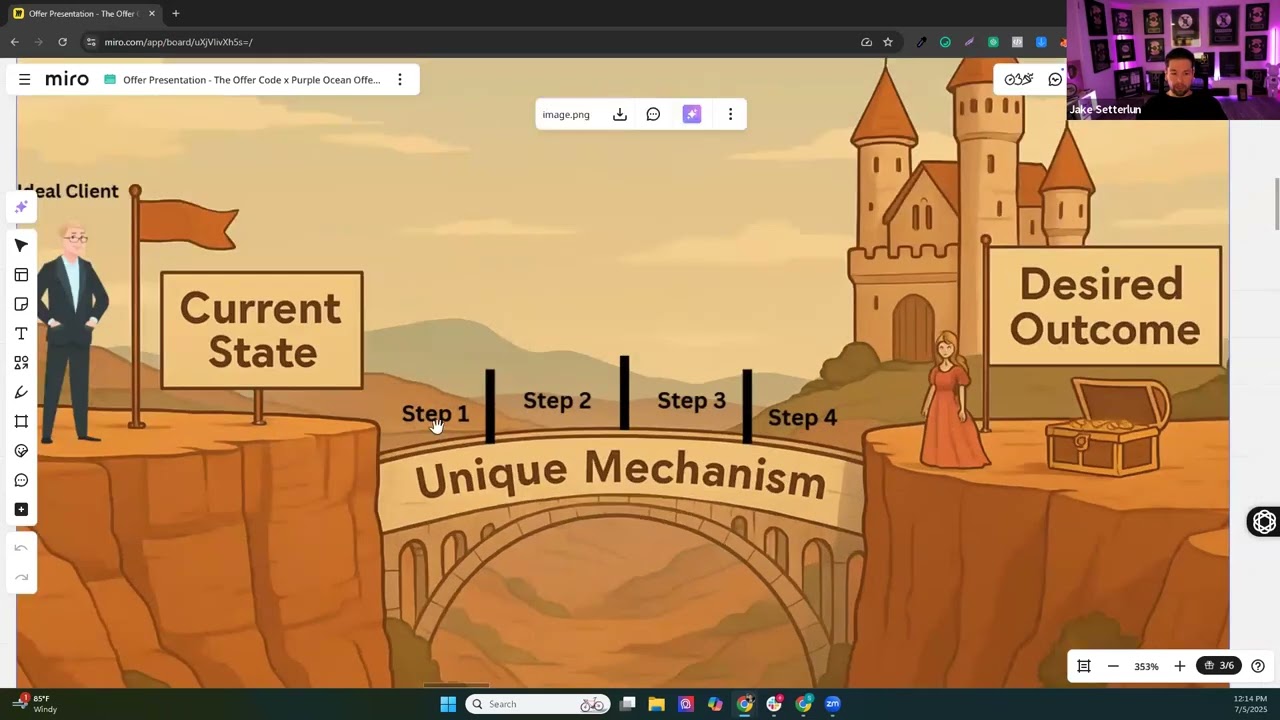
All right, good. Awesome. So let's jump into it. So again, my name is Jake Setterlun. I've been doing this for almost 10 years now. And over that time I have had a lot of successes, but I've also had a lot of failures. I actually didn't make a lot of money for the first few years in business. And since then, since having some success, I've been able to take 8 different businesses to 7 and 8-figure run rates. We've done a lot of different stuff online in terms of with ClickFunnels, getting awards, Inc. 5000, being the number 1 GHL agency. So a lot of different accolades in terms of some of the successes that we've had. But I had the screenshot in here. This is from 2017. This is when I bought my first online course, digital course, after kind of spinning my wheels in the entrepreneur space for a little bit. So it's been a long time coming in terms of everything that I've done. There's been a lot of successes along the way, but I like to show this screenshot right here in terms of revenue, 'cause you can see, you know, back in 2019, getting started with our first, I guess with this Stripe account, we had businesses and failures before then, but really not making a lot of money up until this point right here. You can see that something clearly happened at that point. And what was responsible for that was a lot of different things in terms of our offer that we changed that allowed us to scale our online business. And again, since then we've went off, we've generated $25 million in online rev, we've had multiple other successful businesses. And again, the biggest thing for us in that turning point was having the right offer. And I'm not here today, I'm not going to just teach you the basics of, oh, you know, have an offer that solves a problem. Yes, that is a part of what I call the offer code, which we're going to get into. But we also have what we call purple ocean offers. And everybody talks about blue oceans and having a blue ocean offer. We created and we developed this unique idea of a purple ocean offer. Which is how to actually position yourself in the market. And at the end of this training, I actually have an AI agent I'm gonna drop for you guys. It's just through ChatGPT that you can plug your offers in and it'll spit out a purple ocean offer for you. So I got that for you and everybody that has went through it has been like, oh shit, like this is the best thing in the world. So I'm super excited, but we are gonna start from the basics, which is the offer code, which is putting together an offer that your customers actually resonate with. And a lot of times starting off in business, you're putting together these offers, you're trying to sell something online, but you're not really thinking of what you're actually doing. You're just saying, hey, I can do X, Y, and Z. And you're not thinking about the big picture. And the biggest thing, the biggest trend that I'm going to be teaching through this training is thinking about your offer in the customer's eyes, not your eyes. 'Cause so many people are like, this is what I feel like people need, but they're not thinking from the customer's perspective. And to start off the offer code, what I really, really love to teach people is the bridge analogy. Now, this isn't my unique thing. Back in the day, I went to an event and an individual, I forget his name, but he had this bridge analogy of how to do marketing and how to approach a lot of different things in businesses. And we took this and we applied this to offers. And the whole point of it is that you have this bridge and we can see down here where you have where your customer, 'cause that's all that matters. This is where your customer's currently at. It's their current state. And then they have their desired outcome. This is where they want to get to. And in between there's this gap and your offer is bridging the gap between where they're currently at and where they want to go and where they want to go. You know, a lot of times people are focused on money, a better life, an empire, whatever you're trying to sell somebody. And based off of your individual, this desired outcome has to change. So if I'm gonna be using a marketing agency as an example throughout this training for offers, and you'll see how we actually display the offer to the customer is different than how I would actually be pitching somebody if I was trying to sell them coaching services or something like that. Whereas with coaching services, most people are just worried about making more money. Whereas you'll see with the offer that we have for you today as an example, based off of selling to insurance agents, they want more policy seekers, they want more customers. So we're gonna be using their type of language. So when you're thinking about desired outcome, you're really thinking, okay, what does the end customer actually want? And then again, your bridge is the offer. And part of that is having a step 1, step 2, step 3, step 4, a unique mechanism, which we're gonna be getting into today. But again, the biggest thing starting out is where are they currently at and then where do they want to go? So first principle of having an offer, again, these are the basics. The offer code's the basics, and then we're going to get into the fun stuff, which is the Purple Ocean Offer training. But having a niche-down offer, you have to speak to somebody. If you're out there just saying, I help everybody do anything, you're never going to be able to resonate with anybody in terms of your marketing. Which is a key to scaling. If you can't go out there, you can't run ads to attract individuals, even doing content, it's very hard to attract your ideal customer and then position a product that they actually want to buy. And if you go too broad, you end up just really not being able to hit home on the emotions of that individual. So starting off with the basics, again, I mentioned I have a marketing agency example for you today. Whereas before, let's just say somebody's getting started. This is what we do as a marketing agency. We do Facebook, Google Ads, website builds, SEO, uh, and all of, you know, just all these different marketing things. And the transformation here with being niched down is we are a marketing agency that helps insurance agents. So we're picking a specific niche. And one of the biggest things, cuz you know, everybody always asks, you know, Jake, how do I pick a niche? Do I go after money? Do I go after, you know, potential opportunity? And I think if you're at a certain level, that's absolutely a valid way to think about it. But If you're just starting out, the best way to actually think about what niche I should go into is going to be what you have experience in. In this example today, I'm going to be going over marketing agency for insurance agents. I would go in and I would start that if I actually had experience as an insurance agent. When I got started, we had a marketing agency for real estate agents. Now, I didn't have real estate experience, didn't know a lick about it, but my partner knew a bunch about it. He, he was a previous real estate agent. So for us, when we got started, when we, you know, we got into business together, it made sense for us to sell to real estate agents cuz he knew about it. So starting off, find a niche that you actually have experience in, a family friend in, somebody knows something about it that you can then leverage their experience to position yourself upfront. So again, starting off, we want to be niched down. Next is we want a productized structure. And what this is, is we're now gonna start to think of our product, our service. You can see over here, we're just kind of offering everything to everybody. We do Facebook, a little bit of Google websites. We do a bunch of different stuff, a lot of different offerings. And the, excuse me, the biggest way to scale your offer is going to be having a productized offer because you need to create a machine and you can't have a machine that just does 100 different things. When you think about putting a machine together, it does one very specific thing very, very, very well. Even like a physical machine, it makes one type of product very well. It's the same way we want to think about business is we want to do one thing very well. And the biggest thing I do recommend too, when we think about, okay, how do we actually productize our offer, is also thinking about what's a quick win I can get somebody. You know, if your offer takes A year, 2 years, 3 years to deliver. How can I start to get somebody something tangible in their hands? Service consulting upfront. So even if my service takes a little bit, that I do want to be delivering up upfront. So that is something that you do want to think about when you start to think about productizing your offer. But we can see here the transformation on this is we're a marketing agency from insurance agents over here. We're doing the same thing. But you can see we do one specific thing in this transformation piece. Instead of doing Google, Facebook, websites, all this stuff, all we do over here is we have a very productized offer. First, we're gonna set you up Facebook ads. Again, that's a quick win. They can get some leads in the door very quickly. Then they're gonna automate the backend lead nurture with GHL, which is a CRM. They're also gonna get CRM account access. They're gonna get weekly reports. Uh, one-on-one onboarding, and we're gonna price that for now at $2,000 a month. So it's a productized offer. I can build a team around it. I can onboard somebody, and when I onboard somebody, it's exactly the same process every single time. I'm not switching things up. So next we get into, now that we have a productized structure and we're niched down, we're gonna start to think about what's the transformation that's happening? How am I gonna get somebody from point A to point B? We looked at this map before, and what we want is we want our offer to be the transformation. We don't want to just have an offer. And you can see before where it's like, oh, you know, Facebook CRM onboarding, like all this crap. Yes, it's a productized offer, but it's not transformational. It's not a clear path of, hey, this is step 1, this is step 2, this is step 3. So we're gonna want to transform our offer into something that's actually transformational. transformational in the customer's eyes. So the customer really feels like, okay, when I get onboarded, every single piece, every single step of my offer is taking them to that end goal of where they want to get to. So again, the transformation here is I do Facebook ads for insurance agents. We offer all this crap and we transform this into something that is very tangible. It's very step by step by step. So starting off, might be my offer is first off, we're gonna set up targeting for you to help find people that are interested in insurance policies. Then we're gonna set up Facebook ads for you to find those life insurance leads. We are then gonna qualify those people with automations, and then we're gonna book those people into a booking software or to a CRM for you. So my offer's transformational. I can't have— I can't run Facebook ads without targeting. I can't have lead qualification without leads. So it's this transformation that's happening that you're explaining to them with your offer. And again, it's step 1 leading into step 2, step 2 into step 3 and so forth. And this starts to, in the customer's eyes, they see the transformation, they see what they're buying. It's not just, hey, you're gonna, you know, come in, get all this stuff. You're buying into the transformation and you're starting again, going back to the bridge analogy, You're starting to sell the dream. You're selling the transformation. You're selling the journey in addition to just selling a specific product. So that's the transformational piece. And then we get to kind of some of the more in-depth pieces. And this is going to be something of why it actually is important for you to understand what you're selling. You're going to have to realize what's the actual profit margin on what I'm selling. And for everybody. No matter if you're selling a coaching product, high-ticket offer, agency services, the biggest thing is looking at a 10 to 15% cost to fulfill. Now, the reason that we want to have this at such a low amount starting off is that at scale, you're gonna have marketing expenses, you're gonna have to pay closers, you're gonna have to pay a team, you're gonna have software expenses. And yes, upfront you might be running at a, a 90% profit margin, an 80% profit margin, But at scale over time, that's going to shrink and shrink and shrink. And like I mentioned, we have some businesses that do $10 million a year, but the profit margin, it's not that great. It's 20% profit margin, 30% profit margin, because at scale you have so many expenses and you even thinking like a 5% processor fee, that's an expense. And at scale, that's a lot of money that you have to think about. Looking at this, we can start to piece together a, an actual, you know, legitimate price for our offer. So again, over here we have our transformational offer. We were at $2,000 a month, but let's just say we have a big setup fee upfront. We have to do all of this work, and then after we do all the work, it's set up, the system's good to go. So then it's just kind of smooth sailing from there. So we might want to tag on a $1,000 setup fee. Setup fee for those specific individuals. It costs $500 to set that person up. So we're gonna tag on that $1,000 setup and then we're gonna charge $2,000 a month. So now upfront, first month, we're hitting that 80 to 90% profit margin. So profit margin's in check. We have a transformational offer. We're niched it down. Next, we want to get into logical value perception and what this is. Basically is, does it make sense? Does the offer and pricing actually make sense to the customer? And a big thing here is that, you know, we have a lot of setup upfront with this type of a service. We're doing a lot of work upfront, but month over month over month, there's not a, there's not a lot of work to do, especially with these people. They might not have a huge ad budget or marketing budget, so it's very easy for our team to fulfill. And these people aren't stupid. The people that you're selling to aren't stupid. So we're gonna redo our profit mark— or excuse me, we're gonna redo our pricing to make a little bit more money up front. And then on the back end, we're gonna be like, hey, it's just $100 a month for support. So we're gonna go from a $1,000 setup to $2K a month to a $4,000 one-time fee. And then on the back end, it's $100 a month. Not only am I gonna be able to sell more people at this pricing, But again, it's gonna make sense to the actual end consumer because I can go out there and say, hey, everybody else in your market, they're charging you $2,000, $3,000, $4,000 a month. They're not doing anything month over month. All of the setup is upfront. So I can say that to people. I can be like, hey, I'm on your side. I wanna tell you a secret about the industry. And now we're gonna make all of our money upfront. We have a good profit margin because we're doing all that work upfront for them. And then on the backend, obviously we want a little bit of a recurring, So we're gonna charge $100 a month for support, and that's what we're gonna do. And it's very similar. And when you look at pricing at scale for your offer, when you're doing millions and millions of dollars a year, one of the things I like to do is look at big industries. What are they doing? How are they priced out? Um, we look at school being very popular nowadays where it's a little subscription every month. You get all this value. It's very similar to a Hulu, to a Netflix. where they're going for a mass play. So when you think about at scale, at market, what is everybody buying? Most people are not buying thousands of dollars of services every single month. They're buying these different things. So again, look at big, big, big markets in your space and look at what their pricing structure is and price it accordingly from there. So we've now taken, we've put together a logical value perception. We have a better pricing and a better offer. for the customer that actually makes sense to them. And then now we want to solve a real-world problem. We want something that is top of mind. We want something that we are selling people that is actually what they're going to buy. Now, thankfully, with this offer, we have appointment bookings as kind of the main deliverable. And then all we're going to do is layer on a guarantee. We're going to guarantee them appointments because if we look over here again with our bridge analogy, This desired outcome, they're going to associate appointments with money. When an insurance agent thinks, oh, I got somebody on my calendar for the week, they're going to associate that with money. So I'm not going to come in here and I'm not going to say, hey, I'm going to guarantee you that we're going to get you, you know, make you $50,000 or $100,000. Because to some people, again, you know, yes, everybody wants to make more money, but you really need to get granular. with the problem that you're solving actually feels tangible. You're not just slapping a dollar amount on it. So again, here we are gonna focus on appointments, delivering appointments, but then that's also going to be the guarantee on the offer to make sure that, you know, again, that's something that we're delivering on and they're gonna be buying and seeing the transformation when they're buying from us. So we've now started, we've taken a general Business that offers just a bunch of crazy different stuff. You could apply this to AI agencies, you could apply this to coaching businesses. You just do a bunch of stuff. And now we have an offer that is transformational, transformational, uh, niched down. We have a guarantee, we have pricing that makes sense, but this isn't enough. This is still a red ocean offer cuz there's still hundreds of people that are out there trying to sell Facebook ads to insurance agents.
So.
This is the offer code. This is putting together an, an offer that speaks to your customers. But what we want to do is we want to take this one step further now, and we want to have a purple ocean offer. And like I mentioned before, this is something that we've developed. This is our proprietary method of how we craft winning offers. And when you think about offers with a red ocean, a purple ocean, and a blue ocean, red ocean, you know, it, it's a pretty known thing. where it's a very large competitive market. It's very saturated, and these individuals are very solution aware. But what you're also selling them, they've heard before. So an example for this is, I help X, Y, and Z scale with proven DM ads. If you're in the coaching space, you've heard about DM ads. It's just what it is. Same thing over here is, I help insurance agents scale with Facebook ads. It's very red ocean. It's very, I know, you know, I've heard about this. A lot of competition. I've been pitched by this 1,000 times. I've probably even tried this before. That's red ocean. Now, blue ocean is something completely new, and a lot of individuals pitch, gotta have a blue ocean offer, gotta have a blue ocean offer. And what we've found with blue ocean offers is sometimes they can be a little bit too alien. They can be too unique. An example with that is I help X, Y, and Z. So insurance agents scale with Hulu ads. So not only is it something unique, yes, you're gonna get some attention, you're gonna get some clicks, When you're marketing it, but you have to sell that person that that is actually gonna work, that that's actually something that they wanna buy, but then also that it actually works because they haven't heard in the market like, oh, that's something new, that's something unique. They don't even know that it works. So now you have 2 hurdles. You have to sell yourself and you have to sell that the product is actually gonna work. Where in a red ocean, the benefits of it is they already know that it works. They might have tried it before. But they know that it works because they hear about it so much. So what we've done is we've taken that red ocean, put a blue ocean offer spin on it to create a purple ocean offer, which is taking a red ocean offer because again, the end user know that it works and just putting our own unique spin on it so that we can still fish and we can still compete in this large market where there's a lot of buyers. We're not trying to sell something crazy new that people have never heard of. The people are ready to buy. We're just putting our own spin on it. So in terms of a purple ocean offer, we have 3 different key pieces to having a purple ocean offer. The first being having something proprietary, having a secret sauce. And what you want with this is this is going to be the reason that somebody buys, but it's also this proprietary secret sauce is the reason why somebody's gonna have success with you. Versus somebody else. So again, over here we have this offer. Everybody can go copy this. This is there's nothing proprietary about this, nothing at all. And one of the biggest things that we did, I mentioned having. Let me go back there so I don't ruin my diagram. One of the biggest things we did when we first got started with the marketing agency for real estate agents is we came in here and said, "Hey, we're going to help you target these motivated buyers and sellers." But we have our own unique market exclusivity with this homeowner network. We're gonna help you tap into that homeowner network, ID your future customers, and then we're gonna help you show up everywhere in front of those individuals. Now, secret for y'all, this is just Facebook ads. This is Facebook targeting. But what we did is we took that, that uniqueness, that proprietariness. Yes, we had our own way of doing the, the Facebook targeting. We took that. And we put our own unique spin on it. So if you have a coaching business, a high-ticket offer, you probably have something that's super unique to your business of the way that you deliver for your customers. Whatever you do, you're gonna take that and you're gonna put your own unique spin on it so that it feels like it's your secret sauce. It's something unique. And what we were able to tell people during the sales process is that, hey, guess what? With everybody else, everybody's fishing in that lake. Everybody else, you know, you got everybody lined up on shore. They're all fishing for the same fish. Because we have our own data, we have our own homeowner network, we're going to create your own lake for you.
Right.
We're going to give you your own lake. And these individuals— or excuse me, nobody else is going to be allowed in your lake. You're going to have exclusive access and you're going to be able to fish for these buyers and sellers on your own. And that's going to give you an edge over your competitors. So that's how we were able to position it with our offer that, hey, We got this proprietary data nobody else does. You can go with somebody else, but guess what? You're not going to get the results that we're able to get you. So an example of this with our example with Facebook ads for insurance agents is now we're going to do Facebook ads for insurance agents, but instead of saying targeting people looking for insurance policies, we're going to say in-market prospect latching technology. We have our own unique technology that's going to help you find your ideal customers. And again, for a coaching business, you might be able to say, hey, you know, we have our own unique Jake Method, you know, with a TM on it that, you know, is proprietary to us that we help individuals get results with that unique method. So it's something unique to you. It's that secret sauce. So that is having a, excuse me, a proprietary method to your specific offer. Next, with a purple ocean offer, is starting to think about language. Again, like I mentioned up here before, we have that purple ocean offer, but we still want to compete in that red ocean because that's where all the money is. So first thing with a purple ocean offer in terms of language is negative language. So making sure that we're speaking, we're not saying trigger words in terms of negative language that the end customer might associate with their offer, but then we also want to use consumer-centric language. Which is actually speaking to the customer how they want to be spoken to, not how we feel like they want to be spoken to. So an example with a negative language, I'm going to use the word pineapple on, or I'm going to use the example pineapple on pizza because we use that and we explain that to everybody that we teach this to. It's a very, very, very polarizing thing. Pineapple on pizza. Some people hate it. Some people love it. Now, if you think about somebody that hates pineapple on pizza, They're not gonna go down to the new pizza shop, the new pizza shop down the road and order a pineapple on pizza because they know they don't like it. So they're not gonna go order it somewhere else. But if I put a spin on it and say, hey, I got a new pizza shop with a tropical pizza, even though it's got pineapple on it, there's a chance that I can convince that person to actually order that pizza because I'm putting a spin on it. I'm not using that trigger word of pineapple on pizza. And it's the exact same thing over here. Chiropractors, as an example, and even really just a lot of businesses hate the word lead. They don't like the word lead. Real estate agents hate the word lead. So instead, I'm going to say, I'm going to find you buyers and sellers, or I'm going to find you new patients or attract new patients for you. So we're not going to use those negative languages that they associate with bad experiences with other companies. Same thing over here. Real estate agents hate the word Facebook ads. So instead we're gonna say we have an in-market demand system where we're able to attract these individuals that are looking to buy and sell. We're just using different language to explain the same thing without using these trigger words. But then we're also gonna want to talk to our customers how they want to be spoken to. A lot of us get, you know, with our high-ticket offers, we, we think that we need to speak how we think of, you know, in terms of our language and our knowledge of that specific industry. And with marketing you have things like SEO, CTR, ROAS. There's these key terms that yes, we understand them, we live and die by them, but our customers don't associate money with those words. They just think they're these words that you're spitting out that they can't relate to. So when we're actually talking about our system, we want to have language that's actually resonating with the customer. And what I like to do is think about how would my customer explain my offer to another potential customer? If they had a peer that they were saying, hey, this company does X, Y, and Z, and that's how I want to actually communicate my offer to my customer, not with language that's very, you know, again, that kind of resonates with me. I want to speak how my customer's going to speak to, you know, again, their peers. So the transformation here, we look at it over here, Facebook ads for insurance agents, in-market prospect latching technology. We already got that on lock. But everything else is very generic. So we're going to transform this into the Policy Seeker system. We're going to say, first off, we're going to help you target in-market prospect latching, or we're going to— we have our in-market prospect latching technology. We then have omnichannel advertising. So we do Facebook, IG, Google, LinkedIn. We then— we don't do lead qualification with automations. We do application verification. It's a spin. It's just a It, you know, it's a wordplay, but to an end consumer, what sounds better? Lead qualification or application verification? Application verification all day. And then same thing, we don't do appointment booking, we do meeting coordination. And again, all we're doing is we're playing with language to match how the customer is going to be spoken to. And our last thing, last example that I have for you is also really looking at competitors. You know, a big thing and a big piece of Purple Ocean offers is that we have competitors. We're playing in a red ocean because a red ocean, it's where the money's at. It's where we can make a lot of money, but we have competitors. So what do we need to do? We need to make sure that we beat them in every single aspect, that we have better pricing, better deliverables, better guarantee, and pound for pound, we are the no-brainer offer. So that is the biggest thing that if, if I'm pitching somebody and I, you know, they go off and they talk to every single one of my competitors out there, that 10 times out of 10, they're going to work with me and they're going to buy from me, not my competitor. So there's a lot of different ways, a lot of different things that you can actually add in to having a no-brainer offer versus your competitors. But for us, the 3 biggest things is giving away the farm. So over here, my competitors are just, you know, very standard deliverables. This is what we're gonna do with you. But what I can do is I can come in here and I can give them the farm. I can give them bonuses absolutely for free, and it doesn't cost me anything giving them a full AI recruiting agent, proven recruiting ads, trainings, et cetera. It doesn't cost me anything to deliver that because it's already made. Example for coaches might be some secret training or some secret course. But to the end consumer, it's like, oh shit. Me versus my competitors, not only am I getting the same product, but I'm also getting these bonuses. And then next, in terms of being better than your competitors, we can look at our guarantee. So over here, our competitors, they, they might be guaranteeing 10 appointments. What can I do? I can come in here and say, hey, we're gonna guarantee you 10 policies in 3 months. Again, who are you gonna go with? Are you gonna go after your competitors that they're basically just offering appointments? Are you gonna go with you? And you're guaranteeing 10 policies. And then lastly is FOMO. So we mentioned having that in-market prospect latching technology. We're gonna give you zip code exclusivity to that license, so nobody else in your market is gonna have access to that. But guess what? Quick Google search when I'm on a call with them. You know, I, I am talking to Jim. I don't know if you know of him. I think he's from your area. I'm talking to him tomorrow. So, you know, hey, if you wanna buy, you know, we gotta do a deposit today or we should get you signed up. Because I wouldn't want you to miss out on that exclusivity. So again, layering all of those things in, that's when you put everything together that I've just mentioned to not only have a purple ocean offer, but if we come back and we look at this analogy, you're seeing your offer. This bridge is your offer, but you have to think this customer has 1,000 different bridges. They have 1,000 different ways that they can get across their— this valley, and those are your customers. So how can I not only have a good bridge that's solid that they trust, but that my bridge is the most attractive to that customer? And then all you're doing is you're saying, hey, right here they come through and I'm just collecting money before they get to the other side, before they get to that desired state because they're choosing to go over my bridge versus my competitors. So that is what a purple ocean offer is. And again, a little bit of a checklist for you. In terms of validating your offer. Obviously going through all of these steps is big, but number one, would a customer choose your offer 10 times outta 10? I mentioned that before. Biggest thing, know your competitors, know what they're doing, and be better than them. Is it a transformational and FOMO-inducing offer? Does it feel exclusive? Is it valuable? Is it urgent? And then lastly, do you have that secret sauce that makes you and your offer better than your competitors and an offer that they feel like if they go with anybody else that they're missing out on? Because your competitor doesn't have that secret sauce. So again, we look at this over here, Facebook ads for insurance agents. We have the Policy Seeker System. That's that purple ocean offer with all the deliverables, the guarantee, the exclusivity. If we look at a coaching offer, this might be something that your competitors are offering. And over here, we're gonna offer a 10-week course just like they do, but we're gonna do a custom road planning session. We're gonna do a one-on-one weekly call. We're gonna do daily check-ins. We're gonna give you 24/7 access support, to an AI agent that nobody else has. That's my secret sauce. And then bonus, we're gonna give you access to a Founder Ascension System, and we're gonna have a better guarantee with a lower price. And then lastly, looking at an SEO offer over here, we do SEO website optimizations, all this random crap that's very old school, very traditional, and we're gonna put a new spin on it and we're gonna say, hey, we're gonna get you reviews. We're gonna rank you number 1. We're gonna get you booked on podcasts. We're gonna build a referral network out for you. And bonus, we're gonna give you an AI receptionist. So it's all about positioning. Having the right offer is about positioning. It's about being better than your competitors, but then also making sure that your offer, going back to our bridge, is transformational. And at the end of the day, is your bridge, is your offer something that your customer's gonna choose to go over versus anybody else inside the market? So, Thank you all for being here. That is our training on offers and putting together a solid offer, starting off with the offer code and then getting into Purple Ocean offers. So I'm actually gonna drop the AI agent if I can find it here really quickly for everybody in chat. So if you have an online offer, you can simply go into that, that ChatGPT AI agent, plug in your offer, and it can start to spit out some Purple Ocean offers for you. Uh, based off your industry so that you can workshop. And again, my goal for everybody, uh, today on our call is that you have a purple ocean offer and it is something that you can go out there and have a lot of success in. And again, going back over here, when we look at my results, wrapping this up, we didn't have testimonials at this point. We didn't have testimonials, results, followers, anything like that. All we had was good positioning and a good offer, and that was the key that unlocked all of our success. So I'll leave it at that. Thank you all so much. If you want to drop questions in chat, I can answer those for everybody. But thank you all so much for being here. Um, again, questions, questions, questions, feel free to drop those in chat and I can absolutely answer those for everybody. So thank you so much.
Thank you, Jake.
Absolutely.
Thank you.
So the chat's disabled.
Oh, the chat's disabled.
Okay.
I mean, thank you, bro. I don't know how you guys normally run this. I'm down to answer some questions if you wanna unmute. Um, I can share the doc for sure.
Yeah.
So basically you need to accept our request to promote you as panelists so you can message.
Yeah, we can connect you with somebody.
Um, if you got somebody else that you think knows—
Hey, Jake, what's happening? What's up, Jake? It's good to see you, man.
Hey, I appreciate you hopping on with our, with our group, man.
Uh, I, I love the energy, what you got cooking here, so it was awesome to be able to hop on with you, man.
Yeah, absolutely. Thanks so much for having me. I appreciate it.
Hey, um, you changing the, um, the wording Was that a really big difference? Did it make a huge difference?
100%. The biggest thing with that is when we were selling to real estate agents or even insurance agents that we do now, they associate negative experiences with Facebook ads. So by us changing the wording helps them start to rewire their brain that like, okay, this isn't PTSD triggering words. Not get all soft, but like, that's their thought process. So by having different words, they can start to craft and we can start to help them picture a new experience where they're not just associating it back to, to a negative experience.
All right.
That makes sense.
Hey Jake, this is Pencella. Thank you so much for taking the time to speak to myself and everybody. So how long did it take you? Because I know you've been at this for 10 years, how long did it take you to really get adjusted to this terminology in this fast-paced world that we live in? Because I know right now more than ever, AI, ChatGPT, you know, all that is so rapidly changing. So how do you keep everything consistent even though so many other things around you and the technology and the ways of communicating on social media, advertisement, All that, you know, and still get that high-ticket sale, but also make the customer feel that they made the right decision?
That's a, it's a really good question. So it, it, you know, it's something that I go in waves of. When we were first starting out, super in tune with what was going on in the industry, new things, constantly trying to improve. And, um, you know, we got into our, our businesses and about 2, 3 years of having success, We actually took our foot off the pedal a little bit, and you know this is kind of the negative you know part of my my journey and my experiences. When we took our foot off the pedal, stop you know we weren't as in tune with what was going on in the industry. There's about a year where we were negative every single month because we had this big organization, a lot of team members, and we're constantly putting money back in, and it was from us not having you know an offer that actually resonated any anymore, and that was within. 4 to 5 months, the market changed and people stopped buying what we were offering. So it really is like, that's the biggest piece of this whole online industry. It's constantly improving, having new offers, staying up to date. You look at AI and what AI did, that's a large-scale type of an example. But even going forward in today's market, you're always going to have those little new things that people are like gonna always eat up. So if you can stay on top of it, and my biggest thing is like staying in the trenches, that's what's gonna help you stay top of mind. But it's just something that you have to accept that you're constantly gonna have to be changing because it's just the world that we live in.
Thank you. I did have another question, but I want others to also have time to ask questions to you if they need it.
For sure. I think—
yeah, raise your hand if you got a question, like virtually raise your hand on Zoom.
Yeah.
Thank you, Logan. Yeah, no problem. Uh, Adib?
Yo, what's going on? So I was trying to ask you, for people that are like starting their marketing agency, what, what do you recommend like to get their first clients and everything? And I just got on too, by the way.
So, okay, for sure. So I think it really like having the solid offer is because it's kind of a loaded question. I personally believe everybody that I talk with and I teach is have an offer that's going to sell off the jump because it makes getting your first client easier. So spending some time and looking at what industry do you have experience in, what can you relate to? Do you have experience as a real estate agent, as an insurance agent? And then craft an offer that those individuals are going to buy. And then as far as getting your first client, I mean, if you got some money and you want to try to do some Facebook ads or something like that, by all means. But I like the dirtiness of just cold calling people. Find a list and start calling people up saying, hey, I got this thing. Do you have 5 minutes? I'd love to show you it. And book meetings. And that's what I did when I got started. We were selling marketing to golf courses. I shit you not, by the end of that first year, every single golf course in Wisconsin knew my name because I was calling them up and I was being like, yo, like, hey, we got this thing. Like, I know I called you 3 months ago, but, you know, I want to get it in front of you. I think it's going to do a lot for your business.
And yeah, but what offer, like, what would I show them if I don't have testimonials? I was thinking about doing a like 2-week, $500 offer. I don't know what you think about that.
That's a good question. It depends on your industry. It depends on how good you look. If you go in, and I've done this, I did this for a long time. I'd go into, I've taken some meetings where I go in there with a blank sheet of paper with dick all in my hand and I'm trying to sell them and get money from them. But if you can put together a good presentation, show them what they're buying, put together a good offer, it's something that you can start justifying getting money from those individuals. So it's like, you really, you know, back in the day you could get away with just going out and selling some services, but the market's so flooded nowadays. Like, you almost need to focus a little bit on building the business and having structure and something that looks good website, a good presentation, whatever that might be. Because it shows that like, okay, like you take this serious, you have a good presentation. And that's going to allow you to actually get money. Too many people will just go in and be like, hey, I'm gonna, you know, we're gonna talk for 30 minutes, and I'm gonna send you an invoice for $2K. So it like really look at like, what's your offer and putting together a good presentation, where you're showing them exactly what they're going to be getting from you.
Okay, sounds good. Thank you, man. I appreciate it.
Absolutely, absolutely. Uh, Brian, you're muted, bro. Yo, Brian, you're muted.
My bad, my bad. Um, damn, I forgot what I was saying.
Oh. My bad.
Yeah, man, I really love everything you were saying. Like, it shook me. It even made me geek out on some of the things you were saying.
I was like, oh, this guy is spitting.
Like, especially with the different oceans, that's something I've never heard of. So that was like a big impact for me. And it actually started rolling the ball to freaking kind of plug it into something I want to do. And my question is actually how, man, how do I put this? Damn it. Like, man, my bad.
I lost it.
I had it really good. But if I could go back to it, come back to me.
It's all good.
Okay, that sounds good. Uh, Dominique?
All right, so this is a 2-part question.
Yeah.
Um, oh, sorry about the leaves. So while you're building your system, did you solely rely on trial and error to discover your system that works for you, or were there key references and resources that Kind of really switched the game, those pivotal moments where, I mean, did you have like, was it all intuition and enlightenment? Just tapped into your higher mind and everything just worked out like a gravy boat? Or were there key resources that really shifted, um, for you 10 years ago? Uh, that's part one. And then part two is how are you innovating and anticipating future trends in marketing, um, from now incorporating AI?
For sure. That's a great question. So there's, there's 2 things that I can think of in terms of when I got started that were like the keys that got us to where we're at today. Um, these theories, you know, we weren't that enlightened where we were like, yo, like this is what we got to do and like really seeing the picture that I showed you today. Um, but the 2 biggest things is I had read a book that it was like the principles of marketing, something stupid, like the basics of marketing when I first got started. But one of the things I'll always remember from that book is saying that the winners in markets, like, you know, looking at startups and products, those crazy people on Shark Tank that have these absolutely random, crazy products, those are, those are chances for people. People are going to buy those and it's a chance because they've never heard of it. But when you take an industry and you just tweak it a little bit and you put a little bit of a new spin on it, a little bit of a new, new way of doing things, Those are always the businesses that have the most success. So when we looked at, you know, our business, online business, we were like, okay, like let's have Facebook ads, but like how can we tweak that? And then that's where that proprietary technology came in. 'Cause it was like, we're gonna have this, but we're just gonna put that little spin on it. And then the other thing was always just being super fucking competitive. I'm sorry to swear, but like—
Yeah.
We were just always looking at like, what are our competitors doing? How can we be better? Because in this online space, like that's really what it is. And when you're talking to somebody, they're talking to 3 or 4 other competitors. So I want to make sure that my offer stands out. So it's those 2 things that were really, you know, probably the seeds to everything that, you know, it's grown into today. But as far as like AI and what we're doing with our offers currently, it's super interesting because there's this spread in the market nowadays where You used to have this middle ground of people that would buy mid-ticket services. So anywhere from a couple hundred dollars to a couple thousand dollars a month. And we now have the spread because of information. It's so relevant so that, that middle ground is dissolving because it's very easy for people to just do the services that we would normally offer. So it's now, hey, we have the super low ticket and then we have super high ticket. So I'm gonna either sell all of the knowledge with some AI agents to do it your You know, quote unquote, done with you, do it yourself for $17, $27, $97 a month, something super low ticket. And then, hey, if you want like a very custom hands-on done-for-you experience, then we're gonna sell you that high-ticket product. But like that weird middle ground is shrinking. So that's been the biggest thing for us is we're introducing people into our products with low-ticket subscription-based stuff. And then on the back end, we have more of our high ticket. We're going to work with you more custom type of stuff. So that's the biggest thing nowadays.
Absolutely.
Sergio.
Hey, how's it going, man? Like my brother Brian said about the ocean, that's super dope, man. That's something really unique. And well, I just have an intake, man, because, uh, he, he said pretty much, uh, what I wanted to say. But, um, you know, the part where you said about, um, finding a pitch and what you have experience in, that right there is like, it's like, it's like a diamond right there. Like, because, you know, everybody has their own experiences. And to me, like, that right there just hit another, hit another, like, uh, another, um, epiphany inside my brain about, about using it for sales, you know, like using my own experiences in life in every aspect, you know, know what I mean, and integrating it into this, uh, business, into, um, into what I'm doing there. I appreciate that, man, so much.
Absolutely.
Yeah, no, 100%. I will say this, like, I'll leave you with that kind of going off of it is don't chase money, don't chase a market. Every single market, there's plenty of opportunity. It's about having the right offer that people are going to buy is really the biggest thing. Yeah, most definitely. Thank you. Absolutely.
Thank you.
Hi, there's so many questions. I hope we can still stay connected. I really would like to speak to you. I guess someone who has a little, little experience with a business. I have a photography business, and what I've noticed in the pattern is the communication. So what you were saying about the rivers, the purple, the reds, the blue, it takes time to learn all. It's a whole new language. You're speaking, you know, a different world. And so Being able to visually show that, that personally helps me, which got me thinking to build a website. Now, what, what technology do you use to grab people's attention to help you advertise what you're trying to, to show that you're not like the, you know, you're, you're different, you know, because you said build a business. And to do that, you have to find different hobbies and interests, which the hobbies and interests that you like, I would like to know, and how you made a business out of that. And like I said, technology and what website, what engineering.
Right.
I'm trying to like go at once. I'm trying to like try to put it all together. But, um, what do you do to get known and seen and heard?
For sure.
That's a, that's a really good question. So from a technology perspective, I am a very big, uh, GoHighLevel person. Um, I'm sure, you know, a lot of you have probably heard of them. If not, it's a CRM that has websites, funnels, all this stuff. Um, it's not the best tool in the world, but as like an all-in-one tool, um, huge fan. You can put together websites, funnels, all that stuff, but When I got started, I started working doing social media and marketing for golf courses because I was a longtime golfer and something that I always just did a lot of. But there was, didn't have a lot of success. I was just starting out and I found a partner. And at that time I had a lot of experience in marketing and he was the real estate agent salesperson guy. So I was able to partner with him and we leveraged his real estate experience to then have success. So, you know, that was kind of how we got into the market. But as far as like build, I call 'em trust assets, which is like authority building, especially off rip when you don't have testimonials and a client base and things like that. There's so many different things out there that you can do. Now, you could go down the route of getting free trials, doing free work, case studies, but nowadays it's really that you at the point where you don't even need to do that. I think creating content is a big trust asset. You know, and again, it doesn't have to be the best content in the world, but if I make a YouTube video and I'm just starting out, it's like, hey, here's my $100K DM script. By associating the word $100K and DM script, even though I've never had a customer, it's one of those, it's kind of like in my customer's head if they're researching me, like that's an authority piece. And I could show 'em that video during the sales process. Having a good sales process is important. Having different certifications, Being a part of local communities, but then showcasing it. So if I join my local commerce chamber of commerce, I'm going to put that logo on my website because I'm going to show them and use that by associating myself with that other established business. So it's kind of like trust by association. Again, if I use GoHighLevel, I could put the little powered by GoHighLevel at the bottom of my website. Again, trust asset. I'm associating myself with a bigger brand. If I donate to different charities, I'm going to showcase that. Again, you know, not, not being a scumbag, but like starting out, you, you have to build trust. So I think content's super important. Uh, and then the last thing is getting on podcasts. Is, is there's places like, it's called PodMatch. Um, there's another one called matchmaker.fm. These are, these are places that anybody can go out there and get on podcasts. And then you take that, take the recording, take your feature, and now you've been interviewed by somebody else. That kind of starts to make you this local authority. And it's all of those little things pieced together is going to supplement not having any customer reviews or testimonials when you're first getting started, in addition to your personal experience and just having a video that's like, hey, this is me. Again, if I'm my partner and what we did, we said like, hey, I have this experience. I was a real estate agent for 3 years. Now I've taken, you know, my specific lessons that I've learned and I've developed a system. That allows other real estate agents to do the exact same thing. So it's that story with everything else I mentioned that allows you to, to be positioned as somebody that they would actually buy. And then that's going to help you get in the door. That's going to help them trust you. And then if your offer is better than everybody else, like, that's kind of that magic formula.
Thank you so much. That was, that was a lot. So I appreciate that.
Yep, absolutely. Absolutely.
Brian?
Yeah, hell yeah. Um, my question was, so about getting the price right, how would you— like, how did you price your product service, um, when you were first starting off? Because obviously, you know, when you're starting off, you're still getting experience, right? You're still Getting the whole system down, like once you got it locked down, you got it done, how would you price yourself? How would you price all this?
That's a good question. Um, depending on what you're doing for people up front, if you can, I know, so, you know, everybody's in a different situation. Um, at that time I was living at home so I could do this and I, I was doing free work. I did about 10 to 15 clients for free. I got results for them or the results that I could get. Not everybody was great, but then I'd get a review from them for doing all the free work. And then I leveraged that into being able to charge. And when I started charging, it was, what do I want to make for the work that I'm going to expect to be doing? What do I want to charge? And then at scale, I talk about the 10 to 15% of your fulfillment. That's at scale. That's what you want at scale. But just starting out, it's kind of like, what do I want to make off of this person? And then as you grow, as you scale, as you bring on team members, as you get more results, just start increasing your prices. And then another thing too is like, what are your competitors charging? Because they're also, whatever the customer's willing to dish out is really kind of the benchmark for the industry.
Mm-hmm.
But I will say starting out, like don't listen to the gurus that are like, yo, go out there and You know, that's a $10,000 service. Go try and, you know, sell that for $10K because you're just starting out. Like, nobody knows who you are. You don't, you don't have everything that I just mentioned that goes into a trustworthy company.
Yeah, exactly. Because, uh, like, I was thinking, like, because I'm really good with music and I wanted to always, when I was young, younger, um, I always loved teaching people how to learn music. And it was like a big dream of mine to like be a music teacher or something. And as the years went by, obviously life happens and stuff. I only recently started to think about that again. And then the whole blue ocean, red ocean thing kind of just started clicking it all together and stuff. And I was like, man, like I could even do it like this and I could do this. But then I was like, man, like How would I charge that though? And then that's why I was asking. But that's freaking awesome, bro. I appreciate your advice, man.
Absolutely. Dude, just go get somebody. Like, go find 2 local people and like work with them and see if, you know, you can make it happen and then go from there and just build off it.
I'm an art teacher, so we should connect. I'd love to hear your thoughts, dude. Seriously, I've been an art teacher for 4 years. And I've, I've known in and out of the business. And let me tell you, one of the biggest things as an educator is that there's no money in schools. There's children that are not getting fed anymore, literally. And so, you know, as an educator and as an artist myself, I would like to connect with you and, and, and, and see how we can grow and then maybe follow up with Jake.
Hell yeah.
Hell yeah.
I love that.
I'm down.
Hell yeah! But that's what I like to see. Where's everyone else's energy at, man?
Right?
Opportunity is right here.
Hey, I'm listening.
I'm gonna take that opportunity, bro.
I'm listening. I'm listening. I like photography.
Oh yeah, that's right.
Well, okay.
He's about to make the music videos.
Yeah, yeah.
I'm actually into fashion. I'm into fashion and everything.
Hell yeah, I'm gonna set up the freaking costumes.
Yeah, I'm into fashion and all that.
Yeah.
So, hell yeah, let's go. Okay, cool. Um, let me see, Chance, you got a question?
I do. Yeah, yeah, yeah. So, uh, first off, uh, Jake, I actually just— I am transitioning out of doing sales for an AI agency offer. And so I was just kind of playing around with the, uh, ChatGPT agent you sent and I was already working on that and that's already been really helpful. So I appreciate that. For sure. Um, definitely, definitely good. But my question for you, man, is obviously, I mean, scarcity, urgency are some great marketing tactics. What, who are your mentors or teachers as you're going through the business and growing through your 10 years? Because, uh, I've, I've studied a couple and a lot of these are similar. So I'm curious kind of who yours were and who you took inspiration from.
For sure. I will say like biggest mentor, biggest person that I've ever learned from is the market of, you know, seeing like what's the market doing, what are my competitors doing. But to give you some names, and he's not in the space anymore, Ross Cristofoli, he put us onto, you know, kind of visualizing that proprietary technology thing too and helped me develop that. Ravi Abuvala, I'm sure, you know, a lot of you know that name. Big systems guy, helped us with how do we, you know, look at our business as a machine. Jeremy Haynes, he's a big marketing and advertising guy. Huge, huge, huge in terms of, you know, running ad campaigns, helping us scale. And then Cole Gordon, you know, sales, like shout out to him. He was big for our sales team. So Um, you know, there's nobody like crazy big, but like it's always been individuals that can teach us very technical skills that we would then go in and apply to our business.
Got it.
Appreciate it, man.
Absolutely.
Absolutely.
Let me see.
I got a question.
Yeah, shoot.
Um, I noticed like when you talk about the bridge, the desired income, And the current state. What was the other, uh, there were 3 parts to it, the desired income, the current state, and what, what else was part of that bridge? Wasn't it 3 layers?
So there's, there, there's the desired state. There's desired state. Um, so it's, it's point A, which is where they're currently at, their current state. You have their desired outcome, which is their desired state. And then, I mean, every piece is a little bit different, but really looking like a tangible outcome for them, which is not so much money, a better life, you know, better system, more time, less stress, but it's more granular in terms of what do they associate with that outcome. So, you know, an example for the insurance agents was more appointments. with policy seekers. So I don't know the third exactly, but hopefully that, that answers your question.
Okay. And then I have one more question, which is really, really important. Um, a lot of this, even like with a background in sales and a little bit of marketing, a lot of these words are foreign. Like, this is the first time I ever heard of like blue ocean and red ocean. And, um, so do you have something that you can offer to, like, you know, like, do you have like a little minor course to teach people, um, what these mean? You know what I mean? Before you actually— before we actually go into trying to, you know, um, market, you know what I mean? It needs to be a little more clearer to educate us because all of us are getting a lot of information in a short time. We're just learning how to be high-ticket closers. You know what I mean?
So that part, you know what I mean?
So do you have something more simple that, you know, either, you know, since you're successful, that you're even, you know, even offering, you know, like a little course or where we could get more information to be more knowledgeable in what we're doing? For sure.
Logan, is it okay if I plug? Yeah, he said go for it.
Do your thing, man.
Okay.
Yeah.
I was gonna ask that question, but I was hesitant, and I'm so glad you asked that, Brian, because I think, you know, there's a lot of auditory, but it's, it's a physical doing because we all want to be working together and unite and connect. And in order to do that, sometimes people may— as educator in me— might be more hands-on experience, right, to, to get the click of it all and the verbiage and how it's put together. You know, that's where the magic happens and then we can get Mike and everybody together.
Knowledge is power, you know what I mean?
Like, that's what's up. Yeah, so I guess quick plug then. I do have a school group, SKOOL, for those of you who haven't heard, but it's Setterlun University. We have about 2,300 members in there. It's $17 a month, so it's not an arm and a leg. But we've like the Purple Ocean, like we have a Purple Ocean offer training where we break down everything. Uh, the Offer Code training, a bunch of other stuff on marketing, sales, etc. So yeah, 100%.
So can you drop that in the chat? What is it again?
I mean, yeah, yeah, for sure.
Thank you, appreciate you, man.
Yeah, no, thank you.
I mean, cool, cool.
And then, uh, let me see, Devon, do you have a question?
Yeah, I did have a question. Um, I know like as an entrepreneur, it's like you got to be adaptable, you know. One day may be good, next day may be bad. But when you like hit rock bottom, because I'm kind of experiencing that myself right now, and I just want to know like what can you do? Like what do you do to like stay the course and just dig yourself out of it?
Man, that's a good question. Um, I think for me it's, it's always knowledge. Um, and clarity on, on my vision and those 2 things and combining them, um, really just helps you like see clear in terms of like where you want to go and giving you the confidence, um, to get there.
Okay. So I appreciate that.
Appreciate that.
Yeah.
Like no, no real secret strategy on that. I mean, it's really just kind of brute forcing it, but also having clarity and information.
Okay. Because I be having some people on my team and we all talk about it and we all go through the same thing. So it's like I can just express to you like what I'm going through myself, but it's like I don't really know how to get out of it. Like the way I've been trying to just focus on where I'm going and it helps. But I found I'd be finding times like where I just like, dang, like this is a little tough right now.
Like Yeah, and it can get to you.
It can, it can definitely get to you. It gets to me mentally sometimes, but, you know, I, I just, I try to cope with it. That's all I wanted to ask you because I know, I know, I'm pretty sure you've been through that too. So I just want to know, what do you do when you have any time you go through that?
Yeah, let me, let me ask you this. Like, what's an example of like, you know, something that, you know, is a limit? Like, you know, something that you're struggling with in terms of like, you know, where you want to get to?
Um, it's just like I'm making, making, making Investing in myself. So, you know, getting in the course and then now it's like, I'm in debt right now. I'm trying to come out of it. So it's like, whenever, you know, may not see the results that you, you know, you hoping for or, you know, like, how do you just like, just like, it's cool. Like, just shake it off basically.
For sure.
Because like, I, I've been doing it, but it's like, it's, it's kind of getting overwhelming a little bit. So that's why I wanted to talk to someone like, actually, like, How does how how do you cope with that?
Yeah, so that's that's a good question. Um, so I think part of it needs to be self-confidence. Um, thankfully, like I am, uh, probably I don't want to say ignorant to a fault, but like you know optimistic to a fault where it's like I'm just gonna make this happen and like I don't have any other options. But I understand that not everybody has that, and that's that's a very like hard thing to say that it's like hey just like. Just move forward. And I still have limiting beliefs of different team members, things not working the way that we want. And I mentioned our business took a big hit and it was about a month of us losing month over month over month, putting $20,000, $30,000, $40,000 a month back in.
And that resonated with me when you said that. I'm like, dang, I know that was something that was a little tough to go through. I'm not going to lie.
100%.
He kind of— I know he experienced exactly something that I'm going through right now. So, you know, just talking with you definitely helped like clear my mind a little bit. Well, a lot of it actually.
100%. And it did. I mean, it sucks. I think the biggest thing is, you know, definitely have clarity. Talk to your team members, talk to the people around you, talk to different peers. It's going to help you and ease your nerves a little bit, get it a little bit off your chest. But for me, what got me through those times, and even now today, you can break everything down to a KPI, which is a number. If we're spending a dollar in ads, what's my click? What's my lead cost? What's my appointment cost? And then, okay, my appointment cost is this. What's my show-up rate? Okay, what's my show-up rate? Okay, boom. What's my close rate out of everybody that's showing up? And then— What do those numbers look like? And then how much are we bringing in for that specific dollar amount? And then what's our retention rate? What's our turn rate? What's our refund rate? What's our dispute rate? Whatever. Everything in your business is a number. And if you can just associate everything, successes, failures, back to a number, and then all you have to do is improve those numbers.
Right.
And that's— you can start to disassociate from some of the emotion behind failing and really just looking at it as like a very mathematical—
Help me watch these cars real quick.
Help me watch these loaders. What was that?
Oh.
Oh, I think they forgot to mute.
My bad. Real quick, I wanted to jump on something Davon was saying because I literally just went through something like that not long ago and what really helped me push through that Well, it's something that I learned in the academy, and it actually helped me like just really kind of flip that switch because it's like a switch almost. For me, it's like a switch. Random days I'm feeling pumped as hell, ready to go out there handling business, and then randomly days I'm just like, like I'm down. Like this is like I'm not doing it right.
Shit's not working.
I feel that.
And it's like It fucks with your head a lot. And what helped me, and it's because of thanks to the Academy, thanks to Mike Barron, Logan Perry, shout out my boy Tommy, shout out to all these guys. It's basically discipline, mastering the discipline to stay focused on your purpose. You have to find out what your purpose is and stay focused on it. The moment you can master that discipline is when it starts to fade away. And you have to right away when your mind starts to be negative, you got to replace it with positive, like nah. And you got to remember what, what positive thing recently happened to you. So what I focus on is, man, what did I learn in the academy? I learned how to communicate more. I learned more about closing deals. I learned more about being able to maneuver conversations, being able to actually go out and talk to people more like Everything that I've been learning, and I I ask I tell myself like in the mirror, like I'm like this, and I'm like, dude, what the hell did you just learn? And I'm like, damn, like I gotta stay positive, gotta stay positive. And trust me, dude, I recommend you if you haven't go get the audiobook of Grant Cardone's Sell or Be Sold because it talks about that. It's like a ninety day dilemma type thing. Where you're like on fire, but then for some reason—
What a day to be around right now.
Yeah, you're just like, you just drop like boom, like your productivity drops. And it's something that happens psychologically, and the book talks about it real, real good, bro. Like, I recommend for anybody that goes through that, I strongly recommend you go get that audiobook or that book, right? Like ASAP. Grant Cardone's Seller be sold.
Oh yeah, I gotta write that down.
11 hours long.
I'm gonna say something.
I appreciate that.
Hell yeah, my boy. Hey bro, if you ever need help, bro, like connect with me, bro. I got you.
Oh, that's the bet. I'm, um, what's your, uh, I'm gonna try to connect with you after this.
I just added you, by the way.
I added.
All right, cool. Melvin, you, you got a question, man?
I was gonna say something.
All right, what's up?
Oh, I was saying something to, uh, David. He was talking about the, um, feeling down, and I was watching— like, I just recently signed up as well, and I'm still watching the beginner videos. And then when something that Mike was saying today was like, when you're feeling that way, he learned from somebody that he learned from is like, um, start saying to yourself You know, I like myself, I love myself. Fill yourself with positivity so you feel good again, and then you can reset and start over from there. I mean, I think that was good advice. That's all I really gotta say.
Boom. There we go.
There we go.
That's it. Melvin, you got a question?
I might gotta go through the intro to awareness again.
Uh, so I wanted to ask Jake, like, what are some of your best tips for, uh, cold calling in B2B? And some logistical things that I have to make sure of. For example, if I were to call from like a personal phone number, I would get like spam risk if I, if the carrier sees that I have like a lot of calls that are being ended after a few seconds, right? So I know that with GoHighLevel, you can put together some systems to make sure that like you don't get as much spam risk and all that stuff, right? What other considerations, um, do you think I should also take into account when I am doing cold call B2B?
That's a good question. Um, so there's some good platforms out there like Kixie, uh, if you ever heard of it, where they'll match the zip code with whatever zip code that you're, you're actually calling from. Um, you know, inherently with, I feel like a lot of different cold calling, you're eventually gonna hit, you know, spam risk or You know, that kind of stuff. And really just rotating numbers is again going to be the biggest thing.
Okay.
Kixie.
How do you spell that?
Kixie.
K-I-X-I-E. Okay.
I see. Is that a service that allows you to rotate numbers?
So that'll actually do the— you can rotate numbers, but then you can do the area code matching.
Okay.
I see.
Okay.
So rotate— so number 1, rotating numbers, and then number 2, area code matching. Um, are there any resources you recommend that I, uh, because I've been studying from Jeremy Lee Miner, like he has some pretty good advice for cold calling. Aside from him, what other, uh, good resources do you think that there is for learning cold calling?
So, I mean, I'm not the— I like, I like Straight Line Selling, uh, Jordan Belfer, where he's very Just like, yo, like, you know, take them from here to here. You want to get them on an appointment, shortest path to get to that point. Um, I, I'm, you know, I'm, I'm kind of super bullish on cold calling to be very like less manipulative and psychological and more just like, yo, yes or no.
Um, all right, so being direct has worked pretty well for you?
100%. Um, and then Also, at scale, what's helped— and, and this, you know, again, would be a little bit probably harder for you, but like for anybody else— is like with a local market, finding a cold caller to call a local market. So, um, if you're scaling a team, or even if it's you prospecting businesses, like call your local market because you can relate back to that local market versus, you know, one person calling everybody You know, anywhere.
Yeah.
Okay.
So finding somebody who's stationed in the area that I'm trying to target, and then that also, I assume, also reduces the risk of spam triggers, huh?
Exactly.
Okay.
Also, one very last thing. I'm in your school, by the way. Like, I was in— yeah, I've been in for like a few months. So I was like, wait, That's— I've been to school. When I saw, when I saw like the post from Mike, I was like, that's pretty cool. I recognize this guy.
Yeah, cool.
Thank you for being in there, man. Yeah, I appreciate it.
Yeah, of course. Thank you.
Appreciate you.
Absolutely.
Cool, cool.
Jake, how good are you on time? I mean, I got all day, but I do got work to do, so.
All right, we'll take about one more question. All right, let me see. Okay, Patrick, what's up?
Man, chilling, chilling. I got a question for you, Jake. Hey, Jake, would you say that, you know what I'm saying, something that helps you get your, you know what I'm saying, mindset right would be like something as simple as listening to like a music soundtrack or like, you know what I'm saying, does, does music motivate you to get the mindset to perform to an excellent standard?
Yeah, that's a, that's a really good thing. I use music a lot. Uh, Big Lo Baby guy. So like in the morning, in the shower, if I'm struggling that day, like I, I'll put that on. Um, you know, if I need to chill out and relax a little bit, music. Um, even working sometimes if I'm not on calls. So 100%, it, it does kind of help just get you in a better positive headspace than it just being super silent and—
Yeah.
Okay.
Okay.
Hey, man, I'm gonna have to get some of your playlist, man.
You know what I'm saying? Shoot it to Logan, he'll shoot it to me.
Okay, okay, I can do that.
I have one last question. Oh my God, is that okay? Is that okay? I have one last question.
Is that okay?
It's Pensella.
Cool.
Yeah, the one and only. Okay, so I'll be super quick because I know everybody has to go. Um, so recently, um, I was diagnosed with breast cancer, and now And now I'm going through radiation and I'm learning the business of health insurance and things like that. I was interested in the realtor side. So if— because you were saying you got to pick and choose which you, you know, what hobbies you like and how you can incorporate that into your daily routine to make, you know, to make success. And what is that? Is to get involved into the field, in medical field, because it's really fascinating, interesting. And the question is, is that a good direction to get? I don't even know how to print. To get the right sales, to get the right attention, the help in getting the ads out and everything, and using Like, I know you got into, uh, realtor. Sorry, my brain is going fast because I feel like everyone's waiting. But, um, if I've gone into the medical field or in the sports field, is that a wrong choice? Like, where is the highest success when it comes to finding different businesses and connections to get those sales going?
For sure.
So maybe this will give you a little bit more clarity on like why I say go after something that you have experience in. There, there's 2 pieces to it. Number one, you want to know the industry that you're, you're selling to. So what do they do? How do they talk? What lingo, what lingo do they use? Like, know everything about them. You know your competitors, other service providers in the industry, like you, you know everything about that industry. And then the other thing is more from a branding perspective, which is can you associate your business and your story back to experience in that industry? So hypothetically, you know, if you look at what I did is I had a partner that had experience in real estate. So—
Yes.
Yes. I had to learn the real estate stuff myself. And then I found a partner that I went out there and I just associated myself with them. We had the business. So now I'm checking both of those boxes. An example for, for you, you know, an example, you could definitely go do that. You could jump in headfirst into a specific industry, but you could also learn about that industry. And then go find a strategic partner as like a senior consultant for your business. Call them a power partner. Leverage their story on your website. Say, hey, this is our senior consultant that has XYZ experience in this industry. And then now you know how to speak the lingo. You know about the industry and you're leveraging that person's story. So it's it's not so much about like the easiest thing to do is just take your experience. But if you don't have that, you can just You know, you can kind of hack that by doing those things. Yeah.
And you introduce yourself like, hi, I am sales. Like, how do you, how do you introduce yourself to those people who are willing to say, okay, I'll, uh, give him the information and train him and let's connect?
Um, yeah, good, good question. So I'll usually introduce myself as either the owner or a partner or an account manager of X, Y, and Z company. Depending on who I'm talking to, sometimes I won't say I'm the owner. But then it's simply during the sales process, letting the assets and the information do the talking versus saying, hey, this is me, I have X, Y, and Z experience. During my sales presentation, I'll show them the experience, tell them a little bit about our story, how we got to this point. And then through my language that I'm using, I can show them that I have that experience too.
Got it. Thank you. Thank you all for your patience.
Absolutely.
Cool, cool. Jake, I appreciate you hopping on again, man. Uh, it was good to connect with you on the back end. I'm glad we were able to set this up together. Um, let me see, dude, at some point we gotta get you out here in San Diego. Come and visit, man.
We can make that happen for sure, for sure.
Oh yeah, yeah, we'll connect on the back end. I gotta get up out of here. Uh, But yeah, if you have anything else for them, maybe Instagram link they can follow you at, or whatever it is you want to shoot over to them, by all means go for it, man. The floor is yours. But y'all, I appreciate each and every one of y'all for showing up. Jake, if you have anything else, let them know. Other than that, I'm gonna jump off.
All right, my boy Logan. Peace out.
Absolutely.
Appreciate it. Thank you.
Happy Saturday.
Thank you.
Yeah, thank you all so much for being here. I'll leave it at that. Uh, appreciate y'all, really great questions. Um, if you want to connect, I dropped my Instagram in chat. Uh, other than that, again, thank y'all. Um, best wishes. Again, put these principles in practice and, and just keep at it because you guys are here. That's the first step in, uh, you know, the right direction and just Every single day, keep at it. One step forward and you'll get there. So I appreciate y'all. Thank you so much, sir.
Thank you, Jake.
My man.
Appreciate you, Jake.
You have a good one, bro.
You too, man. Bye.