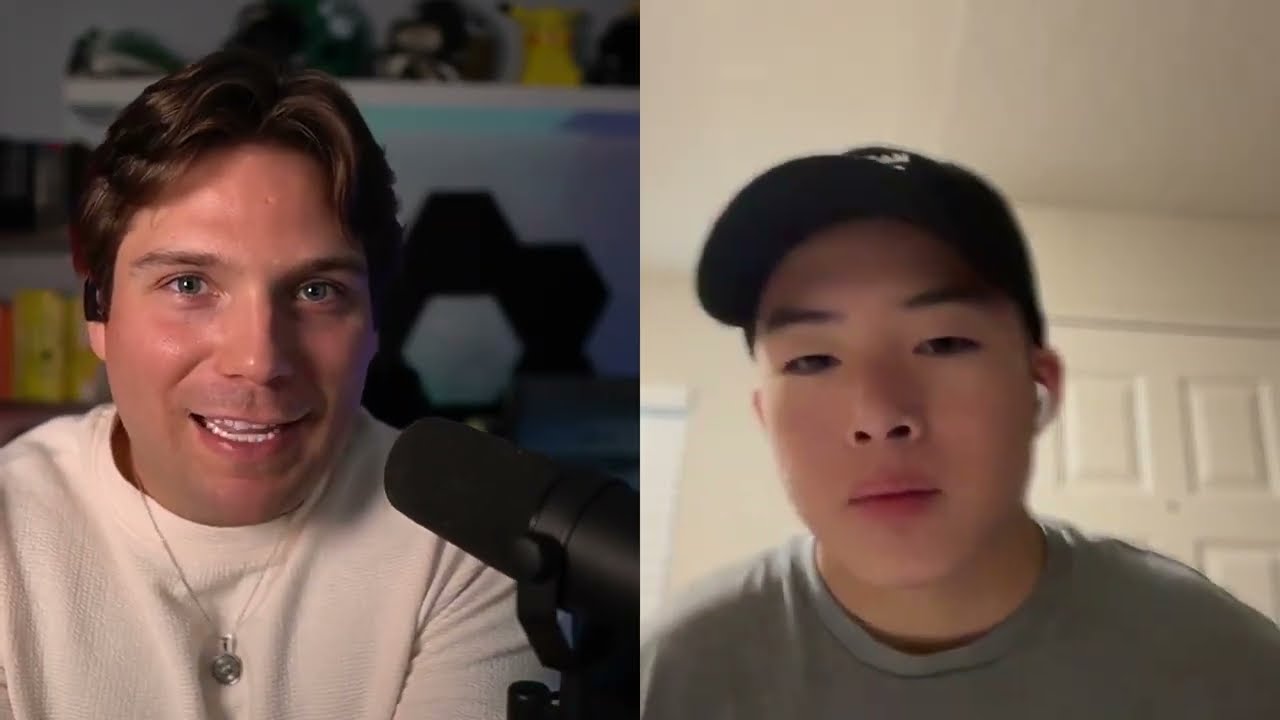
This content was created by Jay Yang. This content was uploaded by Jay Yang. This is a YouTube podcast episode titled "15 – Jay Yang" (created 2024-09-24) — a longform interview hosted by Justin with guest Jay Yang. The conversation covers Jay’s background (early entrepreneurial experiments and a content agency), college experience and freedom, self-improvement practices (journaling, questions, quotes), fitness, writing and building a personal brand/newsletter, permissionless apprenticeship and work with Noah Kagan/Beehive, content strategies for social platforms, and practical advice for starting and scaling online businesses. The tone is an advice-driven interview aimed at ambitious listeners, mixing personal stories, frameworks (networking, virality equation), and tactical guidance.
Chapters
Alright, episode 15, we have Jay Yang on the show. You're actually a year younger than me at 18 years old, and you've done some pretty remarkable things. And, you know, for those who are listening who aren't familiar with your background, could you kind of briefly share, you know, the past few years of, you know, what you've been up to and what you're currently doing right now?
Yeah, past few years, I like to say I've had a portfolio of failures. I tried many things, started a YouTube music promotion channel. I started Instagram theme pages. I even tried a clothing brand, which did not do super well. But each of those quote unquote failures, like, taught me a valuable lesson and snowballed to what I do now. So right now I I kind of run a content agency where I help entrepreneurs grow on social media and grow their business using specifically Twitter.
Awesome. And given that you're 18 and you're almost a month into college, I'm curious, since I went through college freshman year one year ago, I'm curious to hear your thoughts on college because I think I read your article. By the way, you have such a great newsletter. I follow a lot of your what you write. And you were saying how you had this, you know, whole decision on whether or not to go to college because, you know, with what you're doing right now, it's like, hmm, should I go to college or not? And I'm curious to hear, you know, has college kind of lived up to your expectations? Like, how do you view college after being there for a few weeks?
Yeah, well, yeah, it's only been a few weeks and so it's still a little early to tell. But I think the biggest thing I'm learning is like the amount of freedom I have, right? You don't have to do anything. If you want to skip all your classes, like no one's forcing you to go. Like you don't have to do your laundry or make your bed or even shower. But it's kind of on you to do what's best for and in alignment for your goals and who you want to become. So yeah, there's a lot more freedom than in high school.
Yeah, how would you say like the education-wise is like, I know like you're learning a lot outside, you know, you're working with Noah Kagan and you're working with all these like entrepreneurs outside of school. Like how would you, how would you say like your learning has been for college so far? Like would you say that you're learning a lot mostly outside of the classroom or inside the classroom?
Well, I mean, it's still only the first few weeks and so a lot of the class stuff is like orientation and getting set up. But yeah, I'm a big believer in taking ownership of your learning. So I don't believe in outsourcing your learning to school or college. Like if there's something that, like if you have a goal or a project that you're working on, like it's on you to figure out how to best workshop that.
I don't know, you know, but when we get into this new stage of life, I know at least for me, College seemed like the end-all be-all when you're in high school. And when you're in college, it's like, oh, life actually moves forward and college is really just the beginning of everything. And how do you view high school now, given that you've graduated and now you're on this new season of life?
I think high school was a good incubation period for my life, just learning the foundational skills, right? Math, writing. Learning how to work on a team. Like, I was on the varsity basketball team and, yeah, just growing up.
Yeah. Was there like a very surprising thing that surprised you like during your time at college so far?
I mean, honestly, I just say the amount of freedom that I have. There's a lot more free time than there was in high school.
And I guess like on making, I guess, friendships in college, I know that, you know, I guess nowadays we have different outlets to make friends. We have, you know, the internet, we have different outlets. And would you say, like, how did you, like, make high-quality friendships? Like, would you say that it's, like, through, like, in-person conversations or just meeting people online? Like, how would you approach that?
So I'd say two things. So first, and I know a lot of people who listen to this podcast They tend to be more ambitious, driven people who have big ambitions for their life. And so for those who want to live a life that's different from those around them, you know, you can expect to be into different things and be doing different things. And no path is right or wrong, but they're just different things. So it's okay if you don't necessarily relate with those in your surroundings in high school or in college. Second thing I'd say is, yeah, leverage the internet. I've met so many amazing friends over Twitter and Instagram. And so when I visit places like New York or Austin or San Francisco, I'm able to connect with them and turn those online friendships into real in-person friendships. There's a framework I love from Chris, and I don't, I'm going to butcher his last name, but Chris Hadfladzak or something. But he has the ASS networking framework, which is attract, search, and strengthen. And so a lot of people focus on searching for their friends, but I think what's awesome about the internet is you can attract people based on the content you put out, right? If you're writing tweets that are an extension of what you're thinking and feeling on a daily basis, you're going to attract people who have that same vibe and who are on similar missions. And then strengthen. Every week I try and like keep in touch with people from my close circle, whether that's people from Twitter or even my high school friends. Like every week we try and like do a quick FaceTime call and catch up and see how everyone's doing. And I think similar to business, too many people focus on finding new customers or finding new friends versus strengthening their current customer base and their current friendship base.
I like the term attract because I think it was also Sean Perry who said, you know, when you're putting yourself online, it's kind of building a magnet. So you want to kind of be a magnet for other people who are, I guess what you said, on similar missions. So that's, I think it's a good point. And I guess it can kind of backtrack also to, you know, when you started that music promotion channel during COVID And I always ask people like, where did you get that sense of awareness from? And, you know, some people have asked, Oh, I don't really know where this sense of awareness came from. And then some other people say you kind of have to cultivate it. And I want to ask you specifically, like, where did you think you got your sense of self-awareness from? And do you believe it's something that can be cultivated?
I guess for those listening, I'll kind of backtrack and share the story.
Of course.
Yeah, we can dive into like awareness. But yeah, growing up, I always excelled at sports and school. I just feel like I was naturally gifted at that. But then COVID hit and I was stuck at home in my room playing video games for like 5 hours a day, basically rotting away in my room, not being productive. And yeah, in the middle of the summer, I just remember looking at myself in the mirror and going like, what am I doing with my life? And so from that moment on, I made a commitment to myself to to see what's possible, to see like, to see what would the optimal maximal version of Jay look like. And so I fell into the rabbit hole of self-improvement, right? I was taking cold showers, I was journaling, I was working out, waking up early, reading self-help books. And that self-improvement journey just naturally led me into the world of online business. Because when you change your habits, you realize you can change everything else.. And so it gives you a sense of agency over your life. In terms of awareness, there's a story that I love. It's by David Foster Wallace in his speech, This Is Water. And there are two young fish swimming along. And you know, they swim past this older fish swimming on their way. And the older fish nods and looks at them and says, morning, boys, how's the water? And so, you You know, it's good. Two young fish swim on for a bit, and eventually one of them looks over and goes to the other, what the hell is water? And the whole idea is that we go about our daily lives. It's so easy to fall into this default setting of our unconscious mind where, you know, our minds have evolved to create mental heuristics. Another way to say is like shortcuts. To save mental energy. So if you like walk to the same classes every day, eventually your mind will create a mental map so you no longer have to think about where you're going. And so I think for me, the best way I've found to bring self-awareness to where we are in life is to ask self-reflection questions, right? Questions like, will my current habits carry me to my ideal destination? Is this environment that I'm in conducive to my goals? And what would my hero or my idol do in this situation? Because our brains are pattern-solving, problem-solving, pattern-seeking machines. And so when we ask ourselves these questions and when we really want to figure out what the answer is, that's when we start to gain clarity and self-awareness.
No, I like that. I know you tweeted how much you like collecting questions and you're saying how, you know, better questions lead to better answers, which ultimately leads to a better future and where you want to take your life. And have you also been like collecting quotes or mantras? And if you have, like, could you share some of like your favorites?
Yeah, so I'm a huge fan of questions and fan of quotes. I guess in a way I'm an old soul like that. Um, let me see, there's a list somewhere. Let's see. I'm just gonna list out a bunch of my questions. Okay. Gotcha. Quotes. Let's do that. It's a lot. Okay. If someone could only see my actions and not hear my words, what would they say my priorities are? Right. It's not about what you say or how hard you work. At the end of the day, it's about what you get actually get done. Right. What am I optimizing for in my current season of life? If you wanna make progress, you have to memorize this phrase. That's a great idea, but just not right now. How can I use my sawdust more effectively?
Right?
Because what's obvious to us is often amazing to others. And so every single day we're doing things that we may think is, you know, mundane or boring, but to another person is completely revolutionary. Yeah. What am I saying no to by saying yes to this opportunity? Right? Opportunity cost. What are the second and third order effects of this decision? Second order effects. What have I been wrong about lately? Is taking things so seriously improving my performance? How can today feel like play? How can I complete my 2-year goal in the next 3 months? How can I stack the odds in my favor? And how can I make this a no-brainer for the other person? And that's a question I've been thinking a lot about. Whether you're trying to get clients, gain followers, attract customers, the ability to place yourself in the minds of others is the greatest skill you can learn as a marketer, entrepreneur, and just a human being.
Yeah, I guess with these questions, do you kind of like think through it and stick with it as you kind of progress through your day, or is it something that you just like pull up a journal and begin writing down like what you think the answer would be for your own benefit? Like, how do you kind of, how do you kind of like digest these questions, so to speak?
Yeah, 3 things. I mean, one, I journal about it. So I write the question at the top of the page and I just write what my answer would be. Second, this may be also where I'm an old soul, is I'm always thinking and pondering and, you know, in my head. And so when I ask these questions, I just think about it. And third, what I love to do is I have this long list of all these questions. And so at the, at the end of the day, at night, I'll go through the list. I'll like scroll randomly and then I'll pick a question and then I'll, I'll think about it and go to sleep. And so that way my subconscious mind thinking about it. Yeah. And when I wake up, sometimes I'll have an answer and I'll quickly write it down. So those are the 3 things I, I kind of do when I have these questions.
That's awesome. And you also mentioned, you know, that your north star in life, I guess, is, you know, from the Valls quote, which is a calm mind, fit body, house full of love, meaningful work, and enough wealth not to have to worry about it. And usually behind these, this north star are some values that drive you to kind of go out each day and accomplish these goals. So what are some like the non-negotiable principles and values that you live by? On like a day-to-day basis?
Yeah, so I have 3 things that I, I'd say are non-negotiables. Uh, number 1 is do something active, right? Lift, run, play sports, walk. Um, because most people think that they have a software problem when really they have a hardware problem. And what they find and what I found is most of your problems can be solved by drinking more water, getting 8 hours of sleep, and going for a walk. Secondly is like, did I learn something today? Right? You know, Charlie Munger says, you know, he constantly sees people who rise in life who aren't necessarily the smartest or have the best of talent or ability, but they're learning machines. And so if you can learn like one thing, like at the end of the day, if you can ask yourself like, what did I learn? Did I learn at least one thing today? Then you'll, you'll start to make progress. And then third is, is, is family. I, I try and make sure I spend a lot of time with my family. It's been a little bit diffi— a little bit difficult in college. I'm, I'm not with my parents. So I try and text them, keep them updated, call them, FaceTime them.
That's awesome. And you know, you're, you're an avid fan of the gym as well. And you know, from your, your mini essays on Instagram about the gym. And I imagine like it's more than just a thing you do as a habit, because I also run and, you know, it's much more than a habit. It's like something that, you know, you release, you know, your mental burden, and it's something that it's like an outlet for what you do every day, right? So what does the gym actually mean to you?
The gym is everything. I started working out because I wanted to, you know, look good, feel good, but it's, it's been a lot more. It's a mental sanctuary. Especially this past summer, I've, I've been working out with one of my best friends and every day we go to the gym and we push ourselves to exhaustion. It's, it's been great for not just my physical health, but for my mental health as well.
And I also saw like you ran a half marathon as well. How was that? How was that experience?
Yeah, it was, it was unexpected. So at the beginning of the summer I set 2 fitness goals, which was to run a half marathon and to bench 225 pounds, which is 2 plates on each side. You know, about a month in, my friend texted me, he's like, hey, do you wanna run a half marathon? And I was like, no, not really. Like I, I was planning on doing it at the end of the summer. Like I just started running.. But, you know, I said, you know, F it, let's do it. Ended up turning out pretty well. And I'm grateful for my friend for inviting me and for pushing me as we ran.
Yeah, that's awesome. So I guess gym's like one of your big obsessions in life. Like what other obsessions do you have so far? And like what are some activities that you do that kind of make you come alive? I guess the same way that gym does.
Yeah, I mean, lifting is a huge obsession of mine. I want to build a body that I'm super proud of. I want to be active. I want to be that, that 80-year-old who can be doing pull-ups and, and lifting their grandchildren and playing with them. Outside of the gym, it's writing, right? In my bio, I say lifting weights, writing words, and building an internet business. I'm obsessed with the craft of writing. I truly, I truly believe that the audience, business, and career that I want is on the other side of my ability to write words that resonate with people and actually make them act. I think too many people mistake writing for the type of writing they learned in high school, which is like the 5 paragraphs, don't use you or I, right? You know, use big words, but real-world writing where it's not about sounding smart, it's about making your reader feel smart. Is a totally different ballgame.
Yeah, and I mentioned, you know, I guess in the world of business that writing kind of turns into copywriting. And, you know, you've been, you know, I guess I really admire your abilities, you know, practically build a business online and you just being very authentic and sharing your lessons on what you've learned along the way. So I guess for anyone, you know, who's starting from zero and who wants to scale to, you know, how you're making right now, it's like, you know, maybe $10,000 per month, like how, what were the practical steps that you took to get there and what would you recommend for anyone starting out to do?
Yeah, I think number one, it comes down to changing your content diet, right? If, if, if the content you consume ends up becoming the thoughts you think, then if you're consuming not great content, if you're just scrolling TikToks and people dancing, then you're not going to be able to have that creativity to put out content as well. And so if you want to think differently, then you have to consume differently. And so that's why being on this side of Twitter is amazing because there's so many great thinkers, great entrepreneurs, people who are building things, and just being in this environment is naturally conducive to creative ability. If I'd say secondly is just start writing. A lot of people, a lot of people may think, you know, I'm not an expert yet and I have to have a degree or a certification to write online. But that's completely false and it's the complete opposite. I was talking with my cousin the other day and he's a senior in college and he's a teacher's assistant. And I asked him, I was like, how are you teaching these classes with people who are, you know, only a few years younger than you? And he said, you don't have to be an expert, you just have to be one chapter ahead. And the truth is 90% of people on social media are beginners. And so there's always someone one or two steps behind you who could use the message that you might, and you're holding with it, that you're holding within that you're not sharing.
I like that. It's like being the guide, not the guru. It's like just sharing whatever you're learning along the way. Would you say like there's more steps after that which kind of go into that process?
Yeah, I mean, I think it kind of depends on what your goals are for writing online. I know everybody has different goals.
So yeah, that's awesome.
Yeah.
And I guess I think we can kind of go through your tweets because I feel like you have some pretty fire tweets that we can kind of share. And one of them, one of my favorites is like, you know, don't stay up late for something you wouldn't wake up early for. And could you kind of describe like what that actually means?
Yeah, don't stay up late for something you wouldn't wake up for basically means like don't stay up past your normal bedtime to do something that you wouldn't be willing to wake up earlier than your normal wake up time. So it, like, it's very easy to stay up late playing video games or scrolling Instagram. But it would be very difficult to convince yourself to set an alarm for an hour earlier to do those same things. And so when you're deciding whether or not to actually do something that will cause you to lose your 8 hours of sleep or, or, or whatever you're sleeping, ask yourself, would you really be willing to wake up in early to do that same activity?
Another one you wrote, it's like, doing more research is a smart person's favorite way to procrastinate. And it's cool because, you know, when we're starting out something, that's like one skill. And if we want to keep consistent for that skill over a long period of time, that's like a different skill. So what would you say, like, how can someone who's good at starting different things have that consistency to keep on going for the long term?
I'd say gamify it. Best thing I've been doing is keeping, keep setting challenges and a hierarchy of goals that keep you interested, right? Because when you think about like, what's the difference between someone who loves starting something and someone who loves continuing to do something? It's that it gets boring. And so setting the hierarchy of goals of like, and internal challenges really keeps you interested. Secondly, I'd say hire. A big thing I'm learning from Noah Kagan is he's great at starting and he hired a CEO, Eamon, who is great at building systems of scale. And so it's about realizing that, okay, if you are great at starting and not necessarily great at consistency, how can you surround yourself with people who are great at what you're weak at and maybe weak at what you're strong at so you complement each other?
And I guess speaking on Noah Kagan and your whole journey with permissionless or Friendshift, it's really crazy because hearing about your story, it's like you do one thing and that snowballs into another, which leads to another bigger opportunity. It's really cool just seeing how that chain of events kind of connects together. And could you kind of go all the way to the beginning on how you came across this kind of permissionless way of doing work for companies and other people and how that's kind of led to where you are today?
I first came across the permissionless apprenticeship approach from Jack Butcher when he first put out his course. And yeah, it totally blew my mind to a different way of doing things. Like we all get these DMs from people who are, you know, pitching you like, hey, I can create a landing page for you or I can write tweets for you.
Yeah.
But if you ask how I can, like, how can I help? It puts the burden on the other person to figure out who you are and how you can help them. And so the question to ask yourself, similar to what I said before, is how can I make this a no-brainer for the other person, right? How can I make it easy for Noah Kagan, who's busy running a, you know, running a company, running a YouTube channel, has a family, how can I make it easy for him to want to work with me? And so that's where, you know, the permissionless apprenticeship approach comes in where you don't ask how you can help, you just help.
How do you identify problems to help with? Like, for someone who's like, oh my God, this is such a, you know, big-time CEO, like, how can I actually find problems that they might potentially have and kind of work my way to actually solve them? Because I feel like you might need to have a keen eye to actually identify these problems to begin with, right?
Well, ideally it's at the intersection of what you're skilled at and what the other person needs. I can't exactly tell you how to find the problems. Yeah, I think for the right type of person, they don't need to be told how to find a problem. They just will. In terms of doing research, when I interned at Beehive before, when I was doing research, I looked at previous podcasts, YouTube videos, the second page of Google and the second page of YouTube where most people don't look. Twitter advanced search is awesome for that. But yeah, if you have agency, you'll figure it out. If you need someone to tell you how to figure it out, then may not be the right path for you.
Yeah, I guess that's the push for some people might need. Yeah, and I think you're also like a big fan of collecting different types of Twitter hooks, templates, and all that. I think that I found that really remarkable. And could you kind of share your story on, you know, building a personal brand and how you find it valuable to what you're doing right now?
If we dissect what personal brand really means, all it really means is your reputation, right? That's a personal brand. You know, you have a personal brand in your, in your real life. Like, are you somebody who shows up on time or is always late? Are you somebody who, you know, wakes up early or someone who sleeps in, right? Your personal brand has nothing to do with online versus offline and everything to do with your reputation. So as someone who's early in your career, the best thing you can do is build a reputation for somebody who is able to figure things out, somebody who is, has high agency and, and takes things into their own hands, someone who's a ferocious learner, someone who's relentless. And so building a personal brand has been has been everything for me. It's how I've attracted all of these opportunities that I've gotten. It's because of the stuff and the content that I'm putting out on the internet.
I guess a bit more technical of a question. It's like, what differences have you noticed building on Twitter versus on Instagram now? I feel like they're two kind of different platforms. I guess one's more focused on text for Twitter and Instagram might be more focused on visual. But how, how would you kind of approach each one independently? Or are they, do they have some overlap between the two?
I'm gonna push back a little bit and say, you know, it's not about the platform at all. Because platforms come and go, but psychology, psychology rarely changes. And so if you want to grow on social media, it's not about mastering the platform or the algorithm. It's about understanding people and what makes people interested in things., right? Because it doesn't matter if you're on Instagram or Twitter or TikTok, the key principles of content all are the same. You have to grab attention by piquing curiosity.
Yeah.
And then you have to deliver on that value. And so something I do with all my clients is we go through the virality equation, right? And we're gonna get super technical here. So the virality equation is like in your hooks, there's 4 key aspects to make a hook more viral or have more ability to go viral. And the first thing is to increase credibility, right? Why should people listen? Second thing is increase the benefit. What actually are they gaining from this piece of content? Third is to increase the relevance. Who is this piece of content for, right? So if your hook says, you know, 3 tips to grow your business from 7 figures to 8 figures. That's great, but it may not go viral on social media because one, it only applies to people who want to go from 7 to 8 figures, right? And most people aren't there. And two, because 90% of social media are beginners. And then the last fourth part is decrease the perceived effort. And so that's where you see the common hooks of like, you know, this took me 60 years to learn, I'll teach it to you in 2 minutes, right? And that's because you want, you want to save people time. And that's all, that's all content is, is, is packaging up years or more experience and distilling that, compressing that into a more digestible way for people to read.
Mm-hmm. I, I love these frameworks. It's like mastering the fundamentals and then that can pretty much be applied to any platform that you decide to go into. So yeah, it's mastering psychology.
Yeah.
And how does that translate over to your email newsletter? I know that, you know, You've been really consistent at it for posting a new article or essay every Sunday. And how has writing on an email newsletter kind of changed the way you look at social media and where do you intend to take that?
So yeah, my email newsletter is, I'm not trying to sell anything to anyone. It's just It's my outlet for, you know, one of my favorite quotes is thoughts disentangle themselves when passed through lips and fingertips. And writing an email newsletter, writing a weekly essay basically to myself is taking that jumbled mess in my head and being able to articulate that in a clear manner, right? Because clear writing is clear thinking. And so if I can articulate the problem I'm struggling with, and then maybe identify what that problem is and how to solve it, then I'm already halfway there to solving the problem. And so writing the weekly newsletter is more of a personal thing where I'm trying to walk through what I'm feeling, what I'm doing, and what the next steps are.
Could you kind of like go over like your experience working at Beehive? And I know, you know, you've learned a lot and that kind of set you as a good foundation as to working with, you know, customers directly. And how did that experience kind of shape you?
Beehive was probably the number one pivot point in my online journey. Before that, as I said, I had a portfolio of failures. I was trying a lot of things, but I wasn't getting the results that obviously I wanted. And so I sat down with my mom and I was talking with her and she went, you know, it's obvious like you're missing something. And so why not try and work for your favorite company and see what you can learn from them to to take back for your own businesses. And so at the time, Beehive was my favorite company, still is. And I cold emailed Tyler, you know, with the pitch deck of all the ways I can help them. And yeah, it was an incredible experience learning from a team that pretty much ships new features every week. And it was about learning how to work in 2-week sprints, learning how to structure a project, learning how to launch a project, And yeah, I took those, the same stuff that I learned from Beehive and I spun out a consulting offer helping other people start, launch, and grow their newsletters. And that kind of evolved from there. Yeah.
So you said that you kind of took the lessons you learned at Beehive and applied it to your own little business. Like I think you, in your, in today's newsletter that you sent out, you're saying how you're kind of moving on from trading time for money. Now you're trading money for time. Could you kind of explain that and what that actually means in terms of delegating your money to buy back time?
Yeah, for the majority of my business journey, I've been more of a freelancer role where I'm helping different clients. I'm doing basically all of the work. I'm hopping on sales calls, I'm onboarding clients, I'm managing the workflow. I'm keeping track of the KPIs, doing the reporting, making sure everyone's happy. And truth be told, it was a lot. So if I, I know that if I want to get to the next level of business, eventually, like, I have to detach my time from the outcome, right? If I can't take a vacation or be sick and not have my business crumble and fall apart, then I don't have a business. I just have a high-paying job. And so I was talking with a founder of $100 million portfolio and he was telling me about the differences between a struggling entrepreneur and a successful one. And it was learning how to build a team around them. So that's, that's been my next step is just brought on my first employee to help out with some of the non-creative repetitive tasks that I don't necessarily need to be doing, but still need to be done. And that's allowed me to be more strategic about the vision of the business and more strategic about the planning and strategy for my specific clients. So yeah, it's been awesome. Yeah.
Do you think the ultimate goal of that is just to one day buy back all your time so you can just focus on the most important things and just delegate the rest to a team?
Sorry, can you say that again?
Yeah, so do you think that your goal with this is kind of, you know, maybe one day just only focusing on the most important task and then just delegating the rest of the team? Is that kind of like the aim right there?
I mean, I think that's the goal for most people is working on the things that one, you're good at, two, you enjoy doing, and three, are the most impactful and move whatever your business, your goals forward. Whether that's outsourcing it to people or, you know, outsourcing it to software tools. And I just think it's like, as a creative worker, as a knowledge worker, the best thing you can do is create space for you to think about what actually drives the needle forward. Because truth is, 80% of the stuff we do does not matter. And we're busy, we're being busy just for the sake of being busy. And so if we can step back, we can zoom out from a 1,000-foot view and look at what we're doing versus what actually needs to be done. I think that's really important.
I think I came across a study. It's like, people don't actually work like 60 to 80-hour weeks. It's like a lot of it is just kind of the menial tasks that we do, and only like a small percentage of them are actually the meaningful tasks that actually drive the needle forward. So I know this might be a little a little early, but like, what do you think like your ideal day would look like if you're not already living it? Like, what would you want your day-to-day activities to comprise of?
My day-to-day is actually pretty optimized right now. I'm satisfied with how my day is going. I'll give you the North Star vision and tell you how close I am to it. But the North Star would be Wake up 7 o'clock, 3, 4 hours of deep work on meaningful work, whether that's client work or writing the newsletter or researching and maybe even writing a book. Then 2 is fitness, making sure I'm getting a good workout in, I'm keeping my body healthy and then saving the afternoon for more business-related tasks like responding to emails, responding to DMs, hopping on calls, and then the rest of the day just spending time with family, friends, and really just chilling.
Yeah, I think something I really, you know, look up to you for is like how principled you are with your priorities. I feel like sometimes, you know, people when they live their life, it's like a kind of like a jumbled mess of like, oh, doing this and kind of multitasking. But you're like, no, I have this set structure, I have these principles, I'm going to live by it and stick to it on a day-to-day basis. So that's something that, you know, I deeply admire about you and your lifestyle.
I appreciate that.
Yeah, I guess we can finish off with some questions. And, you know, I think most people ask, you know, what's some piece of advice that you'd normally wish you knew earlier? And I guess we could put it in reverse, and it was just What's something that you wish you quit earlier?
To be honest, I feel like I've been pretty early about most things. I gave up video games to pursue online business when I was 15, 16. I quit basketball when my business started to pick up momentum. I quit different freelance opportunities to work on more leveraged ones. I think the biggest thing I wish I quit earlier, which I'm sure most of us wish we all quit earlier, was I wish I quit holding myself back. You know, I've definitely suffered with imposter syndrome and had some mindset blocks that I had to overcome, doubting myself, doing too much research when I really should have been just taking action.
Yeah, I think it's cool. Like, do you see like your life kind of as a video game? Because I imagine, you know, when people play video games a lot and they get kind of sucked into that, it's like, well, how can you reframe playing video games on the video game to playing the video game of life? Like, how would you kind of go about, you know, shifting from playing video games on the actual video game to, to life itself?
Yeah, I think the biggest thing is, uh, work backwards from where you want to go. Set that North Star and then work backwards. What daily actions do you have to do right now today to get one step closer to that, that goal? And the question I've been constantly asking myself, um, is What are the skills, beliefs, and character traits that I have to adopt to get from where I am to where I want to go? Yeah.
How, how would you say like your progress right now would be? And I feel like, I think it was James Clear from Atomic Habits who said, you know, sometimes when we shoot for goals, we have this arrival fallacy that once we reach the goal, we'd be happy. And, but anytime before that, we wouldn't be fulfilled. But these— how do you kind of find fulfillments in the process of the journey, not just for the destination?
You know, that's, uh, something I definitely struggle with a ton, is getting caught up in, in trying to get to that North Star, get to the end vision. And I could be very impatient. Um, I think the biggest thing is slowing down, being observant of what's around you, and also being grateful for all the little things that you've accomplished, right? There's, there's a quote that you've achieved goals that your younger self said you'd be proud of or happy of. I think at the end of the day, though, there's a book called Tiny Dragon, Big Panda, and there's a quote in there.
Yeah, I think I saw that. Yeah, yeah.
Tiny Dragon turns to Big Panda, is like, what's more important, the journey or the destination? And Big Panda goes, the company. And so I think a lot of times, like, we're focused on, oh, what matters more, systems or goals? But honestly, the things that have made me the most fulfilled and most happy and proud of is when I'm around people and helping them as well. So You know, hiring my first employee and seeing him grow, meeting people online and being able to impact their journey, helping them with, like, set up a website or write copy for the landing page or tweaking someone's hook and then them going viral, right? Those little things of seeing other people win and having that outward mindset of how can I make this situation or this experience more magical for those around me.
I love that, you know, keeping good company. That's something to keep in mind. Yeah, and then what's something that you would not be paid billions of dollars to stop doing? Like, if someone paid you a billion dollars to stop doing this, like, what's that thing you wouldn't— you'd keep doing and not take the billion dollars?
I mean, a billion dollars is a heck of a lot of money.
Yeah. Or we can scale it down to a million.
If I'm being real, a billion dollars, like I'd stop writing online, I'd stop building businesses, I'd throw my phone in a lake. The only thing you could not pay me to do for a billion dollars is to stop taking care of my health and stop spending time with family.
Yeah. Those two are very, absolutely crucial. Yeah. I usually end every podcast episode with, you know, a piece of advice you'd give to your 18-year-old self, but given that you're 18, We could do, what advice you'd give to perhaps, you know, yourself in freshman year of high school. So 4 years ago.
I think it goes back to what I have in my bio, which is go to the gym, learn to write, and build an internet business.
I love that simple, concise, and straight to the point. Dude, it's been an honor having you on, Jay.
Yeah, I appreciate you having me on, Justin.
Hey man, I love meeting people like you doing cool stuff. And you know, at such a young age, I feel like there's always so much to learn regardless of whether that person might be younger or older. I just feel like there's just so many stories and lessons that you can take from anyone you meet. So glad to have you on, man.
More from Jay

Why He Took a 50% Pay Cut to Work With the Best | Jay Yang, writer | The Quest with Diksha




No Permission, No Problem, Six Figures at 19 | Jay Yang - Author & Hormozi’s Secret Weapon