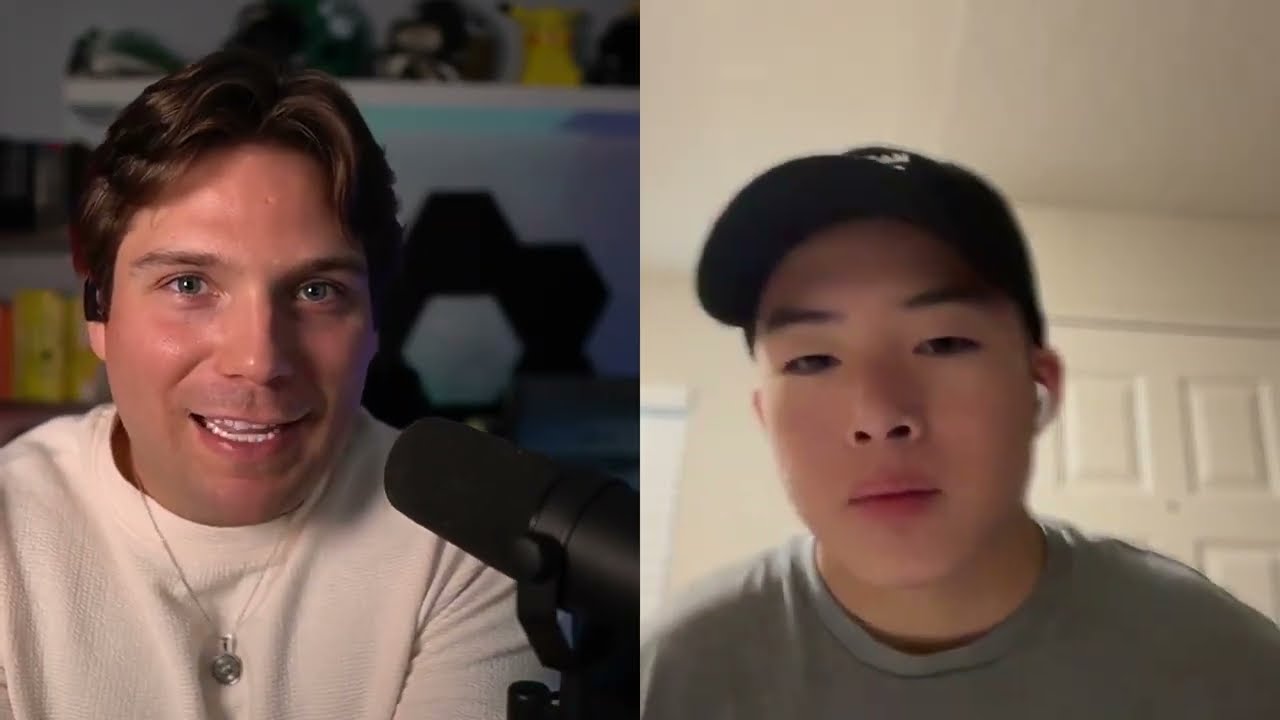
Jay Yang talks about starting with YouTube and music promotion, cold outreach, and why writing and skill-stacking matter. He dropped out of college, self-published his book, and worked with Noah Kagan on marketing. The core idea: you can just do things without waiting for permission.
Chapters
Hey folks, this is Abel James, and thanks so much for joining us on the show. What if success isn't just about working hard, but about creating your own opportunities? Today we're here with teen phenom and author of the book "You Can Just Do Things," Jay Yang. I met Jay last year through our mutual friend and friend of the show, Mr. Noah Kagan, and incredibly, while he was still in high school, without a resume or experience, Jay proactively reached out to Noah to help him with marketing. He impressed Noah so much that he brought Jay on the team for the launch of Noah's first book, Million Dollar Weekend. And thanks in part to Jay's strategies, insights, and tireless work ethic, Noah's book went on to become a New York Times bestseller. In the following months, Jay took it upon himself to write his own book, which he also published and launched and put out there to the world. I just love the gumption on this kid. He's all about taking action, and what he has to say is definitely worth a close listen. Before we get to the interview with Jay, I just want to give a quick thank you to all of you who have reached out with the well wishes in the past couple of weeks. In case you didn't hear or catch the last episode, I was injured in a serious high-speed car wreck, uh, a hit-and-run. And so I've got some herniated discs, ligament damage, had a bad concussion, but I've been recovering over the past couple of months. I've got a great team of doctors who are helping out. For those who have asked, no, they still haven't identified the other driver, at least not to me, so I don't have any update there. But I will keep you updated. So far so good. I'm making progress with the therapy, the balance therapy, and a few of the other things. So feeling optimistic.
And once again, thanks so much for reaching out.
And also, before we get to the interview, please make sure that you're subscribed to the Abel James Show wherever you get your podcasts. And you can also sign up for my newsletter at abeljames.com, A-B-E-L-JAMES.com, and my Substack as a free or a paid member where you can get ad-free versions of this show as well as other goodies. That's at abeljames.substack.com.
Look forward to seeing you there.
All right, On this episode with a prodigal, Jay Yang, you're about to discover how to balance deep work with the constant demands of influencer culture, why mastering the art of cold outreach can be a superpower, especially for introverts, what skill stacks will be the most relevant in an increasingly unpredictable future, why talent doesn't matter if you don't have the courage to fight for the opportunity to share it with the world, and much more. Let's go hang out with Jay.
All right, welcome back, folks. Today we're here with marketing prodigy, teen phenom, and now author of the wonderful book You Can Just Do Things, Jay Yang.
Building six-figure brands before he could legally drink, Jay's all about action over overthinking, and your procrastination and excuses don't stand a chance.
Jay, Thanks so much for joining me, my man.
Thanks for having me on, Abel. I appreciate the super awesome intro.
Of course, this is going to be fun.
So you, um, got started on the entrepreneurial track young, obviously, but it was actually related to music at first.
Tell us, tell us about that and kind of, uh, how you ended up where you are now as a, as a young author.
Well, the story starts back in COVID, actually. I was just like many other kids, stuck at home, stuck in my room and bored out of my mind. And so at the time I was playing video games for like 5 hours a day. And I remember looking in the mirror one day and not being proud of who I was. You know, it sounds weird saying that, like, as a kid you're not proud of yourself. Like, what do you mean? But I just knew that I could be spending my time more efficiently and in a better way. And so that day I literally Googled how to make money online. And one of those things was to start a YouTube channel. And so, you know, during COVID it was a, you know, it was a dark, down, kind of depressive time period. A lot of people were, you know, not feeling the best. And so I figured music would be a great way to inspire people and to impact people in a positive way. And so I started a music promotion channel where I'd promote underground artists' songs, help them get exposure on their music. And I posted a video every single day. For the entire summer during COVID Channel didn't go where I wanted to go, but I did learn a few important lessons. One of the first ones was the power of content. Even though I didn't reach, you know, multiple, multiple millions of people, I did reach a decent amount of people. And it made me realize that little old me from my room could actually impact and inspire people. And so that's what led me down into the road of content, eventually the road of self-improvement. And learning more about entrepreneurship, online business. And honestly, I've fallen in love.
Yeah, I love that.
Now, what about the, the art of cold outreach?
Because especially for someone— I remember being younger and I was definitely introverted and shy. I had moments of kind of being the performer or the athlete or whatever too, but mostly it was, it was shy and introverted. And so the idea of cold outreach, especially at that age, Uh, was terrifying. And even, you know, for my first job out of college in consulting where I had to do some of that, that was also terrifying. So how do you overcome that? Um, because once you do, you realize that it's a— it's really a superpower. It's an incredible advantage.
It's one of the greatest skills you can learn as a young person, but in, in general, as anyone who's ambitious. Um, it is the skill that has changed and impacted my career probably the most. It completely transformed the trajectory of it. And I think the first step in realizing the power is realizing that you can have unlimited shots at gold. Even if someone says no, it's not always as big of a deal as we build it up to be in our minds. And so that's the first step is realizing that, you know, as the book says, you can just do things. You can just reach out to people., in, in different ways. And so actually, I, my brother is creating a tool right now. It's called colddmblueprint.com and it's basically a free resource on how to actually write the cold email. And so we can dive into the tactics, uh, in this conversation, but for anyone who's interested in like getting the templates and having AI help you prompt and, and, you know, craft a compelling message, uh, Cold DM Blueprint is, uh, Honestly, I'm excited about it. I wish I had it when I was cold emailing people. But I think the biggest thing of like how to reach out to somebody is realizing that they don't owe you their time. And so it's not having this sense of entitlement of, oh, I deserve to get a response. It's putting yourself in their shoes and thinking, how can I make this a no-brainer for the other person? And so I like to tell people empathy is one of the greatest assets you can have as a marketer, as an entrepreneur, and even just a human being in general. It's your ability to put yourself in the other person's shoes, see yourself from their lens, and then reduce the friction as much as possible.
Do you think coming up as an athlete has offered advantages in that, in that front or given you confidence or anything else like that?
100%. I would say being an athlete has influenced my life in two ways. I think number one, it's realizing that the inputs do lead to the outputs. And so for context, I started playing basketball when I was in fourth grade and a lot of my peers started in first and second grade. And so right off the bat, I was behind the, I was behind everyone else and I just hated that feeling, feeling inadequate, feeling like you're just not as good as everyone else. And so what I do is I would wrap up, wrap my basketball with a plastic bag, plastic grocery bag to make it more slippery. And then I'd watch YouTube tutorials and I would just dribble. I'd do ball handling routines down in the basement for hours at a time. And slowly but surely I got better. And so I think that's the first lesson is realizing that volume negates luck, and realizing that if you take enough shots at goal, like, one is bound to hit. I think the second thing is advocating for yourself. So on the basketball court, if you are not calling for the ball, if you don't have your hands ready, if you're not putting yourself in a position to score, no one's going to give you the ball. And I think that's the same thing with cold outreach and with your career. If you're not intentionally positioning yourself in the right spots, and you're not calling for the ball, you're not calling for opportunities, you're not being— you're not putting yourself out there, um, you're not going to get those opportunities.
Yeah.
And so as you kind of like navigate all of this and, uh, all the conversations about what college education has become, uh, and also given your early experience in entrepreneurship, how are you handling that? And, and also, how are your peers handling that with all the different variables. I'm curious, like, which ones are top of mind for you?
So I, I was going through that major decision, uh, about a year ago. I graduated high school, uh, I was running my own business. I got several pretty amazing job opportunities, uh, to work with people I really looked up to and knew I could learn a lot from. And so I was juggling these 3 opportunities. Do I go work for someone? Do I continue doing my own thing? Do I go to college? Like, which path makes the most sense? And there were a lot of sleepless nights. There were a lot of times where I was just overwhelmed in a good way. Like, these are problems like that are good to have, but, um, I didn't know what I was going to do. And so what I ended up, the, the mental model, the mental framework that I ended up using was two things. Number one, there's more to life than just your career. And so I knew that. I set my foundation up pretty well that I would not have to necessarily worry about if I would quote unquote make it. It was just a matter of when. And so I didn't want to sacrifice the other parts of my life for the pursuit of financial material success. Um, and the second thing was you can't knock it until you try it. And so I would rather have gone to college, realized it's not for me, and then dropped out than to have never gone to college at all, never experienced what it was like to be a college student, um, and always I kind of regretted in the back of my mind that I didn't have an integral part of what most people's experience and lives are, and I couldn't relate with them to that. And so I did end up going to the University of Illinois for a year, and it was an incredible experience. I met so many lifelong friends that were ambitious, were driven, were doing cool things. And, um, about a month ago, I decided to drop out. I realized that I experienced what I wanted to experience and I was now onto the things, now onto the goals that I wanted to achieve. And so I don't regret going to college and I don't regret dropping out.
Yeah. Uh, what, what did you learn or what was the most valuable thing that you kind of gained from being there for a year?
I think one of the biggest things I learned was being able to learn from everybody. It sounds funny to say that, but while I was in college, I was working with multiple, multiple millionaires, people that I used to look up to in high school, people I used to put up on pedestals. And at the same time, I was shooting the shit with my college buddies in the cafeteria. And so it's being able to see that dichotomy, being able to realize that everyone is just a human being and everyone is— you can extract lessons and learnings from everybody in every situation. I think that was a very valuable lesson.
You know, I really haven't thought about education this way until you put it this way, but like, that's a, that's a great way to do it. Is there's such a stigma associated with dropping out. Even that terminology isn't quite right, you know. It's because maybe the ultimate or ideal college experience isn't just 4 years for everybody. I know it wasn't for me, um, and it's not for a lot of people.
But a lot—
you can get many of the benefits, um, with less time if you really invest a lot of your own energy into figuring it out and, and doing what you can while you're there to take the best of all of those opportunities. Because there is something really special, no matter how talented you are or successful early in life, um, and, and if you have the options to just go straight into business, that's, that's all great. But like, there is something really, really special and sacred about spending time with people around your age who are in all sorts of different situations and will go into all sorts of different directions. And maintaining those friendships over time for me has been a total delight, whether it's people I just went to school with freshman year and they were seniors or whatever. That is such a critical time in life to make relationships and friendships that never feel the same after that, right? At least for me, and I've had this conversation with other gray hairs or whatever, that the friends that you make in adulthood are fantastic and can be incredibly valuable and generous and lifelong friends as well. But there's something just different and special about the ones that you meet when your brain isn't quite baked yet, right? Like, you're not— you may be a man, but you're not quite a full man yet. You're coming of age together, and sharing that experience is, is really special. Um, and so if you can, uh, uh, in the way that you think about it as well as the way that you communicate to other people, see that as a success instead of like the stigma of dropout. I think that's like an awesome way to look at it.
Yeah, 100%. I don't think it has to be either or. There's two sides of the party. They say, oh, people who drop out are bad and they're going to ruin their life. And then people are like, oh, college is a scam. But I think just like in every aspect, every field, every subject, there's always that gray middle. And I think that's where most people should sit. It's realizing that like some of the best— like I've had some of the best conversations in college this past year. We talked about all kinds of things like religion and different backgrounds and then like business and career and just life in general, like families, like the wide variety and depth of those conversations. I don't think it's very hard to find them elsewhere, especially with people who are all around your same age. And so, um, incredible.
Yeah, it's a rare and special thing. And definitely my favorite part of college wasn't the the classes. It was always the conversations with the people who often didn't even take the same classes as you, but you're talking about whatever and exploring deep ideas. Um, and having gone to a few recent reunions, that's still happening, and it like keeps going, uh, back and keeps giving back. So definitely something to take, uh, you know, take seriously and, and invest the time, because it's— there's a temptation to just like keep working and try to get ahead and that, that whole piece of thing. But the truth is there were a lot of people who worked really, really hard and went to school the same time as a lot of us who we never saw because they were always in the library or always in their room. And there's something to be said for— and, and maybe I'd love to hear your take on this too— to not just having kind of the technical chops to get things done and, and all of that, but also, um, importantly, the courage to get out there and rub shoulders with people who are ahead of you, behind you, coming up with you, all of it, right? So, how do you balance that? Because some of it could look like frivolous socializing, but especially if you're pursuing entrepreneurship, a lot of times that's what work looks like, right? That's where you make those connections that really can matter.
I have two minds on that. I would say the first, kind of point is that I think a lot of people should spend more time reflecting on what it means to get ahead. Because when you actually think about it, it's like, get ahead to what, right? I'm now, you know, I've accelerated my career 4 or 5 years ahead of all my peers, but then to do what? And so I think instead of thinking about how can I race ahead as fast as possible, it's How can I live as deeply as possible in the circumstances that I have? And so that's like step one is like when I was thinking of college, I was like, oh, but if I skip the 4 years, I can be 4 years ahead. And then I was like, but for what reason? And so it's like, I'll still want to have friends my age. I'll still want to find a partner. I'll still want to, like, I, there's no point in rushing ahead only to wait for everyone else to catch up. And then the second part is, you know, a lot of my answers will come down to this, but I think it's about intention. I think if you are being frivolous with your socializations to procrastinate on something that you know you should be doing or because you're bored, then maybe it is a waste of time. But if you're being intentional about, hey, I want to learn something or I want to connect with these type of people or I want to just experience different perspectives, then, then I think it could be a good thing. And then, so the way I did it is I was intentional about trying to find pockets of people who had similar visions, values, goals as me. And so I would find these college entrepreneur groups and talk to people and get to know them because these were the people who shared similar goals and were on similar paths. And then the second part is if you're busy, How can you stack two things? So instead of doing a coffee chat, can you go work out with somebody or can you go on a run with somebody and then chat through there? And now you're doing two things. And so I think there's a lot of third door ways you can engage in these activities without feeling like it's a waste of time.
Yeah, absolutely. And you have also worked with people who are kind of running very unique businesses too. So what was your approach to learning as you were interning? Maybe you can also start with a quick story, whether it's with Noah or Beehive, of, of just how you got your foot in the door and then started also delivering real value to, to real companies right away.
So whenever I talk to somebody about what is it, is it right to intern or try to apprentice under an entrepreneur? I give them 4 questions to ask themselves. Number 1 is, what do you want to have happen? What is your North Star? What are you trying to achieve? And that North Star will determine pretty much everything else. Um, the second step is, what skills do I need to learn in order to achieve that North Star? And then you can kind of reverse engineer your way from there. Step 3 is, who do I need to connect with in order to learn those skills, in order to achieve that thing? And then step 4 is, how can I make it a no-brainer to connect with the person, to learn those skills, to then achieve that thing? And so that's the way I approached it. I knew that in my career I wanted to be an entrepreneur and I wanted to be an author. I wanted to build businesses and I wanted to write books. I knew from a pretty young age, which I think is a very— it's a blessing that that is what I wanted. And so I was intentional about seeking out the types of people that were either living the life that I wanted to live or had the business that I wanted to have. And so when I was 16, and this was kind of right after the YouTube channel, I'm still doing, starting these different projects, none of them doing super well. I was like, how can I learn business? How can I learn how to operate like a fast-paced startup so that I can absorb those learnings and then move at that speed myself. And so at the time, my favorite company was Beehive. They're a newsletter company. They were shipping new features pretty much every week. And from an outside-in perspective, I was just blown away at the speed they were moving. And so, uh, I went to their website, beehive.com/careers, and, you know, no careers available, no job openings. And so I was like, well, that sucks, but you know what I could do is let me just cold email the founder, see what happens. There's no downside. And so I cold emailed Tyler Denk, the CEO, and I pitched him 3 ways I could help them. I said I could do this, I could do that, and I could do this. I was basically like, hey, I don't, I really don't want like anything from you except to work with you. Like I will work on these projects in my own silo. I won't talk to anyone. I don't, won't bother you. I just want to work with you guys. And so luckily he liked one of the project ideas and that's how I landed my first internship at a tech startup in at age 16. And then similarly, about a year later when I was 17, I came across Noah Kagan and I just loved the way he was an incredible marketer, an incredible entrepreneur, an incredible creator. I was like, this is someone that I know I can learn from. And so instead of asking, hey, how can I help you, Noah? Or hey, I'll work for you for free. Which puts the burden on him to figure out who I am and how I can help, um, and if I'm like a legit person. And instead, I deconstructed his entire social media and his email funnel. I said, okay, here's your Twitter, here's your email list, this is your landing page. You want to grow your email subscribers, how do you do it? And I sent him 19 pages of analysis, like, here's what you're doing, that's okay. Here's what someone else is doing, that's better. Here's how you can replicate it. And then on top of that, I sent him 9 pieces of ready-to-be-published content. So Twitter threads, like I said, this is for you for free. Post it. If it does well, let's work together. If not, no harm, no foul. This is my gift to you for all the value you've given to my life because I watched some of his YouTube videos and they're awesome. Luckily he loved them. And so that's how I started working with Noah Kagan.
Amazing. And that's how It really works, you know, especially these days. More and more, uh, you just don't know how much you can trust the online persona conversation, text messages, even if it's from, you know, a picture you recognize and the number you recognize. Increasingly, we don't know how much we can trust that. And so those, those real in-person connections, especially if you can build on them over time, I mean, uh, what an incredible person to to know at such a young age, someone like Noah Kagan, who's a wonderful connector in and of himself, uh, in addition to being a legendary entrepreneur. Um, but let's talk about, uh, building skills, because especially as, as computers start to gobble up more and more of what normally the, the workforce would be doing, what sort of skill stacks are you interested in building that are going to be more future-proof, at least as best as you could probably estimate, um, you know, for, for the rest of your working years, which is many, many decades. The amount of uncertainty is increasing, so I, I have no idea what's going to happen. It doesn't seem like any of the experts do either. How are you thinking about this?
Yeah, no, you're completely correct. I don't think anyone really knows what's going to happen, and that's both the benefit and the downside of trying to predict the future is you're just guessing. For me, I'm over-indexing on the skills that feel so obvious to me. Why? Like, it feels, feels effortless to me, and it surprises me how effortless, how effortful it is for other people. And so I think that's what a lot of people should reflect on what feels easy to you, where you're like, how do you not— like, what do you mean you can't do it? Or like, why is it taking you so long? And so for me, that skill has always been writing. I've always been just a naturally faster writer than most people. And so I want to lean into that. And some people may say, oh, well, AI will replace writing. But if you boil down what writing is, writing is thinking. And good writing is clear thinking. And so if you can think clearly, I mean, two things. One, the clearer you think, the better decisions you make. The better decision you make, the better life you lead, right? The difference between someone who is not where they want to be and someone who is could be some luck, but 99% of the time it's the decisions you make. And so it's incredibly important to be able to think clearly. And then number two is, well, let's say AI keeps progressing, which I'm sure it's not going to not progress, well, then one of the best things you can learn is how to prompt AI. And what is prompting AI? It's communication. And so writing sits at that intersection of clear thinking and clear communication. And so I believe if you can be a great writer, you can do both of those things well. And it just so happens, luckily, that it's a skill that I've been practicing for the last 4 or 5 years of my life.
Yeah, well, and it's also having something to say. Because there's a lot of parroting that happens and a lot of just kind of rehashing the same stuff. AI can do that just fine, and copycats can as well, and people can learn that way through mimicry. It's perfectly natural. But critically, having something to say, I think, is going to be important because AI knows everything or could know everything about the past, yet nothing about our insights or maybe natural instincts, which were hopefully tuned into something bigger than that. About the future. And that's where it gets really interesting because I don't know, there's— I guess it could be useful for AI to spit out things like, "It's going to be a good day today, put your smile on," and whatever. But it's much more satisfying, at least for me, to read a quote that came from Benjamin Franklin or just for example, or some athlete I respect or anyone else, an actual person. And so how have you had the courage, uh, to say what you mean, uh, in, in a time when you can get canceled for it? I mean, you came up during cancel culture, right? Like during COVID and all of that. So how do you approach that line of saying something that's meant to kind of like be interesting but not so interesting that you get cut off forever?
Look, the analogy I like to use is I'm not the lecturer or the professor in front of the class telling people how to do something or the best way to do something. I'm like that kid in the back of the class just sharing his notes with his peers. I'm not trying to tell you this is the best way to do something. I'm simply telling you this is how I've done it and this is what's worked for me. And if you love that, amazing. If you don't, continue living your life the way you want to live. Like, I'm not here to try and preach and tell people what to do. I'm simply here to live my best life and share what's worked for me. And so I believe that the best pieces of content come from scars, not scripts. And so I will continue to live my life and try to chase— I'll try to lore max. I'll try to chase the stories and experiences that make for a meaningful life. And then I'll talk about it. I will document it instead of trying to create or posture.
Uh, I, I heard that your, uh, nickname growing up was Curious Jay. Is that right?
Yes.
Does that still apply? Do you, do you still feel that way?
Oh yeah, 100%. Uh, my newsletter used to be Curious Jay, um, and truly there's very few things in life that bring me the most joy as much joy as following my curiosity down rabbit holes of the internet or reading biographies of people from the past. I just think it's so fascinating. I don't even know what it is about curiosity. It's just once I have like a— it's like a dog on a mission. Like once I have this idea, I just want to chase it down. And so it just gives me so much joy. When I was a kid, I was constantly asking questions to the point of like annoying my parents. Like, oh, why is the sky blue? Why, why are bumblebees so fat? Like, like, you know, why are bottles plastic? What is plastic? Like, all these questions I had no idea. And so, um, I did the same thing.
It drove my parents nuts. I asked them, do lobsters eat popcorn, when we were at the ocean one time on vacation, and they lost it. They thought I was messing with them. Yeah, it's just, it's one of those things that, uh, can drive another core principle that you mentioned in your book, in your work, which is relentless learning and how that relates to success. So have you seen other people kind of catch that bug thinking that they're lazy or thinking that they're uninspired and then all of a sudden kind of finding that thing that drives them to a good sort of obsession? Completely.
I think most people aren't unmotivated or lazy. I just think they don't have clarity. I think once you have a, whatever you want to call it, a vision, a mission, a purpose, meaning, whatever your definition is, once you have something that occupies your mind, it makes all the other distractions so much easier to ignore because you're like, this is what I'm after. This is what I want. And so one of my favorite things about being inspired or living inspired is it's inspiring. When you chase after something that lights your soul on fire, you unconsciously give other people permission to do the same. And so there are tons of people I've met in high school and college, even my own brother, I think is now starting to, you know, he created the Cold DM Blueprint of like creating software and apps and just building things online because he's like, hey, I see my brother's doing it like, that's cool, like, let me try. And so I think that's one of the beautiful things about writing and creating and building things and trying to spread positive ripples. You can see those downstream effects.
What about influencer culture and kind of coming up in that?
And it seems like you have a good understanding of deep work and important work, and also you've dodged the bullet of becoming to, I guess, lost in the swipey culture of superficial content creation that, that might get numbers but might not go anywhere. So how do you balance that when, when there's the, uh, opportunity and maybe even expectation to be everywhere all at once and always present putting out content? Uh, how do you choose which to actually put out yourself? I assume that's kind of driven by your natural interest and ability as a writer, and you can kind of go from there, right?
My goal has never been to mold myself for my audience. It has always been to mold my audience for myself. And I don't think I'd ever want an audience that doesn't actually want to follow me for who I am. And so the content I put out is simply a reflection of who I am and my interests. And so it's like, I love going to the gym, so I'm going to tweet about going to the gym, and that's that percentage of my life. I also love self-improvement and mindset and thinking about different ways we can do the hard things and make it easier for us. So that's another portion. It's like, oh, I also love entrepreneurship. And so that's another portion. And so I just think like if you're, if you're building an audience for the sake of building an audience, it's It's no different than playing a video game. I think again, it comes back to that point of intention. Why are we doing this? And so for me, I love to say reminders to myself. And so oftentimes I'll be writing tweets, posts to myself, and when I'm feeling down or I'm feeling discouraged, I just open up Twitter and I go read my own tweets. I'm like, oh, good point, Jay Yang. Like, you know, and so That's, that's what I do. I don't try and say, oh, this tweet will— it'll reach more people, it'll go viral, I'll be famous. Like, I just want to share things that have been useful to me and that may be useful to others.
What about doing your own work but also growing intentionally an audience around that work? How do you apply marketing principles in that sense, either to your own work, or we could talk about, you know, your experience launching a Million Dollar Weekend with Noah, for example?
So two questions there. I would say number one is I write reminders to self now, but that's only because I've been so intentional about studying the craft of writing, studying the psychology behind what inspires others, the psychology of why people share things, and modeling and replicating the things that have worked in the past. So that when I tweet now, it's almost second nature. And so the advice I give people who are starting online is the 3 C's, which is number 1, consume. If you want to write about improving your life and you're watching TikToks all day, are you really going to have thoughts about improving your life? Probably not. And so the first step is to change what you consume, right? If you want to think differently, You need to consume differently. So that's step 1. Step 2 is collect. When you're scrolling Twitter or Instagram or YouTube, what captures your attention? Put that in a— save that to a folder later. And then later identify, okay, what is it about this piece of content that stood out to me? Was it the hook? Was it the topic? Was it the picture? Was it a combination of all 3? And then step 3 is create. How can I then use those principles, use those things that inspired me and then create my own things. And so that's like the easiest, fastest way to improve at writing online, but honestly improving any skill. It's like playing basketball. First, stop watching TikTok and watch basketball videos. Oh my gosh, you love this move that Michael Jordan did. How can you then replicate that to your own game? It's the same thing for any field. Um, in terms of marketing Million Dollar Weekend, uh, that can be a whole podcast, but I'm curious, is there any parts of launching that book that may be most helpful to, to you or your audience?
Well, I guess there are a lot of people out there who have always wanted to launch or, or write a book and then put it out there, uh, in the world. And there are ways to do that with a big splash like Noah did, and then there's kind of like the more self-published approach. And maybe you could offer examples of both because there are pros and cons to both, right? Like, uh, Noah had a big hit with that book and had a fantastic launch. But also, depending on your definition of success and what that looks like in terms of your own satisfaction or creative control or the money involved or whatever, you could have a huge success just launching something on your own through Kindle, Amazon, that sort of thing, self-publish. So, you have experience with both. So, I would just love for you to kind of talk about those, those different worlds and maybe make it a little bit more likely or achievable that those who have the idea that maybe someday they could, they could do it would be a little more likely to?
I think there are— so there's the traditional publishing and there's self-publishing. Traditional publishing is when you go with a publisher and you, you usually get money up front, and then you write the book, and then you put it out there, and then you split the royalties with them. They get most of it, you get a little bit, but that's because you receive money up front. Self-publishing, on the other hand, is you don't work with any publisher, you are the publisher. You don't get any money up front, but you get every royalty except for the ones you may split with Amazon or wherever you promote the book. So that's the math that you have to do in terms of like how much you want to sell. The reason why I chose to self-publish was because I knew that this was something that I wanted to get out now in this stage of my life. And so I talked with a few publishers, but since I was already in the process of writing the book, the economics of working with them didn't make a lot of sense. Now, if this is something that you want to shoot, like you want to go over the moon, you want a James Clear, Noah Kagan style launch, and you want to, you know, become a New York Times bestselling author, traditional publishing may make more sense. But for me, I didn't really care about hitting the New York Times bestselling list on my specific book, at least for this one. And so decided to self-publish. In terms of creating a successful launch, I think a successful launch comes down to tension. And so There's a lot of ways you can do that. With Noah, we created a pre-launch team where we invited people into this Slack group and we shared updates of behind the scenes of the book. But the requirements of being in that group is you had to give feedback on the book as it was being written. You had to buy 2 copies of the book. And then once it was launched, you had to write an Amazon review. And so That was the, the trade-off. And by doing that, we were able to validate the concepts in the book. We were able to test marketing ideas with the launch group. Uh, we were able to share the launch post with the launch group and had them share it with their friends. And we immediately got about 1,000 Amazon reviews. And so that's one of the biggest things I've learned from Noah is this idea of reverse engineering your goal. And so let's say your goal is to get 1,000 book reviews. How can you make it as easy as possible to almost guarantee you get that? And so the launch team was like, oh, if we do this, we get that. So let's do that. And so I think a lot of times it's like, okay, what do you want to have happen? And so for my book, I wanted 1,000 sales. And so my goal was like, how can I get those 1,000 sales? And so before the book was launched, I was meeting different entrepreneurship groups. I went to an entrepreneurship retreat. I was going on different podcasts. I was making sure that before the launch even happened, I was seeding the field so that the, the outcome was more likely.
I love that.
Um, now this was another kind of intriguing point that, that you brought up, I believe, in the book, that everyone wants to talk to the guy, but it's actually the guy's guy who really makes things happen. Talk about that. This is totally true.
Yeah, I mean, I think it's a pretty self-explanatory point. Like if you want to reach out to the person that— usually the people we're trying to reach out to are doing things, they're busy, they have, maybe they have a lot of followers and honestly their DMs are pretty flooded. And so how can you reach out to the person who is the gatekeeper of that person? And so for Noah's example, I actually didn't reach out to Noah. I reached out to his chief of staff, his head of YouTube. And then he sent that message to Noah. So that is an incredible way to increase the likelihood that you get a response. So you could send the message to the guy, but also don't forget about the guy's guy. And so that's what I think, you know, you can just do things in the book about realizing that a lot of the standard default paths are good, but you can do better if you're more driven, more ambitious, and you kind of think outside the box a little bit. And so it's realizing that You could take the path that everyone takes. Like, you can go apply on a job board, you can go apply on a website and get lost in thousands of resumes, or you can go buy a box of donuts, attach your resume, and then hand deliver it to the CEO. Like, there's all kinds of different ways you can be creative about it. And so that's what that principle was about, is realizing that sometimes the best way is not the obvious way.
Yeah, and I think the, the people who are, uh, afraid of that sort of interaction, including myself, are worried that you have to have a perfect interaction with that other person to make the connection, to make the impression, whatever it is, for you to have a shot. Um, but in my experience, there are lots of awkward interactions that lead to perfectly wonderful relationships down the road where it's maybe not the right time or whatever, but because you met and you were both there and you kind of got the vibe, um, that's something that's worth, um, leaning on if you can down the road and, and not being afraid of the fact that it's, it's a lot of it is just showing up and also being able to hang during those awkward scenarios because that's the other piece, um, as you were explaining the, the guy's guy thing, and it could be the gal's gal too, um, But, uh, in many cases, you know, my, my wife Allison has kind of like been the person who is eventually getting the email, and she's doing like operations for a lot of our different projects over the years. And so people wouldn't— they would be interacting with her not realizing that she's my wife. And so like depending on how, um, she was treated in, in that sort of interaction, it can kind of reveal a lot about people. And their intentions. Uh, and so for those who are, you know, kind of listening and out there wanting to be marketers or in, in cold outreach or whatever, like, be very aware that it's important to treat everyone well, not just the person you want to get to. It's, it's so important to, uh, humanize all of this for everybody, because otherwise you're really not gonna get anywhere. And you might not know why, but that's probably why. It's because you were the a-hole the whole time.
It's that, it's that saying, if you, if you meet, if you see someone on the street, like if you meet someone one time and they're an a-hole, they're an a-hole, and then you meet another person, they're an a-hole, it's like you're the a-hole, right?
Right. Now, how did you not get boxed in by the typical, um, achiever's path? Because that was working well for you for a while, right?
What do you mean by the typical achiever's path?
Well, I guess just doing well in school and then eventually, you know, you could get great offers to go to elite schools or college programs and that sort of thing. And then you could be an iBanker or consultant or work for an NGO just like all the rest of them. But you resisted that path, which, you know, can be tempting for people who have the option and kind of the pedigree of never really screwing up that much, which is kind of what that is, right? Is like the overachiever, not, not screwing up. So you have the option. So You didn't go in that direction. Um, I, I'm curious why, and also like, how could you encourage others to, to, to explore a path that feels more natural to them than just kind of the, the one that has many grooves in it that, that everyone's being shuffled down?
Yeah, the, the advice I would give is choose your heroes wisely. And so one of the tactics that I employed, I don't think I wrote it in the book, but it is steer up the career ladder. And so I was on the typical high achiever path, you know, go to a good college, get a degree, work the corporate ladder. But like, if you actually look at the people at the top, they weren't living the life that I wanted to live. And so I was like, well, if I want to live a different life than them, I have to take different actions than them. And so started to do that. And it wasn't like this huge one-time decision. It was over the course of several months, several years. Um, and I found new heroes. I found new people who were living the life that I wanted to live. And so then I started to take actions that they took. And so I think that's one of the simplest ways you can do it is like, who is living the life that I want to live? How can I reverse engineer their actions, how can I then do those actions? And maybe I won't get the exact same life, or maybe I'll realize I want something else, but it will get me at least directionally closer than blindly following the path that I was told to stay on.
Now, at this point, do you feel pressure to keep up with your own success or track record or, or speed?
I think the only pressure I feel is the pressure I put on myself to, to continue to do it.
Yeah.
There is no— there's nothing stresses you more than seeing your full potential and knowing you're not living up to that. And so I think the more that I have done, the more I have realized I could do. And so that both excites and scares me. And so that I think is the— that's the tension, that's the pressure there.
Yeah, that's beautiful. Now, um, I've also heard you— I, I think you were summarizing maybe a quote from Naval Ravikant, right? Where, uh, your definition of success: fit body, calm mind, home full of love, meaningful work, and enough money to not have to worry about it. I think that's a very incredible way to look at success, um, especially coming from where you're at. I wish I had that definition, you know, when I was in your shoes.
Yeah, it's a play off an Evolve quote, and it's intentionally vague and non-specific, and I don't think you'll ever fully achieve those things, right? But I think that's the point. Those are infinite games, and the point is to continually improve at them, not to hit that milestone and do nothing. So that, that's what excites me. Those are lifelong games.
Yeah, you never get to keep any of that. It's, it's very a reflection of what you've been doing that day, those weeks, those months, those years that adds up to those things. But you have to really put in the work. I remember there was, there was one guy who asked me, you know, how did, how did you get this relationship? Seeing me and my wife or whatever, and he's just like, she looks at you in a, in a particular way. And, um, it's like, we've been together for 15 years, you know. That's the type of thing where you, you look at a person in a certain way after a time. And thankfully, this is a good way. There's a different kind of way that can be looked at, especially with long-term relationships, but this is thankfully a good one. But it's like, that's not something that, that happens in a, in a brand new relationship, right, with, with anybody. You know, you don't share your deepest, darkest, uh, secrets and underbelly with people who are brand new. It's much more enriching with these lifelong relationships. But these are, are something that you have to earn, and that's another piece that, that I know you talk about. Like, you need to earn a lot of this. You don't just get it, and you don't get to keep it, right?
Yeah, I mean, if you achieved it without earning it, I feel like you'd feel empty. And honestly, I think you would deteriorate faster than you'd like. It's like the same thing with the people who win the lottery. Why do 99% of them become poor again? It's because it's not about financial security, it's about financial confidence. It's about realizing you have the skills to build back from zero over and over and over again.
I think that's the same thing these domains.
It's like, yes, you could get a surgery or take a pill and get like a six-pack, but then you'd fall right back to where you were because you don't have the habit skills and beliefs to have that.
Absolutely. Awesome. Jay, what's the best place for people to find your book and, uh, your work and whatever you're up to next?
The book is on Amazon, You Could Just Do Things. Um, and the best place to keep up to date with things I'm learning, what I've been up to, is my newsletter, and that is jayyanginspires.beehive.com. So you just look up something similar to that, it'll pop up.
Amazing. Jay, you're the man. Thanks so much for coming on the show.
Appreciate you having me, man.
Hey, Abel here one more time, and if you believe in our mission to create a world where health is the norm, not sickness, here are a few things you can do to help keep this show coming your way. Click like, subscribe, and leave a quick review wherever you listen to or watch your podcasts. You can also subscribe to my new Substack channel for an ad-free version of this show in video and audio. That's at abeljames.substack.com. You can also find me on Twitter or X, YouTube, as well as Fountain FM. Where you can leave a little crypto in the tip jar. And if you can think of someone you care about who might learn from or enjoy this show, please take a quick moment to share it with them. Thanks so much for listening, and we'll see you in the next episode.
More from Jay

Why He Took a 50% Pay Cut to Work With the Best | Jay Yang, writer | The Quest with Diksha




No Permission, No Problem, Six Figures at 19 | Jay Yang - Author & Hormozi’s Secret Weapon