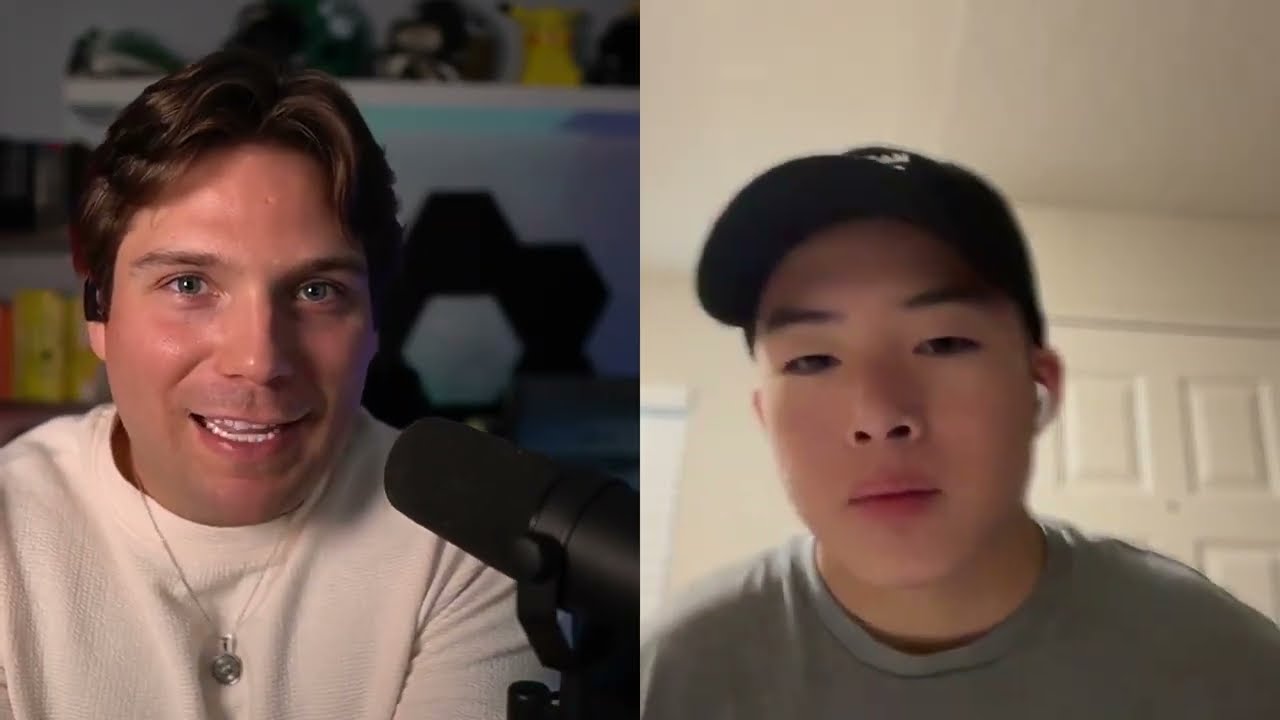
Hormozi's 20-Year-Old: How to Engineer What You Want with Jay Yang
Jay Yang dropped out to work at Acquisition.com and built a framework for engineering your career. He talks about defining a North Star, avoiding Pyrrhic victories, and stacking skills through daily rituals: write, read, lift. Cold outreach and quantity testing turn luck into opportunity.
Chapters
Jay Yang, you wrote You Can Just Do Things. You're 20 years old. You've worked for some of the top creators in the space. I'm so excited to have you on, man. What is your mission in everything that you've done up to this point, and why is it important to who we're speaking to today?
Gosh, well, my personal mission has always been to make my life my masterpiece, to use my life as a way to inspire the people around me. I think one of the best ways you can inspire people isn't to like tell people what to do, but be a positive example that they can be inspired by. And so for a lot of my career, I've tried to accelerate my career and compress timelines. And hopefully in this podcast we'll talk about how to create opportunities and how to stand out.
What do you think the most important thing for us to start with for an audience who is 22% founders, owners, CEOs, people that are building things, people that are driven ambitious in this age of acceleration? What's the most important thing that we can start with to set the scene today?
Well, you know, I think the most important thing to start with, and this is what I write about in my second book that I'm working on, is defining your north star. And there's this story in Alice in Wonderland, you know, one of my favorite movies. And, you know, Alice is walking down this dirt path and this trail splits into two different paths and she doesn't know which path to go down. So she looks up at the Cheshire Cat and goes, "Mr. Cheshire Cat, which path should I take?" And the Cheshire Cat goes, "Well, where do you wanna go?" And Alice goes, "I don't know." And the Cheshire Cat responds, "Then it doesn't matter. If you don't know where you're going to go, then any path will take you there." And my gosh, does that scene live rent-free in my head. How many times do we, say to our friends and family like, you know, I want to be happy or I want to be rich or I'm building my career, but we never actually stop to define what those things are. And so I think that's a great place to start.
Why do you think we've gotten to this point that so many people are so confused on what it is that they actually want? It seems like it's easier to go fast in the wrong direction than it ever has been before. Why is it so hard for people to actually sit down and figure out exactly what it is that they want?
I think it's been ingrained in us, and it's not our fault. It's not really society's fault, but I think we've been ingrained to seek permission or to outsource our agency to those around us. You know, in school we're told you got to raise your hand before you speak. You got to ask to go to the bathroom. You know, it's a multiple choice test. There's only one right answer. And I think life operates slightly differently. And so once we graduate, once we get out into the real world, We have to start to reflect and define these things for us. Like, what does it actually mean to be successful? What does it mean to build a career you love? And I think, you know, if reflection is the first step towards change, I think being aware is the first step towards taking agency over your life.
I think there's also something to be said that there's never been this much noise in the world. Me and you both played sports, right? And I know when I was 12 years old, I was playing on 4 4 different baseball teams. And so that meant I had 4 different coaches that were telling me different things to do with my swing. And I was in a bit of a slump, and they all gave me 4 different pieces of advice. And do you know what I did?
All 4 of those things? None of those things.
I, I had analysis paralysis, which is an actual psychological condition when we have so much information coming at us, we end up just doing nothing, staying the same. And right now you can go on the internet and you can swipe and find millions of people making millions of dollars and telling you slightly different things that you should do to get there. And I think people see all of this success and that's blinding them from what they truly want to do. And then they see that they know how to do it. They have the information. The information's out there for any of us to do what we want to do, to accomplish big things. So with that information, it almost increases this knowing-doing gap where we have so much more frustration because We know what we want to do, we know how to do it, but we aren't actually taking action toward it. And I think that we're paralyzed, not truly taking action toward it, because we haven't made the choice to get clear on what we want. Hmm. What do you think about that?
I would agree completely. I think, you know, even just this morning I was scrolling Instagram and yeah, I saw a reel from a multimillionaire that, you know, you got to, you got to, you know, build a digital business and build digital leverage. And then I saw another girl, she's talking about build a boring business, don't do any AI stuff, like do blue-collar work and Yeah, I think there's never been so much noise. It's definitely difficult to find the signal.
So how do you sift through the noise?
For me, you know, it goes back to defining your North Star. I think it is very hard to get what you want if you don't know what that is. And so step one would actually be not listening to the outside voices and taking a step back and looking inward. What is it that you actually want? And so in the book, I go through an exercise of asking yourself like, okay, well, what does winning mean? Like, you know, let's— people often say like, I want to build a career, but it's like, okay, well, what do you actually want to do your career? Do you want to— do you want to work in an office? Do you want to work at home? Do you want to work with many people or alone? Do you want to work with your hands, with your head? Do you want to sit at a desk? Do you want to move around a lot? And I think like the clearer we can get on like, what do we actually want, that's when we can start moving in the right direction.
Yeah. So you got clear at that at a really young age, and once you did, you took massive action. You took action that most people have no idea that they can even take. Tell me about, like, the limits that we set for ourselves, because I think that so many of us, like, we're about the same age, and we've been told our entire lives that there's a certain way that we should do things., right? And that way is what most people end up doing. And it takes a real sense of self-awareness to understand that, all right, I want a different result than these people, so I'm going to take different action. And when you start to take the action, it was just a 180-degree flip from what most people do. Where did that awareness come from, and how can other people start to implement these hugely different actions into their lives?
Well, I don't think it's necessarily about huge actions or different actions. I think the reason why we started this conversation with defining your North Star is because I fundamentally believe that you can get a lot of what you want out of life if you figure out what you want. And then you ask yourself this important question: What inputs would increase the likelihood that I get the output that I want? Because once you know what you want, then every decision you can filter through that lens of like, okay, if I know that I want to be a successful entrepreneur, well, will learning from other successful entrepreneurs who came before me increase the likelihood I become a successful entrepreneur? Probably. Will going where the action is and moving to a city where there are other entrepreneurs increase the likelihood? Probably. Would working out and being in shape and having high energy increase the likelihood I get what I want? Probably. And so you can filter all of your decisions through that lens of what do I want and what inputs increase the likelihood I get what I want.
I like that. And you seem to think really logically. You think like in— I think it's almost linear fashion. Obviously, you have different nonlinear goals for yourself where your progress hasn't seemed to be linear, but your thinking seems to be very linear and very logical, almost basic, which is not something we see a lot. By basic, I mean you're not overcomplicating it. So many of us have a tendency to attach emotion to our decisions, to have an idea of what we want and then make this 36-step plan in our head on maybe why it might be hard for us to get it. Where did this simplicity mindset come from and How has it benefited you in your life?
I do have to give a lot of credit to my parents. I think I am definitely more nature-wise a more logical-based thinker rather than emotional thinker. But I like to think of it as probabilistic thinking. Like, if you know what you want, then you can ask yourself, okay, well, what would increase the probability I get what I want? So it's more math. It's, it's, it's logic. But I'd say a lot of it was, is nature more than nurture.
I, I grew up a pretty like math-oriented kid as well. Like math, sciences were always my fields. I thought I was going to be an engineer. Um, and then I found that in the past few years I've actually really shifted to my skill set being much more interpersonal, much more, um, like emotional intelligence and social intelligence. I don't know why it shifted, but it's just been something in my maturity. It seems like that hasn't been the case for you. You've kind of just kept with the mathematical analytical mind?
Yes and no. I think it helps to be more probabilistic thinking in terms of zooming out on your big goals. And then I think in terms of interpersonal relationships and reaching out to people and working with people, definitely leaning more on the emotional side. So I don't think it's an either or either. It's a both. Yeah.
How has being analytical helped you in a way that maybe leading with emotion couldn't have?
I think the biggest example of this would be when I decided to drop out of college and work at acquisition.com. So for context, I was freshman year in college, I was running Six Figure Ghostwriting Agency. I was full-time college student and had some work-life balance. I could work in the mornings and hoop in the afternoons and hang out with my friends at night. And then I got this opportunity to work at Acquisition.com. And I remember having several nights just sleepless, just thinking through the decision. Should I drop out and join Acquisition? Should I stay? And I had a lot of FOMO of leaving college, leaving my friends. And I also didn't want to disappoint Alex and Leila. I really looked up to them. I've been watching Alex's YouTube videos since I was a sophomore in high school. And so I had a lot of emotion. And so I said, okay, well, how can I just remove all the emotion and think logically? This is a pretty big decision. Obviously emotion matters, but like, how can I think logically about this decision? And so I came up with this framework that I call the Four Pillar Framework. And so basically I said, what matters to me in my career? Well, 4 things. Number 1, learning. How much am I going to learn? Number 2 is earning. How much am I going to make and how much is this going to increase my capacity to make? Number 3 is network. Who am I going to meet by working at the company like my coworkers? And who am I going to meet because I was at the company? The people who come in through the doors. And then the fourth thing was story, is how much does this opportunity create future opportunities? And so I weighed each decision out of 4, out of 10 for these 4 categories, and I added them up out of 40, and theacquisition.com one won. And so then I chose to take theacquisition.com. Yeah.
With those 4 pillars, do you find that certain opportunities or certain phases in your life are more meant for one of them than the other? 100%.
You know, these 4 categories are the things that matter most to me in my career based on my North Star goal. It could be different for others, like maybe proximity to family or, you know, certain circumstances like that. I think the important part isn't that you adopt my 4, it's that you think deeply about the 4 that matter the most to you.
Yeah, I think that's one of my favorite parts about your content. You're one of the people out there that really isn't teaching per se. You're sharing. Your lessons, you're sharing lessons that you've said are for yourself 2 or 3 years ago. I really, I appreciate you saying that because I think that as a 19-year-old, I can get caught up in the, like, I want to be able to teach and I want to prove that I have something to share. And my best moments and the moments that resonate the deepest with other people are those where I'm literally just saying what I've done in my life and what's worked for me. And sharing my story. Storytelling is becoming so much more important in this age of everything teaching-wise. All the information out there is automated, is accessible. Anyone can say it, right? But we all have our own unique stories. And the way that you're able to share that in such actionable ways, I think is— it's really inspiring, which is your name, Jay Yang. And I'm curious, do you think that everybody has that opportunity, that everybody's story is worth sharing, that everybody listening to this could start posting about their life and their story no matter where they're at, and that could be valuable for other people?
I think one of the most underrated parts of creating content for me has been what I've been more aware of by creating content, by knowing that I have to write a weekly newsletter that will come out every Sunday, then I become more observant about stories and things and amazing experiences that happen throughout the week. And so for me, while creating content has been a way to accelerate my career and meet awesome people, it's also been in some senses therapeutic. And you know, one of my favorite quotes from Orson Scott Card, he says, Everybody walks past stories every day. The great storytellers probably pick up 5 or 6 stories. And I think creating content is a way to become more observant about the world around you.
What's a moment where you've felt that observance?
I would say every day. So at the end of every day, I sit down and I do what I call my reflection journal.
Nice.
And I ask myself like, what happened that was cool throughout this day? What did I learn? If I had to rate this day outta 10, what would that be? You know, what am I excited about for tomorrow? What am I worried about? Kind of like a journal, but also it allows me to then kind of activate my memory and go through the day like what actually happened sequence by sequence, what stood out to me. And that has allowed me to create better content, but it's also allowed me to appreciate how much depth that actually goes around, around us.
Yeah. Alex talks about, Alex Hormozi talks about like, you need to do cool shit in order to be able to talk about it. And a lot of people are spending their entire days like trying to write content about something that might not be too exciting. And I think one way I've thought about life is like, do the most fun, exciting, cool things and then have those stories to tell to people. Because that's what's exciting to people. People want to hear about life lived. And a lot of our generation, especially those of us in this entrepreneurial space, I feel like we've sacrificed a lot. And obviously every decision is a sacrifice, but I think that people are, are sacrificing a lot of life, a lot of experience, a lot of relationships to continue to push forward, to continue to achieve because that's what they've tied their identity to. How have you kind of worked against this entropy of achievement tied to the identity?
Yeah, I think it goes back to, you know, how we started this conversation. What do you want? Like, define your North Star. Maybe you do want the money and the fame and the success and, you know, the material wealth at the expense of everything else.
But I think anyone really wants that though.
I think if you reflect deep enough, I think it is often a proxy for something deeper. It is a temporary solution to a permanent pain that I think isn't filled. And so chapter 2 of the book is called Avoid the Pyrrhic Victory, because back in Greece, there was this country called, there was an emperor called Emperor of Pyrrhus, and he battled against Rome and he beat them twice. And for context, Rome was like, you know, the biggest, the best. And so, you know, all his generals and soldiers were cheering, but he wasn't. And a soldier came up to him and was like, "Why aren't you cheering? We just won." But he said, "Another battle like this and we will be utterly defeated." And a Pyrrhic victory is when the cost of winning exceeds the value of what you've won. And so for an example, it'd be like, Think of the investment banker that made partner at 35, but came back home and, you know, his wife left a note saying, I can't do this anymore. Or an entrepreneur who got so caught up in work that she didn't take care of her health and she was really overweight and depressed and lethargic. Or think of the researcher who spent all his years like trying to, you know, solve cancer, but he came home and You know, his kids said they grew up with a stranger. And I think there is, there is often a cost that we don't think about when we're trying to achieve some of these material goals.
Yeah. Have you felt that in your life?
A little bit. I think when I dropped out of college, I moved to Las Vegas. I moved from Illinois to Las Vegas and I left everything behind. I didn't know a single person in this new state. And so I left my parents, I left my friends, I left my grandparents. I also left my twin brother. And so for context, my twin and I, we were going to rent an apartment for the following year so we could stay together. And I remember having to break the news to him being like, hey, like, I'm actually leaving. And over the year working at Acquisition.com, you know, away from my family, I definitely didn't feel as close with my brother. I think our relationship kind of wasn't as deep as it was, you know, from going from spending every day together to not seeing each other. And so I think there's, there's often some costs there.
Yeah, I felt that. I've spent 2 years of the past 4 years abroad, away from my family, and there is some cost. Um, I'm so grateful for like the opportunity to travel so much and to be in all these incredible places and meet all these incredible people. But there's something to be said about just cherishing what it is that you were given, what it is that you already have. And I really do think that our, our truest fulfillment comes when we can, like, pursue the things that we really do want. Once we've identified that, while still keeping close to us and really valuing and being grateful for the things that are already here. I have this thesis that everything that we need to make us happy is already here right now. We have all the key ingredients to feel happy, to feel fulfilled, present in the present moment. And it's so easy to say, no, I need more to feel that feeling. And I really think that you can only truly be present in the pursuit of more and feel that whatever true success and winning is when you recognize that you do actually have the capacity for that feeling now, and you want more because you want more. It's as simple as that. You don't have to want more to feel a certain way. Yeah, that's been literally what I built this entire platform on, because, man, it's a painful thing to be chasing something, especially at a young age when We're accelerating our career paths 4, 5, 6 years past where our peers are. And you have to constantly ask yourself, why am I doing this? Why am I doing this? Because if you're not clear on the why, I think it's really easy to just burn out. Have you had a burnout moment?
I haven't.. And I think I'm definitely very lucky that I've been more of an introspective person. And so whenever I feel that something isn't aligned, I try and ask myself, how can I correct this? But I can see for a lot of people how that could occur.
Yeah.
So you've done some audacious things in your life, emailed founders directly to get a job. Built complete marketing campaigns before you even get a job to show someone that you can do the thing that you're applying to do. Where do you plan on taking all of this forward?
Yeah, I think, you know, going back to the how can I increase the likelihood I get what I want, I have tried for the last 5 years of my career to find the best people I know at the skills that I am lacking. And get as close to them as possible and absorb as much of their mental models and operations so that if I want to do something similar in the future, I can. And so the last 5 years I've been asking myself, if I know that my goal is to, let's say, be an author or be a successful entrepreneur, well, what skills do I need for that to occur? Well, I probably need to learn how to work, right? If you're working hard but not getting what you want, I would argue you don't know how to work. And so that was my case. I was, when I was 15, I started what I like to call my portfolio failures, where I would start, I started a YouTube channel, I started Instagram theme pages, I even tried starting a clothing brand and none of them went anywhere. And that's why I wanted to work with Tyler Denk and Beehive, because when I was using their platform, I saw how quickly they were shipping new features and I said, okay, that's a company that knows how to work. They're working hard and getting the right output. And so I said, if I work for a fast-growing startup, I'll probably learn how to work hard. Same thing with Noah. It's like, all right, well, if I know how to work, I probably need to know marketing. Well, who's the best marketer I know? Well, Noah Kagan. And so try to look for Noah Kagan. It's like, okay, I learned marketing, I started a marketing agency, but I kept hitting that, like, that plateau. I didn't know how to scale past where I was at. So I'm like, okay, well, who's the best at business that I know? Oh, well, Alex from Mozi. And so each person I've tried to identify, like, what is the thing, what is the skill that is constraining my career and how can I debottleneck it as quickly as possible?
I think an important part there is also you're not just asking these people to help you, you're actively helping them in the process, right? You're learning from them by providing them value at the job. And a lot of people just want information. They want help without really giving anything out. So I think from a perspective of a listener, how can I get the same results that Jay has gotten? It's by making yourself valuable to those people. But a question that I imagine you get, that I imagine a lot of people are curious about is how did you communicate your value to, for example, Tyler Denk at the beginning before you had worked for any of these companies? When you hadn't really done anything before? What did you say that you could do for him when you had no experience?
One of the biggest traps I see a lot of people who are at the beginning of their journey make is finding someone they want to work with and then asking, hey, how can I work for you? Or I want to work for you. I'll do anything for free. Just, you know, help me out. And what that does is it puts the burden on the other person. It puts the burden on the target to figure out, well, who is this person? How can they help me? Are they a weirdo or not? And that's a lot of burden. And so the question I like to tell people to ask themselves is, how can you reduce the friction it takes for the other person to say yes? How can you make this a no-brainer for them? And so for Tyler's example, you know, I wanted to work for Beehive. I looked up the website, I was like, is there any internship positions? There were none. I was like, okay, well, Maybe I can create my own. So when I cold emailed Tyler, I knew that the number one friction point for landing an internship would be Tyler thinking, okay, this kid seems okay, but like, what do we do with him, right? And so instead of waiting for them to figure out what I could help with, I created a pitch deck of 3 things that I could help them with over the summer, like 3 project ideas. And so I said, hey Tyler, here's who I am. Here's 3 things I can help you with. I really want to work with you. Like if you need a busy bee, like I'm your guy. And that reduced the friction it took for him to say yes.
Those 3 things, were they things that you'd done before that you had previous skill sets to apply to?
Yes, I don't remember the exact projects, but one of them was like start an internal podcast interviewing newsletter creators. One of them was building Beehive 101, which was a course on how to better understand the platform. And there was another one, but it was, things that I have tried for myself. I tried starting courses and Instagram theme pages. But I think one thing I, you know, I just caught up with EJ White, who was head of growth at Beehive, and he was telling me like the one thing that convinced him to want to work with me is he said, this kid has a lot of Twitter followers. He's like, at the time I had 22,000 followers on Twitter. And he said, okay, well, you know, this kid's young, he's 16, but he knows how to build an audience. So he knows, he understands some sort of marketing.. And so I think a lot of that reduced the friction.
Right.
So it's almost like you had to go out on your own and prove something that you could do it by yourself a little bit to then get the boost and be able to provide value to others. That's then been able to accelerate you from opportunity to opportunity. And now on your own, you're about to, you're about to go crush it. Do you think, do you think about it like that? Like you have to kind of prove something that you can do it by yourself. And then provide value to someone else that's ahead of you and almost like ladder up from there?
You know, the question I always ask people to reflect on is, would you work with you? And I think like, you know, I can teach you the frameworks on how to write a cold email or how to ask for a referral or how to start creating content. But all of that does not matter. Like you can get in front of your target and still not get the opportunity that you want. If you are not competent, if you're not good enough. And so as harsh as that sounds, like, visibility is only one step. You know, 100 times 0 is still 0. And so you still need that, that skill-building aspect.
Yeah. What does it mean to increase the surface area of luck?
For me, increasing your surface area for luck is probability. And so if we know that we want good things to happen, then what would increase the likelihood that more good things happen? And so, uh, for a lot of my career, I've created content, I've written online, and it wasn't because I wanted to be an influencer. It was simply because I understood that attention was on social media. All the people that I wanted to reach out to, work with, be my future customers and investors were on this corner of Twitter. And so I knew that if I just kept showing up, if I just kept sharing my ideas, sharing what I was learning, sharing what I was building, eventually people would start to notice.
Yeah, I think that we often think that quality is the opposite of quantity, where when we are— if we take more time on something, we're going to make it better. And something I've learned in my journey, and I imagine you have really learned through the people you've worked with and the things you've done on your own, is that in this creator economy quantity leads to quality because it's not what you think you want. It's about actually doing more, putting more out there and being analytical about it, figuring out, okay, what if I sent out like 100 cold emails and I did 2 different formats, which one got more? And then you double down on that and you start testing and you figure out the quality from quantity. And I think that's— is that kind of what you're going for in the increasing your surface area? Area of luck?
Yeah, one of my favorite quotes from the first book is, the path to quality is paved with quantity. And I think one of the most helpful mental reframes for me is that true failure is not failing, it's never trying. And so rather than reframing failure as not getting the outcome that I want, what I've tried to help people realize is that you, you want to pretend that you are a mad scientist, right? When scientists do things, they have an hypothesis, they test it, and if they don't get the result that they want, that's not a failure, that's a data point. And then they can iterate, they can double down on what works or cut what doesn't. And I think I've tried to view my career and view content the same way. It's like, if you don't know what will work, then try everything, see what works, put it out into reality, test before you invest your time, energy, and resources into an endeavor.
And how much should you test it? Like, what is the quantity we're looking for? I think a lot of times people are like, I posted 3 videos, none of them hit. I don't know what to double down on. It's like, at what point is the quantity becoming actually enough data to go from?
You know, someone asked me that question. I was speaking at my college a few months ago and they said, yeah, how much quantity is enough? And I felt kind of snide and I made like a quippy remark. I said more. But I do think that's the answer. At some point you will know when you have enough data. But for every single situation, it's context dependent.
Yeah, I think we both know people who have been like, I posted like 5 videos and like none of them hit. I don't understand. It's like so many people take hundreds, thousands of videos, of episodes of whatever you're doing to figure it out. And that's where really understanding what you want and your why behind it is so important because you're gonna have moments where like nothing's working. And if you're not emotionally attached to what you're doing, you're going to quit. One of my biggest mentors, I never met him personally before he died, but Bob Proctor. Are you familiar with who he is?
Yeah, he, uh, yeah, yeah, yeah.
So Bob, I've done a bunch of his programs, personally connected with like a lot of his close peers in the space. And Bob talks about A, B, and C goals. And an A goal is something that you know how to do. You've already done it before. It's like if you have a Chevy in the garage and your goal is to get a new Chevy, you already know how to do it. You've done it. And then the second one, a B goal, is something that you've never done before, but you know how to do. For you, for example, that was probably when you wrote your first book. You'd worked around people writing books previously. You'd never written your own, but you knew realistically how to do it. And then a C goal is something huge. It's something that you don't know how to do, but you truly understand your why behind it, and you go because you're so emotionally connected to it. And the difference between a B and a C goal is often the fact that a B goal, you're doing it for something else. Not always, but oftentimes people have these goals that they're doing it for the success, they're doing it for the money, and that's what they actually want out of it. The idea of the thing they're working toward itself isn't emotionally resonant enough to keep going if they don't see the money or the success. And I think in today's day and age, it's so easy to start because we see other people making money. We start because we see other people getting famous doing something. And so when we don't see ourselves doing that, when we don't maybe get lucky and just get like an instant viral hit, we quit and we move on to another thing where we see people doing that. But the only true way to success and the fastest way to success ironically seems to be the long way. It seems to be the, I'm committing to this no matter what I see because I am committed to the end result because I'm emotionally attached to this. For you, I see it in your work. You take a path that so many of our peers at our age don't, which is the long game where you think about, all right, I need to develop this skill. So then you take a year or two to work under these people. And I just want to dive a bit deeper into that. I want to understand how we can replicate that idea because I've only started to switched to that in the past year, I really fell into the trap of like, I want to find a quick money grab. I want to do YouTube automation, like I was telling you. What do you think it is that's allowed you to— is it just the clarity of the goal that we talked about at the beginning, or is there something deeper behind it that allows you to play this long game and have this patience to let things unfold in the way that's going to get you to this end result?
I have to preface this by saying I am definitely a perpetually impatient person. I don't think that I have a lot of patience. I think I have just found things to do in the meantime. And for me, I think the reason I've kind of adopted this long game approach is because of the people that I've looked up to. So, for example, Kobe Bryant, when he was 13, he kind of sucked at basketball. He scored 0 points for an entire summer of this summer league. And he knew that he wasn't going to beat these kids in a year. Like he wasn't gonna, you know, practice a lot and beat them in a year. But he knew that if he could stick to his routine and work out and practice and shoot his jump shots and learn over 5 to 6 years, that's when he could beat them. And so I think it's operating from a longer time horizon. So Jay Paul Getty was once the richest man in America and he had this young man come up to him. He had a barrel of oil that was $4,000, and he sold it to J. Paul Getty for $8,000. And so the young man walked away bragging that he doubled his money in a day. But Jay Paul Getty went on to sell that, to hold that barrel of oil and over the next 20 years sell it for $800,000. And so I think it just goes to show the power of zooming out and playing the long game.
What habits do you have that have compounded over time that you do maybe on a daily or weekly basis that you've just committed to in this pursuit of the long game that have put you in the place that you are now today?
It goes back to what you want and what inputs increase the likelihood you get what I want— what you want. If you know that for me, my goal is to be a successful entrepreneur or a successful writer or author, then what daily habits would increase the likelihood I get those outputs? So for me, my habits are pretty simple. I have to write something every day. I have to read something every day, and I have to lift every day. And if I can do those 3 things every single day, I know I will be inching my way closer towards the goals that I want. And you might be thinking like, gosh, that sounds so boring, so trite. But, you know, one of the biggest things I've learned, especially working with Alex, is that success is not a magical list that nobody knows. It's an obvious list that nobody does. And it's often the common sense that we don't put into common practice that prevents us from getting what we want.
Do you memorize those things like how that, that right there? I know you've tweeted that exact thing. Does that just like come from within or is it something that you've read over and over that you've now just memorized? Have you purposely memorized it?
I am definitely more of a nerdy type of person who collects quotes and questions, not intentionally. It's just, I just pick up things and remember it. But I think the most important habit has been writing tweets and tweeting a lot. You know, when I first got on Twitter, I would tweet 10+ times a day. And people often think of tweets as like concision, being concise, but tweets are actually idea compression. It's taking this big concept and compressing it to the most concise, possible form. And so when I say things like, success is not a magical list that nobody knows, it's an obvious list that nobody does, what I'm really saying is do obvious things. But when you say it that way, it makes it memorable. And that's something I've learned from writing online, writing on Twitter.
I really like that framing behind that. It almost reminds me of this story about, I believe it was Picasso. He was in a restaurant and this lady said, Picasso, Picasso, come draw something on my napkin. So Picasso comes over, takes 25, 30 seconds, draws something on her napkin and goes, that'll be $40,000, please. And she goes, what? It took you 30 seconds to draw. He said, it took me 30 years to know how to do that in 30 seconds. And in the same way, tweets that are so concise It's so much effort. It's taken so much time and so much knowledge, so much reading, so much experience to be able to concisely bring such a big idea into such a small two-line thing that sticks with you. How, how important is like being concise in your words? How important has it been to be able to say big ideas in small, precise ways?
What I've learned from people who are much ahead of me in the communication game is that people remember 3 things: stories, steps, and sentences. And so obviously we remember stories more than facts. Steps are like step 1, 2, 3, like step 1, define what you want. Step 2, avoid the Pyrrhic victory. Step 3, increase the likelihood you get what you want with the inputs. But sentences, that's the third one that, you know, I think Morgan Housel had that quote, people don't remember books, they remember sentences. And so I think one of the reasons why Atomic Habits was vastly successful aside from being a great book was that it had a high density of highlightable sentences. It had a lot of memorable sentences that people could take away, share with friends, talk about the book. And so for me in my career, I've been trying to, So you get better at that craft.
Yeah, it's almost like if you build a book of like, how many sentences go into a book? I have no idea.
Many.
Many. If you build a book of all tweetable sentences, then that's going to be one hell of a book, right? Instead of just building one book as one piece, you can almost think of it as like this sentence, this sentence, this sentence, all crafted independently. Did you do that in "You Can Just Do Things" and then the one you're doing now?
Yeah, so with my books, I remember hearing this story of how I think it was Mark Manson tested a lot of the chapters that he wrote on his blog first. Really? And so that story stuck with me. And so when I wrote the first book and now that I'm writing a second book, a lot of the frameworks that I include, a lot of the stories, sentences, ideas that I include in the book, I first actually test online. I test it on Twitter, I test it in my newsletter. When things get more likes or more impressions or more engagements, I can see like, okay, this framework mattered. Like this framework resonated more than that framework. So I'm gonna include that in the book. Or this story really did well, I'm gonna front load that and put that into this chapter.
Yeah. What do you think are the most important things that going forward you can do that maybe you haven't done so far in your career? To continue to leverage you in the correct— in the direction that you want to be going in.
My answer right now would be not anything new, just more better of the same. And so one of the biggest concepts I learned from Alex is one of the best risk-adjusted strategies is to just do more of what's already working. And so a lot of entrepreneurs in general, they, they do this marketing strategy, it works, and then they get bored and then they want to try something new. But before doing new, it makes more sense to do more of what you're doing until you can't physically do more volume and then try and do better of what you're currently doing until that gets diminishing returns. And then you do new. And so I think for my life and my career, I try and operate from the same lens of like, what's working? Can I do more of it? How can I do better? And then do new. Because I think it's easy to get shiny object syndrome of like, going from 0 to 1 is easier than 1 to 10. And so when we get stuck from the 1 to 10, we're like, okay, let's do something else because I know how to go from 0 to 1.
Right. Yeah, I think that's really important. Again, it's just been the past year that I've been able to realize that because I think from age 16 to mid-18, I was stuck in the, all right, I'm going to, I'm going to jump around. I was just having B goals, right? I wanted to get the quick success and what I was actually chasing without knowing it was this dopamine hit of instant success and going 0 to 1 and understanding how to do that. Like, it's so much more fulfilling to be in it for the long run and just commit to yourself. All right, there's— I'm not quitting. There's no option to come out of the other end of this without having the result that I'm looking for. Right. And I think if you just commit to that, if you're just like, I'm not getting out of this without getting the thing. It's almost like this old story of the general in one of the Greek wars who shot flaming arrows at the boats that they arrived on the island on saying, "We're burning the boats. We're not getting off this island alive unless we win." It's almost that freeing feeling of, "All right, I only have one direction to go now. I don't have to worry about what everyone else is doing." 'Cause I think self-comparison is one of the most debilitating, things we can have going on in our minds when we haven't truly committed to the thing that we're working on. I don't know if you feel this, but I used to, you know, see other kids our age, maybe they have a sales agency or they have some— they're doing some marketing thing, whatever they're doing, social media marketing. Used to be like, oh, well, if they're making more money than me, maybe I should be doing that too. And once you get really clear on what it is that you truly want, that— that thing that we started with, it almost eliminates that self-comparison because you're like, okay, I'm committed to this. This is what I'm doing. I don't feel like I want to go chase that quick zero-to-one buck anymore. Have you felt that, like, that clarity around no more self-comparison?
Yeah, one of my favorite quotes from Jeremy Giffen, he says, if you don't know whether you want to be a quarterback, chef, or entrepreneur, then you'll envy all 3 of them. And I think there is a lot of solace that I get in understanding what I want. One of my favorite quotes is, if you commit to nothing, you'll be distracted by everything. And so I think a life without commitment is a life hugging the x-axis of always bouncing around to different things, but never actually getting that exponential, like, curve and never actually getting meaningful results because you always stop compounding, interrupt it, and do something else and do something new.. And so for me, I know that I want to be a successful author and so that I can see other people running a software company or raising millions of dollars or being a podcaster, which I think is really cool. But I can see that, admire that, and not take my eye off of my goal.
Yeah. It's also really important when you're young to explore for most people. And There's this, did you ever take like a psychology class?
Yeah.
Yeah. Do you know, do you remember Marcia?
I don't.
So I'll explain it. Marcia talks about how when you were an adolescent, you kind of go through, it piggybacks off of Erik Erikson's idea that our adolescence is a time of identity exploration. It's where either identity achievement or role confusion. And those are kind of the two outcomes that we're going toward. And James Marcia expanded upon this, giving kind of four outcomes. So you have like a grid, right? And the x-axis is commitment and the y-axis is exploration, okay? So when you have exploration, that's a lot of what we're doing as adolescents. We're trying new things. We're gonna play different sports. We're gonna try out different friend groups. We're gonna go to college. We're maybe gonna go to parties, or then we're gonna experiment with studying all the time. We're gonna start a business. A lot of what we're doing is trying to explore to figure out what we want to commit to. And so that's normal for an adolescent. And a lot of times you can get stuck in this period of moratorium, which is what he calls all exploration and no commitment. Some kids get stuck in commitment with no exploration because their parents told them, you're gonna be a doctor, you're gonna be a lawyer, you're gonna take over the family business. And that can kind of create a feeling of just feeling stuck for the rest of your life.
I'm running this podcast, I'm running a business, and I'm also a full-time neuroscience student. Sometimes, no matter how grateful and ambitious I am, my brain just doesn't want to keep up. And I know that you know the feeling of having all these things you value so much that you just don't feel like you have the time or the focus to get done. And that's exactly why Why I take Magic Mind every single morning. It's a mental performance shot. It's got the adaptogens, the nootropics, and the time-release caffeine so that you don't get the jitters or the 3:00 PM crash, but you get all the energy, all the clarity, and all the focus to accomplish your goals. And I've been taking it every single morning because of those exact things. You guys know that I would never promote a brand that I didn't fully trust would get you the results that you're looking for. So if you're looking for more performance, more clarity, more focus, then go to magicmind.com/wagner20, put Wagner 20 in at checkout and get 20% off a package of these shots or 48% off a subscription. Go try it and let me know what you think.
Let's get back to this awesome episode. And then you can get this, the other idea, which is identity achievement, which is when you have both commitment and exploration at the same time. And I think that's something that from observing you, you've achieved, and you've achieved that faster than most people. I'm at the point where I've achieved that as well. And it's hard for people in that phase at our age because normal mentors, normal professors, the normal people that we'd be hearing from trying to learn they tell you, don't commit yet, you have so much time, you got to keep exploring. And it's almost an uphill battle as someone under 22 to say, I've committed to what my goals are, I know what I want, because a lot of people don't know what they want. And so you've done a good job of putting yourself in positions around people, other people that do know what they want. But I do think that it is somewhat of an uphill battle for for our peers. I don't know if you've experienced that at all.
Yeah, I think I've heard similar dogmas of you have time, you're a baby, keep exploring, keep trying things, don't commit. And I think there is some truth to that. I think it is unwise to commit on the wrong thing. And so exploration is important. The helpful framework that I've tried to to have around this is, you know, Google's 70/20/10 rule. And usually it's for advertising. You put 70% of your budget towards the thing that is working the most, 20% of your budget on variations of the thing that's working most, and 10% of things on just wild experiments, right? But I think the same can apply to our career, especially if you know what you want. You can spend— allocate 70% of your resources towards the one thing you are committed to, 20% on variations of that, playful things, and then 10% on trying things, explore things, do a podcast, travel to a new city, explore. And I think it is helpful to have a little bit of everything.
Is this one of your wild things today right here?
I'd say more wild than most. Yeah.
What are your novel experiences looking like these days?
These days, I'm actually in the process of trying to figure out where do I want to live. And so, yeah, similar to what we've talked about before of test before you invest, I've tried to visit the cities that I am interested in and not as a tourist, but as like a, as a resident. And so, you know, I was in SF a few months ago and now I'm in New York and I try and stay for at least a week and go about my routine as if I was working in this city. I, you know, wake up, go to an office or go to a coffee shop, do work, come back home, walk the streets, figure out if this is the vibe, if these are the people that I want to surround myself with. And I think that's how I've been operating.
Yeah. Where are you leaning toward?
Well, no decision yet. I'm only halfway into my trip with New York, but between you and me and I guess the rest of the internet, but I'll say I'm definitely leaning towards New York. I think the conversations to me are a little bit more diverse than some of the conversations I've had in SF.
Yeah, I don't think I'd want to— Yeah, I don't know, man. I've been in a lot of different cities and I love Europe. Spent a lot of time there now. Don't want to live there. And New York's great. I love it here. I haven't spent a ton of time, but just like you got everything you want. I mean, you can hear the train going by. It's a very vibrant city. A lot of just, there's a lot going on. To me, that's fun, that like constant stimulus. Yeah. Well, Jay, I so appreciate you coming on, man. For everybody that is watching, listening to this, this has been an insane setup, an insane day. A lot of things have gone astray and I think it's all led to the perfect conversation. And I just want to end on a personal note, which is like your ideas. I've been following you for a long time, and your idea that you can just do things has been to anybody that's in my life right now, one of the things I've been saying the most. Because just last summer, I was booking podcasts with people in New York or 2 hours away in Mass, and we do it online. And I didn't understand that I can just like drive here, build out a set in a place when I left my camera gear in my car and like Uber Eats a tripod to put my phone on, all that, and still do it. Like, you can just do things. You can just walk up to someone in the middle of the street that has a steven.com shirt on and get a tour around the headquarters of Flight Story. You can just do it. Like, there's really no limits. All the limits that we set on ourselves are just so unnecessary.
They're not real.
They're made up. And I really, really appreciate that perspective that you've shared with people.
Thank you. That means a lot.
Yeah. What message do you want to leave with my audience? What question do you want to answer that potentially I haven't asked you yet? What do you think is the most important thing that we could say to leave my audience on a note that will help them create positive change in their lives?
You know, I try and end many of my conversations this way, which is that I just want to be a reminder that if you know what you want and you go after it relentlessly, the world will reshape around you and conspire in your favor much more easily than you might think.
Thank you, Jay Yang Yang Yang. This has been The Grateful Podcast. Thank you for tuning in. Thank you so much for tuning in to this episode of The Grateful Podcast and staying until the end.
You're committed.
I respect that about you. If this conversation meant something to you, subscribe to the show and share it with just one person who could benefit from hearing this today. Thank you so much. Stay grateful, stay hungry. I'm Jack Wagner. This has been The Grateful Podcast.
More from Jay

Why He Took a 50% Pay Cut to Work With the Best | Jay Yang, writer | The Quest with Diksha




No Permission, No Problem, Six Figures at 19 | Jay Yang - Author & Hormozi’s Secret Weapon