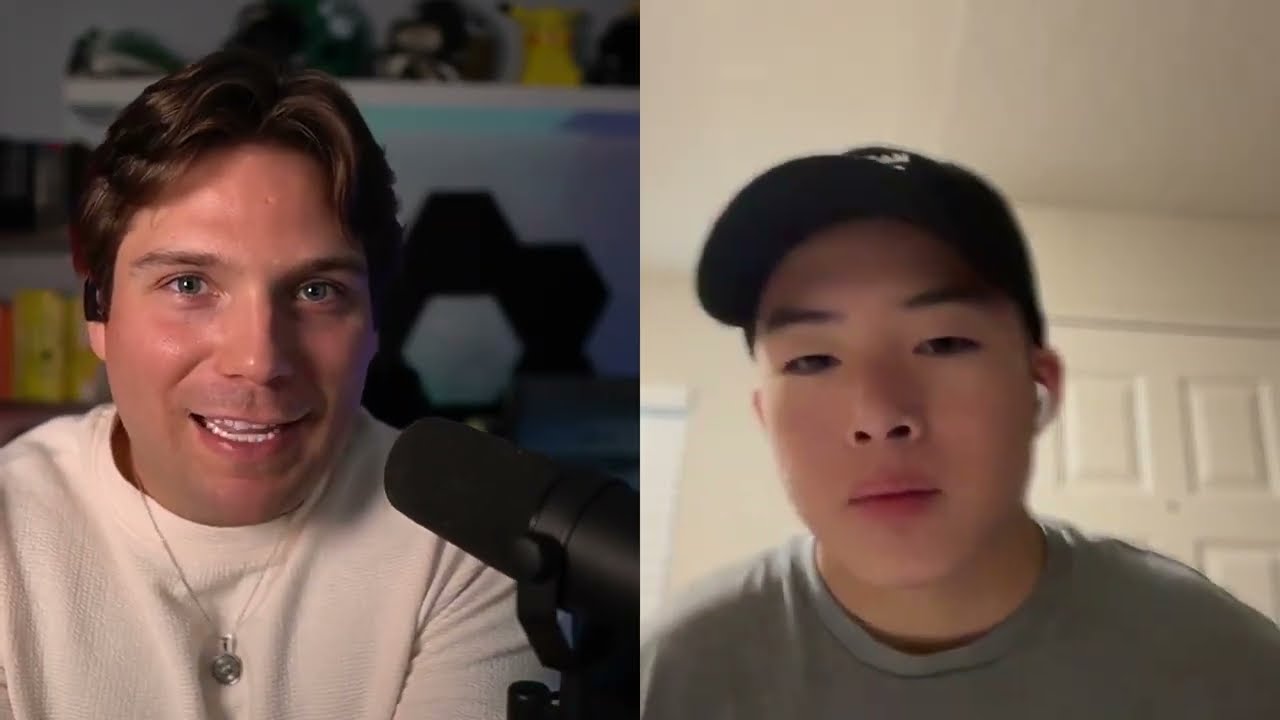
This content was created by Jay Yang. This content was uploaded by Jay Yang. This is a YouTube interview/podcast episode titled "You Can Just Do Things - Jay Yang" (published 2026-05-20). It features a host (Speaker A — the Books for Guys podcast host) interviewing Jay Yang about his background, career trajectory, and mindset. Topics covered include Jay's work with Noah Kagan and acquisition.com (Alex & Laila Hormozi), his cold-outreach pitch that won him a role (19-slide audit + sample content), building audience and friendships online, reverse-engineering successful people, his note-card writing system and how he wrote his book, public speaking development, motivation (hate-to-lose vs. love-to-win), and book recommendations (Tuesdays with Morrie; Million Dollar Weekend). Metadata: content type YOUTUBE, thumbnail https://i.ytimg.com/vi/f8eMlJ09YoA/maxresdefault.jpg, created_time 2026-05-20T01:00:27+00:00.
Chapters
There was a clip that came to mind and it was Marshawn Lynch's All About That Action Boss clip. And I was like, if there's a clip that I think Jay should use as his marketing tool or people to talk about Jay, I was like, Jay is all about that action. And, uh, I had to tell you that because when I saw it, I was like, yeah, I think that's Jay.
All right. I don't think I've seen that clip, but, uh, I'll check it out. All about that action.
I'll send it to you. It's a good one, man. It's just Marshawn Lynch not wanting to talk to the media, just saying he's all about that action. And I was like, all right, I think that lines up with Jay just doing big things. But dude, super excited to have you on the podcast, Jay. And actually, I listened to another podcast that you were on., and it was, uh, Abel. I forgot his last name. He's a big dude. You were on his podcast last summer.
Abel James.
Yeah. Abel James. Yeah, yeah, yeah. So I heard you on his podcast and then I looked up your book and I was like, dang, I gotta get, I gotta get Jay on the show, man. Cuz he's doing big things. And like I was telling you, that's what we're all about. But, um, dude, so I'm gonna kick, kick this question off for you cuz I was looking at your background. I know, you know, for people that Maybe they're following you, maybe they're not, but you know, worked for Noah Kagan for a while and then you went to work at acquisition.com, which Alex and Laila Hormozi, which I'm a big fan of. And, uh, one of my questions for you is obviously Alex and Laila come off as like super intense. They like 100 miles an hour. In my imagination of working there, I feel like one year there is equivalent to like 10 years somewhere else. Is that accurate?
Yeah, I'd say that was pretty accurate. I like to say that my time there was a crash course in business and operations and marketing, just a meld of everything. And I'm, I'm extremely grateful. I learned a ton there.
Yeah. Super cool. I've read like, as a recruiter, I've actually looked at like some of the job descriptions they put out there and it's pretty much like, hey, if you're, if you're not a hustler or a grinder and you don't want to put in X amount of time, like Don't apply. I wish people would be more transparent like that, but no, man. So dude, like I said, Jay, extremely excited to have you. You've got your book out, which we've got on the Books for Guys website, You Can Just Do Things. And man, I would love for you just to share your story a little bit with our audience, because what's cool is I think there's people that are doing successful things and they have this A lot of people who do, you know, good things, they have this trajectory that's kind of like this, but you seem to have a trajectory that's like this, um, the past few years as you've just been able to do so many different things and you seem so driven to accomplish so many things. And I don't even know if you know what all that is. You just seem to have this laser focus of like, I'm gonna go, go do big things. I'm gonna reach out to people, like I'm gonna make things happen. And man, where did— I heard in your podcast, you talked about during COVID like you looked in the mirror one day and you were just not happy with where you were. But man, like tell the story of what, how you got this mindset of just wanting to be great and maximize your life.
Yeah. Well, I think the honest answer to that question of why I'm so driven and why I wanted to work with the top business media people in the world, I think it stems from this this lack of, lack of self-esteem. I think, you know, the very first sport that I really committed myself to was basketball. And I started playing basketball in 4th grade, but a lot of my friends played, you know, in 1st and 2nd grade. And so I was immediately behind and I just hated that feeling of not being enough, not being as good as other people. And so the honest answer is a lot of the initial beginning of my career, I'd say, came from a place of, I want to prove myself. I want to start unknown, finish unforgettable. That kind of transformation. And I think only recently I've started to shift to a cleaner fuel of, no, I actually want to do this because it brings me joy and because it gives me meaning and I find purpose in it. Yeah, that was, that was the beginning. I started tinkering with stuff online and I sucked at it. I tried a ton of different things. I started that YouTube channel where I promote underground artist songs to help them get exposure. I started Instagram theme pages. I started a clothing brand, a newsletter. I tried all these different things and none of them really worked out. And that kind of lit a fire under my ass to, to get better.
Yeah. So it, it just seems like it happened so organically in, in like just something just clicked to you, but like, and you're a young guy. I mean, there's, you know, you, this is kind of more of a recent thing over the last, you know, 5, 7 years in this timeframe where this has switched. Did you, I mean, were there times as a teenager that you were, you were reading books or listening to podcasts or following people that kind of instilled, may— maybe you give credit to helping you find and flip that switch, or, or was it truly just something where you were like, dude, I just don't like where I'm at. I'm just gonna like, I'm going to decide to be different. But I'm curious to know, like, were there outside, was it your parents, were there outside motivations that kind of helped shape that mindset for you?
I think it was a little bit of both. I think nature-wise, I definitely am more of a driven person than a lot of my peers, but it was also nurture. I studied a ton of different people. I could name them for the next 3 hours. I'm writing about this in my second book, this idea of reverse engineering the greats. And I think one of the large reasons I've been able to accelerate my career and, and compress timelines is because I have identified the people that are living the life I want to live, and then I reverse engineered the things that they did in their career and in their lives and said, how can I do something like that but for my life? And so that's allowed me to make their hindsight my foresight and skip a lot of the mistakes that they went through. And so I attribute a lot of the good things in my career to reading biographies of people, to watching YouTube videos, to now even using AI now and kind of looking stuff up and not having to go through things myself through trial and error, but learning from those who came before me.
Yeah, dude, I love, I love that you just said that because literally that's kind of another point of Books for Guys that I try to push out there is like, okay, if you wanna be a millionaire by 30, like there's a blueprint out there in a book. If you wanna be the best athlete you can, you wanna be, you wanna be the next Kobe Bryant, Michael Jordan, LeBron James, there, The Mamba Mentality is a great book. Like there's, if you wanna build a business, there's, there's books out there. If you wanna write a book, there's a book about how to write a book. There's so many things you can read and learn from to skip those trip-ups you can have if you choose not to go learn and seek that out. And so I like that you said that of like reverse engineering the greats, cuz I'm the same way as you. I love reading about people who are doing amazing things. I love learning the struggle that they had and almost learning from that myself and being like, hey, I don't want to go through that, so I probably shouldn't do what they did so I can skip that and, and maybe get to the success faster. Dude, it's just so unique to talk to somebody, uh, again, Jay Yang, you probably hear this all the time and you're, you're super mature and you're probably tired of hearing that, but someone your age though that has figured that out to say like, hey, if I wanna skip levels 1 through 7 of struggle and get to 9, 10, and then start learning what 13, 14, 15 is, you just don't see a lot of people. Doing that, you know, people are scrolling and, and wasting a lot of time and it just seems like you found, I don't know, the secret sauce of being like, hey, I've, I'm gonna get rid of the clutter, focus on what's important, and it's gotten you to where you're at right now. Do you, here's kind of a unique question that I'm not sure, again, I was trying to see what questions you've been asked to, to kind of gear some things differently, but your friend group, like growing up, high school, and I know college you dropped out cause you were like, yeah, not for me. I can go do things a little bit differently. Have you seen, or I guess, has it been hard to have a core group of friends to lean on that are your age because of the way you think? Or have you been able to find a group of guys that's kind of a core group that you can do fun things with, but they're interesting enough 'cause they're also driven? At your age, what is that like? Because I definitely didn't have friends and I wasn't that friend either that was like, I'm going to build a business in 2 years, you know, like we just didn't talk that way. But what's that, what's that experience been like for you?
I would say it has definitely been tough to find people my age in my physical proximity. I think by definition, if you have more grand ambitions than the average person, you will have to take different actions than most people, which will make you feel slightly like an outsider. And so a lot of my high school friends and friends from my hometown are more of my like hang out and have fun type of friends, less than like, let's build a business together or let's strategize and, and talk about self-improvement ideas. And so a lot of the people that I've leaned on are people that I met online and through Twitter and through LinkedIn and just people that, you know, I've DM'd them and they've DM'd me and we've just kind of connected through the interwebs. And I'm grateful now. I have a ton of super cool friends that, you know, now I'm meeting in person and turning You know, URL into IRL friends. And so, yeah, I think finding people online and, and more importantly, like writing online and sharing your thoughts online almost becomes this bat signal for finding other people who think like-minded, who are like-minded like you. And so that's been instrumental in, in my career.
Yeah. That's interesting, man. Again, there's no, there's nothing wrong with, with your friends just shooting the shit and not doing a whole lot. Like that's needed too. But again, I was just thinking like back to, to myself in high school and college, like. I wish I would've had the, the thought process that you did because I'm like, man, what, what could I have done? You know, what books could I have read? And again, that's kind of the purpose of reverse engineering my life and so many others to help, help younger guys out. But you, you, you talk a little bit about too, you, you kind of hinted at it in that answer of cold outreach and reaching out to people that you're interested in learning from and, and interested in knowing more about. Like, man, it's never been easier, I think, to connect with people that you're interested in learning from. And you did it essentially for, I think, more than one job. You know, you reached out with a proposal saying like, hey man, I've noticed this, would love to connect and tell you what I think. Tell, tell a little bit about that story and just your, your process and strategy behind sending out those cold messages that led to some of the opportunities that you've been able to have.
I should give a lot credit to Jack Butcher who had a course back in like 2020 called Permissionless Apprentice, and it was only a dollar. And so I bought that course, took it, and the whole premise was, you know, you can put your work out there on online and instead of, you know, sending a resume or sending a CV, you can create a portfolio of proof and have your work like attract opportunities for you. And so that kind of sparked the idea of, hmm, if I don't I don't have a ton of experience or history, maybe I can do the work upfront to show or prove my competence without having a ton of experience. And so back in 2022, I think I was 17 and I saw that Noah Kagan was looking for someone to help grow his newsletter because he was gonna launch his book and he wanted to grow his newsletter to get more readers. And I thought, Well, I really like Noah, like he's creating content, he's running this big business, like he's living a life that seems pretty cool to me. And so, um, I was like, I want to work with Noah, but I don't have a ton of experience to lean on. So rather than DMing Noah and saying, hey, like I want to work for you, or I'll work for, I'll work for you for free, which sounds well-meaning, but it puts the burden on Noah to figure out who I am and how I can help. So rather than doing that, I did an audit of all of his social media platforms and his newsletter. And I put together this 19-slide pitch deck where it was like, here's your Twitter, you know, you could be doing better. Here's your Instagram, you know, this other person's doing their Instagram this way. You could be doing this. Here's a few things I'd tweak. This is your newsletter landing page. If you add this image and change this, this headline, I think it'll convert better. Just all these suggestions for him in these 19 slides. On top of that, I created 9 pieces of social media content for him to test. So 3 LinkedIn posts, 3 Instagram posts, 3 tweets. And I put that all together and I sent it to Noah and I said, hey, if you like this, like, let's work together. If not, no harm, no foul. Consider it a free gift. I really admire what you're doing. And luckily he loved it. And, you know, he put me on a paid trial. I started writing Instagram captions for his, his Instagram account. And, uh, slowly just absorbed opportunity and responsibility after responsibility and, and became his head of content.
Yeah, dude, that's crazy. Cause I'm, I'm a recruiter in the professional space. And so I'm putting my recruiter hat on for a second here. And whether you have thought about this or not, but I'm sitting here thinking of like every person I know that's looking for a job in this job market. There's this same approach that they're taking of apply and pray and hope somebody finds them. But if you're looking for a job, you should listen to this episode or share this episode with somebody who's listening for a job and, and listen to what you just said, Jay, about being proactive and showing your work so that people can see it. And if there's a need for it coming to you, uh, man, that's so valuable. Like, I don't know if you've built a business around coaching that, but dude, I think there's an idea, you know, to, to, to encourage people to be proactive with their skills. Again, I live on LinkedIn every day, so I'm sitting here thinking like, dang dude. Yeah. Like how many people could overcome that hump if they took that same approach that you did? So kudos, man, just again for thinking that way and going to get, I'm sure when he reached back out, you, you still were probably like, holy cow, it worked.
I mean, I remember it. I remember the DM he sent me back was like, yo, this is Noah. This is fire. Text me. And he, he sent me his number and I just, I was freaking out and he called me and I was in the middle of class, was my sophomore year of high school. And so I was like, teacher, like, yo, I got Mr. Graham. I gotta, I gotta step out and take this. So I run out into the hallway and I'm like, hi, hi, this is Jay. And I was just so nervous, but yeah, it, uh, it worked out.
Yeah. That's cool, man. I'd be the same way. He's really calling. But Jay, kind of switching over to your book. You know, again, like what you're putting out there is super important, man. Again, can speak to so many people, but when did you decide, hey, I'm gonna, I'm gonna write a book. I'm gonna put these ideas pen to paper and I'm gonna, I'm gonna put something together, man. How long did it take you and what was the process like from, from start to finish of, hey, thinking of the content you want to put together, organizing it and, and then putting it out there?
I was super lucky. I came across. This idea of the note card system from Ryan Holiday, where basically he would read these books and then he would highlight things and then he would transfer his highlights onto note cards. And those became the foundation of his books, you know, Stories and Stuff. And so, you know, long before I even had the idea of writing a book, I had just been collecting these note cards of different articles and books I've been reading. And anytime there was something that stood out to me, I would collect it. And so I had this wealth of information. And then the actual spark of the book came when I was a freshman in college. I had a friend who applied to over 1,000 different jobs and, you know, for an internship, and he didn't hear back from a single one of them, like none of them. And he was telling me this and I was just like, one, that's crazy to me, but two, he should try doing the work up front. Uh, he should try some of the things that I've been doing. And so that's when I realized like, oh, maybe the things that I've been doing in my like internet career that I haven't really told a ton of people about. Maybe I should share that. Maybe that can help a lot of my peers. And so that was the, the genesis of the book. And, you know, I used some of the note cards and the actual writing process was simpler than, than I thought because I had a ton of material and a ton of like life stories and experiences and I just had to puzzle piece them together.
Yeah. No, that's cool, man. I've, you know, I, I get to talk to a lot of people who have written books, whether they, whether they be authors, you know, business leaders, doctors, lawyers, athletes, everyone's got like a different process or, or the way they came about writing the book, it's always different. And so I'm always curious, like what that looks like, you know, did you, did you have that vision for yourself? Was it kind of, did it just happen organically where, you know, hey, you ended up with a bunch of notes and you're like, hey, I gotta organize this and, and, you know, let's turn this into something meaningful. And so that's really cool. Jay, as you've, you've already gotten to do so many cool things and meet cool people, work with cool people, doing big, you know, big things. Do you consider yourself, and I'm just thinking of just kind of some fun questions for you, do you consider yourself an introvert or an extrovert? Because you do a lot of, you know, social media stuff, which is very creative. And, but I've seen a picture of you speaking, you know, in a microphone to a group of people. Do you like doing that or is that something that you've had to get comfortable with as your platform has started to grow?
I would definitely consider myself more of an introvert. I think in the grand scheme of things, I'm probably more in the middle, but I definitely had to work at getting better at public speaking and putting myself out there. It's funny, I've done a lot of these cold pitches and creating content and being out there in public, but I'm naturally just a very risk-averse person. I don't like to do things unless I feel like there's a good shot that I can be successful, and I tend to not like to talk about things I haven't deeply thought about. So, you know, public speaking was always hard for me because I wanted to know exactly what people would ask and know exactly what I was going to say before I opened my mouth. You know, I was never the type of person to raise my hand in class before I had the thought. And it was actually one of my pet peeves of like people would raise their hand and then think about what they had to say. I'm like, no, think about what you have to say first. And so, yeah, it was, you know, a lot of reps and practicing to get better.
Yeah. Do you have people that you've been able to lean on? As far as coaches go or mentors that you've been able to ask questions to, I mean, I'm, I'm sure you have, but I'm curious to know, like, is that something you utilize on a daily, weekly basis, or has a lot of this been you just figuring it out on your own?
A lot of it has been, again, reverse engineering the greats. I think for public speaking in particular, it was listening to Simon Sinek and Barack Obama and a lot of these guys and. Noticing how they do their speeches for podcasts. It was listening to James Clear and Shane Parrish and Tim Ferriss and understanding how they create their soundbites. Oh, they start with a sentence and then open up to a story and then recap, like all these different things. And, and so just a lot of listening and, and learning and then practicing and having reps.
Yeah, man, you seem to have such a good balance of the, you can just do things and just doing it. But also taking the time to learn and figure things out, you know, and some people go about it by having, you know, personal coaches or mentors. You go about it a little bit differently of listening to podcasts, reading books, taking notes, and, and kind of figuring it out on your own, which I think is very, it's unique, uh, in a way just cause I haven't talked to a lot of people who have done it on your own, but you're also, at an age we have all these tools and all these things to our, our, that are within grasp that a lot of people I don't think had before. So I do think the path of being a successful entrepreneur or doing big things is a little bit different than probably a lot of the guests that I've talked to. That's, you know, from, they were going through what you were going through 20 years ago, you know, and, and that just wasn't something that you could have access to. Hey, another question I wanna ask you, cause I was, I was thinking about this and just the way you, like what motivates you and, you know, you said you played basketball. Are you a love to win person or a hate to lose? What motivates you more?
I'm probably more of a hate to lose type of person. And, uh, it's something I, I, I'm trying to work at getting better at of realizing that life is a positive sum game and that others winning doesn't mean I'm losing and me winning doesn't mean other people have to lose. I think naturally, you know, just, uh, probably just from playing basketball. Well, like one team has to lose and it's damn well not gonna be me, right? And so that's a lot of my mindset.
Yeah. Do you find yourself like in the work you're trying to do and the things you're trying to accomplish, do you find yourself looking at other people who are already successful and doing big things? Like, does that sometimes trigger you to work harder because you're motivated that you're, you feel like you're behind even though you're not? But do you, I guess, what do you use as motivation besides just your personal personal drive, like what is it that other people do that you take away from them to help propel yourself?
I think I've gotten better at not looking at other people and feeling envious and feeling like, you know, I'm inadequate. That was a lot of what initially drove me, but I think I have started to distinguish between looking at others to study the strategies and tools that they're using to get ahead versus looking at their entire career and being jealous. And so I think, you know, I think James Clear talks about that of like, if you want to look at others compare little things, uh, not big things. And so, yeah, I think I'm getting at a point where, uh, I, I don't find a lot of drive from looking at others anymore. Uh, I think it's because probably a little bit of growing up, I'm starting to become clear about what I actually want out of life. And so when I feel I don't have enough motivation, I just look at my north star. I look at the life I want to live and that brings me a source of fuel.
Yeah, dude, I love hearing you answer that way because I'm sitting here thinking to myself, kind of that same thing where I used to be jealous and I used to be like, like, I gotta have that. I want that, so I'm gonna work harder. It wasn't necessarily that I was mad at that person or it was just like, why can't I get what they have? But over the last, I don't know, several years now, I love seeing people who are successful. Like I love seeing people do great things. Cause I'm like, dude, okay, you're doing something awesome. I'm gonna go do something awesome too. Like it's more motivating than it is the reverse. And I think that is something as. Like successful people figure out. It's like you don't have to be jealous or you don't have to root against somebody so that you can advance. It's like, hey, all, a rising tide raises all ships. Like if they're doing good, like learn what they're doing and just copy it. Like go learn from 'em instead of, you know, maybe creating distance that a lot of people do before you figure that out. Uh, Jay, just a couple more questions for you. When people read your book, What is— and I'm excited that you're already writing a second one too, man. We'll have to, we'll have to spotlight that one and, and have you back on to talk about that. But what do you hope, if nothing else, they take one thing away from it? What do you hope people take away after they read your book?
I think the biggest takeaway that I hope readers will get from the book is that you don't need permission to live your dream life. And if you figure out what you want and go after it with full intensity and full relentlessness, the world will often reconfigure itself around you much more easily than you you might think. So that would be the biggest one. Yeah.
I love that, man. Go essentially just go get it, go make it happen. Like figure it out. I love that. Last question for you, Jay. This has been awesome. I love talking with you and just hearing your energy and passion. I can't wait, now that we've connected, I can't wait to see like everything you do. It's gonna be super cool. Again, I love rooting for people that are just driven and doing awesome things. So you, you've got me as a fan and, and I know a lot of other people are already your fan and, and will become that. But you mentioned reading a lot and learning a lot from others. I always ask people that come on this podcast, you know, what's a book or two that has meant a lot to you personally or professionally, and what's a book that you like to recommend to other people when asked?
Hey, I think the top two books that I often recommend to many of the people who ask me for book recommendations, the first one is Tuesdays with Morrie by Mitch Albom. I think that. Played a profound impact on how I view success and realizing that there are bigger things than just money and realizing that at the end of the day, all the chess pieces go in the same box and to make the most of the finite life that we have. The more tactical business book that I recommend people is, you know, I'm slightly biased, but Million Dollar Weekend by Noah Kagan. And I think it is by far the best book to get from zero to one, and it personally helped me build a multi-six-figure business while in college. It is the most tactical and practical book on starting a business that I know of, and I've read many of the business books. And so those two would be the top two.
Good recommendations, man. Good recommendations. Well, Jay, dude, thank you so much for doing this. I'm excited cuz for one, again, I go, I go back to your trajectory. When I look back on this, this episode in 2, 3, 5 years, you're gonna be way up here doing all these things and I'm gonna be like, I had Jay, Jay Hey, he was on the Books for Guys podcast, you know, back in 2026. And so, man, thank you for taking the time to do this. We are super proud to spotlight your book and to cheer you on and everything that you're doing. And, uh, brother, keep crushing it, man. Excited to see everything you do.
I appreciate it.
Awesome. Thanks, Jay.
More from Jay

Why He Took a 50% Pay Cut to Work With the Best | Jay Yang, writer | The Quest with Diksha




No Permission, No Problem, Six Figures at 19 | Jay Yang - Author & Hormozi’s Secret Weapon