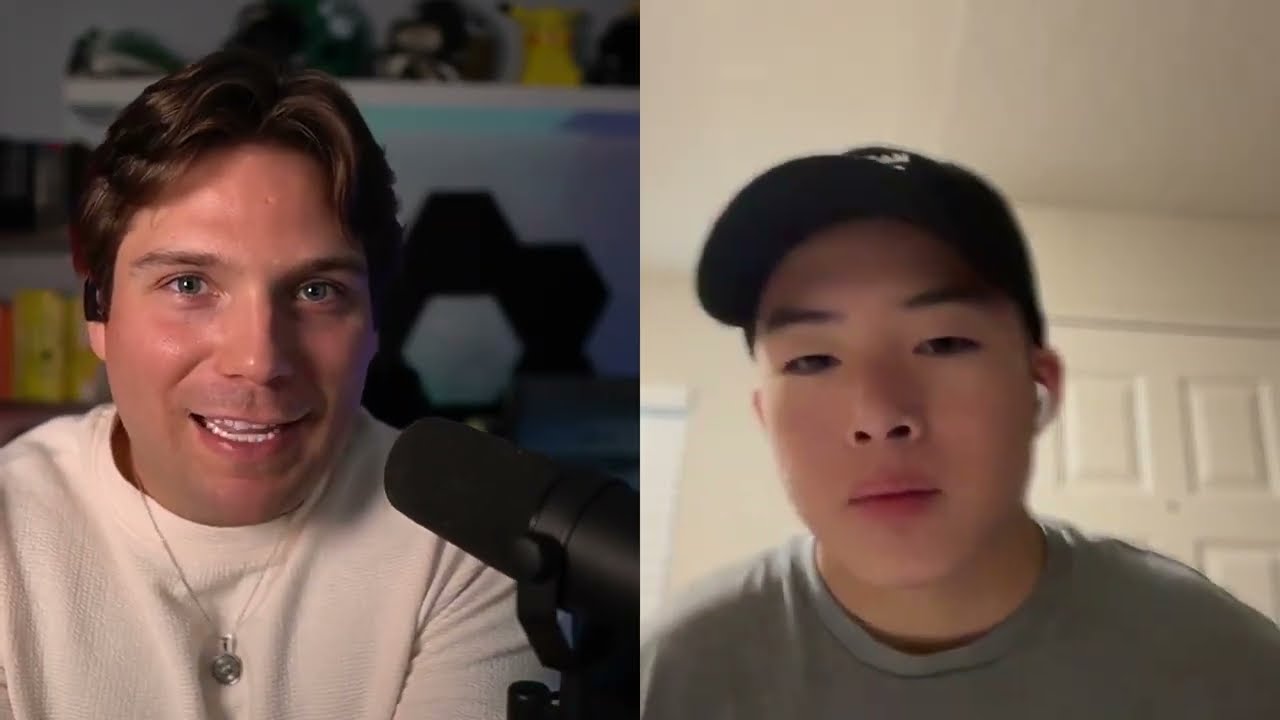
YouTube Strategist Explains How to Land a Dream Job That Pays You Well Too

Jay Yang walks through his career at Beehive, acquisition.com, and other high-growth companies, then breaks down concrete tactics for landing dream jobs: pitch decks, cold outreach, referrals, and public challenges. He shares frameworks for career decisions and what makes an S-tier employee.
Chapters
I have a running Google Doc, hundreds of pages of everything that I've learned at acquisition.com.
What is the difference between an S-tier employee and say an A-tier employee?
The best way you can use content to showcase your competence and create opportunities is to— My name is Jay Yang. I am a 20-year-old bestselling author, and before this I have worked behind the scenes with some of my favorite entrepreneurs.
Jay, you have worked for Alex Hormozi, Noah Kagan, and Tyler Denk, three of the most well-respected names in the entire creator economy. How did you get an opportunity to work with those people?
Yeah, so it started with Tyler Denk at Beehive. I was 16 at the time, and before then I had started a bunch of, you know, what I like to call my portfolio failures, and nothing really worked out. And so my mom suggested that I work with one of my favorite entrepreneurs and see if I could learn something from them. And so I went to Beehive's website and I typed up like internship, and, you know, obviously nothing appeared. And so I said, all right, I'm gonna, I'm gonna create my own opportunity. I am going to create my own internship. And so I cold emailed Tyler Denk with a pitch deck, a 10-slide pitch deck with 3 summer project ideas that I could do. Because I knew that if I was Tyler and I got pitched, the number 1 friction point I would have is, okay, this kid seems cool, but what do we actually do with him? And so I wanted to reduce the friction it took for Tyler to say yes. So I pitched him 3 ideas. I said, here's 3 things I can work on. Just pick one of them and I'll do it for free. And that kind of kickstarted the, the rest of my journey.
And so that eventually led to an opportunity working as head of content for Noah Kagan, where you were earning, I think, $150,000 a year at 17 years old, which is absurd to me. What happened from the moment you left Beehive to the moment you joined as head of content?
Yeah, so I saw that Noah was looking for someone to help grow his newsletter. He was going to launch his book soon and he wanted to grow his newsletter. And I was like, well, I just came from a newsletter company. I think I can help. And so I knew that the pitch deck worked with Tyler, and so I said, I'm just going to do it bigger, better. And so I dropped everything and I spent the next 50 hours creating a 19-slide pitch deck, deconstructing Noah's entire social media and email funnel. And the question I asked myself was, if I had this role, what would my strategy be? And then I tried to deliver it to him upfront. And so I said, all right, here's what his newsletter looks like. Here's the landing page. Here's what platform he's using. Here are all the social channels he's using to grow the newsletter. Here's how he's doing on each social channel. Here's what I'd do and change if I were to run this. And then I sent that pitch deck to him along with 9 pieces of ready-to-be-published content that he could test right away to test that I knew what I was talking about.
That's incredible. And then that obviously led to him reaching back out to you.
Yeah, exactly. I, I got a DM from him like, yo man, this is Noah. Saw your presentation. This is fire. Here's my number. Give me a call. And it was just— I was so excited. And I remember like I was in class at the time. I think I was in a business class and I got just goosebumps, chills, because I've been watching Noah's content on YouTube for a long time. And, you know, he's someone I looked up to. And so I was definitely, definitely pretty nervous and pretty excited.
Did you get offered a position right on that phone call or did it lead to something else beforehand?
I don't remember how the exact phone call went. I do know that I started with Noah on a trial, and this is one of Noah's core philosophies, which is test before you invest.. And so whether we're trying to onboard a new teammate or test out a new tool, we always try and see, or even like test a content strategy. We always like do a mini test before we fully invest time, energy, and resources. And so I started on a free trial with Noah where basically for the first 30 days I was just writing his Instagram captions and it was the most like unglamorous, boring, tedious work ever. But I try to overdeliver as much as possible. I'd, I'd write the captions and then also design an Instagram post. Hey, try this out. And so I'd, I constantly try and give him like ideas to test and slowly over time I would absorb more responsibility until I started leading all of his content.
It must be kind of daunting to do a lot of free labor without knowing if this is ever going to yield some kind of return for you.
Yes and no. I think the mindset reframe that I give a lot of people who are like, oh, that's— they're taking advantage of you, you're working for free, is when you have like nothing going for you, then you have nothing going for you, which means you have to like use what you have. And I had a lot of time and energy. I didn't have a lot of money or skill set, and so I had to use what I had to create opportunities. And I think the second reframe is No matter what happens, you get better. It's an asymmetric bet. The downside is you get a no or rejection, and the upside is you get everything you want. It's like in the process of doing this work upfront, in the process of using the pitch deck approach, even if Noah said no, I just spent 50 hours getting better at my craft of doing research, doing an audit, practicing a cold pitch, practicing creating a public pitch deck, practicing content strategy.
What goes inside a pitch deck to make it excellent?
Most of my pitch decks are tailored to each client, and that's part of the audit process. It's researching, and it can be even as specific, like for example, like for the pitch deck for the Alex Hormozi role, at the end it's like, "Who is Jay?" And it's like a picture of me flexing my bicep because I know that Alex likes working out, right? And so, the pitch deck is both about like strategy of the role, but also just like doing research into their personality and their values and things they like and believe. Because you want to show that you are in their in-group, you are like them. There's a golden rule like treat other people the way you want to be treated, but I think there's a rule above the golden rule, which is the platinum rule. Treat other people the way they want to be treated. That's empathy. That's putting yourself in their shoes. And so the question to ask is, if I was Alex, or if I was Noah, if I was Tyler, what would I want to see from someone who's pitching me? What would make it a no-brainer for me? Then reverse engineering the things that you put into the pitch deck.
I've always had this like really profound respect for people who can get their point across with brevity. And I think about the people that I work with or the people that you have worked with, and these are people who are exceptionally busy and get pitched multiple times a day. How do you know with a slide deck or with any kind of outreach that you do when to add a word or a slide? How do you, how do you make sure that you're being concise but also empathetic, as you said?
I think the question I ask is like, what needs to be true for them to be able to make a decision on whether they should work with me or not?. And so obviously I try and front load a lot of the core strategies in the pitch deck so that if they just skim it, they immediately feel like they got value. And so if you look at Noah Kagan's pitch deck, the very first slide is a very visual contrast between his current landing page and the landing page that I designed for him. And so it's, it's super visual, it's super easy to skim. You can immediately see the value and the difference. And then throughout the rest of the presentation, it's, it's more tactics. The reason I like pitch decks more than memos or anything else, or even videos, is it's so easy to just even open, open on your phone and just like swipe through and you can do it in like 30 seconds. I know that like Noah's busy, Alex is busy, Tyler's busy. And so I'm a big fan of pitch decks because you can show instead of tell with pictures, images, and graphics.
You have listed on your website that this pitch deck to this free working opportunity with Noah ultimately led to a $150,000 job working for him. And this was when you were something like 19 years old. When did that conversation actually happen where you said, okay, it's time to actually start earning from this opportunity? And how did you get a rate that at that age and at that time is exceptionally respectable.
Yeah, I was actually 17 at the time.
Even younger.
But the conversation with Noah was pretty like candid and honest. You know, at the time Noah wasn't my only client. I was also doing work for other startups. And so he asked me like, "Hey Jay, like what would it take to bring you on full-time?" And I told him what I was earning with some of these other clients. And I said, "If you could, if you can just match that or go a little bit above that," that would make it more likely for me to want to work with you full-time and like dedicate my life and career to this. But I think like the more important part is the reason Noah asked like, hey, what would it take for you to go full-time is because throughout my, I think it was 6 months working with him before we had that conversation, I was constantly absorbing responsibilities and problems like to take it off his plate. I tell people, I call it finding your and. Whenever you want to do something or learn something, you have to think about it from the company's perspective, which is let's use the acquisition.com example. I joined the media team as a written media strategist, and so I was doing a lot of tweets, emails, but I wanted to learn ads. I wanted to learn paid marketing because I knew that was something that was the constraint of my career. I didn't know it. And so rather than saying, hey, can I transfer from the media team to the marketing team, which is risky for the company, I said, I'm just going to do my job and I'm going to do paid marketing. I'm going to just insert myself in here. I'm going to write a batch of ads. I'm going to send it to the director of marketing. I'm going to make it an absolute no-brainer for them to want me to be on the, on the marketing team. And so Similarly with Noah, it's like, how can you do your job and the next job so that it becomes a no-brainer when they say, hey, we need a head of content? It's like, oh, well, Jay's kind of been doing it informally for the last 6 months. And so it's an absolute no-brainer. Let's just make Jay the head of content.
I love that. So you have worked with some incredible people. I want to know, what have you learned about greatness from somebody like Alex Hormozi or Leila Hormozi or Noah Kagan or Tyler Denk?
If I had to boil it down to one word, it would be intention. I think the common through line between Tyler, Noah, and Alex is this immense amount of focus on what they're doing. For example, when I was working with Noah before we launched the book that ended up becoming a New York Times bestselling book, he spent the 18 months prior working on the launch strategy, going on podcasts, testing the book title, testing the subtitle, testing the color of the COVID like running Facebook ads to test the color of the book. The amount of intention and things that went into the launch before the launch even happened was just crazy to me. It completely reset my standards for what greatness looks like. That's what I think is most valuable about working with people who are at the best of your— at their craft is like this, your standards raise.
How have you cultivated intention in your own working life now?
I think it's just operating on longer time horizons. For example, Alex wrote his third book, $100 Million Money Models, 6 years before he launched it. Like, can you imagine that? Like, I've— like, I haven't even been doing marketing for 6 years in total. He just spent 6 years on one book. You know, now that I'm writing my second book, it's realizing that the alpha, the value in doing the pre-work before something is out is 10 times the value of the work you do after the launch. And so I'm willing to spend an extra year, an extra 2 years on this book so that I know when it does launch, it can get 10x, 100x the results because I spent that much time on the minutiae, the details that makes this book great.
So the philosophy in Silicon Valley of shipping things at 70% done, would you disagree with that?
I would say similar to Noah, it's test and invest. And so a lot of this book, like, you know, I'm testing a lot of the chapters as newsletter editions. I'm testing a lot of the sentences as tweets, a lot of the stories like in podcasts like these. And so that when I do ship the final product, the book, I know that all of these concepts are validated. This chapter did well, you know, let's, let's front load that. This story did well, let's highlight that. This sentence did well, let's bold that. And so the book is just the most hyper-tested premium product because I know all the concepts have been tested and validated.
I love that. Mark Manson, who I used to work for, he followed that same strategy when he was writing his book. He was a blogger for a decade before writing that book. And one of his most popular blog titles, the one that went most viral on Facebook was titled The Subtle Art of Not Giving Up. And so he knew when that book got published that that was a really strong title. So I love that, that philosophy, that principle. It makes so much sense. I want to talk about you being an excellent employee. This is a podcast for people who work for other creators. And some of the quotes that are on your website, one from Tyler Ferriss, "This kid is going to be a beast." One from Tyler Denk, "I'd put every dollar I had into Jay Yang." So you're obviously some kind of S-tier employee. What is the differentiator between an S-tier employee, an A-tier employee, and maybe a B or an F-tier employee?
If we were to zoom out, I think the common traits between people who are A-tier employees— and now I'm like at a point where I'm hiring my own employees and teammates, and you know, it's cool to see the difference— is it's how large of a responsibility you can give a teammate with as little instruction. And so for example, like if you told a toddler like, hey, get better at basketball. Like, they wouldn't know what to do, right? But if you said, hey toddler, here's how to make a good chest pass. Put your right foot forward first, have the ball with two hands, extend your elbows, finish with your thumbs down, and that's how you make a good pass. Do that 100 times. And then you keep— so like, it's good employees, you can just assign responsibilities. Bad or not as high-performing employees, you have to break it down into chunks and into steps and kind of have to hold their hand. And so as much as possible, you know, I try and be proactive with a lot of the things that I do. And so for example, one of the tactics that I used at Acquire position was a Monday morning visibility email. And so every Monday morning I would send an email with what I got done the previous week, as well as things I got done during the weekend, because I knew that Alex and Leila like people who work weekends, as well as things that I'm gonna prioritize for the following week and why I'm prioritizing them in that sequence. I got to show like how I'm thinking as a leader. Like I'm not just assigning, I'm not showing you a to-do list, I'm showing you what I'm doing and why it's sequenced in that order in, in terms of impact and importance, as well as the things I did last week. And I think it's little things like that to push information to your managers instead of having them have to pull it out of you that like makes it so much easier to, to work with you.
Okay. I'm gonna adopt that cuz I think that's super clever. And so this was not something that was assigned to you. This is something that just came to you. You said, I need to tell my management team exactly what I'm working on.
Yeah. And it was birthed because Alex was like, what are you doing, Jay? Like, he, he didn't think I was doing anything. And I was like, what do you mean? I'm, I'm always the first one in the office, last one to leave. Like, I'm doing everything. But he didn't know that. And I think it's probably a little bit because of my Asian background. Like I'm, I'm not wired to like, you know, talk about what I do or brag about what I do. I just kind of like doing good work and letting the work speak for itself. But what I realized at an actual company was, you know, visibility does matter and like you have to kind of play that game. And so you can have a lot of impact, but if your boss doesn't know you have a lot of impact, then did you have a lot of impact? And so there's kind of the game of like 10 out of 10 impact with 0 out of 10 visibility equals 0 out of 10 opportunities. And so you need to kind of play that game of also letting them know what you're working on and how it's going. Now that I'm hiring teammates, the ones that I know are gonna be A players are the ones that immediately have a high volume of activity when they start. We start on Monday and by Friday they have 5 things done and the next week's stuff done and questions for me. Versus another employee, maybe a B-level employee, start on Monday and by Friday they're still like, "Hey, what's the login again? I can't, you know, I'm struggling with this." And so I think the Monday morning visibility emails allow them to see the amount of high-volume activity that I've been doing and the impact that it's had.
I want to talk about you leaving acquisition because that sounds like such an incredible opportunity. Everybody on the planet would want to have face time with Alex Hormozi, and you did. And then this past January, you packed up and left. Why would you do that?
Yeah, I think the, the best way to explain why I left is to first start with why I joined in the first place.
Okay.
And so as you guys know, like, I joined Beehive at 16, Noah Kagan at 17, started a ghostwriting agency at 18 and got it to mid-six figures while I was in college. And so when the opportunity at 19 presented itself, I was kind of hesitant. I was running a business. Do I really want to shut down this business, drop out of college, move from Illinois to Las Vegas to join acquisition? And so I had a lot of sleepless nights trying to decide between the two. And it was obviously champagne. It's good problems to have, right? Between a six-figure business or acquisition. But I realized that I had a lot of emotions. I, I felt FOMO of missing out on the college experience, and I also didn't want to disappoint Alex and Layla. And so what I said was, man, I'm just going to remove all the emotion. I'm just going to think logically about this. And so I came up with a framework that I call the Four Pillar Framework. And basically the question I asked myself was, what are the four things that matter to me most in my career? And I boiled it down to learning, which is how much I'm going to learn, earning, how much is this role going to help me make, and more importantly, increase my capacity to make in the future. Number 3 was network, who am I going to meet by being at the company, my teammates, my coworkers, and who am I going to meet because I was at the company, the people that walk in the doors. And then 4th was story, how well does this opportunity create future opportunities. And so what I did was I ranked those 4 categories out of 10 for my current opportunity, which is the agency in college and acquisition. So like, how much am I going to learn in college plus running the agency? How much are you going to learn at acquisition? So I ranked all those up and acquisition.com won. And so I said, all right, I'm going to take the leap. I'm going to, I'm going to do this. But I always knew, and I think many of the people there knew that a lot of the people at the company were entrepreneurial at heart. And so it's almost like doing a 1 to 2 year tour of like, We're going to come in here, we're going to work our butts off, we're going to work harder than we've ever worked, and we're going to learn as much as we can. But we're always going to do something, you know, we're always going to end up doing our own thing again. It's just part of our nature. And so that's kind of the mindset that I came into of like, I will have no life this next year. Like, I will not talk to anyone. I like to say that when I was in Vegas, I was in Las Vegas for a year, but I don't know much about Vegas because the only road that I drove on was the road from my apartment to the headquarters. I was super intentional about that. So I talked with a friend before I joined. I said, hey, you know, I'm probably not going to stay here forever. I'm going to leave when I'm not learning as much. And he said, okay, well, how do you know when you've stopped learning? And I said, oh, I'll just know. He's like, no, you won't. You're going to be too emotional. You won't know. Like, you're going to always, like, convince yourself you should stay because you're going to get comfortable there. And so I said, okay, I'll quantify it. So I have a running Google Doc, hundreds of pages of everything that I've learned at acquisition.com. And I said, once I stop adding to this running doc at least once a week, then I know learning has declined and it's probably time to do something new. And so a few things kind of culminated at the end is like, one, I stopped adding to the learning doc. Two, some of my grandparents' family members had some health issues, and so I wanted to be back closer to family.
So it seems like after a certain period of time, there's diminishing returns on those four pillars, right?
Right.
Nice. Okay, great. Can you tell me— so there's a contact quadrant: referrals, cold outreach, content, public pitch.
Yeah, the contact quadrant is going to be part of my next book. Is how you actually get in front of people. It's a spin-off of Alex's Core 4, but there are really only 4 ways you can reach out to someone, right? There's only 2— there's 2 types of people: people you know and people you don't know, friendlies and strangers. And then there's only 2 ways to contact people: one-on-one or one-to-many. And so that's where the Contact Quadrant was born. It's, all right, now that you have this— you have this pitch deck, how do you actually get it in front of them? And so the first method is cold outreach, which is sending a DM or an email. A lot of people do that and they don't get a lot of results. And so The pro tip here is to follow the 3 S's, which is simple, specific, and strategic. And so mistake number 1 is when your email is long-winded and hard to read. These are busy people. Like, Alex is not going to spend 10 minutes reading your email. He'll give you 10 seconds at most. Honestly, his executive assistant will give you 10 seconds at most. And so you need to make it skippable. Short sentences, short paragraphs, bullet points if possible, so it's easy to skim. The second S is specific. If this email feels like you have blast sent this to hundreds of people, then the likelihood they respond is very low, right? You wouldn't address a love letter to whom this may concern. Similarly, you wouldn't address a cold email, hey Alex, love your content, how can I work for you? Like, that's like, you could send that to everyone. And so you want to be specific, like tailor this email to the person you're, you're sending it to. And the third S is strategic. This is where you attach your pitch deck or the, or the TAG method, one of the things you've done upfront because you wanna show that you have thought deeply about this and that it deserves a response from them. And so that's like the, the core method for cold outreach.
So somehow I came across this article from entrepreneur.com ages ago, and it was about this 18-year-old person. Someone reached out to Tim Ferriss and wrote an email and Tim said, this is the perfect email structure. And when I learned that every single email that I've ever written has been formatted like this and it's increased my cold outreach to people that I wanna meet and connect with. So I wanna read it really quickly. It goes, dear so-and-so, I know you're really busy and that you get a lot of emails, so this will only take 60 seconds to read. And then paragraph 2, here's where you say who you are and you add 1 or 2 lines that establish your credibility. Paragraph number 3, here is where you ask your very specific question. And then paragraph number 4, I totally understand if you're too busy to respond, but even a 1 or 2 line reply would really make my day. All the best, Devin. I find that so powerful because it does a really good job keeping things concise and intentional. And for somebody who really truly does get a million emails a day, it's so easy to just skim through and get to the point really, really quickly.
Yeah, I love it. I think there's many different formats for what good cold email looks like, but I think like the biggest thing is actually it's a quote from Tim Ferriss. He says, life punishes the vague wish and rewards the specific ask. And so whenever possible, the recipient should be able to respond with one of three responses. Yes. No, or let me forward this to the right person. And so it makes it super easy to, to respond to your email.
So that's cold outreach. What about referrals?
So referrals is where you meet someone who introduces you to the person you want to meet. Honestly, one of the biggest tips is don't overlook referrals. Like, I think people like to think it's, uh, like nepotism if you use people you know to get opportunities. One of the biggest tactics I can give is never underestimate the second in command. You know, you don't always have to outreach specifically to the person you want to reach out to. Reach out to the head of content or the chief of staff or the executive assistant or the assistant coach. Like, these are people who get a tenth of the amount of cold outreaches to them and can often determine whether you get the role or not. When I sent the pitch deck to Noah, I actually sent it to Jeremy Mary, who was his director of YouTube at the time, and Jeremy sent it to Noah.
Tell me about the other two pillars. We have content. And public pitch?
So content, obviously we can talk for hours about content, but I think specifically for creating opportunities and not necessarily trying to be an influencer, the best way you can use content to showcase your competence and create opportunities is to use the public challenge. So a public challenge is when you basically break down someone's work for 30 days or 100 days straight. So for example, let's say I wanted to land a role as as an assistant coach for an NBA basketball team. I might start a video series where I break down my favorite team's offensive plays and defensive schemes and how I would tweak them. Then I would tag the team's coaching staff in each video in, in the— to increase the likelihood they see it. You know, let's say I wanted to be a copywriter. I had a friend who, he actually did this for 30 days. He called it the One Sales Page Per Day Challenge. Every day he would find a business owner review their sales page and rewrite it in public and show how he would improve it. And then he would post that every day for 30 days. And he didn't finish the challenge because someone hired him on day 12. And so I think this is like one of the best ways to show your competence and increase your surface area for luck is instead of like doing your practice work behind closed doors, just do it in public. You know, people will see it, people will tag people, they'll send it to friends, and it's one of the best ways to create opportunities.
What's an opportunity that you're kind of pursuing right now? I feel like you have kind of figured out all the right frameworks. What's something you're trying to reach for?
I think now it's less about working with the people like I admire, you know, and more about now building my own brand. I've always been a huge proponent of the learn before you earn method. I think like so many people learn one skill and then try and like make as much money from that skill as possible. They try and maximize it. But that's kind of like trying to like max out your bench press within 2 weeks of lifting. And so rather than trying to maximize your first skill set, I have always been a huge proponent of using your current skill set to learn the next skill set. And so for example, I'd learned copywriting and then I wanted to learn marketing. So I traded that skill to learn marketing from Noah. I learned marketing and copywriting from Noah, but I didn't know anything about business and operations. So I traded that to work at acquisition.com. And so like, did I make as much money as I could have in the past the last 3 to 5 years? Probably not. But I think I've learned a lot more and I've traded making the fast money for hopefully making some of the big money in the future.
I often think about how can I learn better or faster? And one of the challenges that I always come up with is I don't know what I don't know. How do you uncover the things you need to know?
You know, I write about this in my second book, which is Define Your North Star. And so I think like step one of like, what should I learn? Is what do you want? What does like your ideal life look like? Because once you know what that looks like, you can then reverse engineer the steps it takes to get there and the skills you need to do that. And so it's like, what outcome do I want? What do I need to do to get that outcome? Then what skill sets do I need to learn to be able to do those things to get the outcome that I want? And then you can ask yourself, what inputs increase the likelihood I get the output that I want? And so that's where like, you know, the TAG method and the Public Pitch method and this Contact Quadrant kind of really like comes together. Let's say you want to be an author. Well, what skill sets do you need to be an author? You probably need to learn how to write, probably need to learn social media marketing, you probably need to learn how to package a book or market a book or launch a book. Okay, well then what skills do you need to learn? All of those skills. What inputs increase the likelihood you learn those skills? Well, learning from an author. Okay, let's work for an author. Well, what would increase the likelihood an author wants to work with you? Well, if you do the work up front, it probably increases the likelihood they say yes. Okay, great, let's do that. Well, how do you increase the likelihood you get in front of the author? Well, there's only 4 ways you can do it. So let's do one of those 4 methods. And so you kind of see how like this is all coming together of like the North Star question is what do you want? And then what inputs increase the likelihood you get what you want?
From the author example, you know, the things that you need to learn to be a great author is like obviously writing and marketing and that kind of stuff. But some of the things that you would probably benefit from learning that you might not immediately make the connection between would be you know, operating a business. And in the pursuit of being a great author, that's not really something that's on your radar. So how do you find those, like, adjacent skills that you don't really realize you need to know?
To me, it's about reverse engineering and studying the greats. And so, for example, like, let's say I look up to Mark Manson. Well, what did Mark Manson do at the start of his career? And you can get, like, really granular, like, do as much research into podcasts he went on blogs he's written in the past. You can use like Perplexity as a tool to kind of research some of his earlier stuff and, and really deep dive into like, what did he do at the beginning of his journey? And then you can ask yourself, do I have those skills? How can I apply those lessons to my context? And then you can start to, as you engage on the journey, your field of vision changes and you start to see some of those, those, uh, accessory skills.
Yeah, I read a lot of memoirs when I was growing up and I always thought, whatever I'm gonna do, it's not gonna be identical to the path that this memoir is following, but learning from it will help uncover things that I need to learn or understand in order to actually get towards the goal that I'm working towards. Who is a creator, or in your case, a behind-the-scenes operator, who is awesome and worthy of a shout-out?
I think the first person that comes to mind is Frank LaFerro, and he's not necessarily a creator per se, but he was director of recruiting and then director of workshop operations at Acquisition, and recently he started his own business. And I think he is wildly underrated. He's still trying to figure out the content game for his business now, but he hired over half the team and he is one of the most forefront experts at people and process issues. And so whenever I talk with a business owner who's like, oh man, I'm struggling to hire someone, or I just hired this new person, but they're not working out. I don't know how to train them. I don't know how to like, you know, teach them. I always say, talk to Frank. One of my favorite stories about Frank is for 2 months straight, we would wake up at 3:30 AM and we'd go, we'd drive to the headquarters. And we'd go to the conference room and we would just jam on business. We'd write out on the whiteboard, like, here's, if this happens, here's what you should do. If you were to, how do you know who should, you should recruit? How do you actually do the recruiting? Like, we would break down like this entire mind map of business about marketing, sales, people, process, and we would get super granular. And we did that for 2 months straight and it fundamentally changed how I view business. I feel like I have a lens on which to, to view business. And when I talk to business owners now, I, I have a easier time identifying their constraint and figuring out how to solve it because of my time with Frank. And so I think he's, I think he's one of the most underrated people out there right now.
What's his unfair advantage?
His unfair advantage is he just loves people.
How does he translate that into doing excellent work?
Fundamentally, when you are recruiting someone or training someone, it takes a lot of empathy to figure out, like, from their perspective, how do you make it easier for them? And so I think a lot of reasons will bring on a hire and it won't work out is because Well, we didn't set expectations up front, or we didn't give them SOPs or checklists to follow. We didn't tell them what good looks like. And so if you have empathy, if you care about people, you have a natural tendency to be like, okay, if I were in their shoes, what would I want? I'd probably want to know what to expect. Okay, so here's what to expect. And so his ability to think of processes on how to train people stems from his care and his love for people.
What is one thing that you could plug to our audience on how to stay connected with you?
I think the best place to stay up to date with everything is my newsletter. It's called The Spark. So if you go to jayyanginspires.beehive.com, I write a weekly newsletter on Sunday, basically what I'm learning in real time about marketing strategy and life in general.
That's it for this episode. Thank you so much for watching or listening. If you're new here, please consider subscribing, or if you're listening on the audio platforms, leave us a review. For some reason, I'm really fixated on getting our Spotify reviews up. Some of our competitor podcasts just have like 10 or 15 more reviews than us, but they've got like 150 episodes more than us. So I'm like really, really excited to try and do that. So please, if you're listening on Spotify, I'm specifically asking you to leave us a review. We will see you next week on Thursday with someone brand new from the creator economy. Thank you so much for being here. See ya.
More from Jay

Why He Took a 50% Pay Cut to Work With the Best | Jay Yang, writer | The Quest with Diksha



No Permission, No Problem, Six Figures at 19 | Jay Yang - Author & Hormozi’s Secret Weapon