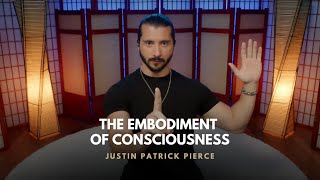
In this monologue, the speaker contrasts two modes of attention: a narrow, laser‑focused focus (illustrated by staring at a finger) that creates tunnel vision and reduces consciousness to a tiny point, and a wide, peripheral awareness that expands one’s sense of space and presence. He explains how the narrow mode, while useful for certain tasks, can diminish intimacy and performance when applied to lovemaking or public speaking, making partners feel small and disconnected. By deliberately widening visual and sensory awareness—seeing left and right, up and down without moving the eyes, sensing vibrations, sounds, and subtle cues—the individual can feel larger, more embodied, and more present. This shift in attention translates into a more ecstatic, engaging sexual experience and a confident stage presence. The speaker frames this expansion of awareness as the “embodiment of consciousness,” urging listeners to practice it throughout the day to avoid irritation, distraction, and a lack of excitement in relationships.
Chapters
Bring up your finger and just look at your finger. You notice that you focus on your finger, your attention is being reduced to the finger itself. And if we really concentrate, you'll almost develop tunnel vision as your periphery starts to close in. This is what happens with really intense concentration meditation practice, is you actually start to see a black tunnel if you focus that intensely for all day, for days on end. So as you draw your attention to that single point, you're reducing your attention. It's almost like a laser beam. And when you're in that state, when you're hyper-focused— we do this all the time with our work, we don't even realize we're doing it. We could be on our computer and we're doing that sort of thing, and we're just tunnel vision. Our partner walks up, we didn't even notice, we don't hear anything, we're just— it's not just that we're seeing there. Our entire consciousness is reduced and concentrated to the size of that small point. We're only aware of that one thing. Now that can be a powerful tool in moments. But you bring that into lovemaking, and now you're doing that same thing with their nipple, with their lip, with their thigh, with their clit. And they feel you only that small. You don't feel big. Your consciousness feels small to them. It's not as ecstatic as it could be. Now focus on the periphery. See as far to the left and right as you can at the same time. See down and see up without actually moving your eyes. Notice you don't have to move your eyes to do this. You're becoming aware of this space. There's a visual space you're aware of, but then your awareness doesn't actually end with your visual sight. Awareness extends. I could be aware of someone behind me because the vibrations on the floor, picking up on subtle sounds, shadows moving— like, there's different ways to detect. So our awareness is beyond our vision. So when we start to widen our awareness we start to feel bigger. There's a completely different experience if you walk out on a stage, if you're all nervous and your attention's down and kind of inward, versus walking on a stage and your attention fills the entire space. Totally different experience. All it is is it's a shift in your attention. So your intimate partner feels that in you. And if you're walking around like this all day, just looking at your finger, man, it's going to irritate her. You're not going to feel present. You're going to feel always distracted, and it's not going to feel particularly exciting to have sex with that. That she's wanting to feel this awareness that opens up, and that feels like presence. That is the embodiment of consciousness when our attention is free and wide.