Leading with Humanity with Rita McGrath and Kevin Nolan
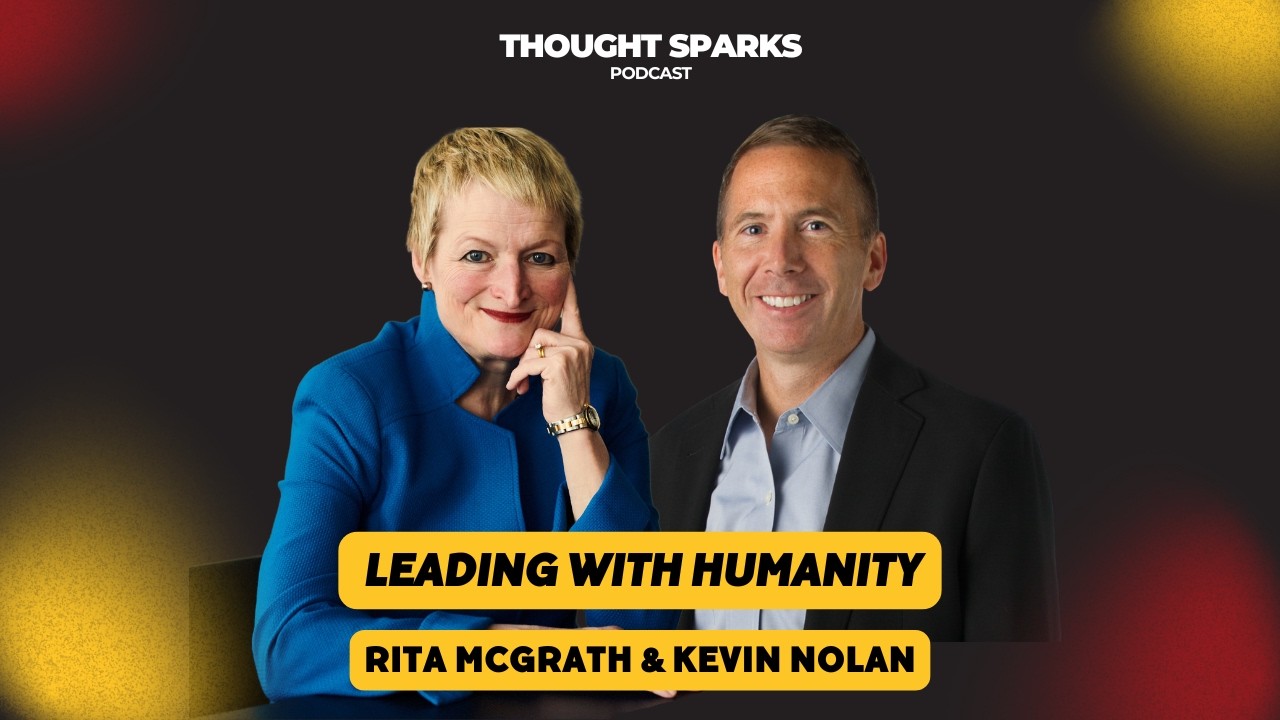
In this Thought Sparks podcast, Rita McGrath interviews Kevin Nolan, CEO of GE Appliances, about the company’s acquisition by Haier and the radical cultural shift that followed. Nolan recounts how GE’s traditional, top‑down, profit‑driven management clashed with Haier’s philosophy of "salad management," zero‑distance to customers, and the use of "leading goals"—ambitious objectives whose path to achievement is unknown. He explains how Haier broke the organization into autonomous micro‑enterprises, giving each unit authority to decide how to meet the leading goal, and how this structure enabled GE Appliances to rise from a marginal player to the #1 U.S. appliance brand in five years without acquisitions. The conversation then moves to FirstBuild, an open‑innovation lab that operates like a maker space, crowdsources ideas, and funds itself through rapid product validation. Nolan shares examples of successful FirstBuild products (nugget ice makers, sourdough starter kits, heat‑pump water heaters) and failures, illustrating the importance of fast kill cycles. Throughout, he reflects on the need for humility, empowerment, and direct engagement with front‑line employees, contrasting GE’s historic “corporate jet” culture with a hands‑on CEO approach. The interview also touches on lean principles, model‑1 vs. model‑2 learning, reshoring manufacturing, and the future of micro‑production. The discussion offers practical insights for leaders seeking to blend profitability with human‑centric, agile organization design.
Chapters
How can you grow if you're not profitable? And it's like, hmm, that's a good question. And they're like, if you're not profitable, how do you have money to invest and grow in a business? So how can you choose one when these have to be symbiotic? They have to be together. They have to go together.
Welcome to Thought Sparks. Like, subscribe, comment, share, and enjoy.
Welcome to another edition of the Thought Sparks podcast. I am so thrilled and honored that— I guess I can count you as a good friend, Kevin Nolan, who is the CEO of GE Appliances. Yes, that GE Appliances, you know, with the big curvy circles, that was acquired some years ago by Haier, a Chinese appliance powerhouse. And I thought it would be just such fun to have him come on and tell the story. For those of you with an interest, some of the exploits of this company have been featured in the Harvard Business Review. There have been a fair number of articles. But today, you're gonna have the pleasure of hearing from the actual protagonist behind this interesting story. So, Kevin, welcome.
It's great to be here, Rita.
So, for those that don't know the story, I guess, let's begin at the beginning. So, you were an engineer's engineer working as, I guess, Chief Technical Officer at GE for a long, long time before any of this happened. And this was during a period where the company was kind of falling out of love with your business. So, maybe you start there.
It's a nice way to put it. Yeah. So if you look at where we were at GE Appliance, we were actually a good business. It wasn't a business that was failing in any mark of the words, but it wasn't a business that was thriving at the same time. If you looked at our place in GE at the time, We really fell out of, I think, the strategic direction that the business was heading. And that wasn't new. I mean, I started with the company right out of university, and I started with a division that was called ED&C, where we made electrical equipment, circuit breakers. And I went from there to the appliance business for a couple of reasons. And one, as an engineer, I kind of wanted to work more on consumer products. Right. And I also was looking at the time, there was a lot of outsourcing going on. And I would say the appliance division was kind of the leader in that trend because things like microwaves and window air conditioners, which were made in the US, had been already moved over to Asia. And I thought if the future, and that was at the time, late '80s, early '90s, there was this talk of, we can just be a service economy, right? And we don't need manufacturing in this country anymore. As an engineer, that was very troublesome, as you can imagine.
Well, and since then, the narrative has, shall we say, shifted somewhat?
Yeah, I think some ideas prove out maybe not to be the best that this country has had. But when I came in '97, the whole thing was, why would you ever go to that business? they're gonna get rid of it. So you can say even all the way back to that time in '97, and that was under Jack Welch at the time, it was already kind of viewed as not in the strategic direction of where the company went. So I think just things over time added up, and 10 years ago, as you said, we finally did get sold. And it wasn't the first attempt at trying to divest this business. So it's been a very interesting journey.
I remember you telling me about that, that finally they found someone. So there were some big surprises, as I recall you mentioning to me, about the way that Haier's management handled both the transaction and what happened afterwards. So the sort of typical Western playbook when you buy a company, right, is you sort of get rid of all the leadership, you install your own people, you install all your own management systems, And then you try to boost the thing the way that you thought you could. But I should also add that typical playbook most of the time doesn't work out. I mean, the track record of large acquisitions is truly dismal. So maybe what made this so different?
It was an interesting time for us because I'd been in this industry a long time and knowing most of the players, the one player I didn't really know was Haier. It was an odd company to us. They had a small business in the US. They were building refrigerators in South Carolina, never successful. They were a company that in North America, nobody really thought about. When you thought about your competitors and when you would have strategic long-term planning, that name never came up. It was just not there. It wasn't something that you were concerned about. So, When they ended up being the acquirer, it was one that I had a lot of reservations because the unknown is always scarier than the known. And doesn't mean it's worse, it just means as human beings, I think we get fearful of it. And when we first started dealing with Haier, we went over and the chairman, Jean Rumin, at the time, he's a man, I know you've spent time with him and you've met him, Rita, but— Yeah. He's a man that thinks somewhat at a different level. And when he talks, he talks in a lot of philosophical terms and not in down-to-earth practical business terms. So he talked about things like, we need to have salad management. And I'm like, you're like, what is salad management? He says, well, salad, everyone has somewhat the same base ingredients. But then they put the dressing that they like on top. And so every country, every region, they need to, you know, have the same fundamentals, but they need to tailor it to the way that they like it. So it fits their taste, it fits their, their culture. So you hear all that, you're like, well, what does that mean? You know, from, 'cause I'm used to a GE playbook where, I mean, we were one of the best. You go in there and we acquire, and even internally, like there was a time where we put The old industrial business, the lighting business, really the old Thomas Edison businesses under one roof. I had technology for it. So what do I do? I go in and you're gonna run programs this way, you're gonna execute, and I don't care how you've done it, GE Lighting for years. This is the playbook and this is what we're gonna do. And it's not like we ask if you like it, ask if you— it's, we just go in. So I'm expecting that kind of treatment, not a discussion on salads. Mm-hmm.
I have a funny anecdote about GE in those days. And I think this might've been right around that same time period. I was teaching at Crotonville, and they had, for whatever reason, they'd asked me to come in and give a lecture on discovery-driven planning, this planning technique where you're dealing with uncertainty by planning through key checkpoints. And it's in the pit, right? And so all these guys are there. And then this guy from, I think he was from aerospace, gets up and he says, Professor McGrath. And when they call you Professor, You know you're in trouble. And so he says, do you need to know something about the General Electric Company? I said, okay. He said, around here, we don't plan to learn, we plan to win. And that turned out to be quite true.
Yeah, yeah, yeah, yeah. And I think—
So I didn't mean to interrupt you, but go ahead.
But that, I mean, you get to a lot of it, the humility, right? The humility of an organization. And I'd say that's probably an advantage we had in this whole because if anything to survive in appliances, you need to be humble because for years of some people saying they don't really like you, they don't. You you seem to maybe gain humility through those through those experiences. But you know when when we got into it with Haier, then they then they talked about this philosophy around Dan Hui. And for any China speakers out there, I apologize off the bat. But what it really boiled down to is really understanding customer value. And as employees, we need to work on satisfying our customers. And very simple, right? The value of a company is really the value that customers see in you and boiling that down to an individual level, whether you have internal customers, external customers. And when I hear that coming from GE, it's like, yeah, yeah, yeah, customer-centric. Of course, we're all customer-centric. And so a lot of this just sounded like rhetoric that you've heard before, but when you really started to see in what hire, right away they're looking at us, well, what do you want to do? And we're like, well, what do you want us to do? And like, well, how are we supposed to run the business now? Well, don't you know it's your market? You should know how to run the business. So you could see like a cultural, just talking beyond and total misunderstanding going on of what we expected and what we were given. And it was an interesting time because a lot of people, I think, were waiting to be told, you know, how are you going to run this business? What plays do you want us to make? You know, what should we do? Should we raise price? Should we lower price? Should we invest in this? Should we not invest in this? And all we got, all we kept getting back was, is you need to have a leading goal. You need to have a leading goal, and then you need to put plans in place to achieve that leading goal. And it was a very unsettling, you know, when you think, and this time, the first year I was at, as the, you know, the chief technology officer. And I spent a lot of time that year trying to go over and understand, because I was, you know, longtime GE guy. I'm like, do I really want to work for this company? I mean, what is this company? And what, you know, and, and somewhat going over there trying to learn and just saying, is this— and somewhat selfishly, does this fit something that, you know, I might be interested in? I can really, you know, put my heart and soul into. And the more and more we got direction, it was just confusing. And I think that The trigger point to me was maybe 6 to 9 months in. And we were at that time in the water heater business. We had invested a lot, put a lot of technology in, and it was somewhat near and dear to me because we developed these heat pump hot water heaters that really introduced them into the US market, you know, a way that would fit our market, very energy efficient, you know, and to me strategically a very important product because it really brought consumers like huge savings in their homes. And our business here decided that we shouldn't really be in the water heater business and that we should get out of it. So we sold that business to a competitor after the Haier acquisition. And, you know, everyone kind of thought that, oh, Haier must have said get out of that business. Well, if you look at Haier, they actually have a strong water heater business in China. So when they bought us, the one thing I thought, well, at least We'll get into water heaters in a big way because our parent is in that business where GE wasn't. It was something that we were kind of driving. And I remember going to the leadership there, and that was the leadership of 690, which is the appliance division of Haier Group. Why would you let them do that? Because I was over in China when the thing went down. Why would you let them sell that? You just bought our company, paid a lot of money, and part of what you paid for was our water heater business that was growing. It was actually, I thought, performing well because going from nowhere, we were growing 40%, 50% a year.
Wow.
And the answer I got back was, well, you need to understand Rondonja better. And I'm like, I didn't ask you about that. I asked you, why did you let them do that? And I just got back again, you need to understand Randon Rhee. And I just walked away angry, scratching my head and like, these people are crazy. This is a crazy company. And I'd say that started me really wanting to understand what is this? Because this is— I realize now this is different. This is nothing like I've ever seen before.
Fascinating. So, um, so you— and the, the, the principle— so this is a very famous, um, management process, and it talks about things like zero distance between the company and the customer and breaking the enterprise down into micro-enterprises where people make independent choices. So for example, you can decide as a micro-enterprise which lawyers you use and, you know, which marketing department you use. And if the people inside the company providing that service aren't up to your liking, I am told you Go somewhere else. And so it kind of brings that competition right down to a local level. But to come back to the GE story, one of the things I remember very vividly you're talking about was discovering the power of people being allowed to make stuff without being told what to make.
Yeah, GE had a lot of autonomy. Okay, as we were viewed in the business, right, we got to drive that business. But you had autonomy with a lot of checks and with a lot of, you know, and it was Fairfield, right? That's where headquarters were at the time.
That's right.
And you would always hear, what does Fairfield think? You know, how are we gonna— and there was a lot of work that was done of putting presentations together and any big investment decision You had to make a trip up to Fairfield and put the pitch together, right? And, and, and get judged whether it was good or bad. And, you know, even some like decisions that were made real time is at a certain level Fairfield definitely was involved. Now, when you look at it, do they really understand and know appliances? No. Were they Do you understand business? Yes. And the Haier philosophy was so different, so different, and is so different than that of they expect you and your local markets to make those decisions. Now, what they spend a lot of time on is what your leading goal is. What are you trying to accomplish? And that was an interesting thing for us too, is a lot of companies, they put goals together, they put strategic plans, But those are typically intermingled with your performance. So if a CEO is putting a leading goal together, they're worried about, well, what's the board going to view? And my comp is going to be tied to that target and that plan I put together. And Haier disjoints those things. It looks at— and I think it's a very difficult thing to do, but very powerful if done. Is how can you have a true leading goal that you can sign up to and you're not going to be measured exactly to that goal? Because a leading goal means you don't know how to get there.
Hmm.
And it's a very uncomfortable thing coming from where I came from. And I think most US corporations to put a goal together that they don't know how to achieve. But if it's a leading goal, The definition of it says you don't know how to do it. And that's why it's leading, right? Because it's pushing you.
Super interesting.
It's pushing you outside of what you know. And how many executives in their mind, if they ever want to survive, you know, and you look at the tenure of a CEO, of who's going to sign up to a goal that they have no clue how to achieve? It's kind of an intelligence test.
Right.
But Haier looks at, you need that, right? And then you have to push yourself to figure out, you know, how to achieve it.
Mm-hmm.
And I remember the early days of, of Haier, you know, typical GE, and this is when I was the chief technology officer, but it's still, I was looking at it the same way as they're like, you know, what's your leading goal? And we put something together and we kept asking, well, what do you want it? Basically, what do you want it to be? And it was like, do you want us to grow share? Or do you want us to grow profitability? So that was our whole thing of give us the direction you want us to go, and we'll put a plan together to to go in that direction and lead in that direction. And it was it was so funny because it felt like there was a language barrier, right? Of what do you want? Do you want us to go down the share path, or do you want us to go down the profit path? And they kept looking at us like we were speaking. Some language they really didn't understand, never mind English. And finally it came, one of them said, what, one of the executives there said, what are you guys asking that question for? It doesn't make any sense to us. And we're like, well, what do you mean? That's a basic question in business. And that's the question we've all been trained on. You know, it's what flag is up? Is it the share flag or is it the profit flag?
Right.
And they looked and they said, well, how can you grow if you're not profitable? And it's like, hmm, that's a good question. And they're like, if you're not profitable, how do you have money to invest and grow in a business? So how can you choose one when these have to be symbiotic? They have to be together. They have to go together. So then, so then we're like, okay, we're not going to get an answer. So what are we going to do? And I would say for the first year, it was kind of just churning and churning on kind of what, what does the parent want this company to do and to achieve?
But they didn't change out your management team or anything?
No, they didn't. They didn't. But after the first year, the, the leader that was there, you know, moved on to different things and, you know, very successful. And I think it was, I don't know all the reasons, but for some reason, which I don't know all the reasons, they put me in the CEO job. And the first thing is, what's your leading goal and what do you want to do? And so, at that point, I kind of understood more of how they were thinking. And I'd say that first year spending a bunch of time over with Haier, Is, is helped me a ton. And, you know, that's the point I said, okay, our leading goal is in 5 years we're gonna be the number 1 appliance company in America.
Wow.
You know, at that point we were number 5, right? It was like 4 or 5.
That's pretty ambitious. That's pretty ambitious.
Did I have a clue how to do it? No, not at all. Um, what I did have, the only thing I had is I had confidence. And what I had confidence in is the team. And because I knew we had such great people here, and I always was wondering, why aren't we succeeding more? Is it us? Are we just not good enough? Or is there something in the system that's not allowing us to reach our potential? And so, I put that leading goal. And what was funny is that the biggest issue was my team. Huh. How can you sign— like, okay, Tell us the plan. You must know how you're going to do it. I'm like, I don't know how I'm going to do it. They said a leading goal. That sounds like a good leading goal, right? Who doesn't want to be number one? Sure. Of course. Who doesn't want to win? And so, I would say the first thing was really getting into of getting our team to believe in ourselves and believe in who we are and getting our team to also believe that we're on our own. Mm-hmm. Is that no one's gonna tell us what to do.
Mm-hmm.
And no one's gonna tell us if our plan is good or if our plan is bad. They're not gonna judge our plan. They're gonna let us execute our plan and support along the way and help us when we need it. And the good thing is they understand appliances. Um, but it's on us and we're in where we are and we've gotta figure this thing out as a team. And that, I think, is a testament to very, very few companies would spend— I forget exactly what it was, $5.4 billion to buy an enterprise and then just say, you guys go make it successful. And that was an unsettling feeling.
I bet. But it must have been also liberating and exciting, right? Maybe. Because, I mean, you were pretty much pretty squashed in the GE system. And we know now with the wisdom of hindsight how soul-destroying so many of those practices at GE were. I mean, it was funny. I'm writing a new book, and one of the chapters is kind of a retrospective on some of the things that went on at GE. And I was a great admirer of the company for many reasons. It was, for a long time, very well run. But there were also these things that kind of killed human initiative. Kind of across the board.
What's funny is I think, I think the fundamental teachings of GE are still so sound and so good. And I think what happened was management started to, to lose their humility. And sometimes, like, the, the worst place to be is number one. It's very unsettling, right? The best thing in the world is competition. And feeling like you got to catch somebody. Like, it's very hard to run a race when no one's near you, right? And you're way out in front. You're not going to run your best time, right?
That's right.
And so I go back and part of why I say what we did is go back on what were some of the really fundamentals that I think made the company great, because it was a great company. Concepts like workout. So if you look at Rondonjaí, a lot of what the chairman studied was GE practices.
Right.
Which is fascinating.
Yeah, totally.
And, you know, empowerment. Like, empowerment was a fundamental when I came into the General Electric Company. I joined in '89. I mean, it was all about empowerment and workout. And what does workout and empowerment mean? It's if you think, what did Hayek tell us to do? You're empowered and we'll work it out. I love that. It was back to what, you know, I grew up as a young engineer kind of falling in love with the General Electric Company. And I think, you know, leaders got, you know, too thinking they were too smart. They stopped relying on the people that were closest to the problem. We didn't, you know, we weren't humble enough to take on things like lean. Mm-hmm. You know, if you look at practices like Lean, they sound very simple. You know, it's just go where the work is and take out waste. And to really understand Lean, you have to understand 5S, right? So 5S is a very simple thing, you know, set things in the right place and you gotta, you know, everything is about standards. And, you know, if you go through the steps of 5S, It sounds easy, but it's almost impossible to learn, right? Because it's a continuous— You have to do it. Continuous. Yeah. And it's a continuous improvement. And, you know, and that was another thing on GE was continuous improvement. But I think we thought we were more sophisticated than these simple tools. Like if you think a simple thing is you gotta be user-centric, zero distance to the customer. So you can go to any corporation in the US, and if I say, hey, we're zero distance, and that's really what drives us as an institution, every CEO is going to say they're zero distance.
Of course.
You know, meanwhile, they're flying around in a corporate jet, they're walking around with an entourage.
The elevator goes to their floor only.
Their floor. No one's allowed on the floor. And they've got suits that, you know, are tailored. And they've got all kinds of signs of separation, not only from their customer, but from their organization. And so when you say these things, everyone thinks they do 'em, but are they?
Yeah.
And do they have the humility to really say that we're gonna really work and satisfy our customers?
I love that.
And I think that, that's a real difference that I saw at Haier with, with just the thinking of a radical, radical user-centric approach.
Yeah. So this is maybe a good point to shift to things like FirstBuild and how you kind of ran across that model, because I continue to think it's fascinating. I use it as an example a lot, but sort of how do you, how did you find them and how did you then turn that into what became part of this innovation engine that you built?
Yeah, so FirstBuild's a very interesting case. And FirstBuild that people probably haven't heard of, but you can go online, YouTube, or anyways, and look at FirstBuild. And what it is, it's really our innovation engine. Now, this was created pre-Hier. And what happened, I was running technology for years and I was running our innovation. And we had your typical funnel and a lot, you get any corporate consultant, you hire them in and they'll talk to you about innovation and you need to run one of these funnels where you downselect ideas, and then you bring those to the market. I had run that, and that to me was the fun part of my job. It was the one thing I could do that someone wasn't telling me what to do, right? So it allows engineers to be engineers and discover and invent. And every engineer knows what people need, right? That's what we're best at. We think we know what you need. If these stupid people up top would just listen to us, we could fix everything with the right product. And I had run that for years, but me and another individual, Venkat, at the time was leading that for me. We really looked at each other and said, this doesn't work too well. And this isn't working for us, but we protected it like crazy because we loved it. And at that time, there was some interesting things going on at GE. Beth Comstock at the time was the head of marketing, and she was onto this thing called FastWorks. Oh, yeah. And Eric Ries at the time was looking at kind of reinventing how innovation goes, and a lot based on software and agile and things. And so we started as a company, they started talking about this and Beth started working with some startups and I got interested because I'm like, well, you look at these startups, that's where a lot of innovation was coming out of and opposite of what we do in corporate. Mm-hmm. And I, I just started, we, we took like a week of explore, uh, not a week, excuse me, a year of exploration. And we started just going and actually working with some of these startups, trying to understand how these startups act. And seeing it was radically different than the way corporations acted. And something's good and something's bad, right? There was chaos and they failed more than they succeed, which as a corporation, like, we can't do that. But I'm like, well, our innovation actually did fail more than it succeeds inside corporate. And we looked also at the maker community and we started seeing new things with 3D printing coming out, new tools. And we're like, can the maker community, can this startup mentality, is there any way we can do it? So we kind of came up with this whole concept and working with people like Local Motors at the time, if anyone wants to go and see Jay Rogers, who, you know, came out of Harvard, was a brilliant man, started a new concept for developing cars. So we said, can we do something like that with appliances? And that, lo and behold, started FirstBuild. FirstBuild, what it is, is radically different. It is literally the opposite of corporate innovation. So what the tenets of FirstBuild is, it's totally open to the public. It's located off campus. It's on the University of Louisville campus, long story behind all that. But anyone can come in there at any time. And we also share what we're thinking about. Like right now, you can go online And you can look at what is an idea that they're thinking about. And the other tenet with FirstBuild is we're not allowed to work on anything corporate I want them to work on. I have no control over what they do, zero. Okay. And they don't have control over what they do. The only thing they can work on and develop is a product that resonates with consumers. So, feedback, external feedback is so important. spend any money, they're like, is this a need? Is this a problem? And once they get a signal that, yeah, people care and people need, then they start developing, working, and they're open as they work. It has been wildly successful and it has outpaced any innovation model I've ever seen in my career.
I remember you telling me once that you wandered in there one evening And saw 2 of your best guys, like, in their own free time, wailing away at something they really cared about. And you were like, these guys have been, you know, in corporate all day long, and for the first time they're showing, like, signs of energy. Yeah.
And it gets to, you know, people, what motivates people. I think, you know, it's— people love solving problems and fulfilling needs. And, and, and I think what was interesting with HyAir is every other suitor that was looking at purchasing would see FirstBuild in the deck. First thing, typical corporate, well, what about IP? What do you do about this? And what— and it was all the questions you hear out of your typical organization. Hayer was the only one when Jean Roumim came by, he got it immediately. He understood what was going on. And that gave me somewhat of a hint into this company's different because Why does that guy get what we're doing down here? Now, we've later learned, like Eric von Hippel from MIT, co-creation, user innovation. I realized it, and he has all the theory and understanding. And I think Eric will tell you that it is a much better way to innovate. Oh, absolutely. And the theory and the scholars will back that up.
Totally. Just as an aside, for those who aren't familiar with Eric's theory, he did a lot of extensive fieldwork, and he discovered that most significant innovations come from a combination of what he calls lead users cooperating with manufacturers in the field.
Yeah. And we stumbled into this thing because it works. And I can't say enough good things about Eric and the insights he's had. But what's funny, the door— we've had the doors open. Nobody has copied this. And we've tried to take so many corporations through this thing. You know, we're open with the model too. And it's funny, I could be as open because I guarantee you very few, if any, corporations will copy this model, even though it's proven. The math works. I can give you all the statistics. Why? Because they can't give up control. Is corporate leaders and typical CEOs cannot give up control. And what's special about high air is it forces you to give up control. As a CEO, I can't control what my micro enterprises are doing. And what CEO wants to say that I'm not in control? So the success out like. We just launched, um, with King Arthur Flour, a, uh, sourdough starter.
Huh.
And I think the idea came was, uh, a co-op. I think she was like introduced in sourdoughs, a couple people down there, and the things resonate. That thing is doing exceptionally well. And I guarantee there's no other appliance company that could ever come up with the insight that there's a way to help people with their starters to take a big pain point away in making sourdough.
I love that.
But, but it's one that, that kind of model, you know, that works with lead users and it can discover and it can, and help bring these things and scale these things.
So I remember you telling me that, um, after a couple of years at this, you became convinced that you were the last person on earth who should be giving the green light or stopping projects, selecting projects. So what were some of the more strange ones?
Well, I mean, the first one was probably the most interesting, this Nugget Ice that's been wildly successful.
Oh, yes.
And that right away showed us to just stay out of this. I mean, it's, you know, and as engineers, I think it's very humbling is we don't know the needs because the whole thing, like Kurt Carlson has this methodology, NABC, and Kurt will always say the big problem with, and he worked some with GE in the past and others, and he says, Nobody gets the need right and no one understands the need. And because the only way you can really understand the need is talking to the people that have a need. And that's why we typically invent on our own. Like at home, everybody doesn't realize they're an inventor. So if you've got something at home, whether it's how your kitchen's organized or how you do your lawn, you create this system of use. Yeah. that fits you, and you invent around that, and you modify it, and you change it. Those people know the needs. Corporate have no insight into that. And it's one where we finally have to realize, as an engineer, if you have a need, I'm pretty good at putting a solution together, but I am terrible about understanding what you need. It's because how can I? I'm not you.
Right. Well, just for those that don't know, so the nugget ice is a product that makes ice that's not like hard and dry the way normal ice cube makers are. It's ice that's meant to be chewed, if I, if memory serves me.
Yeah. People call it hospital ice or certain restaurants have it. And, insight came there is we found a bunch of people that every morning were going out to a restaurant to get ice for the day. And, we're like, I'm, I just thought, as I said, these people are nuts. I mean, what are they wasting time? And they were typically salespeople. So, as an engineer, we're like, oh, they just are wasting time going to get ice. But there was huge insight that we didn't realize. Yes. And then, there's also an insight into why is it hospital ice? Because it's very soothing to people that are ill or something that have ice. Anyone that's been with someone that is severely ill. So, there's needs and there was no real way to get that into a consumer's home.
What were some of the others?
Well, we've had more failures than good things, so
that's par for the course, right?
Yeah. And, and I think that's what's good about it too, is it fails very quickly. Is if there's something that doesn't pick up, you know, it just goes away. And some, and some failures we have insight into. Like, we came out with one of the first induction cooktops that had a closed-loop system on temperature. And, you can sous vide, you can do all kinds of things. But, the form factor and the way we brought it didn't really resonate, but the need we understood very well. And so, now, if you buy one of our higher-end cooktops, it has those capabilities built in and extremely good for cooking.
I'm proud to tell you I am renovating a kitchen and Everything in it's GE.
Where—
Is going to be in GE. What?
I love you, Rita, but even more now that, uh—
Well, we already have the fridge. We have the, uh, the high-end, you know, whatever, the monogram. Um, it's very, very nice. We're very happy with it. And then it's getting— it's getting its little friends to come join it in the kitchen pretty soon.
But, you know, an early one we came out with is we put an autofill pitcher. So in the refrigerator, it would just keep filling up with cold filter water. We failed on that too because we didn't put it on the right platform. And now we've got that on a platform and people love it. I mean, it's one of the best features.
Oh, don't you have a thing that goes in your oven that can also go right into your dishwasher so you don't have to clean the oven?
Yeah, like the bottom plate on there. So instead of having that self-clean. So a lot's come out of there, but I'd say what's more interesting, and this is the problem with innovation, is it's expensive for a company, right? And every company tries to brag on the equation of how much you're spending on your innovation, percent of revenue. Are we at 2%? Are we 3% or 4%? And this is, I think, the real secret sauce of FirstBuild. In downtimes, people typically cut that innovation budget. Yeah. 'Cause you gotta live for today and innovation is for tomorrow. And FirstBuild, one of the tenets of it has to be self-funding. So it doesn't get any funding from corporate.
Oh, wow.
So the only way FirstBuild can survive is it's gotta make money. And if you think about innovation, it's expensive, right? You gotta do all this research, all this development. So they're starved. And they have to figure out very quickly, has this thing got a chance? If not, I gotta cut bait and kill it. So that typically is very hard to kill things, but there they kill things very quickly, 'cause they're like, this doesn't look like it's gonna get anywhere. It's gonna die.
I think that's genius. I think that's genius. I mean, the number of companies I go to, and I've studied this for years, you know, it's like, how do you create a recipe for guaranteed corporate flops? You know, I study these big failures, right? And so I have this file full of these flops that I, You have to lose your parent company at least $50 million to make it into my flops file. And it happens all the time. You dig— somebody, some senior executive has an idea, they get carried away with it, they put a huge team on it, they give it all this funding, they give it an 18-month run rate before it, you know, gets launched. They put some hapless senior executive in charge of it with this impossible deadline. And there's no room for learning, you know, and the chances you get it right from the get-go are virtually zero.
Yeah, what kills most companies is CEOs with bad strategies, right? And that gets into— and they never want to admit, you never heard a CEO said this strategy was bad, I'm going to pivot, right? So you get too wedded to going down those strategies. But, you know, the other thing that innovation, what I hated as an engineer is bad times, finance comes right after you. So it was somewhat the idea we put together too. If, if, and I like math, I said, if we could have it so it costs zero, then the whole equation of what's your percent of revenue doesn't matter anymore, right? So it's like a divide by zero issue. So if you have zero-cost innovation, you can do as much of it as you want.
I love that.
Right? It's, it's endless.
So let me just make sure I'm, I'm, I'm clear. So at FirstBuild, they actually create complete products and, and like from beginning to end, and then they can sell them. And then when they get above a certain threshold, just The parent take them over? Is that how that works?
Typically, that's what's happened. I mean, that's, and that's, that's also what's a little dangerous. And we do it on purpose too. Like, if you look at Nugget Ice, that thing, you never have to work again. And for, I mean, it's made a lot of money for our company. So we took that away and that's kind of forced us to start a small appliance because we weren't in small appliances. So, you know, now we're in that and that's, they no longer see the benefits of that product. So they need to stay hungry because we don't want to ride on a success, right? But certain things we'll keep in there. Like if you look at, we have a very high-end pizza oven that is low production. It was very innovative on how we tooled that up and how we came out. That's still, that's still with FirstBuild. It does well for FirstBuild. We actually manufacture that in Connecticut. Who would think that in Stamford, Connecticut, you could have a factory and make product? And, it helps really fund that facility we have up there that's open to the public, that's got a FirstBuild, that's got a beautiful showroom. So, certain things they'll keep there. The sourdough starter, that's sitting there with FirstBuild right now, and they're working with it and promoting it. But, they've got to keep coming up with what's next.
I love that. That's so smart. And, you know, it really does defang all these corporate antibodies.
Yeah. But again, the big question is, why don't others do it? And I always scratch my head.
Well, you know, I can share with you an insight that hit me like a ton of bricks. And this is not a new insight. This is a very old insight. So there's a researcher, Chris Argyris, who you may have heard of. He's studied, you know, teamwork and how companies learn and how they fail to learn. And back in the 1970s, he was publishing on what he called Model 1 and Model 2. And Model 1 is a situation where people will not pay attention to the external reality because they're so concerned with conforming to whatever it is that people want to hear inside the company. So whatever the boss thinks, whatever my peers think, or whatever. And, you know, if I'm noticing an earthquake starting to open up over there, I won't say anything because the boss really doesn't want to hear that. And so what ends up happening to these Model 1 companies is they gradually get less and less and less connected to reality. And that becomes an existential threat. Now, Model 2, in contrast, is almost like what you're forcing FirstBuild to do, which is be intensely attuned to the environment. And so, Model 1's kind of what he calls single-loop learning. So, you have a problem, you fix it, but you're not really addressing the underlying system. Model 2, you're forced to confront the system all the time. So, you get deeper into what's actually causing what. And I've been gaily running my whole career, 30-something years, talking about this model 2 thinking. So, test your assumptions, talk about them, make sure they're clear to everybody. Well, how are we going to test them at the lowest possible cost? All that stuff that I've been writing about for a long time. And we could talk about fast works too in that connection. And I kind of thought that's the way the world worked. And then I was revisiting Chris Argyris's work for this book I'm working on, and it hit me like a ton of bricks. No, most organizations prefer to live in model 1. And I never really appreciated how dominant that was.
Yeah. And that's, if you look at Haier and the whole thing of micro-enterprises, I mean, it gets to that, to that issue.
Mm-hmm.
I think, cuz what is, what are micro-enterprises? Those are where in a company, try to break your company down to units that customers care about. Right. So, and then you put authority in those units. Right. And it's up to them to figure out their path forward, their strategies, the way they, the way they need to succeed. And the theory is the smaller you can break that down, the better it is because you're going to be closer to the signals and you're going to feel the results of your decisions and your strategies and adapt and move quicker. And it takes the role from a CEO that needs to be totally different. And to me, it's another thing. It shows it works. I mean, we were able to break this company down into a few micro-enterprises, same people, Same managers, same everything, and take it from really a somewhat irrelevant player in the American market to in 5 years actually hitting number 1. That's awesome. And to me, it's just like such a clear case of, and it was somewhat of an experiment where I had enough pride of we weren't the problem. Hey, GE, you sold us and you shouldn't have because you had some great people. And you had a business that you should have really loved instead of looking at it the way you did. But it proved it. It's, and, and so what did we change? We didn't change the people. We didn't change the market. We didn't make any acquisitions. There was no, you know, and most CEOs, how do you grow a company? Well, I got to acquire. I got to acquire. No acquisitions and be able to move from where we were to be number 1 in 5 years. It's amazing. I think it's a testament to it works. It works if you can really take that top-level command and control and have everyone internally worried about what I think instead of them worrying about what are you going to do to achieve your leading goal and your results of what you want to have happen. But that's so hard for a CEO to do.
For a lot of them. Yeah.
Yeah. You got to give up control. And you know what? You're not that smart. And, you know, they think, oh, I'm brilliant. And then you're not.
Of course. Aren't we? I have a friend who recently became a CEO. And I said, well, how's it going? He said, it's awesome. My jokes are funnier. My wisdom is all-knowing. And I think I'm even taller. Now, he's a guy with a great, great sense of self-awareness. So he was being ironic about this. But, but it's true, you know, that's a real power dynamic. So tell me a little bit about what you've learned about being a CEO in that kind of context? Because I think if people have role models they can look at, at least there's, there's something they can see, you know, that's what's different.
Yeah. What, what I think is important is you gotta fight what CEOs usually become is, you know, when you're in a room, do people argue with you? You know, and are still people willing to challenge you? Are still, will people not listen to you? And, you know, will you still be able to go out and see? Because, you know, and this I learned a lot from a lean standpoint.
Mm-hmm.
Can you go to a factory? Like, you know, yesterday I walked around the factory. I typically get out there whenever I have free time. I go by myself, I go unannounced. And can you talk to people? Because the people that really know what's going on in your company are the operators on the shop floor, right? They're the people, the sales folks, the people that are frontline. You know, I was in Connecticut talking to a guy that teaches installation on our appliances and showing all these problems we have. Service tech talking to, they'll call me up, hey, this is a, what are you guys doing? So have you shut those filters off or are you getting more filters? So Do you use your position to get more access to the real people that are doing the work or using your position to separate yourself? And, you know, to me as a CEO flying around in a corporate jet is the worst thing. You know, it is the worst. I learned more things on the airplane sometimes than you could imagine when, you know, I was sitting in line waiting to get on my last overseas trip and there's a guy talking about how he was a supplier of ours and how he was like taking basically the company, you know, I would've never gotten these insights if I wasn't sitting in line talking to somebody. Because when you're there, you don't present yourself as someone with a bunch of airs, you know, people open up and they'll talk and you can learn. And then you can say, hey, I've got some problems, things I can do different. And I think very few CEOs want to be exposed to that.
Mm-hmm.
You know, and, and They all justify these corporate jets, which is to me a big symbol of, oh, my time's so important. Is it? Is it really that important? Or is your time better spent talking to people about what you need to do? And it matters what kind of product, but we're a product that's in your home. We're a product that— And the most important thing is to talk to people that use your product and understand what you need to do better. and keeping humble. But that's a hard thing. I think that's a hard thing because I always ask to see most CEOs, why do you want that job? Why? What? Because everyone's like, oh, I want the job. Why? What's it for? Is it for the jet or is it for actually helping solve problems and helping make better products? And, you know, I see a lot of my competitors out there. You know, strategy, strategy, strategy. And yeah, you need strategy, but what do you need it for? You need it to make better products, right? And at the end of the day, I always try to ground people. Guys, be humble. All we do is we make appliances. You know, we're not solving world hunger. We're making appliances. And be humble and let's be good at it, right? And let's get people the products that they really want.
Are there some decisions that you reserve for yourself? Like, I was talking to a CEO of a very large pharma company, and by and large, he operates with a very similar philosophy that you do. But he says, you know, there are some decisions that kind of have to be made by me, and named a few. Do you have a rubric like that?
I would say there's more directions that need to be made by me. Like, one direction I fundamentally believe in is US manufacturing. And we've been on this reshoring thing for a long time now. We're not tariff-driven or other things. It's— I fundamentally— and this gets into also the theory of zero distance— is if we're really going to serve our customers well, we should be serving them from their market, right? And we should be making product as close to them as possible. That's part of FirstBuild, has microfactories. Jay Rogers, who I mentioned before, Local Motors, his dream was every city would have a car manufacturer for that city. Right? And the idea is with new tools and new ways, can we kind of break the mass manufacturing mold and bring back manufacturing? So there's some strategic directions where I believe it's the right thing to do, but now everyone else has got to figure out, okay, what do we do? You know, what is the right? So to me, it's more of what fundamental direction do you want to set? Because I do believe it's not easy. Yeah. Like bringing manufacturing back, it's hard. And it's much easier to source and get someone else to live with all those problems. But long-term, I know it's not the best thing for the company. It's not the best thing for our country, but most of all, it's not the best thing for our consumers.
I love that. I love that. And that's very consistent with this theory that I've been working with, which is that we really are transitioning from this mass production, cheap petroleum, housing, suburbs, highways kind of economy to something that's very different. It's got a lot more intelligence built into it. It's much more, I think, much more microproduction that's going to be happening. So as an example, there's a Hyundai factory built in Singapore to make cars, and it's a vertical factory. So you drive your— the car starts getting made on the ground floor, And then it goes up, I think it's 7 stories, and there's a little road that goes from the top floor. So your brand new car starts off in the ground floor, makes its way to the top floor, and then as the owner, you join it on the top floor and you can drive down the ramp with your brand new car. You can custom order this thing and within 3 hours—
You hope the brakes were put in right, I bet.
I assume they've got all that right. But you can actually order a customized car, and I'm told something like 3 hours later, you can drive it off the plant. Isn't that amazing?
Yeah. And if you look at zero distance, it forces you to start thinking like that. Because none of us— like, Henry Ford killed innovation for cars, if you really think about it. Before Henry Ford, right, you had a coachmaker in every town, every city, and you went and got your custom. So what we love about mass manufacturing is it does drive costs down, so it's more accessible to everyone. Because before Henry Ford, you had to be wealthy to have those those modes of transportation. So to me, the future is both, right? The future is the economies of scale, but the personalization that we want, because—
Love that.
We all want things different. And, and that's a lot what we keep trying to work on, on, you know, because when we're making these big investments and we are invested a lot in US manufacturing, $3.5 billion so far since, since my tenure, And we got another $3 billion we're actively working on right now. Those are long-term investments. And it means these factories and things got to be full. So to me, the real secret to, you know, a lot of people ask, how do you have confidence to do all that investment? I have confidence in our innovation model because the products that you're building a factory for now are going to be radically different. Like where I'm sitting right here was built 70 years ago. Wow. And you look at what was built 70 years ago, it has nothing to do with what's being built today. So the future of any manufacturing investment has to be your innovation system, your innovation engine. And to me, all these things kind of go together, but I think it's getting to what do consumers really want? And I do have belief we all want something different.
Mm-hmm. I am told that you actually are a maker yourself. You've got a batch of patents. What are some of the things you personally are working on now?
So I'd say my hobby, I've always made things my whole life. You know, I go home and that's what I like to do. What I'm into now is clocks, and I've been doing that for a while. So I'm not a good one. I'm still definitely learning, but, you know, making clock mechanisms. I'd say is a passion.
How fun.
And it's good for me because I still love being an engineer. And the thing I don't like about being a CEO is, you know, I'm falling behind a little bit. So you see these young people coming into the business and they're, you know, the CAD systems and the tech. So it still gives me— so I'm still pretty good on doing Fusion 360. I can run a CNC, I can run a lathe. And, you know, I like it, but I think it also, it's tied into what I do at work because we make things. And, you know, I think I just have a fundamental love and passion for making.
Oh, I love that. So, what would you like people to do differently, you know, in the future? So, you know, you've seen just about every flavor of management there is to be seen. Well, what are some things that you'd encourage people to
I think corporations, if they could just rely on the people that are closer to the work and respect those people. And whether it's, you know, if you want to find the best ideas in manufacturing, go talk to the person that's in the plant every day that's dealing with the problems.
Mm-hmm.
You know, if you want to know what products people want, talk to sales folks, go out and see what's happening on there. And I think there's just too much, you know, to me, the death of corporations is when you see a new corporate headquarters being built. It's like, that is the worst. Like, I am scared to death even to change my furniture. I've had the same furniture for 25 years. I don't want to do it because bad things happen when you're sitting there focused on your little environment and not out there talking to people and learning from people. And to me, I think, I bet there'd be a good index of when everyone's building new headquarters, good time to get out because it means what are they focused on? Are they really focused on serving that consumer?
Mm-hmm. Mm-hmm. I love, what a great thing to end on. So Kevin, it has been just an honor and a privilege, and if I can be helpful in any of your endeavors, make sure you let me know. And to our listeners, you have just listened to a MasterClass. class in how to lead with humanity. So thank you very much.
No, great talking, Rita. Thank you.