Getting Europe into the Fast Lane | Eileen O'Mara, Luciana Lixandru & Marc Lemaître
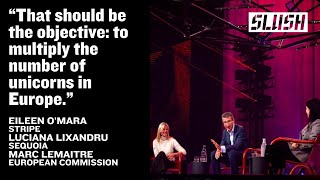
Stripe CEO Eileen O'Mara and EU Commission Director-General Marc Lemaître discuss why European AI startups reach 55-80 markets in their first year but Europe still lags in unicorns. They outline new policies: a 28-day online company registration to rival Delaware, expanded innovation funding, and a single market push to unlock talent and capital.
Chapters
Good morning Slush. I hope everyone is feeling great after yesterday's parties. You know, Slush is my favorite event of the year. I try to come every single time. It doesn't always happen, but I'm sure I've been six, seven times by now and this year actually is really special. I'm here with wonderful panelists who will share a really unique perspective on building in Europe. Eileen is the CEO of Stripe. She's been there leading go to market for over six years. I asked her where she lives. It's unclear between Dublin, New York and San Francisco. So I guess on a plane because Stripe is a global business and it's a pleasure to have her perspective on the ecosystem given that Stripe is the backbone to the startup economy to some extent. And I'm also delighted to have Marc Lemaitre with us. Mark is joining us from the European Commission. Mark is the Director General of startups research and innovation. So he will give us a really unique perspective on policy and what's the right balance for policy and regulation for the European ecosystem. Thank you both for joining us. So let's go straight into it, Eileen. As I mentioned, Stripe is an innovator, has been for a long time. It works with the vast majority of fast growing startups and pretty much every AI company that one can think of. What are you seeing in Europe on the ground in general, but also with an AI angle given that's a very, very important topic right now.
Yeah, well thank you. It's great to be here. And obviously Stripe is an American Irish company and very proud European company. So we're thrilled to be in partnership with so many startups, particularly here in Europe. It's such an interesting time and it's a different time we believe. So we're seeing a lot of different things. And you know, with 2 million users on Stripe in Europe, so phenomenal amount of companies are relying on Stripe to grow and scale their business. But specific to AI, like there's a whole new phenomenon happening. There's three things that we think are really important. One, AI companies are global natives. And with that, I mean the data that we have, when we look at our top 100 AI companies on Stripe, the medium company is in 55 markets within one year.
Incredible.
And over 80 markets within two years. And you think about like that level of scale was never possible in traditional SaaS land. The other thing that's super interesting is that AIs are growing really fast. The average AI company is getting to 5 million in revenue in the first year. The top 100 are getting to 30 million in 18 months. You think about all of the amazing founders here in AI companies. That is incredible. Never happened before. The third thing we think is very different is that AI are serving different segments of the markets from day one. What I mean by that is they're serving consumers. Many of you have subscriptions to ChatGPT. They're serving developers and founders. Many of you, obviously, from the startup economy here, are using different models. They're building an ecosystem. There's so many companies that are embedding these models and serving vertical and horizontal solutions in the market, and they're serving enterprise. And they're doing that from day one. So they've like four distinct revenue streams and they're growing so fast. On the back of that, we're delighted and, like, super proud, obviously, to be powering many of the European startups, but especially the AI companies. 11 labs lovable N88. And I think what's really encouraging is that these are from many countries across Europe, and the innovation we're seeing here is on par with the us which is really exciting. That's incredible.
And I have many questions about some of the stats that you mentioned, because they're super interesting and I didn't realize quite how fast these companies go international. But I do want to ask Mark a little bit about policy as well, because I've been in venture now for 15 years, and it feels that the pace of change is only increasing. And I'm in it every single day working with founders, and I still feel like I can barely catch up. From your perspective, how are you able to catch up with all this rapid change from a policy perspective, given that there are many, many states with many, many different opinions? Tell us a bit more about that.
Well, thanks very much, Lucena, and it's great to be here with you and with Eileen. Hello, everyone. I'd like to start by pointing to the slogan of this year, like, still doubting about Europe. Go to hell, Go to Helsinki. That's what we all did. And I think that's the right decision because Europe today has momentum. If we look at the latest figures, you know, 60% more startups in 2025 compared to 2023. So that's in a very short time indeed. It means that things are accelerating. They are also accelerating in Europe. And as regulators, we want to rise to the challenge and we want to change things as quickly as they are needed. And here I think we can point to a few fast success stories. One is the European Innovation Council, which by now is the biggest deep tech funder in Europe, five years into the making and we want to not only double down, but triple down in the coming years, providing it even with much more firepower. A second element I could mention, because Europe has a problem of scaling, it doesn't have enough funding for scaling seven times more in the US than in Europe today. We want to close that gap. We want to close that gap very fast. And our aim is less than one year after announcing it in May this year to launch a so called Scale Up Europe fund together with private investors. We are on track for that. And so, you know, come this time next year we will have a Scale up Europe fund which will be up and running and changing the scale up funding market. But then there are a lot of other things which I can expand upon because regulations in different areas. Let's think of biotech in particular, where Europe really has great research and innovation strengths in biotech. We need to improve on the regulatory environment for authorizations. We need to be faster. Absolutely. And this we want to do very quickly. We will have a first Biotech act proposal before the end of this of this year, which should already fix things for the health dimension of biotech. And we will not stop there many more things in the pipeline.
It's really wonderful to hear about all these initiatives and I definitely think that more capital is better, but I have a slightly different opinion. I actually think that access to capital is, has become easier and easier over time for European founders because there are a lot of firms like ourselves. We opened offices in Europe five years ago and many of our peers from the US opened offices. There are a lot of great local European firms. So I would say 10 years ago when, when the ecosystem was very young, it was the case that access to capital was difficult. Today, I mean, we should hear from the founders, they'll have a better view. But today I think capital is more and more accessible. I think what's really important is also that capital follows great founders, great startups and their ability to grow and build within a certain ecosystem. So if we move to that. Whenever I travel to the valley, I'm teased by my peers there that Europe innovates in regulation and is at the bleeding edge of regulation. What would you say to that?
Well, I would agree up to a point that we definitely need to be extremely serious about putting our regulations back on the drawing board and making them as lean and as simple as possible. We have committed to reducing by 25% for the private sector generally the regulatory burden in Europe by 35%. For SMEs. And we have many things in the pipeline. Only yesterday the European Commission proposed a digital package which is meant to simplify things on three key dimensions, data and data flow, essential for feeding AI models. Secondly, cybersecurity rules that we, that we have. And thirdly, the AI act itself, which is well known and perhaps exaggeratedly criticized sometimes. Why do I say exaggeratedly criticized? Because the AI act at least means that there is one regulatory framework for Europe. Look at the US today. I mean, nothing is happening at federal level, but there are many things happening at state level. But we want to, we did revisit that in order to simplify things and we made these proposals yesterday on that. So I fully agree we need to do more on regulation. But again, coming back to funding, if you look at the European Innovation Council, we have a success rate of 2% by now. So clearly we can, we could, if we had the funding, we could support more founders and we want to do that. This is why we, we have proposed to triple the means for the European Innovation Council. But coming back again to the scale up funding there, we really see big gaps. We estimate that in fact 7%, it's not a small figure of all the American unicorns have European origin. So we want, and I think you are embodying a story of transatlantic back and forth. Right. We want to make sure that we are not the incubator for companies to then globalize from elsewhere than Europe. And this is where we really see that on funding availability, we really need to make a difference now so that companies globalize from Europe.
Marc, it's really wonderful to hear. It sounds like the European Commission really listened to people from the ecosystem. So thank you for sharing all of this. Actually, I wasn't aware about some of these goals, so I think it's great for the founders in the audience to hear this. Thank you. I do want to say regulation can also be a good thing if it's handled well. And I was actually asking some of the founders that we work with in Europe about examples of regulations that really help them. We work with a company out of France and Germany called Pennylane. It's a fintech for SMEs and for them, electronic invoicing, for example, is an incredible tailwind. The company is growing really, really fast. And I think there are other examples like that as well. Eileen, what do you think?
Yeah, just on the funding, because I want to be balanced on this and obviously I have the benefit and the privilege of speaking to founders everywhere. Even though it's improved Massively in Europe for the last three years, founding into tech companies in Europe has averaged between 40 and 45 billion. So pretty flat over the last three years. Same period in the US it is five to six times more so in the US where Europe is the same size as that economy is getting 43 mil, the US is at 500 billion, so 43 billion, 500 billion. So I know it's improving here, but the ability to raise money in the US versus Europe is night and day. And I think there's a cultural change here as well. In the US if you're a founder and you fail, you're celebrated. And oftentimes our founders here in Europe, there's like, this is my one shot. So I do think we have a lot more to do to support like startups and founders and getting access to capital and having the will and the right to like achieve and also feel confident that if they fail, they'll have another turn on regulation. I mean, I think that the EU is doing some amazing things and I think that should be acknowledged. I think one area in particular that we've seen immense innovation on the back of regulation is PSD2 and open banking.
Right?
When you look at Europe and you look at, you know, companies like Revolut and wise and N86, they, they would not have happened without regulation. And I would say anybody here that travels the world like the EU fintechs and the European fintechs are way ahead of innovation that we're seeing in other markets. So I think a gold star obviously for the EU on regulation. But how can you apply to that now that we can really innovate on the back of it as opposed to constrain growth? Like one of the big things I heard here from the founders I spoke to, it's like it's country by country, 27 countries and each one I have to obviously create my entity and get regulated under that regime. I think the work that EU Inc. Is like pretty phenomenal, but it's not the same as going to Delaware and in 24 hours being incorporated in the U.S. so I think we still have a long way to go to support like the founders and the entrepreneurs here.
I'm delighted to say that Sequoia is very much open for business in Europe. So great founders, please reach out. But on a serious note, I think you both touched on a very, very important topic from different angles, which is we have amazing talent in Europe. I mean, we have some of the best universities in the world. If you look at a lot of the Very successful founders who are building in the Valley. They're actually from Europe. Many of them are educated in Europe and then went over there to build their company. And from where I sit, this is actually one of my biggest concerns about Europe. It's this, this idea that in order to build a large company you have to move and you have to move really early. One path that I think is great is starting a company here, building tech and product here, leveraging the amazing STEM talent from Europe and then of course building a commercial muscle. And commercial go to market in the US as well, because it is the largest market. So that's great. But what we're seeing more and more of, and especially in the age of AI is is founders who are saying, you know what, I'm just going to go and start building my company in the Valley. And I think that's not good for Europe, obviously from my perspective as a venture capitalist, because I'm here, I want to partner with them here. We think traveling that journey is important, but doing it too early is not great for our ecosystem. Do you have any thoughts on that?
Well, certainly that's exactly the policy goal that we have to change what you have described and so that people, entrepreneurs, people with ideas, especially when they are here in Europe, that they choose Europe first and then the second step will be to convince others to choose Europe to come to Europe to indeed launch their ventures. We, you, you mentioned Delaware and you mentioned, you know, how far can regulation help? And indeed we, we should not diabolize regulation. Regulation worked extremely well in fintech.
100%.
I was, I was referring to AI because I think in on AI, we, we have not got it wrong in Europe. What we need is one market in Europe that is absolutely.
I agree.
We have it in Fintech largely we don't have it yet in biotech. And let's hope we get it right on, on AI. So that is our aim. And where do we need to do better as well? It is on company law, company creation. You, you mentioned 24 hours in Delaware. We will be proposing in March a so called 28 company law regime which you can opt for in lieu of your national regime. And we have very simple aims for that. Three, one, you can incorporate in 48 hours. I guess that would be still competitive. I think so with Delaware. Secondly, that you can do it all online and thirdly, that you can choose the member state in which you do that. So basically, you know, you could really make use of the single market and choose what is the best location for, for you and of course, we will, on top of that, try to provide improvements on access to talent, you know, to really find the people you need everywhere in Europe and from outside of Europe as well.
Yeah, I think. I mean, the big difference I see in Europe and across, like what is a segmented, fragmented marketplace is just there's no one single hub. So when, you know, we talk and you'll know this obviously, Luciana, with Sequoia, you go to the Valley and you have access to every founder and every scale leader that is building a company globally in Europe. You go to Paris, you go to Berlin, you go to Tallinn, you go to Dublin, you go to London. So. So it's very fragmented. And one of the things we're looking to do from a Stripe perspective is make sure we're opening our network to any startup, to any founders in Europe, and ensuring that you can leverage the network that we have in the US and globally. And I think that is one thing that we have to figure out in Europe is how can you create that fabric across Europe so that if you're a founder in Madrid, that you have the same access to that network and that builds momentum and it builds customers. And I think that's one of the things that we all collectively actually should be really thinking about and working together on. I'd love to ask you a question or two, if that's okay.
Sounds great.
Yeah. I mean, the question that we often get asked is like, who or when will we see a company that is a trillion dollar valuation out of Europe? What do you think?
I definitely think it's a matter of time. It's not an if, it's a when, but it's a journey. And I think a lot of things need to come together. There are companies that are already in Europe that I think have a real shot of getting there. And there are new companies that are being built every single day by amazing teams that hopefully will have those ambitions. I mean, if we count Stripe as a European company, hopefully, I think that's an incredible candidate. But also companies in fintech in particular, I think Europe has such a strong tradition of building amazing fintech companies. And I would say that that's the one area where we were as good as the US we're actually even better. And thanks to some of the regulations that we talked about before, if we look at companies like Revolut, that's an incredible business. Do they have a chance of getting there? I would say absolutely. Companies like Trade Republic out of Germany, equally. Do they have a chance of getting there? Absolutely. But I think it's definitely harder and a few things need to change. I'll tell you what I think are the things that just, it's hard to change them and the things where we can have an impact. Single market, you both talked about this. It's just very, very difficult starting in a small market and then very quickly having to think about launching France and Germany and the US and the uk and in many cases it's not just a different language. The consumer or the enterprise thinks differently and buys differently. So I think that's just much, much harder coming out of Europe. I will say once you develop that muscle is a real differentiator because it is hard to develop that muscle, but that, you know, it's hard to overcome that when in the US you just have one large single market. But there are also things that, that we can change. One of them is just the attitude from, from enterprises, from buyers. In the US sales cycles are shorter. Enterprises are used to working with startups. Our companies, whenever they start in Europe and go to sell in the US we see a very quick acceleration. The revenues are faster, contracts are bigger. You know, it seems to be easier to sell there. So. But I think that is something that can change as European enterprises see that startups are serious, they want to innovate, they want to build great products, they develop trust with the startup ecosystem. So I think that's something that hopefully is going to change. I think you mentioned this, Eileen, and I don't want to underestimate it, but a culture of celebrating success in the US they have the American dream and that's inspirational and people cheer for people who reach the American dream. And I don't know that the European dream is as aspirational and I don't know that we cheer for each other as much as we should. So I really think celebrating success and wanting people around us to do really well, I think that's really important culturally. And then last but not least, this may seem tactical, but one, one of my frustrations when I work with founders in Europe is just workforce mobility. These startups are growing so fast. Let's say I'm looking for a great C sales leader. By the time I find this person, it's going to take me three months and then they have a three month notice period. So six months later I'm a completely different business. I mean you, you founders in the audience, you know how fast these startups change. So I think in the US workforce mobility just helps founders and startups move much faster. And if you ask me what's the one indicator of a startup's future success? It's speed of execution. It's not, not making mistakes because everyone's gonna make mistakes. But how fast do you make the mistakes and recover from them? I think that's really important. So these are some things that come to mind that just make it easier to build in the US but can we overcome them? Yes. Are founders already overcoming them? Yes, absolutely. So I think we're in a good spot and I'm definitely enthusiastic and I do think that these very large companies will grow out of Europe, but it's going to take some time. But some of them are already building and growing and I think we have great candidates.
I'm like, I'm really keen to like ask you for a forecast. If you were to pick a year, what year do you think that we might have one in Europe? Any ideas?
It's very hard to tell.
Very hard.
It's very hard to tell.
Well, maybe Mark.
Mark. Yeah, maybe Mark has like.
I think first of all you kind of have to get to unicorn status before you get to a trillion. Like if you look at the global stage, 10% of unicorns are based out of Europe. I kind of find that as a bit of a staggering stat that we don't have more unicorns like found and built out of Europe. Mark, from your perspective, what do you think we need to change? Obviously you touched on some things like culturally regulation, but from your vantage point, what's stopping us here in Europe from driving more of the unicorn environment out of Europe?
Well, we already covered a lot of ground, but I think indeed that should be the objective, to multiply the number of unicorns in Europe. We are not fixated with, you know, reaching the trillion dollar or euros bar I don't think that would be the measure of success in Europe. You have mentioned one thing which, which I would want to turn around and call definitely a competitive advantage of Europe. It is its diversity. But we need to connect the dots. So we need to have a single market, but we need to connect the innovation hubs in Europe. They are not connected enough today and we are working on that as well in order to bring them together and to do exactly what you are also trying to do your yourself to offer a platform where all founders can really go and look for what they need in terms of talent, in terms of capital, in terms of lead companies that would be their first clients in terms of still research or technology infrastructures that they might, might need to further mature their technologies. And here one element I would want to add to the catalog of things. It's not all about regulation. It is a lot also about the first clients and the demand. And here we do have a huge difference between the US and Europe. And it's both on the public side and on the private side. And we would like to change that on both sides. So on the public side that there would be much more pre commercial procurement by public buyers and on the private side that they would also change their procurement practices for the large corporates and that they would also turn, it is a bit culture, I guess, that we need to change that. They would also turn to the opportunities offered by startups.
I'm so glad to hear that this is such a focus and I do want to say I avoided your question a little bit earlier, but the fact that you talked about public buyers reminded me I think defense in Europe right now is a very interesting sector. I think it was definitely fintech, the sector where, where Europe led. I think we're doing well in AI. It's still early and we need to push more. But at least in terms of application companies, we have some amazing ones like the ones that you mentioned before, Eileen 11 Labs and many others. And we're now seeing a crop of very, very mission driven founders wanting to go and build in defense. And A, I think that's really important for society, but B, the opportunity there is incredible because we're at this intersection of technology moving really fast and really the large companies just not adopting new technologies fast enough. But also governments actually doing a good job at being open to working with startups. And you know, unfortunately it comes from outside pressure and need, but it is happening and we see this with our companies. Conversations are shorter, there is trust, there's a lot of collaboration and back and forth, forth. So that gives me a lot of encouragement in terms of what we're seeing from some of these governments.
Yeah. And I mean once you have that change in behavior, albeit driven by defense, it will probably change across multiple different sectors, which is exciting. We've only time, I think for one more question. So maybe to both of you, if you think about here, and obviously we're turning the corner into 2026. Mark, what are you most optimistic about for Europe in 26?
Well, I'm, I'm very optimistic and it relates to, as I said, the momentum that, that we are seeing and the, the political determination that we are seeing in Europe generally. So these are really the, the ingredients that we, that, that we need. I really think in policy terms and in terms of public instruments that are supportive. We will see a lot of positive change over, over the coming year. So, you know, we just all need to stay focused on the ball, to continue to feel the sense of urgency. Absolutely. To move forward and to cover all the ground that, that we have referred to, including no doubt the cultural ground. I think Finland, Helsinki, these are places which, which demonstrate what needs to happen everywhere in Europe in terms of promoting entrepreneurship in universities to start with, to really have a broader base for us to grow. So I'm extremely upbeat and I really think that choose Europe to scale globally is something which will happen massively in the coming years.
Well, it sounds like it's going to be an exciting year of progress, so thank you, Litiana.
It's similar I said before, I've been a venture in Europe for about 15 years and I dedicated my entire career to the European tech ecosystem and I actually have never felt as good as I feel now. So, yes. Is there an AI bubble? I mean, probably. Is it harder to build in Europe? Probably. I mean, yes, but the quality of founders coming out of Europe today that are starting companies is incredible. So many founders that learned from great scale ups like Stripe, like the revoluts of the world and many other and many others. So many repeat founders that had an exit and then want to do it bigger, better, bolder the second time around and so many first time founders straight out of college who are incredibly smart, incredibly ambitious and mission driven. It's actually a very exciting time to be in technology today.
Yeah, I agree. And I think the energy and momentum here at Slush is incredible. And from a Stripe perspective, folks, if we can help with anything, extending our network, giving any guidance on what we've learned on our journey, we have a big standover there. So please do come along and we'd love to, to have a conversation with that. We're on time, so thank you. Thank you everyone for joining us. Thank you, Mark. Thank you, Luciana.
Thank you both.
Thank you.
More from Luciana

Luciana Lixandru: Who Are The Daring People Who Will Build The Next Legendary European Companies?

Unpacking the European VC playbook with Frederic Court and Luciana Lixandru | StrictlyVC London

Lessons From a Lifetime in Venture - (Sequoia) Doug Leone & (Sequoia) Luciana Lixandru | Slush 2022


Spotting Global Potential at Seed & Series A: The VC Perspective | SaaStock EMEA Online 2021

Fireside: Matthew Miller & Luciana Lixandru, Partners at Sequoia Capital - Sequoia in Europe