⭐ Start-Ups in Austerity #WEF23 #Davos

Founders from Calibrate, SingleStore, Airwallex, and Sequoia Capital discuss how startups survive high inflation and geopolitical tension. They explain why flat rounds matter more than aggressive growth, which sectors still attract money (AI, climate-tech, cross-border commerce), and why unit economics and runway management separate winners from failures.
Chapters
Hi everyone. Welcome to this morning's session, Startups in Austerity. I'm your moderator Zachary Bogue from dcvc and a few housekeeping things that the WEF wanted me to say. Please tweet about the session. They also mentioned something about Chatham House rules, but this is being live streamed so I don't know that that was applicable in my briefing document. And please use the hashtag WEF WEF23. So let's set a little bit of context first. I've heard it said that this is one of the most consequential annual meetings for a long time. There's rising rates, rising inflation, there's the first state on state conflict since World War II. There's increasing geopolitical tensions, there's food insecurity, water insecurity and increasing impacts of climate change. Against that backdrop, startups need to continue to figure out how to scale their business, raise capital, build products that their customers love and just continue to operate. So I think that the part of the message from Startups on Austerity and what you've come out to hear is what is the new playbook? And with that I'm going to introduce our panel. First off we have Isabel Kenyon, founder and CEO of Calibrate. And first I'll actually say that all three of the startups are members of the innovator unicorn community here at the wef. Next up is Raj Verma, CEO of Single Store. Next is Luciana Lyksandro, the initial or the first partner for Sequoia Capital here in Europe. And then Jack Zhen of Airwallex. And I would actually like to start off and have each of you in one sentence or less please describe and I will cut you off, please describe your businesses.
Cool.
Calibrate is a digital metabolic health business based in the United States. We pair doctors and coaches with consumers to help them improve their metabolic health and lose weight.
Yeah, Single Store is just easily the best database in the world. It's the fastest, the cheapest and has some of the best investors.
Zach.
Hi, Luciana from Sequoia. We're a global venture capital firm started in the valley five decades ago and we invest in early and growth stage companies.
Hi, I'm Jack, the CEO and co founder of Aeroallics. We are global payments infrastructure company empower modern businesses to go global. We build one of the most powerful payments and banking infrastructure in cross 100 countries to inspire the entrepreneurs to chasing economic opportunities worldwide.
Nice work guys, that's great. And my first question is for Isabel. So Calibrate has both direct to consumer as well as B2B models inside the same platform. And obviously consumers spending is changing and business spending is changing. And so how are you responding to that and what are you seeing and are you seeing differences in the two. The two markets?
We're paying really close attention to both and actually seeing a shift in, in the momentum behind both. So we started the business direct to consumer to begin with, and on that side of the business, we actually see increased consumer demand in the health care space. Our product is expensive for consumers, it's fifteen hundred dollars a year. But we see just consumers continue to be very focused on their health. And our cost of acquisition is the lowest ever been. It's ever been on the direct to consumer side. And so we're going to continue to accelerate into the direct to consumer business until we see Otherwise. On the B2B side, we saw a massive shift. So we saw it as an employer benefit in the US and what we saw was that employers went from saying, I have all the budget to try all the things and I want the best possible suite of benefits to I want benefits that help me save money. And we've had to really fundamentally change the value prop and the messaging and the positioning, but more importantly the payment model. So we've changed to put our fees at risk and to really focus on outcomes.
Oh, great. So I think a topic that's on everyone's mind in Silicon Valley and broadly in the investor and startup community is valuation. And Raj, you raised rounds in 2020, 2021 and 2022. So you've kind of got good snapshots along the way. So I'd love to hear how you think the funding market, broadly as well as valuations are evolving.
Yeah, I think, you know, the funding market is always there for a quality product. You know that better than anyone else does. And I remember 13th of March 2020, when the world was coming to an end, I had the one thing that CEOs get, by the way, is enough advice. Free at that. And the fact was that Covid's come, everything's gonna be doom and gloom. Take $100 million of debt, draw down the debt, because the world's gonna run out of money. This is March, August of 2020. The advice was, burn baby, burn growth, growth, growth. Don't worry, there's enough capital in the world that will fuel your growth. Now that was great. 2021, that continued then 2022, oh my God. You can't spend money. Fire people. All right. You have to bring your Sales and marketing cost down, by the way, these are just fads. I am probably the most optimistic person, not only on this stage, but even in the conference, because I'm leaving a lot more optimistic than I came to this Davos conference because I think the message is not about, you know, good times or bad times. It's about delivering a quality product and a quality product to your consumers and a quality product to your investors. We raised in 20, we doubled in 21, and we increased by 50% in 2022. And if there is, I hate to advise because that's what I said, I get so much of it. But the thing when we look back at it was we had a strategy, we had an execution plan, and we stuck to the basic basics rather, you know, what's how to build a good business. Spend less than you make. It's as simple, deliver a quality product, right? And I tell you what, you just do that one thing, you will always get up rounds for the rest of your life. You know, we were at a dinner and I think the president of NASDAQ or CEO, she stood up and she said the demand for quality products will always remain in the market. Right? So I really think that quality is delivered through high rate of innovation and leveraged distribution.
Does anyone else have any comments on valuation? I know Jack, you've also just done a few, a few great rounds.
Yeah, we didn't do up round. We did a flat round about two, three months ago. So I'll put it this way. So we did a sort of in 2021, October, November, at the peak, we did a $5.5 billion round. And a few months ago we did another round of 5.5. And the 2021 round took me two weeks to close and we probably 5x oversubscribed. So I said no to over half a billion dollars. The last round took me four and a half months and I talked to over 100 investors. So it is really, I guess, a lot of work. But I think one sort of advice I would give people listening to this forum is focus your time on quality investors that actually understand your business. Because founders who kind of go anxiety and nervous and try to kind of cost net wide, but the people that doesn't understand the industry or the vertical, they will never come in in this sort of time. And apart from obviously building good quality product and save money, I think it's important to spend time, valuable time with the people that actually believe in your vision and then continue demonstrating you can have a pathway to cash flow positive and Continue to build confidence to those strategic investors. That's the sort of investor you want to spend time with in this sort of environment.
Thanks.
Maybe I'll jump in for, for a second. It's very interesting to hear both Raj's and Jack's perspective, and I would say maybe Jack's perspective resonates a little bit more with what we're seeing. But I really love, I really love the optimism and congratulations for, for raising a great round to both of you at growth stages. So it's slightly later stage companies. What we're seeing is that the flat round is the new up round. Companies that are doing well, have fundamentally good unit economics, are growing, are raising a little bit of cushion for a difficult macro, typically at the same valuation that they raised that maybe a year ago or a couple of years ago. And then many companies that are not in a very solid place from a unit economics perspective are waiting a little bit longer and are trying to extend Runway for a couple of years at least, so they don't have to have these conversations for a little bit of time.
Great.
Just in addition to that, so when I say flat round, mean seems like nothing have changed. What had changed is our revenue tripled. So the multiple went from, you know, close to 80x of gross profit to like 20 something x gross profit. So the valuation hadn't changed, but a lot of the business have changed. We stopped, we began, we went from burning, you know, $12 million a month to almost cash flow positive. So that have a lot of change. We have to basically push the business really hard to kind of raise money in this sort of environment.
Absolutely. That's, that's great, that's interesting. You know, you almost are sort of growing into the valuations is another way that I've heard founders talk about it. Right, so next question for Luciana. You know, back in 2008, you know, Sequoia published the famous rest in peace, good times. And then as Covid came down, the black swan missive. And so I think in the tech community, we all get up every morning and are kind of hesitantly checking our emails, looking for episode three of that installment. So how are, how are, how is Sequoia thinking about that, that broadly or where when we expect episode 3?
I'll start by saying that something that Raj said earlier that resonated. I am leaving Davos more optimistic than I came than I was when I came here. From a macro perspective, it seems that a lot of people who spend a lot of time thinking about the economy think that we might get lucky and things might not be as bad as as was predicted a few months ago. That said, I will tell you we are advising our founders to prepare for a prolonged period of difficult macro and difficult fundraising environments. However, this means different things for different companies. As I mentioned, there are companies that are in a really strong position that are very well capitalized because they did take advantage of the fundraising environment from a couple of years ago. And in those situations, you know what a better time to really accelerate and overtake your competitors to that might not be in a strong position. We also have companies that are a bit more vulnerable or a bit earlier stage. And of course in those cases the advice is to be a bit more cautious, maybe invest in product but not as much and go to market until the market turns. So I don't think that we can have blanket advice for every company because every company is in a different situation. But we are advising them to prepare for a prolonged period of paying. To be candid. The other thing I'll, I'll say what we've learned and maybe this is the optimistic early stage investor in me, but what we've learned is that innovation happens through cycles. We were fortunate enough to partner with Google and PayPal who navigated the dot com bubble and Square and Stripe were started during the great financial crisis. And I will tell you we were meeting really mission driven great founders two years ago and we're meeting really mission driven great founders today. Everyone here around me will know this better than me, but I've never heard a founder say I'm going to start a company because it's easy to raise money. They start companies because they're obsessed with solving a problem and they want to give to dedicate their lives to that. So we're still in a fortunate position at the early stages to meet these great founders.
I feel a lot of people start a company in 2021 because they can raise money.
I'll say one thing if I may add to what you said. There were many conversations where potential future founders were asking VCs what should I do? What kind of company should I start? I will tell you we are not having those conversations. It's a very mission driven founders that are just making it happen in any environment.
Great. So Jack, as I was researching this panel I saw online that you had a big surge because of the pandemic, because of the importance of electronic payments and electronic financial infrastructure. So one, is that accurate? So I always want to double check that. And two, how are you responding to that? So in our portfolio we see Companies that sort of had headwinds and tailwinds from the pandemic. And it seems like you guys were great beneficiaries of some tailwinds and are those durable and how are you thinking about that?
I think Errol Wallace was born to solve a global money movement and transaction and payments issue. Right. Try to democratize global banking and financial services. And I think there's two really important events that happened in the sort of last seven and a half years we were born. The first one is the globalization of E commerce and the platform like Shopify, Logistics, Amazon, ebay. So the kind of environment is ready for even smaller businesses to starting a global e commerce business from day one. So we haven't, we did anticipating that and that driving a lot of the growth in the last seven, eight years. And the second thing happened that we also didn't anticipate is Covid and that made workforce globalize. When you have globalized workforce you have to think about how do you pay them the salary, how do you manage your corporate expense, how do you manage your finance, how do you manage your treasury, how do you manage your employee benefit, et cetera, et cetera. So I think we still have sort of a tail end of that kind of. We would say the globalized workforce will continue to grow and airwall also continue to benefit from that. But we also kind of see a lot of for example like travel, we have 20% of revenue in travel in 2020 and we kind of lost that 100% kind of cross border travel for the whole 2020 and 2021. And we're seeing that kind of comeback. So we see a lot of positive signals in travel. We see a lot of positive signals in cross border kind of tuition. So international students start traveling again and took overseas to study. But we see a lot of shrink in E commerce. You know average wallet size per customer is shrinking and we see that kind of worse in US and Europe than apac. So generally because Air Wallet is operating in both of APAC and Europe and in US and we generally see APAC is outperforming Europe and US and on the sort of SaaS expenditure or SaaS sales, the sales cycle is getting longer in Europe and the US and people willing to spending less. I think because the SaaS business still very nascent in APAC and we haven't seen much of that impact right now. But if you ask me sort of predicting the future, I would probably say I have a very similar view to Luciana. I think the environment going to be pretty tough for the next one or two years. You know, we have a lot of cash in the bank account and we cash flow positive almost, but we still operating, you know, towards a positive or, you know, more kind of EBITDA gross margin rather than just talking about revenue, gross profit. So our KPI went from revenue in 2021 to gross profit to 2022 to EBITDA in 20.
I like it. Change those KPIs, young teams out there that are listening. Next question for Isabel. So you just wrote a recent piece on the Forum Agenda about managing teams in sort of times of uncertainty. You said that teams are anxious about the economy, taking care of their families and about social justice. So what's your perspective on that? And how do you balance sort of the needs of the increased needs of your team as well as sort of the needs of continuing to externally run the business?
I'll pick up where Jack left off. I am a first time founder, I'm a third time employee of a startup and I think both give me really good perspective. But I built this business in 2020 and raised $125 million for it 12 months after launching. So it was all up and to the right and we built a team that was very excited about that rocket ship and then it came crashing down. And so I think for me it's been about really dialing up my empathy and leaning into my real authentic personality. Because I really don't think you can get teams to continue to be as excited about your mission and to be as bought into what you're doing. Unemployment is still at record lows and so they still have amazing opportunities to go work pretty much anywhere. And you still have to recruit your team every day. And what's easy for you, the CEO, is you're sitting in places like Davos having a really complex conversation with lots of nuance around what's going on in the macro environment. But teams are just feeling what they feel every day. They're feeling like groceries have gotten really expensive, they're feeling like their sick parents need a lot of care and a lot of time for that. And they're feeling like it'd be a lot easier to do that at Google than it would be to do that working at a startup. And so for us, it's been about figuring out what are the things we control, what are the things we don't control. It's one of our core values. Keep our team in control and just make sure the team really understands the they don't control things outside of their control and keep Designing around that.
Great.
So an important way I metric myself as a venture capitalist is the number of companies that have billboards on Highway 101, which is the highway connecting San Francisco and Silicon Valley. And Raj, you have a very provocative billboard up there right now, potentially talking about one of your competitors that has sort of grown faster but with less of a pathway toward profitability. So the next question is how, in times like this, how do you manage sort of that the tension between growing quickly and actually being on the pathway to profitability.
Yeah, I do think that, you know, I'm going to say something provocative. Very unlike me. I think the investors got lazy in 2020. Right? They just got lazy. Right? They had so much money they needed to deploy it. And there was really not a multi vector sort of a phenomena to investing. Right. What are you growing at? How is your ARR growing? And that was it, that was a single vector. Now the fundraising is multi vector. How much are you growing and how much are you spending to grow that? What is your time? How are you addressing incumbency? And really, if you see to it, someone said this to me and it stuck with me. In our business, which is infrastructure software, we haven't invented a Google, we haven't invented something that did not exist. Right. Databases have existed for 60 years. In fact, IBM sells one that was first written 60 years ago. And so they're great partners, by the way. I'm just saying it's existed for 60 years and there's $120 billion TAM, our view is that, you know, incumbency innovation. So we are the innovative vendor, there are incumbents. The seminal challenge is does incumbency find innovation before innovation finds distribution? If you come to think of it, that's the seminal challenge. Now for some of the startups who are innovative and who have great products, they start spending too much on distribution. They just do. Now if you're going to spend $3 to bring in a dollar of revenue, it's going to catch up with you. It just will. Right? So in our business there are two things. One, we are part of a strategic spend, right? So when Covid hit, our churn was 0.3%. In the good times, our churn was 0.3%. This morning our churn is 0.3%. Why? Because we are part of a strategic budget in companies, not something which is, you know, sort of non strategic. Right. And discretionary. What did we do when Covid hit? We cut all discretionary spend. Right. So if you come to think of it, one question you should ask yourself as a founder, if you are, you know, listening to this, another bit of advice is, are you part of something strategic in an organization? Because that is what provides you stickiness right now. The other thing about the provocative billboards.
Sorry, keep going.
The other bit is in a competitive market like ours, I mean, there are 368 databases in the world. And I remember the first meeting I had when I took over as a CEO about four years ago. And this is what we said. You don't go to South Africa to hunt duck. So if you're going to go play in the database market, you've got to want to be the top three to five databases in the world, otherwise go home. That's why we've been a little provocative on Highway 101, social media, etc. And it's good humored. But yeah, I do think that increasing the rate of innovation and keeping your eye on that and leverage distribution and top grading of talent are the three things that the CEOs should keep an eye on. And if I can say one last thing, you know, even during good times, one of the advice that I had gotten from a CEO again was, you know, they did an exercise which was a sky is falling exercise every six months. So they would actually gather the ELT and the rest the next rung of management and say, let's study a company which was doing really, really well three, four, five years ago, right. And now went out of business. We actually studied MapReduce, which was $120 million business which went out in three months. What could be learned from that? All right, so you don't get to, you know, you don't start drinking too much of your own Kool Aid. And the other thing that we do on a regular basis is what if we started Single store today? What will we do differently so that you do not become the incumbent. Right.
So, yeah, great, thank you. So I think we've heard. Well, I think we'll do Q and A after one more question. So we've heard a good, good perspective on sort of the US from Isabel and Raj, as well as what's going on in Asia Pacific. And then Luciana, I think we're sitting here in Europe and the question on everyone's mind is sort of, you know, are there extra complications investing in Europe right now and how is that sort of startup ecosystem sort of evolving?
Happy to talk about that. I've been in venture capital and technology in Europe for over a decade, so I'm a big believer in Europe. I actually think it's always been a bit harder to build a company out of Europe. Why? Because it's a very fragmented market and as soon as you start selling in Germany or France or wherever it is that you start, you have to start thinking about that second market. Otherwise you cannot build a giant business. So you have to develop that muscle early on. Sure, we can think of it as a benefit, as a blessing in disguise because you start building a playbook so then you can grow faster and faster through international expansion. But I think it's always actually been a little bit more difficult. And yet successful companies start in Europe and define categories globally and still make it happen. So again, it goes, it goes back to my earlier point in terms of macro. I don't hear founders talking about starting a company because of macro or being influenced by macro. I think if they're obsessed with solving a problem and something is keeping them up at night, they will probably go and take that risk. They won't think it's easy to raise money. Therefore I'll start or the vast majority, at least the mission driven founders. So yes, it's always been a little bit harder, but we are also very fortunate to work with great founders who've made it and I'm sure there will be many more of those.
So I was just saying. Well, just to. So it feels like it's kind of, it's always been a little bit, a little bit more difficult. You're not feeling sort of extra, extra pressure with.
I'll say this, I have the privilege of seeing founders in the US and in Europe because we work as one team at Sequoia between California and London. And the spirit is very similar and the conversations are very similar between founders who start in the US and founders who start in Europe. We're not seeing extra pessimism or extra optimism in one or the other.
Just adding one additional point on why, you know, starting businesses in Europe is harder because I launched in UK and France and Benelux, a few other countries and in the US as well. So one of the fundamental difference I say is building, especially because software in a fintech space is getting commoditized in the United States you have infrastructure, fintech and every single vertical can play. You have a reconciliation player, you have a banking service player, you have a credit card issuer. None of these things exist in Asia Pacific and Europe. So you could build a great multibillion dollar business in the United States, build a software layer just entirely on top of other providers and services innovators where such thing just doesn't exist in a very segmented market. People think Europe, but Europe is many countries, there's many markets, and you need bespoke infrastructure, connectivities, product market fit in every single market. And that is the same thing Asia Pacific. And that makes the business model very different and make the scale of the business very different. And I would say it's more challenging to scale, but also I think will make your business more defensible. So that's the kind of pros and cons of how I see the business.
So I can just one comment. I agree with you. I think the environment in EMEA for us is slower than the States. And I do think status quo is a little more acceptable in Europe than it is in the US So people taking on innovative solutions, especially when the media is crying doom and gloom, is a lot more acceptable in Europe than it's in. And that's not a bad thing. It's just the reality. And I do think that the labor laws in Europe just make it very difficult for startups to get in there. However, that said, two of our largest development centers are in, you know, in Lisbon and Ukraine, and we are getting just unbelievable productivity and innovation from those two centers. So it's sort of a mixed bag. But you're right, I think Europe is a lot slower right now than it was a year ago, for sure.
Everything you said resonates on the negatives and on the positives. There are actually more engineers in Europe than in the US and there are great universities and the work ethic is great. And they're excited to be in the startup world because they don't really have access to X years ago.
And also I do think in our technology, the deep math that is required to build it, the kind of deep math talent that you get in Europe is surreal. So we actually have 40 people in Lisbon. For a company our size, 400 people. That's a lot. And the productivity that we get. And I should give a shout out to Ukraine as well. And I just tell a little story because I just don't want anyone in this room to think that I'm negative on Europe at all. When the war broke out, we have about 35 employees in Ukraine. They did not miss a single day of work. Right. When we said, what can we do for you? They said, please donate to the army instead. Right. So the people of Ukraine actually inspired us in the States rather than the other way around. So, you know, big, big shout out. Great.
Thank you for the question.
So I think we need to transition to Q&A so please, please, we've got a mic. So please introduce yourself. Stand up and introduce yourself and then ask your question.
Sure. Thank you. My name is Benjamin Isaac. I'm part of the global shapers community and we heard just now that investors may have gotten lazy in the last hype cycle. And as the startup ecosystem is facing times of austerity, it appears we're also learning about other excesses in the industry. And what I'm alluding to is degrading standards of corporate governance in the startup ecosystem. An acceleration, a self serving acceleration of ever faster up rounds driven by pushed by investors that may seek to accumulate as much capital as quickly as possible. And I'd be curious both regarding the investors on stage and the founders that have navigated this bubble cycle. What structural reforms would you hope for, would you advocate for to ensure the next innovation cycle delivers a greater ratio between productive innovation on the one hand and capital invested on the other? I take a shot at it might not be right. The fact really is no amount of governance can protect you from a brilliant man. You know that's just true, right? So if you want to do evil and you've been to a really good university, you will do evil, right? So it's hard to protect yourself against that. And I'm not a big one for regulations per se. However, I do think that we as a hundred million dollar company which is relatively small, do public company audits and have been doing that for two years. So we actually try and put governance and compliance ahead of most other things. Even as a smaller company, we don't do anything in the shades of grey arena at all. Right. It's either right or it's not right. And I do think that once you draw that line in the sand and it starts at the top, right? And then everyone else follows because there are some very innovative ideas that your field gives you and you just have to push back and get rid of people who sometimes give you those ideas which are in the shades of gray. That's just to my my $0.02 with.
Luciana and I kicked off this debate backstage, but I think it's a very interesting time because founders often in this cycle haven't been through cycles like this before at all. And good investors have been through cycles like this before. But a lot of investors who were investing in 2021 weren't investing in any other cycle like this before. And so I think and really no venture investor has invested through hyperinflation. And so I think you have a lot of people learning a lot of things very quickly. And that creates difficulties in getting to, in squaring between two different parties. And so I think what I, what I feel as a founder is that there is investors were investing and were excited and now investors are confused. And I joke a lot with my investors. It's your job to price companies and it's my job to figure out how much capital my business needs. And we could all argue all day if it's my job to manage dilution or not, but it's really secondary to the first. Right. And so I think at the end of the day we have to get back to basics and founders have to figure out how much capital their businesses need and how to make sure their business is performing in a place where they have access to that amount of capital. And investors have to get back to their jobs of being comfortable pricing rounds and not worrying about how that looks or how they'll be perceived or how their peers will view them. Because at the end of the day, the market's only going to keep moving if that happens.
And I think the exact words of that date, that debate backstage was whose fault is it, investors or the founders? And I think you can also say that sort of valuation and governance, those kind of are both part and parcel of the same negotiation. Right. So and I would like to think that the mature investors and entrepreneurs never. When it swings, the pendulum swings one way, you never really want to max out valuation and lack of governance from your investors. And when it swings, that was 2021. When it swings back, said mature investors. And then when it swings back the other way, you also don't want to unduly punish valuation and too much governance. And it's about actually being rational and finding sort of the right, the right balance.
And Zach, just one other comment was, you know, when we were raising our round in 2020 and we'd have a slide which said this is our fully funded plan, a few of them would look at us, you know, cross eyed saying why do you have a fully funded plan? Because that was not asked for by investors. Right. So they just ignored. And that's what I was saying about investors getting lazy. They were just hyper focused on one vector which was err, growth. And I do think that now the fully funded plan, when do you get cash flow break even? Normal questions you should be asking are now asked a lot more.
I'll jump in. I think you both made very good points. So. So thank you for sharing that. I'd love to maybe not put every investor out there in the same bucket or every founder out there in the same bucket. I think that that's not right. And I'm not saying X is better than Y, but I do think different people had different attitudes. It was a period of excess. Of course we all agree. I'll tell you this personally, I'm joking with my partners. I'm having more fun at work today than I was having at work two years ago. Although of course the markets are where they are and macro is tough. So there is a lot of, there are a lot of things in the world that are maybe even more difficult today. But I think it's very good for the ecosystem for everyone to focus on fundamentals. We have time to spend with founders, even more so than before, before making that 10 year commitment because this is what we make. It's not just the capital. It's a commitment to be your partner for a decade plus. We have time to be proactive and dream up about new markets and new products and that's a luxury that we didn't really have two years ago. So thank you for sharing your views and I'll say from where I sit, I go to the office excited every day to do my job and more.
So than I want to make one comment on the fully funded plan. I actually have a different view than that because there's a balance between capital allocation and growth, especially for infrastructure businesses. There's a lot of upfront capital. It's not possible for the investor to give you 100 million, $200 million to build an infrastructure, give you a fully funded plan. And when I started the company seven and a half years ago, I have no idea where the company going to go. We have this passion to solving a very large problem globally and we just follow our passion. I think that still stands true and the great investors like Luciana, the investors will see through the passion of the founder if they solve the real problem and it's enough time and they will continue to get funded, especially early stage companies.
But the fully funded plan, just so that I'm clear, doesn't mean you have enough money to be cash flow break even. But how much money you would need to ultimately get there and when do you have to raise again? That was the point.
Okay, yeah, point taken.
I'll be provocative as well, if that's okay. I think for later stage companies of course that's doable and advisable because you understand how much you need to spend in order to get revenue back and you have product market completely and you have a go to market engine in the early stage business, it's more difficult.
Completely.
It's almost completely. It's almost metaphysical to do that.
Absolutely.
Exactly.
Exactly.
It's a healthy debate, however.
No, but let me just be provocative back a little bit and all good natured. How do you justify 170x multiple of future ARR in a company that got listed in our space?
That is a very, very, very generous multiple.
Right. And now, by the way, by the way, there's just one other point, right? So that again, we are operators. You guys are the smart ones here in the room. The fact is, the fact is I remember a day that a company called Snowflake, you heard of that, sir, Right. Was valued at $123 billion and IBM was valued at $110 billion. How did that make sense? Now, Snowflake's a great company. It's valued at 45 billion, which is great. All right. And by the way, IBM is Now valued at 130 billion. Great. So do you not think that there was something going on in the market which was not right?
Well, I think we should ask public.
Investors.
Now, snowflakes growing 100 like 100% year on year. IBM is growing less than 10% year on year.
That's fine.
Are there any other questions from the audience? Do you have the.
I'm Isabel Hartung. I'm an advisory board member at reusling. I have a question. I mean, we talked right now about the mechanics and inclination of investors. I'm just curious to look at the sector. So where do you see the biggest upside? And if you listen to the politicians, I mean, they all dream of green tech and whatever coming up, inventions coming out of nowhere to solve our CO2 problem. So what do you see? Do you believe in that? And of course, we all know scaling is not that easy. So even if somebody has right now innovative ideas, I mean, when could we see that?
Sounds like you should add to that.
Happy to share about some spaces that we're really seeing flourish right now. And I think if you ask people in the audience, probably nine out of 10, we'll talk about AI. I think people who actually work in AI are giggling because a lot of these advances have been happening for the past few years, but they've been available to the general public more recently. So there is a lot of excitement in our community around what AI can create from a productivity perspective. And I think it's moving very, very fast. And I think it's our job to figure out what are the right business models and what are the right Teams to partner with. You know, it's not always the first team that tries a business model in a new space that's going to win. Google was not the first search engine for example. So you know, I suspect if there is one area where things are still going to move a little bit fast, closer to what we were seeing a couple of years ago is this because there is excitement, but there's also real, real advancement. And I think it's our job to keep a cool head and figure out the right businesses and the right teams. I would say that's probably the one area where we're seeing the most activity and then we're seeing a lot of interesting developments. Of course, infrastructure always, you know, we're dipping our toes into robotics. The why nows are so strong and we're seeing companies that have real IP now and that have learned how to scale the hardware part as well, not just the software part. So we're seeing really interesting things there. Anything about moving, sorry, commerce, cross border and anything that has to do with that theme I think is still really, really interesting and still growing fast post, post Covid as well. I would say these are just a few areas that come to mind, but.
There are a lot and I'll jump in on the CO2 piece. We, you know, over the past decade have seen the emergence of some terrific models that use AI to substitute for, for capex. It's not Capex free because there's still steel in the ground to remove CO2. But you could actually start seeing these products, these, these platforms that are AI enabled really begin to take meaningful bites out of global greenhouse gas emissions. And it's just, it's our job to scale them.
Absolutely. And I would say data is one space that you should keep an eye on and it's not self serving really. Maybe it sounds that way but I do feel that you know the generation 6 to 16 that is going to enter the consumer market in the next whatever, three, five, ten years, their idea of customer experience is very different from our idea of customer experience. This entire Metaverse thing that we talk about will require data utilization at a level that is unprecedented.
Right.
So I mean a large bank in the US for it to determine whether Raj Verma who's bought a product is an existing customer or a new customer takes them 6 days versus in the metaverse when my daughter Zoe goes into bank right. They will be hello Zoe, you bought this product and you should try this by the way. How can I serve you? So the availability of data to help and deploy Customer service is one area which I'd keep an eye on.
All right, so we have time for one incredibly quick question and an incredibly quick answer from one of you. I'm David Kim, chairman of Dyson Group.
Which is one of the largest natural gas company.
Using the constant cash flow, I'm investing into the equities, buy into equities of startup companies. And my question is what is the early sign of failure? The red flag which you can perceive. Just give me one answer for each.
The early sign of failure. I'm happy to take this. I will say this. I think what you can really tell in the early days is speed of execution, speed of execution of the team, which you can already observe in the early days when you don't have revenue and you don't have those milestones. I think that is very closely correlated with long term success. So if a team is not moving fast enough, that could be one indicator in my opinion.
Great.
If the thought I stopped talking about work, life, balance and that's a sign of failure.
All right guys, hold on.
Show heart rate.
That was one quick.
That's the most stickiness.
So thank everyone for coming out today. And just to wrap it up, we covered a lot of ground today. So in terms of valuation, we heard everything that flat round is the new up to. If you have good product, you have up rounds for the rest of your life. We also heard that obviously let's change those KPIs around revenue to start looking more at profitability. So this is flight to quality. So we just are going to be increasingly looking at fundamentals. Don't forget your team in this equation and really tune up the empathy globally. Sort of the things in a area like Europe that make it more difficult, that also becomes defensible. Whereas if you can scale quickly in places like the U.S. there's also going to be 364 other databases and then finally and then also Asia Pacific there's really ability to scale quickly but also some of the same, a little of the same difficulties as Europe because of the fragmentation. And then I think the overarching theme to land the plane was that innovation happens every day in and out of crisis and economic crisis. So you just got to continue to keep your eye on the innovation. So thank all the panelists.
Thank you, thank you.
More from Luciana
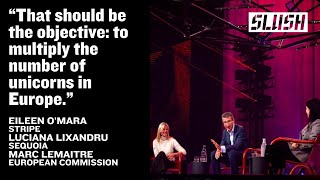
Getting Europe into the Fast Lane | Eileen O'Mara, Luciana Lixandru & Marc Lemaître
Luciana Lixandru: Who Are The Daring People Who Will Build The Next Legendary European Companies?

Unpacking the European VC playbook with Frederic Court and Luciana Lixandru | StrictlyVC London

Lessons From a Lifetime in Venture - (Sequoia) Doug Leone & (Sequoia) Luciana Lixandru | Slush 2022



Spotting Global Potential at Seed & Series A: The VC Perspective | SaaStock EMEA Online 2021

Fireside: Matthew Miller & Luciana Lixandru, Partners at Sequoia Capital - Sequoia in Europe