Lessons From a Lifetime in Venture - (Sequoia) Doug Leone & (Sequoia) Luciana Lixandru | Slush 2022
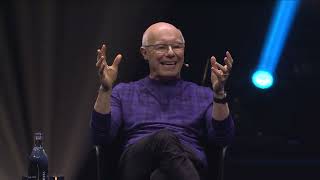
Doug Leone of Sequoia says the current downturn is deeper than 2000 or 2008, driven by interest-rate hikes and geopolitical tension, with recovery unlikely before 2024. Founders should focus on hard ROI, capital efficiency, and rejecting early offers that don't match long-term vision. Leone calls this a crucible moment that forces founders to shed bad habits and think 3-5 years ahead.
Chapters
We love Slosh. We are so happy to be back here this year and we love the energy and the music. And I am particularly honored to be here today with my partner Doug. And introducing Doug in two minutes is an impossible task, but I will do my very best. Doug started at Sequoia 30 years ago. He was leader of the firm from 1996 until this year. During this period Sequoia went from a California based and quite California focused early stage firm to what it is today, a firm that's active in China, in India, in Europe. We opened the office here a couple of years ago. We invest in Latin America and we invest across stages today from Seed series A growth public companies. Doug also worked with some legendary companies and incredible founders, just to name a few. ServiceNow. I think even in this market it's. I don't think I checked. Even in this market it's an $85 billion publicly listed company. Nubank, it's the largest publicly listed new age fintech out there. And Wiz, which arguably is the fastest growing enterprise software company out there. So that is quite an impressive list of founders and we are really excited to learn from Doug's experience today. Doug, let's go straight into it. Slush this year is different from last year. It's a period of uncertainty. The NASDAQ dropped 30% since the beginning of the year. Were energy crisis, inflation. How do you feel about today and is this period similar or different from 2001 and from 2008?
So the first thing I want to say is thank you for being here. At my age, it's really an honor to be here in front of so many people that want to change the whole world. So I want to make sure you understand that this is a very genuine sentiment on my part. We live in a moment in time. Think about the privilege of being friends with so many people that do that. So a really heartfelt thank you to all of you. Thank you. So unfortunately, and I'll give you the good news, the situation here today I think is more difficult and more challenging than either 08, which was really a protective financial services crisis, or, or 2000, which is a protected technology crisis. Here we have a global crisis. We have interest rates around the world increasing. Consumers globally are starting to run out of money. We have an energy crisis and then we have all the issues of geopolitical challenges. And my forecast is that we're not going to get away with this very quickly. If you turn back to the 70s, there was a malaise of 16 years. Even if you go back to 2000. A number of public companies didn't recover for 10 years. So I think we have to be ready for a prolonged time where we're going to find consumers running out of money. Large companies and most of the economies that we all work and live in are consumer driven economies. In the US it's 70% consumer consumers running out of money, demand decreasing, tech companies, budgets being cut. And so I think we should be prepared for a longer period of challenges that we have faced in the past. How long, who really knows. But it will not be 12 months. It's not. We're going to hope for a 2024 recovery. That would be my forecast.
Doug, we have a lot of founders in the audience. What kind of companies do you think can win in this environment?
A few things. Companies that solve real problems. Companies that can justify a hard ROI period. Not soft productivity gains. Productivity gains is a soft roi, but where you go for someone either controlling a budget. Let me help you save real money. Or agree Gene, let me help you make some real money and do so with a true mathematical argument. Those and then companies that have strong leaders. And what's a strong leader? A strong leader is somebody not only that has a vision and can execute in good culture, but in this market. Someone that can communicate clearly with their employee base. Someone that doesn't bullshit their employee base. Because at this time you want to bring your employees in and ask them and tell them here's the challenges. And by the way, Google Facebook meta are laying off. So it's not that we're in an environment everybody can run away and just be honest with them and communicate. Here's the challenges. But more importantly, here's, here's the plan because you got to get people to buy in and it's got to be a clear plan. And then get everybody to all hands and said we're going to go dominate. Those are the kinds of companies, in my opinion, that are going to first survive. And by the way, survival in this market is half of the battle. And then excel.
Let's talk about that a little bit. I'm sure that you have a lot of advice for founders. You shared some of it already. Do you have specific advice for very early stage founders, let's say for seed stage founders or growth stage founders or not so blanket.
So the younger you go in a company, the more immune you are to economic conditions. Think of it at the other extreme in the way we solve all math problems, we look at the extremes. If you're a public company, you really are Targeted, you're pegged to the public market environment. If you're a seed stage company and you're a year and a half from product and revenue and maybe two years from profitability and seven years from exit, you have nothing to do with the public market. And so realize where you are in that continuum. 1 But to me, the more important segmentation is you have to figure out if you're weak or strong. And the lesson for me for 208, and we always learn from you, you have to realize we learn from you all the time, was if you can afford it, do not take your foot off the product accelerator even during tough times, because tough times are going to be followed by good times. And if you've had the ability to invest in product, which is really the core of the company, and sales being on the outer rim, you're going to come out with a much better offering when the time is right. And so my advice is in product, if you can afford it, continue to invest in sales. Don't go far out on the payback curve. It's not time because your competitors are dying. So there's no reason to push it. If your payback curve was a year, now is the wrong time to go get customers with a two year payback. So product first, revenue second. And then if you're really, really weak, you did the best you can to hold on to product marginally proven. But if you're strong, attack on product, attack on product and find the right balance for sales and revenues.
It sounds very straightforward. But I wonder, Doug, how many founders really realize in the moment if they're in a position of strength or in a position of weakness?
Well, look, it's not that tough. The only thing that's tough is product market fit. It's the genius level you bring in. Product market fit, each one is different. Everything else I mentioned is mechanical. Mere mortals can figure that out. It's what we experienced business partners. Notice I didn't use the word investor. Experienced business partners can help you solve. And essentially what you're really doing is you're doing a SWOT analysis. Strength, weaknesses, challenges and opportunities. And you look at the market opportunity, figure out where you are. You know, in most cases your competitors are going to die and you're dealing with the stodgy public companies that are not going to be innovating. And just do a clear SWOT analysis, figure out where you are. Because every strategy you do and every tactic you employ has to do not from the inside out, but from the outside in. It's a response to the market at large. So do a clear no holds bar analysis with your trusted business partners, figure out where you are and then take action. Really not much more complicated than that. Like everything else in life, the easiest solution is probably the best solution.
We talk a lot at Sequoia about crucible moments, these moments that can really change the course of a company and as an industry. Perhaps we're going through a crucible moment now. When you make all the decisions you just talked about. Are there any particular, is there any particular advice for founders from a mentality perspective? Is there anything that you've learned from the founders that you work with that really helped them or that you use as an example?
So I'm going to try not to be self serving and really be helpful to you. Think of what happened in the last two or three years. Whatever you did was rewarded by some investor because of the plethora of capital. You were rewarded no matter what. You made a shit decision, a crap decision. You got money, you made a good decision, you got money, which is a lousy way for you to learn your craft. All that is gone. The healthy balance between founder and business partner is now in place. And what you're going to learn now is the best lessons you're ever going to learn, even in our business. Imagine an investing associate that joined us two years ago. Everything they invested went up and to the right. They actually thought they knew what they were doing. But what a terrific training time. And so I would view this as a cleansing period. I would view this an incredible opportunity. This is a crucible moment, but not in the way you think. I think this is a crucible moment for you to undo some of the bad habits and become business people, true business people, to invest your precious capital into things that really have payback. And let's face it, if you have $10 million in a bank and can do one thing versus $45 million that can do three things, where do you think the better decision is going to be made? Where do you think the better decision is going to be made? When you're loose or when you're desperate and you really have to focus. So this is a crucible moment for you. But in my way of viewing it, it is a terrific crucible moment to shed some of the things you've heard before. Let me remind you, I have to be a unicorn. God forbid if I don't raise money at a higher price. The morale of the employees, all that's gone communicate to employees. If you need the capital, don't think about, oh, it's $100 million less. The only question you should ask yourself is this. How do we make our company, not my company, our company, the strongest possible company three to five years from now? That is the only question that matters. When we hold your shares and we figure out what to do now you're public, we don't ask ourselves, my look out. The Stock went up 10 points. Maybe we should sell or distribute. The only question we ask ourselves is what can this company be three or five years from now? Because every wonderful company has always has the crazy buyout offer. The only thing that matters is the future. We all have the possibility of playing long term, of looking the long term, which is really what our business is all about. Crucible moment. To take advantage of the situation not so much to survive, but to figure out how to get stronger in a world where fewer companies are getting started. The major companies have layoffs. You have a chance to upgrade, you have a chance to get stronger. If you play your cards right.
It almost sounds like you're saying that the last few years were less good than today to start a company like everything else.
You know, one of the things I learned in life is the truth is often the opposite of what you think. The last two or three years seem like wonderful boom time. But look, talent was diluted. Many lookalike companies got invested. A whole bunch of investors came in that absolutely had no clue what they were doing. Think about it now. Fewer competition, fewer competitive companies, more talent. The investors who were weak are frozen. This is a much healthier time for you and us. So I would view this as an amazing time. The two times I love most are boon times. And times like these, boon times, you exit, you sell. Terrific. Time like this is you invest. It can be a good time to buy and sell at the same time. This is a time to buy, to invest, to develop great habits. And so, out of this gloom that's in the air, I would encourage you shed all that gloom and really be aggressive and really think right now in terms how to dominate. You have a chance to dominate. My partner Ravi reminded me 10 minutes ago. The Ayton center line. It is tough to pass more than one car in a sunny day when you're racing, but you can pass 10 cars on a rainy day. Think about that.
I like the positive attitude and I'll build that. In 2001, Sequoia invested in two companies that are generational. Google and PayPal. Of course, we also invested in many, many companies that are no longer here. Was it obvious from the early days that PayPal and Google would create something special, would survive that period, would even thrive in that period? Is there anything those founders did that our founders in the audience can learn from?
You know, very interesting. Google, a lay market entrant. And there's a great line by a Google investor who I won't name that three years after the investment said, we've never paid so much for so little. Google was a company that was a walk in the woods. There are many roads to heaven. As my partner Shailender in India says, very philosophical. In India there's no one way. And Google is a company that took a long time, as many of your companies will. And so that was not as obvious. PayPal was more interesting because it was a conglomeration of an incredible amount of talent. In fact, if you look at all the people that left PayPal, they started many, many companies. And so. So PayPal was more obvious there. The issue of PayPal was the gun to the head that ebay said, being that most of the revenues from PayPal were from eBay and the fact that we wanted to hold on for a long time. And it was one of situations not unlike YouTube that was sold 353 days after we made the investment where the offer seemed so extravagant. Think of YouTube, think of PayPal. Think of Instagram sold for a billion dollars, which actually saved Facebook. And so many lessons there. The lessons there is great. Companies are started during dark times. Don't accept what looks to be a terrific offer. I gave you the question you want to ask a few years from now. And there are many roads to heaven in the case of PayPal and YouTube, more of a direct line. Both in the case of YouTube, late market entrant, in the case of PayPal, early market entrant and in the case of YouTube, a bit of a walk in the woods. So there is no singular way to get to heaven. You just have to find your way and, and have the conviction to stick with it.
I'll ask you an unfair question. People talk often about those cases where a founder and a team had a great offer on the table and it was really hard to say no, but they said no and then went on to build even bigger companies that became legendary. I think Service now maybe is an example. I'm not sure.
Is this first time founders or second time founder?
Regardless, yes. There are also stories that don't get told as often where founders reject a great offer and then don't find success. I know it's an unfair question. Because I'm asking you to generalize. How do you know?
Look, there are many investors. We're not that smart. But you have to assume through real logic that after 50 years, we've learned something. And what we've learned is when the flywheel starts going, it surprises us with you as a founder. The first time you see it, you go, oh my God, I can be worth X. In our case, we haven't gotten too many of those wrong. Mostly because of really pattern recognition and experience, what we often recommend to founders. Not founders in a series A that get bribed by new investors. You haven't done anything. You've written three lines of code. How about if you take 10 million off the table and you get us as investor? That's cool. Called bribery. It should be legal. People should go to jail for that. But if you're a founder that's built a business, you've got revenue. I would suggest the following. Take 10% of your holding off the table, 20% max. Take the pressure off, which really then de risks you, maybe your partner in life and so on, and gives you the courage and maybe even the business alignment to go for it. For the long term, I think the answer to your question is make sure you align yourself to the business partner. And I want to say a word about that. I am so tired of hearing founders saying that. I got a term sheet. Whoa. I got a term sheet. To me, and I'm going to speak out of school is like saying, I went to a bar and the first person, male or female, depending on you, are spoke to me. I got married. That's what it sounds to me like. Think about how you architect your product. Most of you are technical. You spend time architecting your product. Why don't you architect your cap table exactly the same way? And yet that doesn't occur to you. We hear I got a term sheet. Oh, he was first. So what? Be very careful in who you choose as your business partners. Do careful reference checks not only in the companies that work. We all have companies that work. But ask, give me a list of three companies that didn't work. Show me your character is when a CEO was struggling, what did you do? And those are the great references you want to ask out of your business financial partners.
How about mistakes? Are there really obvious mistakes that founders should avoid in this part of the cycle?
Yeah, don't get caught up in a mania. The next round. Oh, I've got to do last round's post or the morale of my company. Be pragmatic, play long Term, if you've got to raise $50 million and your last round was 500 and this round that's 350 first of all, the 500 has what is called weighted average dilution that you're not going to pay very much and then explain to your employees that you're way better off with another 50 million at a reduced price. Your 409A will come down, your next set of employees are going to have slightly lower price share which is an advantage and go for it. Explain to them that now you have the firepower to win in a long term. To me that's the greatest error I'm seeing right now trying to protect some artificial last rounds price for all the bad reasons.
One of the reasons is that there has been so much press around startups and back in my day, I'm joking but let's say five, six, seven years ago in Europe at least, startups did not used to announce their valuations when they raised money and today it became quite common. What's your general advice on startups relationships with the press? Should they try to be front and center? Build a brand? Should they stay stealth for as long as possible?
Startups have two advantages, stealth and speed. Why would you ever give up any one of them? So my advice as a board member is shut the hell up unless there's a reason to be loud. And what are the reasons? Customers. I don't think a customer cares whether you raise money at 350, 650 or 850. Recruiting or fundraising. I don't think a press release helps you in recruiting either. It is the sales skills of a CEO of a founder. And so most cases when you're small and weak, why announce there's so many announcements. Just lay low and be like the restaurant that doesn't post their phone number. And yet there's a line out the door. There are times you have revenue, you have 42 salespeople, you want a little marketing air cover. That's when it's time to speak. You're a year before the ipo. You want to create a buzz. That's the time to speak. But at most time speaking only provides you with cocktail kind of material so you can show your friends how well you're doing. That's a bunch of crap. Resist that notion.
One of the things that many of us appreciate about you is that you're very direct and speaking about the press. Sequoia has been in the press a lot for the past couple of weeks. What should we have done differently so.
First of all, I'm not going to mention any acronyms and you must appreciate that we don't know what's going to happen. But I'll forecast for you. Regulators, investigators are going to come. So I'm not going to comment there. I'm going to make general comments. We are in the dream business with you. Would you like us to lose that trait? Now I can tell you that after the last week, for the next three to six months, that we're going to dream a little less. But like having a child, you forget the pain of having that child three months later, a year later. We want to be in the dream business. I can tell you we've done careful due diligence. But what you see at the end of the quarter in a due diligence statement doesn't reflect what someone may have done in the middle of the quarter. We've looked at it. There's nothing much we could have done any differently. And we do not want to lose our virginity. Our true belief to align ourselves with you and to dream with you. I think we lose that and we're out of business.
Thank you for sharing that. Doug, any parting words of wisdom for our founders in the audience and the general audience?
Don't listen to all the stuff you read. You have a great opportunity in front of you. If you play your cards right, you have an opportunity to pass 10 cars. Do not waste a good recession. That would be my parting advice.
Doug, we love hearing from you. We love having you in Europe. Thank you so much for coming from California to Helsinki and I want to thank everyone in the audience. And we love meeting founders so much that we organized an open coffee get together with all the Sequoia partners who are here. I think it's six of us. So please, if you're free at 1:30, join us. I tweeted the details, but we're going to be in the place first, first floor lobby and just ask us if you can find them. We're excited to say hello to you in a bit.
Thank you and thank you for listening. Thank you very much.
Thank you. Thank you, Doug. Thank you. Thank you, thank you.
More from Luciana
Getting Europe into the Fast Lane | Eileen O'Mara, Luciana Lixandru & Marc Lemaître
Luciana Lixandru: Who Are The Daring People Who Will Build The Next Legendary European Companies?
Unpacking the European VC playbook with Frederic Court and Luciana Lixandru | StrictlyVC London



Spotting Global Potential at Seed & Series A: The VC Perspective | SaaStock EMEA Online 2021


Fireside: Matthew Miller & Luciana Lixandru, Partners at Sequoia Capital - Sequoia in Europe