Sequoia Unplugged: Building to Endure
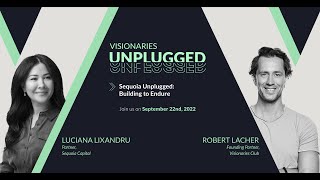
In this Sequoia Unplugged interview, host Speaker A sits down with Luciana Lixandru, a partner who joined Sequoia two years ago to lead its European expansion. Luciana recounts how Sequoia built a 18‑person office in Europe, the entrepreneurial nature of her role, and how she balances the demands of being both a founder‑mindset operator and an investor. She offers practical advice for founders navigating a cooling venture market, emphasizing fundamentals, unit economics, and planning for two‑to‑three years of runway while also recognizing that market slow‑downs can create acceleration opportunities for companies with strong fundamentals. Luciana explains Sequoia’s multi‑stage investment approach—seed, Series A, Series B, growth, and public‑market arms—and notes that while fundraising activity has slowed, the firm remains “open for business.” She discusses the founder traits Sequoia values: authentic founder‑market fit, a compelling personal story, intense grit, and often unconventional backgrounds that demonstrate resilience. Luciana shares personal motivation, describing her love for investing and the excitement of being part of many founders’ journeys. She reflects on past misjudgments of market size, citing early skepticism about Deliveroo and Airbnb, and stresses that market size is often limited only by the founder’s imagination. Finally, she highlights positive trends in Europe—more founders with prior scale‑up experience and a surplus of talent due to hiring slow‑downs at large tech firms—suggesting it’s a fertile time to start new companies despite broader economic uncertainty.
Chapters
And I'm so incredibly excited to have Luciana with us today. Luciana joined Sequoia two years ago as partner to build the European efforts. You all know Sequoia, they've been on top of the market for 50 years, have backed companies like Apple, WhatsApp, Cisco Systems, Google, so pretty much everything we use every other day. And we've been lucky that we were able to team up on a few investments in Europe like Yokoi Central to ledgie. So. But Luciana has also been in the ecosystem for more than 10 years already having back great category leaders like UiPath, Miro and other companies. So thanks so much for being here and excited to do this chat.
Thank you so much for having me. And before we talk about Sequoia or the market or companies, I just want to talk about you and Polly for a second. And I'm just so impressed with what you and your team and Polly built in the last few years from the new fund announced today to your portfolio and to this wonderful community. When I walked in, I thought this was a rock concert, not a tech VC get together. So congratulations.
Thanks so much for the flowers. Thanks so much. So we're, I'm lucky to be on the board with you of our portfolio company, XCentral. And you're maybe the most hard working person I've ever seen. So when I send you a message on WhatsApp at 2 o' clock at night, it typically takes two to three seconds until I get an answer. And I'm wondering, I mean, we can actually try it out. I think even at a Sequoia event, I did this and got an answer from you. But no jokes aside, I'm wondering, since you're on the one hand side, an entrepreneur, building Sequoia in Europe, really building this great brand and taking it here, on the other side, you're an investor that needs to look into companies, work with companies. How do you balance being an entrepreneur and being an investor in your daily routine? Because for us also building visionaries, this is something really challenging.
Yeah, so my thought process when I decided to join Sequoia a couple of years ago, a lot of it, at least some of it had to do with the fact that the role itself was quite entrepreneurial. And I think I didn't realize how hard that would be, to be honest, because before I was pretty much just focused on investing. So we were, we didn't have a team in Europe and we didn't have an office in Europe and we had some investments that were led by my partners who are Based in the US But I didn't have a portfolio of course, because I was just joining. And fast forward to today. We're 18 people in the office. I was just 18, I was just looking at the list, I was like, how are we 18 people? We're five investors. Well, four investors.
So they write your WhatsApp whenever, at midnight you have two, three people.
So. Exactly. That's why I'm always on, no joking. We have four investors and actually someone from Germany starting on Monday, we have five people on the talent side. And that's one area where we want to invest a lot and where we see that our founders really are asking us for help the most. And then we have eight other people in other wonderful functions from marketing to our pre seed program called ARC and other parts of the operation. So all this to say it's been really fun and I think we're now in a place where a lot of our quote unquote infrastructure is in place. And I'm delighted to be able to spend more time on my first love, which is investing, because I love this job. I realize every day it's what I've been doing for over a decade. So I would say it's a mix. But my first love is certainly investing.
Okay, so all founders here, stay tuned. There might be many more deals for Luciana in the upcoming weeks.
We'd love to chat and we'd love to do more in Germany.
Yeah, speaking about that, you know, that's kind of in contrast, if we look at the current market environment, it makes many people very nervous, not just LPs, but I think especially founders because we had two years of an incredible hype cycle. So much capital going into Europe and I mean you've been in this industry for 10 years working with companies. Sequoia has been for 50 years. What do you tell founders, maybe in particular B2B founders these days, how to deal with this environment?
It's been a very strange two and a half years until about six months ago. It was the fastest pace I've ever seen in venture and I'm sure I'm not sharing anything new in the last six months. Things calm will come down, slow down, I should say a lot. And there is some advice that can be more quote unquote, blanket advice and then some of it. I think it has to be very company specific. So because my partners have seen cycles in the dot com bubble and the financial crisis, as soon as we had a sense that something would turn in the market, both from a macro perspective and from A capital markets perspective. We got all our founders on a call and we talked to them about what we think might come. And of course it's we might be right or we might be wrong, but we gave them our two cents on what might come from a macro perspective in particular. And a lot of that was around fundamentals. Build a great business, focus on unit economics. Until six months ago or a year ago, it was incredibly, or not incredibly, but it was much easier to raise capital. Every valuation was higher than the other. We were already sensing a few months ago that things were really slowing down from this perspective. So a lot of the general advice is focus on fundamentals, build a great business. At the end of the day, that's what matters. And that's when you don't depend on macro as much or in capital markets as much. To be more specific, we told our companies at the time to try to plan for two to three years of Runway. Two ideally. Well, sorry, three ideally. Two if that's not possible. But at the same time, every company has its own journey and every company is in a different position. So at the same time, situations of crisis can be great opportunities. And some companies that have wonderful fundamentals and might have unfair access to capital and might just be in a great position to accelerate, I think that's absolutely what they should do and they should take advantage of this opportunity where their competitors might not have that access to capital or. Or might not have the good enough unit economics to really double down. So sorry, I don't mean to be vague. Of course, generally speaking, focus on fundamentals. But at the same time, every company is in a unique situation and it could also be the right time for some of you to really double down and really accelerate and really overcome some of your competitors.
Yeah, we always use this quote for Ion Zena. Some of you are already tired of it, but you cannot overtake.
I was going to use it steam.
Cars in sunny weather, but you can when it's raining. So I guess if you have the right setup sometimes. Amazing to be acyclic and really take a win on this, maybe turning things around. How do you act as Sequoia? Because if we look at Europe, you know, there has been so much money going into the market. I mean all the other U.S.B.C.S opening offices that happened in the last two years. Now we have the situation that, you know, things are going maybe into recession or at least kind of big market correction. How do you deal with the environment? Are you saying we're even more aggressive and at seat because you know, Then companies have time. Are you basically acting as always? Is there kind of a reaction? There are a lot of rumors, like OCUA is now becoming especially active or.
We'Re definitely open for business, that is for sure. I think I should unpack your question a little bit. We're always looking for wonderful founders who want to build great businesses. And we invest across stages. We have a seed focused fund, a series A focused fund, a series B and growth focused fund, and we even have public arms. So for us, whenever we meet a great founder, we're able to partner with them. Of course, ideally we're seed stage investors at heart. So we love finding founders really early on. And we're very fortunate as a firm to invest in Airbnb and Stripe at seed. And those companies obviously have done very well. So we've always been seed focused. But that said, we're open for business, we invest across stages. We have seen, to be honest, less founders wanting to fundraise right now. But it's not because we're not as active as ever. I think everyone is just trying to figure out what's the right valuation for me today. Given that public market multiples dropped meaningfully, when is the right time for me to raise even some early stage founders? My sense is that, or sorry, founders that are thinking of starting companies pre founders, my sense is that they're trying to figure out the level of uncertainty before making that jump. So it definitely has not been as active in the market and for us in the past six months or so, but I would say it's more on the other side. It's not that we're not super excited to meet founders, spend time with founders and partner with them.
Maybe speaking a little more about founders, because I think if I look at the investments that you have done, the founders, some of them that we've worked on together, they're incredibly non obvious, non linear profiles. So what traits do you look in as a good founder? I mean, let's take Daniel from UiPath from Bucharest, who has worked 10 years on that kind of product before he really got discovered. And then Andre from Miro, an incredible story, he's also here today. Or Baynard from Xentr, you know, comes out of the middle of nowhere in Augsburg. It's not the typical, I'd say Stanford Y Combinator founder that Sequoia sometimes backs in the us so what do you look into as a founder? What excites you?
So as a team, we analyze things a lot and we, we talk a lot about founder profiles and actually I personally find that very difficult because we look for outliers and outliers spike on different dimensions. And there's one founder of Miro and there's one founder of Central, and there's one founder of Zoom or UiPath. And of course I think there are certain traits that ideally most of every founder have, but I think every outlier spikes on a different dimension. So I'll start by saying that, that said, there are certain things that of course as an investor I am attracted to. One of them is definitely founder market fit and an authentic founding story. And the reason is everyone here knows this much better than me, but typically it's not that easy building a great company. And I think if you have an authentic founding story and if you really started this company because you're obsessed with solving a problem, I think that's going to give you that extra push when things are not so obvious. And speaking about Central, I mean, I loved Bennett's founding story. We talked about this in the early days, how he, him and Claudia, his wife, had an e commerce website and he had no tools to run his business. So he started coding at 5am before work and late at night and he started building the product for himself, then realized, wait, there are millions of companies out there that have the same problem. So founder, market fit and really this authentic founding story, we love that at Sequoia and I love that personally. The other one is very obvious, but I really think without it it's just very hard and it's just intensity. I think just unfortunately you have to give it your all, at least for a period of time, at the beginning you're an entrepreneur, you know, at least at the beginning, for a period of time. I really think just intensity, not taking no for an answer, just having that sort of grit is incredibly important. And then last but not least, you mentioned I do like a non typical profile. I think I had a somewhat non typical profile. I grew up in Romania and I was lucky enough to be able to study in the US and I didn't know about technology even in college, to be honest, I didn't think about technology. So it doesn't have to be that a founder studied at Stanford or MIT and wonderful founders came from there. But personally I do like someone who maybe even had to overcome a little bit more to get that early success because I think you probably have to be that much better to overcome some of that. So personally I do have a very soft spot for founders with more unusual backgrounds who start in, in locations that might not be London Or San Francisco. And nowadays as we know, founders can really start companies from anywhere. That's a long answer, but it's a very meaty topic, right? And a very important topic. And we think about this a lot and we talk about it a lot.
No, it's something that fascinates us a lot because Europe is so decentralized so you find all those amazing people everywhere but it's so difficult to find them. So if you're just in Berlin, London, you sometimes get the more kind of linear or profiles and but maybe a good perspective since you know, you talked a little about, you talked a little bit about yourself and kind of what you like to see in founders. And it's I think personally impressive, you know how with what energy you've kind of, you're so self made, grew up in Romania, then went to US because you wanted to study there, but pretty much kind of tried to pay everything by yourself and then entered European VC and our on top of European vc. What drives you like what still keeps you hungry to achieve? Personally.
I find this question very. I asked this question in interviews, however I find it very difficult to answer it. And my partner Doug Leon actually when we were getting to know each other he asked me this question and I don't think I was able to answer it. I'll do my best. I found something that I really love really early on. People always ask me, would you join a company? Would you start a company? And I just love investing and I love being a small part of many journeys, not just one journey. And I've been investing for over a decade now and I really honestly could not imagine doing anything else. So I feel very, very privileged from this perspective. And I'm that annoying person at the dinner table who does not complain about their job, quite the opposite, is really excited about their job. So that's a big part of it. I think I was very lucky to find something that really energizes me and even if I have free time, I enjoy just checking things about companies I work with or meetings. Yeah, I text more. So I think that's part of it. And I guess in this industry we're probably all a bit competitive at least with ourselves, so just trying to get a little bit better every day and failing many days, but at least trying.
That's a great motivation. Are there things that you really, really needed to learn the hardware or is there one lesson where it was really hard for you to learn but that really brought you forward?
Yes, of course. So many. Let me think. I think one mistake that I used to make, and I think that many investors make when looking at a company, at a company thinking about, you know, doing our little spreadsheet analysis and thinking, oh, this is a small market. I definitely wish I had been more open minded about this. I heard this quote. I don't know who says it, and it's not mine, but I think it's so good. Market size is up to the founder's imagination. So I think if you have someone with a passion that we were talking about before and with really, really wanting to solve a problem and who can really see around corners, then I think founders can zig and zag and expand the market or create a new market or find new pockets. So that's definitely one learning. So, for example, deliveroo. We met will back in 2014, early 14, and I didn't see it initially. I was like, oh, how many people are going to order food delivery at home and they're going to pay for.
Pre Covid long time.
Pre Covid long time ago. And I thought this must be just, you know, affluent neighborhood phenomenon. It cannot become a world worldwide phenomenon. And I was obviously so wrong. I mean, look around. My, my sister in Romania orders food delivery and not quite my parents, but.
You do it for your mother. I know.
I mean, it's one of the biggest markets out there. It's created wonderful generational businesses. So I would say that's one mistake. Just market size early on, I think it's very hard to tell. Sorry. Not that I want to go on too much about this, but I think Airbnb, I obviously was not there for those conversations 10, 12 years ago, but I cannot imagine that people must have thought, wow, everyone will want to rent out their houses and people will want to live into each other. Not live, but stay in each other's houses. Those things are not obvious. But if you find that bark and that user love, you can go really far.
Thanks so much for those many also very, very personal impressions of you. Maybe one last question, because I think in this conversation, when we speak about founders, when we speak about being in vc, it's always taking a very optimistic perspective, no matter kind of what the world around us. Because you have to be an optimist, you have to be a risk taker, even if markets are great. But in this world where some things are maybe not that easy or some things look dark, what spikes you that you think is positive right now or encourages you to be cheerful.
In technology? If we talk about our world a lot, one thing that we're Seeing more and more of in Europe is founders that have traveled a journey with other scale ups and have learned in other people's companies and now want to build their own companies. And I think that gives you a little fast forward in the early days, or founders who tried before and they might have succeeded, or they might not have succeeded, but they have that previous founding experience. And I think we're seeing more and more of that in the last few years in Europe, and that was not the case before. And the other thing is talent, especially in this period, if you look, I mean, every time I read the news, Facebook is no longer hiring or meta. I'm sorry, is no longer hiring or they have to. Are you cutting me off?
No, no, you're back. Absolutely not.
Big companies and even scale ups, of course, have to react to the market environment and either they're not hiring as aggressively or they're even cutting back. So if anything, I think from a talent perspective, it should be better than ever for very early stage founders. So I think it should be a great time to start a business. I mean, PayPal, Google, they started during the dot com period and Airbnb started during the global financial crisis. Great companies are created always and sometimes even more so in these situations that seem more difficult, but that can really create opportunities.
Luciana, thank you so much for coming over. Thanks so much for your perspective. I think it's great to have Sequoia with all the 50 years of boldness in Europe and having someone like you leading it. So thanks for being with us.
That's so kind of you. Thank you so much. I'm really delighted to meet everyone and see everyone at drinks later.
Thank you so much.
More from Luciana
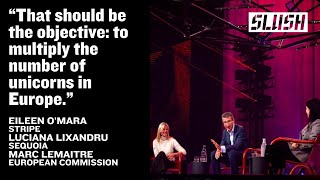
Getting Europe into the Fast Lane | Eileen O'Mara, Luciana Lixandru & Marc Lemaître
Luciana Lixandru: Who Are The Daring People Who Will Build The Next Legendary European Companies?
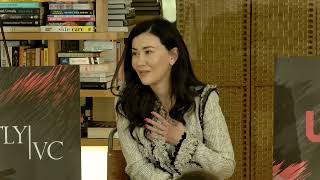
Unpacking the European VC playbook with Frederic Court and Luciana Lixandru | StrictlyVC London
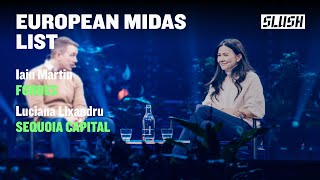
Lessons From a Lifetime in Venture - (Sequoia) Doug Leone & (Sequoia) Luciana Lixandru | Slush 2022
Spotting Global Potential at Seed & Series A: The VC Perspective | SaaStock EMEA Online 2021

Fireside: Matthew Miller & Luciana Lixandru, Partners at Sequoia Capital - Sequoia in Europe