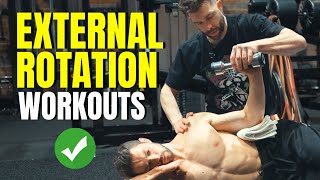
In this instructional video, the coach (Speaker A) demonstrates three core external‑rotation movements that together cover roughly 80 % of an effective external‑rotation program. The first exercise is a side‑lying external rotation performed with a dumbbell, a towel prop, and an offset grip; the coach explains how the towel raises the humerus, how to depress the lats, and how to use a clubbell (2 kg) for added lever‑based stability. The second exercise uses a cable machine with a single‑rope attachment; the coach emphasizes lat depression, a hip‑wide stance, and a “point to the floor” cue to limit unwanted torso rotation while keeping the rope tension constant. The third exercise is a seated/kneeling external rotation with heavy dumbbells (fat‑dumbbells), where the client’s elbow is seated in a knee crevice, the torso is kept “proud,” and the lat is again depressed to maximize shoulder stability. Across all three variations the coach stresses low‑rep (≈5 reps) work at the end range, progressive overload via leverage or weight, and constant cueing of wrist stability, lat depression, parallel‑to‑floor arm path, and a proud chest. The video ends with a brief call‑to‑action for viewers to subscribe for more “superhuman” training content.
Chapters
In this video, I'm going to show you my 3 go-to exercises for external rotation. If you get these 3 right, it's probably 80% of your external rotation programming done. We've got Jason here, he's going to be demonstrating. And the first one, and the most remedial of them all, is side-lying external rotation. So Jason, if you can lie down for us on your side, we're going to show you the first variation of external rotation. So we'll get you facing that way, and you're going to be using a dumbbell. So to begin with, right? So we're gonna show you some variations. I'll grab the towel, actually just do it normally so I can show the folks why I've got that towel here. And Jason's gonna go through this and I'm just gonna critique some things as Jason does it and then give you some pointers. So what Jason's doing is not bad, it's not bad. However, there is some points here that definitely can be improved upon. So the first thing is, if we look at the humerus, it's coming down on a slight angle. So we do wanna prop that up just a tiny bit and that's exactly why I've got the towel. So the towel does serve two functions in this case and I'll show you how. I've folded it into a square. I'm gonna put that just under his armpit there. So before Jason does anything now, what I'm gonna cue with Jason is I'm gonna get him actually a little bit more flat. So instead of being on your hands, just put that one there so you can bend your arm and that way you can just rest on your arm right that way, right? So the next thing is I'm gonna get him to depress his lats down into his underpants, right? So you can see what just happened there. He pulled all of this down into his underpants. Now he's in a nice stable position. The next part that I really like is the wrist is often a reflection of the shoulder. If we have weak wrists in our shoulder extension movement, it's probably indicative that our shoulder is not fully stabilized and not really doing its job. So what I'm gonna do with Jason is I'm gonna actually get him to do an offset grip. So Jason, just loosen your grip for me. So now you can see that's an offset grip. He's grabbing the dumbbell at the bottom part, and now he's gonna have to really stabilize from the wrist and keep everything steady and straight. So now the lines that we create is we have this line from the humerus to the elbow and this line. So I want everything, this is what I'm assessing and looking at his body. I wanna see that. Okay, now Jason, pull that down. Now you're gonna rotate, externally rotate, keeping that wrist nice. Now, he does have a little bit of restriction here, so I'm gonna help him manually to get through that full range of motion. So pull that down. I'm only gonna get him to do 5 reps. And a little bit more, a little bit more, really stick yourself up as you do it. Good. So this is light, but you can see that he is struggling with this as well. because we're really hitting that end range. And also you can see that grip that I've got him to use. He's not used to. It is harder. So I've really set him up. This should be nice and difficult, right? And pull, pull, pull, pull, pull, pull, pull, pull. And he's a little bit weak through that in range. So I'm going to help him out and relax. Okay, Relax there for a sec, Jason. So one of the implements we can use to make this exercise a little harder is we'll get rid of this and we'll use a club belt. Now, this club bell is only actually 2 kilos, but from a leverage point. Again, if I put him here, it's created a lot more lever, so he's going to have to keep everything nice and straight. So one of the things I want to get into— won't be that mean to him today, but one of the reasons why I love the clubbell when using external rotation is because when we train external rotation, one of the big pieces of it is training stability. So if I can put an implement into someone's hand that forces that stability piece, we're already halfway there. Now another little cue that I do as a trainer is I put this underneath squish. I'm going to try and pull it from him, and the reason why I want to pull it from him is because I want him to push everything through and create more stability as well. So I give that as a little cue. Getting position, Jason. We'll just do a couple of these to demonstrate. And get into that position again. It's only 2 kilos. Pulling that. And now you can see with the club belt, it's probably even too— yeah, that's where you want to be. Now go and rotate, rotate, rotate, rotate, rotate. And he switched on a little bit from the last set. And again, keep that risk. And also there's nice feedback to Jason as well. You can see the kettlebell, he can see if he's dipping, so he knows where he should be. So really try and keep that parallel to the floor, parallel. So now he's got a cue that he has to think about as he does it. One more, keep it parallel to the floor, keep it parallel to the floor, keep it parallel to the floor, push yourself in. That's the end position. And good, control down, control down. Beautiful. All right, so Let's move to the next variation, which is using a cable. So this is also fairly remedial, although I do find on the floor side lying easier for people to pick up. We're going to move over here and use the cable. So the way I like to do the cable is I like to use a single rope. Now, a single rope is this attachment. It's not a double rope, it's a single rope. It's not a popular attachment, which I find a little bit strange because it is quite a attachment for multiple reasons. So I'm gonna get Jason to demonstrate. There you go, that way. Excellent. So I'm going to put that here. All right, so again, right, the reason for the towel— a cue. It gets him to put— squeeze everything together. But the other thing, if I remove that, right, we look at this humerus, it comes straight down. It's not really where we want it to be. Now he's nice and anchored, he's nice and tight. So I'm going to get him to depress his lat down. And yeah, uh, we will go— just relax that side. So we have this side right now. The other thing I like to do with this is get a little bit of space from the machine before we even start. How are we weight, that should be okay. Now feet closer together, closer together, go hip stance. Now here I want you to point to the floor as hard as you can. Now the reason why I do that is because when people often do their external rotation, they move and flex to one side. Your latissimus dorsi stabilizes by anchoring him in and getting him to point to one side. I minimize the amount of rotation and rockiness, and I really just get him to work on this. So we'll see how this weight is for Jason. It might even be too heavy, but we'll have a look. Squeeze this together. Now go and open up, open up, open up, open up, open up. One. And even more, even more. Yeah, we might be a bit too heavy, so let me grab this one. Let's go here and open up. And you can see Jason's a strong guy, he's got a lot of muscle in his pec, but this external rotation piece is often neglected. Point, point, point, point aggressively. Point aggressively, point aggressively, and squeeze. I'm going to take that towel from you if you don't keep it tight. I'm going to take the towel. Open, open, open, open, open, open, open, open, open, open. And again, squeeze it through, squeeze it through, squeeze it through. Keep it tight, keep it tight, keep it tight. Again. A lot of people just, they. They phone this one in. We really do it. We really want to think about all this stability and just one more. And this is why I usually like about 5 reps for external rotation as well. That's it. I like five reps for. The point being is, most people don't stay stable if you do anything above that. So We're going to go to our last variation. So I said there's 3 go-tos that I have. This is the third, and this is seated kneeling external rotation. I like the fat dumbbells where possible for this. Jason, if you want to get into this position, get your bum right to the edge. So of this side, so if we're doing that leg, you're going to be at the edge here. That's it, there we go. All right, cool. And I like that— reason being I like this setup is because it anchors it the same every single time. If we start from here and there's space here, we're going to get a different position with our leg every single time. So I really always make sure that the client is always set up, and it's beautifully demonstrated so that way I could talk through this piece by Jason. It's— we set it up the exact same way every time. So if I can, Jason, just go a little bit wider for me. So leg out, really anchor that in. Cool. Now when we're looking at this here, what we want to have is a slight dip from the shoulder down, which we've almost got. I'm just going to get Jason to move his leg out. Now the other thing I'm going to get you to do, Jason, is I just want to show the viewers— just move your hand out the way for a second. I just want to show the knee. There's a little crevice here on the knee. That's where I want your elbow to go, right there, right? So just chuck it into that groove. There, perfect. So we're going to need that leg a little further out. There we go, because I'm looking at this slight— now same thing with the lat. I want the lat pulled down, so pull the lat into your underpants, extend through the thoracic, get nice and proud, think proud. That's it. Now come through, so rotate and stay proud, stay proud with your chest. What I find here with this other hand is if you swing around, grab the bench, there you go, and then stay as proud as you possibly can. And come back up. See how he just let that come in? We don't want that either. So go to the end range, but keep yourself proud, which may diminish how far you can go. Now his elbow is moving all over the place, so I'm just going to help him out a little bit. Keep yourself proud and turn your head straight. There, keep your head that way. And to press that lat, to press that lat. The idea here is you want to create as much stability as possible, so don't let this shoulder move. To press, to press, to press, to press, to press, to press. Good. You can see how this does make it quite a bit harder as well. Keep it depressed as you rotate. Keep it depressed as you rotate. Keep it depressed as you rotate. Good. Excellent. Just do one more. Keep that elbow. Keep that elbow. Keep that elbow. Excellent. He's really struggling with that. So you can see here, right, with Jason, he's not quite at the level where this is suitable for him, but I would definitely start him at the floor because he definitely got a lot of resistance and using that, that clubbell. This is a great exercise for Jason to progress to, but not quite where we are. And again, the reason why I say that— and it could be a neural because his elbow was moving all the way around. Maybe I give him a bit more time, he gets that. But it is an indicator that the strength there is lacking to stabilize. And again, that is the function, really what we want to be training for when we're looking at that external rotation. If you've enjoyed this video on my go-to external rotation exercises, consider subscribing. Want more videos to learn how to build your superhuman? Click here or here.