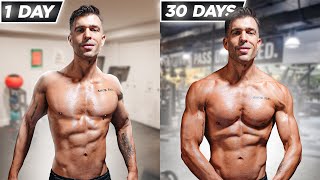
In this instructional video, the presenter outlines a six‑exercise program designed to build muscle quickly and safely. He emphasizes using low‑skill, high‑load compound movements taken close to "proximal failure"—the point where muscles can no longer complete a rep—because such exercises allow maximal weight while minimizing injury risk. The six core lifts are: (1) trap‑bar deadlift, praised for its self‑centered load and safety; (2) chin‑ups, highlighted for combining strength with body‑weight control; (3) incline press, chosen to develop the upper chest and expose weaknesses; (4) front squat, presented as a technical litmus test that ensures functional strength; (5) split squat, used to achieve deep knee‑flexion end‑range tension for quad growth; and (6) seated Arnold press, which rotates through all shoulder heads without stressing the lower back. Throughout, the speaker stresses controlled tempo, time‑under‑tension, and end‑range work. He also offers a free "Fitness User Manual" covering protein targets, macronutrient organization, goal‑setting, and shopping lists, positioning it as the nutritional counterpart to the workout plan. The video concludes with a call to action to download the manual and a motivational sign‑off encouraging viewers to eat well, train hard, and supplement smart.
Chapters
Build muscle fast with these 6 exercises, starting with the trap bar deadlift. Reaching, reaching, reaching, reaching, reaching. I grab the bar. Now my sternum, my kind of like just above my, my, we say below my chest, I point that up to the sky. And I stand up as one. This is a compound exercise. So you can see here, my upper back, my lower back, my glutes, my hamstrings, everything is working. Even a bit of quads is working in this as well. And this is quite safe to take to failure. Thing is that building muscle is we want exercises that are relatively low skill, and because they're low skill, we can take them closer to proximal failure. So what is proximal failure? Proximal failure is where our muscles just give out, they give up. We need to get close to that fireout, we need to get close to proximal failure where our muscles just simply cannot do another rep. If we were to try that on a normal deadlift, the risk of injury is very, very high because there's a lot that can go wrong on a normal deadlift. The reason why I like the trap bar deadlift is because the load is self-organized. What do I mean by self-organized? Watch this, right? I step inside the trap bar deadlift, the load is now in my center of mass. On a normal deadlift, the bar is here, and if the bar swings forward even just a millimeter, I can absolutely do my L4-L5 in a millisecond if I've got a load that I'm working towards proximal failure. Whereas the trap bar deadlift, the load is self-organized. You want to use as heavy a load as possible while taking something to failure. And again, if movements are complicated or in movements where things can go wrong, like say a standard deadlift where that bar can shift out, they're not the movements. So anything that has a high degree of skill or complexity, we don't really want to be putting it as our number one movements for building muscle because we want to be taking movements to failure and movements that allow us to move as much weight as possible. And this is why I definitely prefer the trap bar deadlift as a movement to help build muscle over a normal standard deadlift because I can take it to failure much easier and safer. For building muscle and building mass, nutrition is important, and that's exactly why I want to give you a free copy of my fitness user manual stacked with what protein to eat, how much protein to eat, how to organize your carbs and macronutrients, everything you need to build the muscle and mass that you want so that you can get in shape once and for all. We even have a goal setting section and a shopping list so all the guesswork is taken care of for you. I'm going to give you that copy at the end of this video. Now back to exercise number 2, which is chin-ups. In this position, I'm going to pull my back in and raise my body up so everything works as one. Now with a chin-up, we have two options. We can do bodyweight chin-up for reps, or we can get a belt and add load. Why do I pick a chin-up? A chin-up is one of those movements where you want to be strong, but you also need to maintain a healthy body weight to do a chin-up. So You can either get stronger or you can get lighter, and wisdom is that you do both. You maintain a healthy athletic body weight whilst getting jacked and as strong as humanly possible. So a chin-up inbuilt makes you look after, I suppose, your body composition and your weight. It's going to relate and help with so many other exercises and help you just be a better athlete all around. On a chin-up, we want to be looking at strength and building muscle and mass, and to do that we need controlled movements, we need time under tension, not just random kipping and using our whole body to get up. This is a movement that's going to help you get functionally strong. I know people use the word functionally, but there really is nothing more functional than pulling yourself up over a bar. Now let's move to the next exercise. The next exercise is an incline press. The reason why I specifically like an incline press over a flat barbell bench press for building muscle is a number of reasons. The first reason is most of the time guys need more upper chest development, and the flat press, yes, you are going to develop muscle on it and you can use more load on a flat press. However, there is a much more— you can get away with using a lot more load if you know how to set yourself up technically on a flat press. Here, this exposes you. An incline press absolutely exposes you at a 45-degree angle. You have to be strong through your chest, your shoulders, and your triceps because of that exposure. You're not able to get into the same arc that you are in the same position that you are on a flat press. So for building muscle, you're going to be exposed, and it's going to expose things that are your weaknesses. We're always going to be able to build better and faster when we work on our weaknesses than when we just work on our strengths. That's why I include it as one of my best movements to build muscle. So the fourth exercise is the front squat. Here we go. Why do I like front squats, and why would I include a somewhat technical movement, or a very technical technical movement when before at the start of the video I said avoid technical movements. Now here's the reason: there is no hiding on a front squat, and to do a front squat well, so many things have to go right. When building muscle, you don't just want to build muscle and be kind of like muscle bound and not be able to move. A front squat is a litmus test to be able to build muscle and still be able to move and perform well. The payoff of what you get to learn a good front squat from a technical point of view is definitely worth it because it makes you a better lifter, a better athlete. And at the end of the day, you don't just want to look good, you want to be able to move well. And a front squat certainly is a litmus test for moving well. Well, that's why we include a front squat as part of your muscle building program. The fifth exercise is a split squat, a split squat as a bodyweight split squat. And we can tailor this in so many different ways at so many different levels. So the first is we can do a bodyweight where that knee— what we really want is the knee to be really going over the toe. If that is too aggressive for you, you grab one of these blocks, and it's just going to basically elevate us a little bit, so it reduces the range of motion so we can get into this. It feels a little nicer. Likewise, if we want to enhance the range of motion, we can. If we've got great flexibility, we can put our leg back. Now I'm going to show you with the dumbbells, right? I'm just going to load, just grab 5 kilos. Now what I like on a split squat, I like pauses. I like to really get into that deep range of motion, right? Like to really get there. So we can use— we definitely can use dumbbells. The other thing I like to use is to force that stretch. Again, for muscle building, what has been shown with building muscle is end range. End range is super, super important and often underrated. Now what is a split squat? It's really working on that knee flexion at an end range. And if you can get— like you'll see here is there is no daylight between. My hamstring has completely covered my calf. So in this position, now I'm up. Now the reason why I like a cable— cables look different. Cable is going to be pushing my body forward, as you can see, to really get that enhanced, that knee flexion, right? And my heel has come a little bit off my— off the ground to get even more knee flexion. And knee flexion is simply what it means is how far can your knee go over your toe, and in this position, that's the end range. I'm pushing back, you can see the quad, you can see the quad working, right? And again, this is going to be a support and supplementary exercise to my squatting. And the other thing is, man, I can take this to failure. Yeah, I can safely take this to failure. I can really push it. I can get into those end ranges, very, very safe movement. And the other thing is, it's going to help me move well. It's gonna give me full range of motion while giving me big quads. And this is why I absolutely love a split squat for building muscle. So the last exercise is the Arnie press. So the reason why we're not gonna use a standing overhead press, a limitation of the standing overhead press is actually our lower back. So it's one of those exercises that we can't really take to failure overhead, but this, we can absolutely take this to the end degree. So you can see here when I'm doing the Arnie press, I rotate the handles straight in front of my body and then I rotate out into that pronated position. So I go from a supinated position to a pronated position, as you can see, and I'm using the bench to support my lower back. So my lower back isn't a factor in terms of the reps that I do. So this is really working, fully engaging my shoulders all the way around. So I love this movement for shoulder development because it really just hits every element of the shoulder, hits the front delt, it hits the side delt, it hits the rear delt, it hits everything because you're fully rotating through as you do it. So this is a great exercise. It cuts out the limitation of lower back that would be the limitation. If I was to do the same thing and do it standing, the limitation is that lower back. And what a lot of people do on an overhead press is they get into that lordosis where they start pressing and making almost like an incline press, which is what we don't want. We don't want that because then you putting a lot of pressure on the lower back. So we want to be able to take this as close to failure as possible, and this is very safe. And this is why I love this exercise as one of the movements to build muscle for the shoulders. Use these 6 exercises to pack on muscle fast. And as promised, here's the link to my Fitness User Manual. Grab it now, it's going to get you on the right track to pack on slabs of muscle fast. Till next time, friends, eat well, train hard, and supplement smart.