Behind the Scenes: An Olympic Athlete's Journey
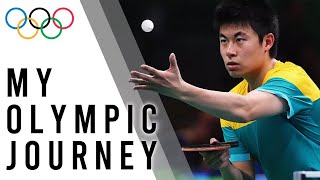
Australian table-tennis Olympian Hemming Hu talks about competing in Rio 2016 and Tokyo 2020, receiving 45 kg of Olympic clothing, and spending six years training overseas in China, Europe, and Germany. He describes the psychological toll of elite sport and why mental factors often decide matches.
Chapters
Before we get rolling with today's episode, I have a very small favor to ask. If you get any value whatsoever from our episodes of the Enterprise Fitness Podcast, please share it with a friend or leave us a review. You see, our mission here at Enterprise Fitness is to empower as many people as possible with their health, fitness, and training, and we believe the best way to do that is with education. That's why week after week we continue to put these episodes on and try and jam-pack them with as much valuable information as possible. So hope you enjoy today's show so much so that you want to leave us a review. Now let's get into it. Welcome to the show that punches you in the face with information. Welcome to the Enterprise Fitness Podcast. My name is Mark Ottobre, owner and founder of Enterprise Fitness. I am joined by Cristiano Colla and Heming Hu. So in this episode, we are going to be getting into what it's like to go to the Olympics, the Olympic journey. Everyone say ooh. So there's only one of us on this table who's been to the Olympics. Cristiano.
Yeah, you see my tattoo?
Yeah. Hemming, you apparently, rumor has it, grapevine, you've been to the Olympics.
Yeah, apparently.
Um, how many times?
Twice.
Twice?
Yeah.
Yeah, and I heard that they gave you these bags full of Olympic clothes. Yeah, we start—
still has it.
Yeah, so the, uh, on the second last night there, they all would happen both times, they'd actually put up a sign 'Uh, we normally want you guys to come first, but tonight it's okay to come second.' And then there was a bunch of, uh, a bunch of gifts there.
That's hilarious, but that's not what I was talking about.
I thought it was.
No, they gave you bags of clothes, right?
Oh yeah, yeah, ridiculous amounts, like more than you could ever need. 40, 45 kilos, both Olympics. Unreal.
45 kilos of clothes?
45 kilos of clothes.
So this was before you got to the Olympic Village?
I went to the one in— I went to Rio 2016. They— yeah, we went to Sydney just to pick it up. Tokyo, they gave it to us there because of all the COVID rules and all that.
So, but can you describe this bag of clothes? Because I'm fascinated by it, because you said it was like 45 kilos.
Yeah, so before Rio, we went to Sydney and there were like— they gave us 2 or 3 suitcases full, and in those suitcases you had tons of bags. Yeah, just loaded with clothes.
So, so everything from like socks, jocks, chants, tops, village wear.
You had to obviously be in the gear at all times. Competition shirts.
What do you mean all the time?
So every— from morning to night, every time you're in the village, the whole Olympic, Olympic experience, you're going to be in the Australian kit, right?
That's why they gave you 45 kilos of clothes.
Yeah.
And you do wash— do you wash those?
You don't wash them? Well, there's laundry. There was always a huge queue for it, but yeah, I tried to wash it as much as I could.
You didn't wash it, did you?
I'm a bit of a smelly bastard.
So, but you had enough clothes to last you through, right?
It was pretty hot because—
No, you didn't.
You just smelled like shit. Yeah, I smelled like shit the whole— every 5 or 6 days.
Oh wow, that's no one— no one would go near you. So Opening ceremony, you were there for the opening ceremony?
I was there in Rio, I was there in Rio, didn't go to the one in Tokyo.
Um, let's talk about Rio.
Well, the Rio, the opening ceremony was unreal. As a kid, obviously, I, as a kid, I was watching Nadal, Djokovic, I was very into the tennis, watching a lot of like Maurice Green, these 100-meter sprinters as well. I would look at them, I would look at, I would watch the opening ceremony, look at these guys on TV, look at the flag holders, and just be like 'Wow, that is so cool. I want my parents to be watching me one day on that.' So walking out was, yeah, it was a surreal experience in Brazil, right?
So it's just like stadium full, 50,000 people. I don't know how many, 50,000, how many?
I can't remember the number. A lot, a lot. And you're walking out, like the whole marching process took about an hour, but there's a huge build-up for that. And you're walking out amongst like Sam Stoser, people that I grew up idolizing. You're walking out amongst them, you're doing a whole lap around a big football stadium, soccer stadium, and then you've got fans raving. You know you're on TV. The next day, your friends, your family, they'll post on social media saying, wow, I saw you on TV last night.
Um, and what was that feel like personally? Like, if you said that's where you wanted to be, you want your folks to see you walk out, I mean, that must have been Pretty big.
To be honest, I actually felt as a kid that was my biggest fantasy, but actually when I first did that, I actually cared more about if the girl that I was seeing at that time saw me or not. As I started to progress through my selflessness career, me and my parents are great now, but often I felt quite disconnected from family because, yeah, going out there, actually I cared more about what my, my friends were thinking. If my friends and people that I was going to school and university with would see me at that opening ceremony.
How old were you?
20. I was 20 at the first— 20 or 21 at the first Olympics.
All right, so let's talk about the Olympic journey, right? How old are you when you first make your first Olympics?
I would have been— I would have been 21.
All right, so 21-year-old Hemming, going back some years, you train and train and train, you win a state title, you win a national title, you win an international title, you win Commonwealth Games, Am I on track with this? No. Fill in the blanks for me.
I didn't win any Commonwealth Games.
Okay, you go to the Commonwealth Games.
What age did you start to play table tennis?
Started at 6.
But you went to the Commonwealth Games?
I went to the Commonwealth Games.
How many times did you go?
Twice.
Twice. So you go to Commonwealth Games, you don't quite get a medal, but you made it to the team. And then these Olympic qualifiers, and you've got to beat everyone in Australia basically to get on the Olympic team, is that correct?
Correct.
So all this whole process is, they're pretty monumental milestones in and of themselves.
Yeah, and I think that the feeling that came with the whole, the journey of what happened and who I became in that journey was a lot more meaningful than, I mean, stepping out there in that opening ceremony, getting my Olympic clothes, seeing my idols at the Olympics, that was a fantastic experience, but that's ultimately the icing on the cake of what really was the beef behind what I got.
That's the gift for doing the hard work.
Correct.
Getting onto the Olympic team, Firstly, so we know, how many people make it onto a table tennis Olympic team?
So far there's probably— we get magazines every year for saying how many there are. I think the last one was like 5,366.
No, as in like per year.
You're not taking 5,000. Well, every 4 years, probably 400.
400 table tennis players go?
No, no, 400 athletes. Yeah, try 3 table— 3 men and 3 women.
Oh, that's what I'm asking.
And how— and you probably have— they screen it out. You probably have like 15 in the— 15 male, 15 men in the mix who are possible to go. Yeah.
And only 3 or 4— 3 go only for each country.
For Australia, for each country.
Yeah, each country.
So 3. So we're really only taking— and it's any age, there's no weight classes?
No, no, no, no age. Yeah. And they actually made it 3 because they actually cut it down because Well, it's always been 3, but now only 2 can play singles at the Olympics because China used to take all the gold, silver, and bronze. So international table tennis had to do something to get to stop China winning all the medals. Funny story.
That's funny. So in all of Australia, there is only 3 places to go on this team to table tennis. It's very, very, very, very, very competitive to get onto the team.
Yeah.
So what was it like when you made your first Olympic team? Tell us about that process. Were you surprised? Were you like, yeah, I've got this, no one's going to beat me, I'm Hemming who?
People— and I think sometimes I can project like a bit of arrogance, but I was always way more sensitive and way more insecure than people thought. When I first made the Olympics, I was like, oh, I'm glad I don't have to go through that again. Like, thank, thank fuck I've made it. Like, that's gone. I don't have to then go through that same process. And obviously not look— I wasn't looking ahead to 4 years thinking like, I don't know, what's it going to feel like going through that pressure of not knowing again. I was just thankful I made it. And I was at that very moment, I was like, whoa, this whole doing this my whole childhood was worth it. Like all those times where I felt like giving up, I didn't give up.
It doesn't sound like you're really that elated though. You weren't like—
I was very late. No, so I remember Juan and Christine, my my sister-in-law and my brother were watching. This was a really gruelling trials. I was living overseas 2 years before that, my ranking had dropped because I hadn't been in Australia, and I was always a feisty kid. I rang, it cost a lot of money, I was ringing from Sweden, ringing the national coach saying, how am I ranked 7th in Australia now, what's going on? So there was a lot of angst, there was a lot of, for me personally, there was a lot to prove. When I finally won that last point that confirmed me as the first qualifier for the Rio Games.
First qualifier as well?
I was the first— I wasn't, but I was the first person to know that I was going to the Olympics for sure.
Wow. Yeah, so it was huge for you.
It was like huge, I was bawling my eyes out. Oh, you said out of joy? Yeah, yeah.
So you make the team, you go to Rio, it's this— I hope every world is watching me, this is my moment. What are your expectations at the Olympics?
At the Olympics, we're always just happy to be there. We wanted to enjoy— my family and friends were there, so I wanted to play the best I could. But ultimately, I didn't have the pressure to win or not. And I think that, like, that may be seen as a good thing because you enjoy it, but it also could be what held me back from actually potentially winning those matches.
How did you do in the Olympics? What'd you like— how'd you do against, say, the Swedes or The Romanians.
We, we didn't want to know. No, we came 9th in— I was in the team event, I was in the doubles and not the singles for both of them because I lost those matches when it came to qualifying for singles. But we lost to Hong Kong, we lost to Japan the next time. We weren't really disappointed.
So you weren't playing singles? No, you're playing doubles.
That was disappointing because, because only 2 per country can go and You can't have 3.
Well, were you the third wheel? As in, like, was the other 2 preferred to play the singles other than you?
So we had a first— we had first a trial to see who would make the team, right? And then within that, you'd play off for positions 1 and 2 to see who plays at singles.
I see.
And in both those times, I won the first time. I really wasn't as good as those 2. In the second time, I was going through, um, I lost those, those crucial matches, which rather— which was rather disappointing. But when I look back at it now, it's like the fact that you were able to go to 2 was cool.
I interrupt this podcast to give you a very special message. December, we are running an Elite Results Bootcamp. What is the Elite Results Bootcamp? It is a 3-day bootcamp where we teach our systems around strength, hypertrophy, and fat loss. It is intense. There are 6 workouts over the 3 days, and our trainers not only spill the beans on all the techniques, methods, systems that we use to get next level results, we take you through actual workouts so you can experience in real time. If you're a client, if you're someone who's interested in Enterprise Fitness, or if you're a trainer looking to level up, check out our course Enterprise Fitness Academy and click on Elite Results.
Is it harder to play the double rather than the single?
It's, it's a lot harder for me because I've never been a great doubles— yeah, double specialist.
What's the main difference?
The main difference is especially if you're a tall— or I'm not a tall, super tall guy, but in singles you can strategize everything yourself. In doubles, you've got to straight— you've got to move around each other, take one shot each, and you've got to really strategize of how you're going to beat the opponent's patterns and how you're going to create patterns for you and your partner. So it's, it's— there's an art to it for sure.
And the— I mean, watching the ball, how fast it moves, if you— your brother has said if you serve the way you serve, you won't hit the ball back.
No, no. And people think I do have a great hand-eye coordination. It's certainly not bad. Hua's is actually better. It's just because I've played the game so many times. Now I realize when I try to teach clients, they don't get it straight away. I know I've done it so much that I know when someone hits it this way, it's probably this spin. If I do that, then the possibilities are that and that and that. It's so subconscious. I just know exactly when someone does something, what's going to happen.
Did you get to play China?
I've played him a few times, yeah.
And how did, how did you go?
Not pretty, not well.
Were you able to return their serves?
Um, so style is a huge thing. I was always like reasonably competitive but not able to win when the close moments came, whereas there's been some Europeans where if the style didn't match up, it was really nasty.
What do you mean nasty?
If someone may be 30 in the world, but if I didn't like his style, he'd really make me feel like shit. He'd really crush me apart.
If you didn't like his style, what do you mean by style?
So someone might be more of a calculated player, more of a touchy-feel player, and they're more like readers of the game. Whereas a lot of the Chinese players are good at that, but they're more— they just do what I do but at a better level. They're more of the attacking type, so you feel like you're in the rallies, you can maybe even get 6 or 7 points a set, but you're never going to get to that 11 before them because when the crunch moments come, they've got more solidity.
Isn't that like a psychological thing or like a mental—
I think it is. And I think, I think a lot of, even a lot of athletes don't really, they don't know where to go to help to really break through their own barriers.
Yeah.
So yes, a lot of the times the Chinese players will come on tour and just their pure presence will, that'll win them a lot of matches. Just some players could have won those matches, but seeing another red outfit, they just went before the game.
Yeah.
Yeah, they're already—
So how much of table tennis is psychological?
I think when the levels are close enough, probably 80%, right? But obviously if, like, if the levels are different, then zero.
You got to play against, like, casually, like, hey man, do you want to play? When you're at the Olympics, I imagine, like, you could just play the best in the world and you'd spar against them, so to speak.
Yeah, yeah, yeah, yeah.
Was there any countries that were surprisingly consistently good? Compared to others?
I think China, obviously. Yeah. Um, Germany was, was ridiculously underrated. I think France was ridiculously underrated. Um, Korea, Japan, those are the big—
So are you saying that, say, like the Europeans, say like Germany for example, they could crush you, or they would— the Chinese would crush them?
The Chinese would crush them because those guys were on tour every single week or every two weeks. Over the long term, over the span of playing each other 20, 30 times, um, yeah, Yeah, the top Chinese are really— they're in a league of their own.
Do you think it's, uh, it's body composition as well? Is— do you think that's a factor, like the structure of a Chinese?
Before the second Olympics, I was kind of feeling the end of my career, and that's when I was going out a lot. And then randomly I got a call mid— um, because we're going through COVID lockdowns— randomly, 2021, April, I played at Hua, came to watch me as a brotherly love kind of thing. He just sat me down and said, man, you got too much body fat on, you're moving too slow. And I never really had Hua work with me, and a good trainer that is someone who really works with you one-on-one, knows what they're doing. And we stripped off about, we stripped off like 8, 9 kilos. Wow. Then I was in the best shape of my life, and that got me realizing, oh wow, this is all too late. I was in the best form of my life. I was ready. I really backed myself to be national singles champion again for the second time. But COVID obviously cancelled that national championships. That was annoying.
So you make the Olympics, Rio, done and dusted. I mean, what— there's rumors around parties around Rio, you know, you had— what was that swimmer who, um, did you get any surprises in Rio?
Yeah, there was, um, so you had to leave 48 hours after you played.
Oh really?
Yeah, so the second— that, that was a bit annoying. So I haven't been to any closing ceremony, but I remember obviously Australia was very strict with the mask rules and I In Rio though, Rio, there was no Rio. I was still very going through my nerdy Asian, little Asian nerdy phase, so I didn't really— what were girls or anything like that? Tokyo is when I started to really start to rebel against—
so basically you're at Rio, right? And you play last game, you play 48 hours, you're out.
No, there was no rule there, so I just, I went straight to Germany because I signed a contract to play for a team for 9 months.
You didn't get to see the closing ceremony?
No, I—
that was out of choice just because I, um So there was no wild parties for you, you were on the straight and narrow.
Yeah, yeah, yeah, the straight and narrow there. Tokyo, you had to leave 48 hours with your 45 kilos of clothes.
That's 45 kilos of clothes, no deodorant and never washed. What did the custom officers say as you went through? Fuck, man, you stink. This guy's like an athlete, tell me something I don't know.
No, I shipped a lot of them home, so it was quite— it was actually quite a quite a process. I shipped a lot of it back home, went to Germany, played full-time. Did you wash it when you shipped it home?
Here's some clothes that stink, all the best.
I hope my parents did. But no, that one I went back and missed a lot of things. I was happy. That's what made me so good as well. I was happy to miss out on dating anyone. I was happy to miss out on parties. I was happy to miss out on events. I dedicated a lot of years to living in Europe, living in Asia, just to play table tennis, just to be the best player that I could.
How many years?
I lived overseas 6 years in total.
Oh really?
I really count 5, 6 years in total.
Where'd you live?
Did my VCE years in, in Asia, in China.
Oh, did you?
So again, I missed out on the Youth Olympics by a point. Literally bawled my eyes out for 2 months straight. And my parents, they were more flexible than a lot of Asians, but they were very like They had in mind I was going to quit in VCE like every other Asian kid and focus on study, quit table tennis. They had this all-or-nothing mentality, but then they saw how much I wanted it, and they at some level knew that he has a dream to chase, this could be good, let's actually give him a shot.
Why did you want it?
Why did I want what?
Why'd you, why'd you want the Olympic dream?
I wanted to prove to my— because as a kid growing up, Asian wasn't easy.
Asian wasn't easy?
No, growing up Asian was not easy.
You mean being Asian wasn't easy?
Being Asian wasn't easy either.
I see English isn't easy for you either.
No, but no, but being Asian wasn't easy in, you know, like a bit of racism still existed, and I was that kid that still shat my pants at 9 years old. And this is something that, you know, it has its— it had its goods, but kids at school, teachers would ring my parents and say, there's something wrong with your boy, he's there's something that other kids have that he doesn't. And that really aggravated me a lot. That really made me want to prove that, no, I do have— like, I wanted to prove I'm special. And quickly I felt— fell in love with table tennis in that you could go to a tournament, lose to a certain guy, but if you worked hard and really improved, you could be better than that guy next time, or you could beat him on any given day, or you could lose. That sort of stuff inspired me to be like, I want to be the best player I could be. And slowly I got onto that journey. And then making the Olympics, whether I really— I didn't realize it as a kid, but it was that way to then prove to myself that I can put— I can do something that I put my mind to, and that it is possible, and that there isn't anything wrong with me.
It was your mountain.
It was my mountain.
Amazing. So the lesson— so I don't— I've got to back up on this one point, right? I didn't actually know that you lived 6, 7 years overseas on your own?
Uh, first the VCE years were—
so what's VCE?
So you're—
that's basically Victorian something.
It's basically a certificate of education.
Oh, there you go. Used to be a teacher. Yeah, he knows. Basically at the end of— do they still call it VCE? I don't know if they do. Basically in every state it's basically the last 2 years of high school. So you have primary school and you have high school. Yeah, in high school the last year, year 11 and year 12, are your VCE. Which is— I don't know why they call it that. You do because you're a teacher. Anything else you want to explain to tell our Italian immigrant over there?
I couldn't tell you. I couldn't tell you why.
It's just what they do. Yeah, and then you get a score and an enter, and people think it means the world to them when in reality often it doesn't. It means jack a shit. A jack a shit. That's what it means. A jack a shit.
You sound like Sushi Mango when you say that.
You lived that long overseas by yourself, no parents, you on your own?
No, no. So for those of you— those 2 years in, um, those 2 years in China, I lived in a very professional team and my mum was with me for the whole 2 years. All right, so my mum— my parents did sacrifice a lot. Um, she, she left, left my whole fam, the whole family to, to be with me, and she obviously, she didn't trust me to travel by myself at 16 and 17. Then when I went back to Europe to, to keep getting more match experience under my belt That's— I did all that by myself.
15?
No, then I did that in my university years at about 21, 22, and then I would often go back.
Sponsored you?
And first year I had to grind, I had to pay a lot of money to first get there by myself. And then when I got good enough, that's when I could make enough money to, to support myself.
What was that experience like, traveling by yourself and living out of the country and playing a sport that you loved?
It was up and down. There were moments in Germany when— I love Germans, but they, when you lose a match, they're certainly not like, hey, it's a team spirit, come in, come in. If you won, they hugged you, you were the man. If you lost, at dinner they let you know about it. Yeah, they let you know that losing wasn't okay.
What would they say?
So, yeah, ah, we had a lot of Polish guys, but most of them would be like, but why you lose? But why? It's not difficult. You had some Austrians as well.
Oh, that's hilarious.
And my team was one of the nicer ones. I mean, some people were really like— like managers would delay their pay because they weren't happy. And it's cutthroat, it's brutal, but you do get a lot of like— it's probably one of the reasons why Germany is so good at the sport.
Does it pay good to play table tennis at that level?
It doesn't. You really need to be— I think a misconception about sport is that all athletes are getting paid millions like Novak Djokovic, but it's the 1%. It's the 1%. So, you know, there are a lot of good players out there, 50 in the world, and they're financially struggling. That's the reality. So it's not easy.
If I can ask this question, it's a bit of a confrontational question, but was it worth it?
Yes. Yes. It wasn't worth it because of the fact that I can say I'm an Olympian. I mean, that, that does— being able to say I'm an Olympian, I played at home Commonwealth Games, and some people know me from that, watch me in the crowd. That helps for the relationships, it certainly does. But the biggest thing is the skills that I've learned from that, and those are the same skills that will enable me to really be successful anything I commit myself to.
Yeah, so I've noticed that. I'll double down on that, is that when you came to here, I noticed that same way I approached it. I'm like, yes, this is, this is the Olympian coming out, like the work ethic of I'm going to obsess and everything else is just the distraction, and this is, this is the only thing I'm focusing on. To the point where everything else just— you don't even think about it. Uh, I noticed that trait in you pretty, pretty quickly, so I can definitely see how that was developed in your formative years, the obsession of singularity of task and becoming really outstanding at one thing. You were going to ask a question, Christian?
I was going to ask, what's the age span in table tennis?
I think for Chinese players it's definitely less because they, they probably clump at about 33.
So funny, 33, retire.
I, I'd— it's hard to say exactly because in China it's the norm to get a fake age.
Okay, all right.
So when you're young, you have categories like under 13, under 15, under 17. And I remember playing tournaments there, they were like big stadiums, 987 people in the first tournament I played, and I was 16. But to be able to get more matches, I got a license that said I was 14. So people usually go 2 or 3 years younger. And if you don't do it, you're missing out because you're competing with another guy who's lied about his age or her age, and it's cutthroat. You can go to the police in one of these first world countries and get a fake age. And often Chinese players do retire at around that 33 mark, but really they could be 29, they could be 35 or 36.
So I don't understand, so they make themselves younger?
Yeah, so you pay the police, they do it for you behind closed doors, and you got a new passport.
And that's because you're physically more like powerful or like fast in the way you play?
Well, more because—
so you have more chance to win against somebody who's young?
More because in, in China internally, it's so hard to make the national team that if you don't do it, you're a 16-year-old. If you play— if you're 16 and you're playing under 16, if you don't lie about your age, you're playing other 16-year-olds who are actually 19, and that's a huge disadvantage.
As in it's more advantageous, more experienced, 19-year-old?
Yeah, absolutely.
Yeah, so that's why they're just— they're trying to get through— basically what you're saying is they're trying to get 3 years of experience being like, I'm 19 but I'm actually 16, I've had 3 years experience. Because physically they might not look any different, but they're lying about the experience that they've actually had.
So the more they can lie about their age, yeah, the better.
Does that go on Olympic Games as well, or it's more controlled?
At the Olympic Games, once you're past 18, it doesn't matter. No one cares if you're 35 and winning or 28 and winning. Oh really? It's in the junior years that people have most— that they're most nifty about it. But it's, it's a weird situation because in China you have to do it to make it to the top. It's the most cutthroat thing I've ever seen, trying to make the national Chinese team.
Don't you feel like that's cheating?
It is cheating. It absolutely is.
It's like it brings the whole performance enhancing debate performance, you know, performance enhancement. I mean, look, it's like, well, if you can lie about your age, yeah, you can lie about something else. Yeah, like, I mean, that's pretty advantageous to lie about.
Did you do drugs?
For the record, for the record, I played with an Australian passport. I did this in China so I could play more matches. Um, drug tests, actually, I got tested at 3 AM once.
Yeah, that's what they do.
Oh man, that was probably the worst that I had because that— they woke me up mid-sleep. One time they came— for those that don't know, I do love the Australian Open tennis. But one time they came when it was 2-all, 3-all, and Djokovic was just playing Nadal, and I'm like, piss off now, seriously, you're a hero.
And then you had to piss?
Yeah, actually, and I couldn't piss, so they had to wait in my house watching with me.
Did they find anything?
They had to search, like, awesome.
Um, so I suppose for the folks listening at home, final thoughts, summary on going to the Olympics? Do you recommend it?
I do recommend it. I really do recommend it. I don't think it's for everyone. Some people, and this is no hate to them, but some people like being a social player in sports and some people are certainly good at that. But I think for those that really deep down, you can tell when someone has that fire. Like one of my clients, Andy, he has that. He just has a lot of blockages that doesn't believe in himself. So when I teach him some of the mindsets, like I assume I'm gonna win, I train myself to do that, and he sees that as arrogant because he's not yet aware. I would say people that really want to make it do— I would say for their parents, definitely it's worth the investment. Whether they make it or not, it's irrelevant. It's who you become in trying to be the best person you can.
What advice would you give to parents of a young athlete who perhaps pushing them towards a sport and think that pushing them harder is the way to go? What are the, the top tips that you'd give to parents?
It's a really delicate one because parents have, you know, your child has an innate relationship with you, with your parent, which I don't— I'm not a parent, but I know that my parents would always push me to study harder and I would rebel against that. And it's not a coincidence because they would always want me to study hard and they're like, table tennis is this relaxing thing, however you get in it, whatever. But in turn, they actually like— they actually push me away from studying and from table tennis. They let me pursue my own fire and my own desires. And they let me— they supported me by paying for me and being there when I needed it, but they didn't push me and they didn't yell at me if I lost. They didn't— they let me go my own way. So with parenting, it is a tricky thing because you're investing all this money into your kid being a tennis player or a hockey player, but ultimately what's going to get them to succeed the most is you backing off and letting their coach do all the work and letting yourselves have a separate relationship with family and sport. 'Cause when the two get mixed together, 99 times out of 100, it's really ugly and the kid ends up resenting the sport. Love for what you do is the most important thing as well, because if you fundamentally don't love what you do, you are gonna give up that sport no matter how good you were, how much potential you have. But if you love the sport, an untalented guy or a girl, no matter how untalented you are, you will find a way to get to where you wanna get to if you have that desire. So backing off is often the best way to support your child.
It's a great place to leave on. Thank you, Hemming, for sharing all about your Olympic journey. I hope everyone got a lot out of it. I sure did, and didn't know that you lived so, so long overseas. Thanks for watching the Enterprise Fitness Podcast. If you have enjoyed this episode, I have a simple ask. The ask is share it. Share it if this has inspired you, or you think someone who's pursuing professional sport would benefit listening to this. Share it far and wide. We do it for the love of sharing great information on hard training, good nutrition, and living well. So my name is Mark Ottobre, owner and founder of Enterprise Fitness. Wherever you're listening to this, make sure you hit subscribe. And until next time, make sure you train hard, eat well, and supplement smart. Oh, hi there. I hope you enjoyed the podcast. While I've still got you, why not check out our book, www.enterprisediet.com, today and grab your copy?










