Best Exercises to Recover From Injury Fast (For Athletes)
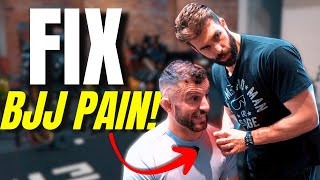
In this instructional video, a coach works with Chris, an elite jiu‑jitsu athlete, to assess and rehabilitate his shoulder and back injuries. The session begins with a flexibility test (toe‑touch and backbend) to illustrate the concept of "antithesis"—unlocking range by opening the opposite, constrained tissue. The coach prescribes high‑volume back‑bends, core‑focused kettlebell counter‑balance squats, and a series of mid‑back and abdominal activation drills using a stick and belly‑button draw‑in. After identifying sharp pain in the supraspinatus during light dumbbell presses, the coach introduces the "Locke Big 3" shoulder mobility sequence, emphasizing controlled external rotation and wrist‑to‑elbow peeling. The routine progresses to shoulder hygiene work: hangs, weighted‑stick dislocates, and shoulder extension drills, noting biceps or pec limitations. Throughout, the coach stresses neuromuscular priming, pattern retraining (hip‑hinge vs. back‑dominant movement), and integrates these mobility drills into jiu‑jitsu specific positions. The video concludes with a concise warm‑up protocol—back‑bends, hip hinges, Locke Big 3, peel, and plank‑Y‑raise—designed to build pain‑free performance.
Chapters
In the previous video, I assessed Chris, an elite jiu-jitsu athlete who has injuries and limitations affecting his performance. Today, I show Chris how to rehab his shoulder and back and become pain and injury free.
That feels much better.
I want you to reach down so we look at your flexibility because this will— nice little test, a nice little hack. Reach down, touch your toes. All right, so he's not touching his toes. We can see that. All right, now, so hands on hips, we're gonna do a backbend. We're gonna do 20, keeping those legs stiff. 1, and just move through it as you feel. 2, 16, 17. Good. 20. All right, let's do the test again. Let's reach down, let's get the cameraman. All right, where We're touching our toes.
I don't think I've ever touched my toes from standing.
And we did no stretching, right? We did no stretching. So we've basically—
I've never done that.
Yeah, we've unlocked the antithesis. So, so is there— this is where we look, working on nervous system as well, right? So yeah, we're using antithesis. We always think it's from the hamstrings that are stretched, but if we get the opposing things that are constrained, which for you it's your back right now, if we open up your back and work the right muscle group, all of a sudden we open up that end range.
That is a huge win, even just that in itself.
Yeah. So your prescription of this is you're going to do back bends 3 sets upon wake. So like, do it in the AM. And I'm not sure if you train twice a day or you're, you know, rolling twice a day, which you probably are. So like, let's say your morning— your morning clients. Yeah, you do 20, right? You want to do 3 sets, or before you start training people. And then when you get back to the gym, you do another, or before bed. Just— you just need to get them done. Volume is going to be your friend. The next thing is we're just going to get your abs working. So I'm going to use a kettlebell. You're going to grab this upside down like so, and you're going to push it away from your body Like, yeah, is that all right?
Yep.
Yep. Now I want you to squat for me. So this is a counterbalance squat. Yep. And really what I want you to do is really focus on your core, because that's what we're, we're really working on. This is getting that nice and tight, nice and tight. Good. So 2, nice and slow. This is not as much about the legs as about the glutes and getting this core working. Really want your abs working. We're going to pair this. I want you on the floor, and we're going to do something for your mid-back. Bring your hands up above your head. Yep, that looks okay. All right, now I want you to put this stick in your hands here, and I'm going to get you to turn it out and bring your hands a little wider, a little wider, so you're holding it in like a wide position. Now imagine you're holding it like a gun with your fingers there. Okay, great. Now what I want you to do is bring your belly button up to suck your belly button in. Yeah, but your bum stays down, right? So you're going to squeeze your glutes, suck your belly button in. I'm going to put 60 seconds on the clock and let's see if you can hold it. Okay, so now I want you to lift this up, keeping this there. All right, 60 seconds begins now. Great. I want you to straighten your arms as much as you can. Keep that belly button on. Good. Bring your belly button up. Should feel it all through here. Good, and time. That's it. Oh man, how'd that one feel?
That was so much harder than I was thinking it was going to be.
In this position now, let's go into a plank. When we do a plank, to make it easy, we go super narrow. You're doing the easiest form of plank there is. Like this? That's the easiest way to do it. I don't like anything that's easy. Oh, so let's get your hands away. Yeah, feet away as well. That's much better right now. This is much better. Now when you make a fist Now I want you to bring your hips right up so you've got your tailbone. I want you to hide your tailbone. So there, that's it. Now lock your legs out, squeeze your bum. I'm gonna put the timer on. Draw your belly button into your spine. Draw your belly button into your spine. Good. If I was going to push you, this should be— you should be nice and, nice and stable. Nice. Don't— everything should be flexed. Everything. And time. And back to the floor. So wider with your hands. So what we're going to do now is I'm going to get your back warmed up and get your abs warmed up, right? So both. So yep, now we go again. I've got that 60 seconds on and that same position, right? So I call this gymnast position, is I want that there. So belly button up and reach as far as you can. Oh, there we go. It's opening up. Belly button in, belly button in. And we'll call it there because those arms are bending way too much. Oh man. Right, so we've got about 40 seconds on there. Now, what's something that would cause pain for you in that shoulder?
I'm assuming a push-up, a push-up motion.
Let's just do, let's just do like on your knees. So do it super light and just tell me, just because I want to see it, have it, have a test of something that hurts and then something that doesn't hurt.
So like now that feels fine.
Yeah. So that, that's okay?
That's okay. Yeah, for now. Yeah, usually it's when I'm cold It's a little bit sore and tender, right? But then I think once I warm up, even on the mats, it feels okay.
Okay, just like do a set of dumbbells and just tell me, like, go light. I don't like— something that would hurt, but don't make the hurt go to a 10, obviously. Just something that— something that you're going to do so I can see when— do the exercises with you and then see if that recreates the pain. That hurts a little bit, doing—
yeah.
Okay. Um, what about a press with dumbbells?
Yeah, like that.
Yeah, that. Okay, perfect.
And I feel it just on the tip of the front.
It's like a real sharp— there.
Okay, like just that little—
yep. Okay, so that is probably your supraspinatus. So if I— in here, we saw— yeah, right in there. That's really sore.
Uh, it feels like it's a bit deeper than that, but that's like the start of There, there.
Oh yeah, right in there, right? Whatever that is. Super smart. It's been in there, it's not sore at all. So I can really get in there, it's fine. Okay, so we're gonna do another exercise from my good friend Andrew Locke. All these— have you done these before?
Uh, what are they?
No, this is the Locke Big 3. When you do it, what I want is imagine you're on a sheet of ice, and if you crack the ice, you go into the cold freezing water. So you bring it up and then you bring it down slow. So you don't crack the ice, don't crack the ice. 2, got 10 reps. If you can, can you straighten this wrist a bit more? Uh, as in extend it that way, like that? Yeah, exactly. 7, where are you feeling that?
Yeah, the back of the shoulders, but in a good way.
8, all through there. Yep, yep, up nice and high. 10. All right, bring it to your sides. 1, lock out, try and lock out the triceps as best you can. 2, 10. Now flip the hands the other way, palms up. Yep, get nice and close. And last 10 here. 1, 2, keep your arms nice and straight. 9, one more. 10, excellent. Bring your hands here in a T position, right? So head down again, and I'm going to get you elbow there. Elbow's in line, so when your elbow's in line with shoulder like that. Now we're going to do this one, which is— I really like this one. You're going to go fingers, so fingers peel off, all your fingers are off, then peel off your wrists. So peel off the wrists, peel this off, peel this off, and then peel up your elbows and hold. So a little higher there. So start again. And so we're going to peel. So you want to go fingers, wrists, forearms, elbows up nice and high. Hold that. 1, 2, 3, come back down. Because I want, I want the wrist to be as high as possible to be really using all of this, getting to that external rotation. Hold and back down. Feel it?
Yeah.
Peel, peel, peel, peel, peel. Excellent. Hold and relax. How'd that feel?
Again, a lot harder, but that felt great. Really good on the shoulders.
Yep.
All along the back. Like, yeah, that feels nice.
All right. Can we just have a look at, you know, how you did that before?
Yeah. Yeah.
Because what I do here is I use it as a control test, right? Yeah.
That feels much better.
What was the pain?
Like right here at the front of the shoulder. Yeah, but like, I know it's still there, but it's not as—
What did it go from? So sit up. So what, what was the pain at and what is it at now?
So after those first few reps, maybe like a 5, 6.
Now it's like a 1. All right, so we went from 5, 6.
I couldn't do the reps before. As in like, I'm pushing through something bad.
So the reason why I like doing like this is it tells us and informs us and saying, yes, we're on the right track. Yeah, because I was saying before, we have neuromuscular, and that's what we're doing. We're, we're priming the body to use the correct muscles when we're doing the exercise. Training is about getting you to perform. So yes, we could get you stronger with the movements that you have, but the problem with that is that if there's inefficiencies in those movements, you're gonna— the constraint is gonna be injury, as in the limitation, the ceiling of that is gonna be based off the joint. At the moment, your hinge is very inefficient because using your back. So what you're gonna do for this, to learn this one, is Hands on knees, and it's just getting that neuromuscular happening and just basically extending. So reach down but stick your butt up to the air. That's it. And just do 20 reps. So, and try and reach down a little bit further each time you go. But really, like I can see here, you don't elongate. I really want you to elongate through the hips. So when you get used to that pattern, so instead of your default being that you come from the back, or the default be that you come from the hips. Exactly, exactly. So we just need to train this into you. To begin with, with no load, just as a pattern that I want you to start to really establish that when you bend, you move through the hips. When we're doing the back bend is we're shifting the vertebra disc space and creating more space from the— because we don't bulge a disc when we're here, we bulge the disc when we're here, right? Because that's where the disc is shifting forward. Yeah. What this one on the flip side is teaching you is the pattern of how to extend your hips. So when you do, everything is nice and safe. Stabilized rather. I always like when someone has a shoulder injury and part of shoulder hygiene is I always like to include a hang. What I mean by shoulder hygiene is things just to keep— if you, if you do these certain things, it'll keep the shoulder healthy, right? A lot of things run through the shoulder capsule— your tricep, your bicep, your lat. So when we do have a shoulder issue or dysfunction, it's not always just external rotations that are the issue. It could be another one of the, the muscles that a tendon that is pulling where it shouldn't be. So I like this one. Because what we're doing is we're opening up the shoulder capsule completely. And when we do it, we don't want to be passive about it. See my feet, I'm trying to pull my feet down to the floor. And I'm not here, would notice I'm pulling myself forward and pushing myself down. So you kind of want to try and almost like your lats well, not almost, your lats will be in a very much a stretched position. Where do you feel it?
Um, hands.
Good.
And lats.
Fantastic. Don't rotate your pelvis back, rotate your pelvis forward. So I also want you to try and stack your ribs on top of your pelvis. So the pelvis— yeah, exactly right. So it's almost like, you know how we did the plank? Yeah. You need to be in the plank position while you're hanging, which is also good for you because jiu-jitsu requires A lot of grip strength.
I think that's it.
Well, I had a minute on, right?
Oh, sorry.
Yeah, so you were like a second away from a minute.
Ah, okay. Yeah, I was here.
Forearms too. Good, perfect. So what you want to think of this is everything we're doing, we're trying to lead to something and progress it, right? So I think for jiu-jitsu, one of the mobility exercises that I, I think would be really great to include— but again, it's going to be hard for you right now, but it's something we can definitely work towards is the weighted stick dislocate, right? So the weighted stick dislocate, as you can see here, is I'm bringing this all the way through, full grip here, and all the way back. Now we can definitely add weight to this, and as we warm up— so you've got to look, a lot of really good things happen when I do this. So getting full articulation, but I'm also bringing that bicep through the shoulder. So I'm going through shoulder flexion and extension and bringing that bicep along for the ride with me. You won't be able to do this based on your arms, but if you think of it like this, right, when we're doing this stuff on the floor, we're introducing shoulder extension as we do it. So there's a lot of things that can lead to this. And also when we're getting this strength through above, we're starting to create that distance. So everything we're doing, we're going to be stacking.
Yeah.
So you're not going to do the full thing, just— we're just going to see when it starts to break down. So go, just don't go any further. Yep, there. Cool. That's where you'd probably say you're at. Yeah, yeah, I can't—
yeah, unless I change something.
Yeah, unless you get wider. So biceps are limitation?
Yeah. Is that what it would be?
What do you feel? Where is it feeling?
In the middle of my back.
Oh, the back weakness.
Yeah.
And we're going to do shoulder extension, right? So now I want you to bring it up above you. So let's have a look at where you're at without tilting forward, without tilting forward. So go wider on your hands if you need to. That's it. And get into that. Yeah, exactly that Uh, shoulder. Bad pain?
No, like if I push, maybe.
It's through here?
Oh yeah, through there. And my left pec.
So we're not, we're not where we want to be. Left pec is the stretch-off because they're torn. Yeah, yeah. The reason I want to show you that is that is a progression, which I just want to kind of like plant the seed. But eventually you'll be able to get there by doing things on the floor, because on the floor you're doing a regressed version, right? On the floor you're doing shoulder extension with the dumbbells, like on the Big 3. Yeah, that's where we're going to start.
So how high can you—
you should be able to go quite Well, you should be able to weight it, right? So you want to be here. Oh, whoa.
And where am I getting to?
Like, you're like, you're barely compensating and you're like, you're really jacked up. So yeah, again, the limitation there for a lot of people will actually be the bicep, could be the pec. Well, depending on the person, right?
Yeah.
But we want to be able to be in this position. Yeah.
Without like falling apart.
And I think like for you in jiu-jitsu, right, there's other movements that like you know, the manta or the table, right? So like if you're in this position, you're able to fully extend through the hips and like put some pressure on that bicep and go through. I'm not going to get you to do those things now, but I think it's jiu-jitsu the whole time where balled up. Yeah, but being— having that ability, that range of motion, you can obviously see like you're healthy through all those ranges of motion. Yeah, it's going to make less painful. Correct.
Yeah.
Your warm-ups If you think of it like this, you've got— and the more proficient you become at this, the faster you're going to move through it, right? So you've got like your 20 back bends paired with your hip hinges, right? So what we're doing here is we're just loosening up the back and we're getting to that pattern where we're just going to be relying more on the glutes. So you pair back, back, boom, boom, boom. You don't need any rest between. Then you go straight into the big 3. Yeah, big 3, um, 10, 10, 10, and then 8 reps with the peel, and then pairing the plank with the Y-raise on stick.
Yes, so we've got to stick at the gym as well, so that's great.
If you've enjoyed this video, click here or here.










