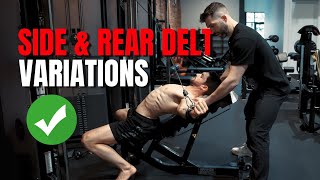
In this instructional video, the trainer walks through a comprehensive series of side‑deltoid and rear‑deltoid exercises, demonstrating each with a model named Jason. The session begins with the often‑overlooked mermaid raise performed on the floor, then moves through multiple standing lateral‑raise variations—including staggered stance, offset‑grip, and hand‑placement tweaks—to fine‑tune the arm’s adduction path and tension. Seated and bench‑based lateral raises on a 45° incline are shown to eliminate back strain and maximize pelvic stability. The tutorial then shifts to rear‑deltoid work, using an incline‑bench position, angle adjustments, and lever‑arm changes to target the posterior deltoid more effectively. A detailed discussion follows on resistance‑profile mismatches between dumbbells and cables, introducing a hybrid hook device that equalizes tension throughout the range of motion. The trainer demonstrates the hybrid hook for both side‑raise and rear‑deltoid movements, adds a lean‑away side raise for constant difficulty, and incorporates wrist straps for cable rear‑deltoid work, emphasizing hand positioning and thoracic extension. Throughout, the trainer offers cueing, safety tips, and progression ideas, concluding with a call‑to‑action for viewers to subscribe for more “superhuman” training content.
Chapters
In this video, I'm going to show you all of the variations to side delts and rear delts. I've got Jason here who's going to be demonstrating. We're going to start with the mermaid raise. So it's on the floor. This is often an overlooked but a fantastic exercise. Jason, take a seat on the floor. This is a mermaid raise. So Jason is in the mermaid position where his feet are straight in front. He's going to be grabbing the dumbbells. Now, you may not have seen this exercise before, but this is a beauty that's going to work your side delt. So You can see he's raising here. Now, if I want to make this a little harder, what I can do is I'm going to push him forward, push him forward, keep your chest up, Jason, for me. So arch your back more, stop for a sec, bring it down and pull yourself forward. There, his hamstrings are a little tight. So if you want to bend your knees for us, right, and then bring yourself forward. Now go. So in this position, you can see Jason's delts working quite nicely. So I like this exercise for people who rock maybe their lateral delt as much. This is really going to be looking at the side delt, kind of an idiot-proof way to do side delt. So Standing up, Jason. The next variation is the one you've probably seen a lot of, which is the standing lateral raise. So if you want to grab those, Jason, you're going to do a lateral raise with the dumbbells. And pretty standard, this is how most people will do their lateral raise. And obviously there's a seated variation. Now on this, I like a staggered stance. So put one foot in front of the other. So there you go. And what this is going to allow you to do is get on a 45, yeah, a little more of an axis there. So that's where we are. Now, if you're wondering how far to come out, right? You know, do you come perfectly to the side? Do you come a little bit into the front? An easy way to kind of identify this, right? Is we look at Jason's shoulder. We can see 'cause he's quite nice and lean, right? So we look at the lateral delt. So his lateral delt is here. So Jason, all I want you to imagine is I want you to adduct the arm just from here. So as you do that, yeah, you're gonna come a little bit more forward. So that would be your perfect range, right? So bring it down. Let's do both at the same time now. Bring and shorten that in. So that's where we want you. Now the other thing is what a little hack for people is, I like to use an offset grip and he's already kind of there, but I'm going to really get him to jam his hands right into there so the weight naturally tilts forward. What that's going to do is just enhance the feeling and the tension, the lever point of the dumbbell when he does this. So obviously the further out his arms are in front of him, the more his shoulders are going to have to work. So off you go, Jason. So now he's using a little bit of an offset grip, which will just enhance the feeling, enhance the tension point of that lateral raise just a little more, right? So another thing I like to do with clients if I'm training them is I put my hands just at their thighs so they've got constant tension as they come down. That's really nice. He's got his traps nice and soft and he's really using the lateral delt there. Okay, Jason, now we're going to sit down just behind you. Now I've set up the dumbbell. Grab those, grab those and sit down just behind you. I've set up the bench purposely like that on a 45-degree angle because what I want is his pelvis to shift so he's locked in position. So sitting up, Jason, sitting up, and pelvis there. Now dumbbells beside you. Now do the raise. So Jason did have before on the floor a little struggle getting into the position that I wanted him to, which was I wanted him to tilt forward. As you can see, with the bench at this angle, his pelvis fits nicely and his back— there's no tension in his back now as well. Probably feels really comfortable for you too as well, Jason. You can see, get the nod of approval too. So this is where now I can pull him forward, right, in this position, relatively easy, and I haven't got any of the restrictions that I once had. So this back now, which was a factor in the exercise, and I think he's loving this right now because this is, out of everything we've done so far, mechanically where we're at right now. I don't know if you can see it on the video, but this is where he's probably working the most he's dealt so far. But we've got a heap more variations to show you. So relax there, Jason. I don't want to fatigue you too far. Now let's start looking into how we're going to do some of our rear delts. This is pretty much perfectly set up. So what I'm going to do is, Jason, grab the dumbbells again. We're using dumbbells still, and I want your chest to the bench, and you're going to do almost exactly the same thing as you were doing. Let's get your knees on the bench this time. So let's cut out the, the leg completely. So there is absolutely no lower body in this position. There's no back in this position. Let your arms dangle forward Now raise. See, before— that's a good point, right? He had retracted and he was going to use his back. What we're going to do is we're going to let him dangle forward. Now we're going to get him to raise. We don't want to be using our back. That is beautiful. Look at that, right? So in this position, still using the offset grip, you can see now we're getting a lot more rear delt as he comes up. So beautiful, nice and high. Really aim for your ears. Now if we want to even enhance that a little bit more and get even a bit more range of motion, We just changed the incline. So watch this. Relax for a second, Jason. And to enhance that into the rear delts even more so, we've just changed the angle about 5 to 10 degrees. Knees still on the angle. There we go. Now he's going to come up nice and wide. So the cue I use here again, dangle the arms forward first. Now raise. Now reach for me. There you go. Now he's using a lot more rear delt in this position because we've changed the lever arm of the exercise. So no longer is he upright. He's now using a lot more rear delt. Excellent. And just do one more, one more. It's going to say two more, but he's still got heaps to go, so that's nice. All right, relax there. Perfect. Now, one of the issues with using dumbbells is the resistance profile and the strength curve. It's really, really easy from here, but then gets hard all of a sudden at the top. And if we use cables, the reverse is true. It's easy through here and then gets hard easy at the top and hard through that starting point, rather. A way to combat that is to use a simple device. It's called a hybrid hook, and it creates, if we're using dumbbells, a nice even resistance profile throughout the whole exercise. So whereas if we're using the dumbbell, as I said, here easy, cable here it's hard. As we're at the top on the dumbbell, it's nice and all the tension's through here. On the cable, there's no tension there. If we put this on a hybrid hook, which we've got now— Jason, come demonstrate for me a lateral raise— what you'll see is there's an easy— there's— oh, hang on, let's just put that on there so we don't— yep, that's perfect. Um, what you'll see now on this variation is there's an even pull of resistance profile throughout the whole range of motion. So he's getting the benefit of the dumbbell and the resistance profile, and he's also getting the benefit of the, the dumbbell on this, and he's also getting the benefit of the cable. So it's a very, very easy pull. Now let's do the lean away version. So let's lock that arm out, lean away, and all the way through. So this is your lean away side, uh, side lateral raise. How's that one feeling? Good. And you can see it's hard throughout. It's hard at the start. Come up, come up, come up. And he's got heaps of tension at the end. All right, relax. Now you can of course do the same thing here for the rear delt. So into this position, Jason, I want you here grabbing the cable. You can switch arms if you like, and we're going to do the demo with the rear delt using the Hybrid Hook. Now again, of course, you can do this using a cable, you can use this using just the dumbbell, the same principles, but we're going to do it with a Hybrid Hook because it really does offer the most unique resistance profile of all the exercises— so of all the implements, rather. So up we go. Excellent. Now try and keep that there and just use the readout. Up, up, up we go. It's probably a little too much, so chest up. Imagine I'm sitting on your back. That's it. All right, so this is a little heavy for Jason, so we're gonna, we're gonna change it up a little bit, right? So this isn't a great one right now because it's probably offering too much resistance. Not to worry, we have a heap of variations that we're going to we're going to go through. So next variation. So that one does require a bit more strength. Put these on, Jason. These are some wrist wraps— or wrist straps, rather— that we're going to be able to connect you onto the cable. So in this position, you can see I've grabbed both of them and I'm just pulling it back. As a gym owner, I hate when people grab the cables because it bends the cable. That's why I got these, these wrist ones, so people can hook themselves in, really open themselves up, and this will light up both his rear delts and really his upper back as well. There we go. All right, so lying back, Jason, and hitting through that upper back. So pulling in, excellent. And really work those rear delts. And again, we want these wrists in line with the ears. So ears are here, so there we go. Feel that? Good, let's get 8 of these. We'll call that 2, 3, and try and twist that thumb down. So that's it, that's it. Excellent. If you have more on your rear delt, once we change the hand position. So do be mindful of the hand position because it is going to determine where in the back you're going to be working more so. And right now we're really working into those delts. Excellent. Really good. Do one more, one more, one more. But really crank on that end range, really try and stick that thoracic up and get into there. Excellent. If you've enjoyed this video and want more great tips, consider subscribing. Want more videos to learn how to build your superhuman? Click here or here.