Blow Up Your Bench Press Fast (3 Science-Based Steps)
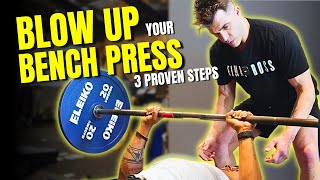
Mark Ottobre from Enterprise Fitness breaks down the bench press into three parts: setup (feet planted, hips back, thoracic extension, mid-width grip), bar path (use chalk to track it), and breathing (deep inhale, hold pressure through the set). He shows why an arced, externally-rotated shoulder position creates stability and flags common mistakes like shoulder protraction and bouncing.
Chapters
In this video, I'm going to be showing you how to do the perfect bench press. Hi, my name is Mark Ottobre. I'm the owner and founder of Enterprise Fitness. I've trained world champions, Commonwealth Games gold medalists, and thousands of people to head-turning results. Before we get into today's video, 90% of you haven't subscribed to my channel. So if you enjoy this video, you want more great tips, click subscribe. It's completely free and you're guaranteed not to miss a thing. In this video on barbell bench press, I'm going to be going over position and setup. Bar path, and breathing techniques. So, Kay, what I want you to do is just— let's see how you do you. Let's see how you do the bench press. And I'm going to start talking through to see and just show you some of the common mistakes that people make, how we can enhance it, and how we want to think about the bench press. His setup is pretty good, and obviously that's what we expect. He is a trainer. Go on, let's have a look at how you press. His setup's not bad, so I'm going to talk about the things that he does really well. So what he's doing really well, he's got a nice arc. Now people often question about, is this arc healthy or is this arc okay? Absolutely it is. It is something that we want to promote and it's something that we want to do. In fact, let's get Kay to just flatten out his back for a second. Now if you can see this, cameraman, as he flattened out, what happened was his shoulders protracted in. As the shoulder's protracted in, go do a bench press for us. You can see here, if he flattens out, now the front delt is working. We don't want that on a bench press because that's instability. That's the front delt working. Go, just do a couple of presses so we can show the folks at home. So you can see that. So this arc is coupled with external rotation. So what he's going to do here is press up again, right? He's getting into thoracic extension in this position. So if I push down, one of the cues that I like, one of my favorite cues on bench press Obviously, if I'm working with a male client, if I'm working with a female client, it's a different cue. But as a male client, I put my hand here and I want him to press against my hand. That really promotes the thoracic extension, that T-spine extension. T-spine is coupled with depression of the lats, and that depression of the lats is coupled with the external rotation, which then creates a really nice stable position. So, okay, try and push your chest up to the bar. If I'm working with a female client, that's the cue that I'll give is push your chest up to the bar. And you can see here how much more stable his shoulders are in that position, and that's because we really are arcing. So when you see an arc on a bench press and you see elite powerlifters getting to this really high arc, it's because it's creating stability. Stability is key for every exercise, and obviously on a bench press, it's absolutely key in making sure our shoulders are stable. I'll get you to, to rack it. All right, now for the newbies who might be watching this, we're going to go over some even more finer points. I'm just going to get you to sit up Right. Sit up for a second. Now imagine you've never done bench press before. You're lying on the bench. Go ahead, lie on the bench. Just want to talk people through some things if they've never done bench press before. Your feet should always be considered. Now, foot position. If you look at an elite bench presser, they may have their feet all the way— I'll show you on this angle— all the way behind their body. Right. And that position is because they have the ability and mobility and strength through the lower back. Now, that's a position that you have to earn. It's not somewhere where people are going to start off from the beginning. So for most folks, a position of putting their feet, just their heel slightly under their foot. Now, one of the cues that I like to use is getting people to really push their heels down into the floor. Now, as we do that, you saw what happened immediately. That action is coupled with that T extension. So you can see how this is a transference of force through the hip. Now he's lifting up his chest. Now let's talk about grip position, because there are a lot of elite powerlifters online who will talk about go very, very wide. As they go very, very wide on a bench press and they talk about this being the ideal way for bench press. Now I'm going to say this is not the ideal way for bench press. It may be the ideal way for some elite bench pressers to go super wide. Just do a couple of reps on the super wide. The reason if you are bench pressing for the sake of bench pressing super wide, the reason why that works is because it shortens the range of motion. But when we consider that, that is bench pressing for the sake of getting better at bench pressing. That's not going to often have the most carryover of strength. Now, if we're an athlete and we're thinking about this more from a hybrid perspective, as to we want the most bang for buck, we want the ability to— for this exercise to cross over to throwing, punching, pushing, we are going to use what's called a biocromial grip. So biocromial grip is really, really easy to find. We're going to be like zombies, put our hands out in front, we're going to grab the bar. So I'm going to get you to do that, okay? Hands out in front, That's where your hands are. You're going to— now that's a bi-chromial grip, right? So this is really nice. Some people look at this as a close grip bench press, but this will have a significant carryover to athletics. When I say athletics, general performance, general doing things that require throwing, jumping, sprinting, that you have a dynamic in nature, not just bench pressing. So for a lot of newbie clients, this is where I like to start, that bi-chromial grip. So Kaye, do a couple of reps for me here. Yes, it is going to be a little bit more enhanced in the tricep. but the setup is going to be absolutely the same, right? So you can see how he's pushing himself up, pushing himself up to the bar. Now, another thing with what you see here, Kaye actually has very long arms. So you can see the range of motion as he does this, bring down, bring down, it's actually longer. So folks who have shorter arms always going to be stronger on the bench press because there's less range of motion. But this also means that Kaye is going to develop strength very, very well through a full range of motion here. So Kay's starting to lose it on the chest a little bit. So I'm just going to cue you. Perfect. Perfect. And push those heels down, push those heels down. And that's another thing that you just saw during the exercise. You shouldn't be moving your feet in different positions. Your feet should be planted the whole time. In fact, you're pressing your heels down. And the only difference between your warm-up weight and the working weight is the speed of the bar. So come back, come in. So that means if I put Kay up to his max weight, it would look exactly the same as his warm-up. The only difference is there'd be a bit of grind at the top, it'd be a little bit slower. And that's another thing, as people struggle on the bench press, right? I need you to do this again. So I just want you to pretend you're going on this and struggling, okay? So you come down and what a lot of people do is they hit a resistance, they struggle, and then just protract for me. They do this, right? They push their shoulders forward and they change their technique. It is the worst thing you could possibly do on the bench press, right? So instead, when you're doing this, actually stay in position, right? Let's just pretend that he's got his max weight on there. I know for Kay, probably be at 160 kilos. He's coming down, he's coming down. Now as he pushes up, push up, push up, right? He keeps that technique. So the cue that I use in that position is heels down, chest up, and really getting that thoracic extension to make sure everything is super locked in and super stable. And this is where obviously a spotter is very helpful because if he doesn't get it, we've got the face savers there. We can grab it. So putting it back safely. I'm going to show you a little trick that I use with newbie clients just to help them start thinking about bar path. To do this, I need chalk. I'll be right back in one sec. What we can do to help clients— I'm just going to put a little bit of weight on this for Kay, just a little bit, so there's a little bit of feedback. Hop up for one sec, just hop up. Now what I'm going to do is I'm going to chalk this bar, right? So I'm chalking the, the mid of the bar because what we're going to do here is we're going to look at Kay's bar path, right? He's going to do 5 reps for me. Now, if he bench presses well and has accuracy and precision in his lift— and that's the thing you got to think about bench press, right? A deadlift doesn't require as much accuracy. Yes, you need to be in the right position, but you can have a bit of grunt. Like a sumo deadlift, different story. You do need to have a high amount of accuracy. But when we look at the arousal curve, when we're approaching a bench press, we don't want to be too hyped up because there is a high degree of accuracy that we want to accomplish when we're doing a bench press. So what that means is that if I grab the bar and I bring it down really, really fast and chuck it up where that bar path goes, if I miss my bar path, it's very unlikely I'm going to be getting it up at a max weight. The other thing we need to consider is if someone comes down on a bench press with speed, the velo— they're actually creating more velocity. So if I come down fast and I create velocity on the way down, I need more strength to overcome that velocity. This again is when you look at elite bench pressers, they will bring the bar down very slow, very controlled, and then power it up. There shouldn't be any bouncing whatsoever on a bench press. It will make you weaker long term. So I'm going to get Kaye to do this. We're going to do 5 reps and we're going to see and we're going to look at— so when we talk about bar path, we're going to look at Kaye's bar path and we're going to objectify it very well using this technique here. So to emphasize the bar path to really make sure that we're accurate with Kaye. I'm going to talk about 3 major points. First, I want his heels nice and hard into the floor. I want his hips pushed into the bench. And I want his chest up nice and high to my hand. I'm just cueing him, I'm putting a little bit of pressure on his chest. So he gets that really high T extension. Alright, now when you're ready, Kaye, breathe through your nose. Fill your body up with air. We'll talk about breath a bit later. Come up. Now bring that bar to your chest. Bring that bar to your chest. Good. And just bench the way you would bench. Bring that bar to your chest. Think about those 3 things we spoke about. Bar to your chest. 2, power up. 3, bar to your chest. 4 and 5. Okay, rack it. Now, okay, sits up. We have about Oh, it's probably about 4 different lines on his chest that we have there. So he's not accurate, right? He's not accurate at where we're at right now. So obviously this is still a lightweight. He's not getting the feedback. We can go up a little bit. We're going to talk about breath in a sec. But you can see using this technique that his bar path isn't perfect. So when we are using heavier weights, this is again another consideration. We want to get the bar path dialed in. We want it to look the same every single time. What I'm going to do, I'm going to get Kaye to dust himself off. Get rid of all that chalk. I am going to put a little bit more weight on the bar for you because having a bit more feedback will help you get into a better position. Now we're not going massively heavy and this is still very far away from a working weight for Kaye. Kaye's a strong dude. People ask all the time about breathing on a bench press and the answer is, how do you breathe? Actually, you want to hold your breath on a bench press for multiple reasons and I'll explain why, right? So if Kaye, just get into position, this is light enough for you. I'm going to get you to do a couple of reps, and I want to show the folks at home. I want you to just breathe. So, so come out, you're going to lift up, you're just going to, as you do it, breathe out and breathe in. And pay particularly close attention to Kay's upper body, his back more specifically, and what happens at his chest. So just breathe, not holding your breath. So, and breathe, breathe out. Okay, cool. So that's enough, that's 2. So what we saw then, right, for the, for the non-initiated what we saw then, I'll explain, is this was moving. And if his torso is moving, it means his scap is moving, which also means that he's less stable. Now, we spoke about stability being one of the key factors in strength. So we want stability, we want to have the movement pattern, and then we're able to express strength. And then from that strength, we're able to perform. We always need to think about it like this. So when we're setting up a bench press, what we're going to do is Kay's going to get into position. So get into position as you would. And then the last step is once we're in position, Kay, I'm going to get you to take a really super deep breath in through your nose and fill your whole body up with air. So I'm going to get you to relax and you're going to do it again, right? Because I just, I really want that air. And then we're going to do a set and I want you to hold your breath for all 5 reps. Okay, so ready? Ready? Good. Hold up. Okay, now bring your chest up. Hold that breath. Heels down, heels down, heels down, heels down, heels down. Good. As soon as you touch, I want you to come back up. As soon as you touch, bang. Good, that's it. Control, control, control, control. Up. Good. One more. Control, control, control. Up. Good. And you can see less lines on his, on his shirt as well. Sit-ups. Show the folks at home that line was actually there before this bottom one here was before, he had almost the same bar path every single time when we use that technique and controlled for his breath. That's all we did was we controlled for his breath. And by controlling for his breath, we made him more stable and you would have noticed the bar actually moved faster then as well. Again, you may not be knowing these things if you're new to bench pressing and new to training. But if we compared the first exercise, the first way he did it where his breath wasn't controlled for and hold, held, to the second time where I got him to hold his breath, it was much easier. And the reason it was easier is because he was more stable. So to summarize, the 3 main points for bench pressing that you want to take away from this video is: 1, ensure that your setup is correct. We spoke about heels, hips, T-extension, that thoracic extension. So ensure you do that and use a close grip if you are a newbie. The second point is consider bar path. Where is the bar path? Where is the bar moving? And third and final point is ensure that you take that deep breath in through your nose and hold really tight to increase stability. Folks, if you have enjoyed this video, please subscribe to our channel for more in-depth look at exercise breakdowns and how you can build your superhuman. Train hard, eat well, and supplement smart.










