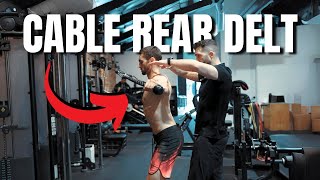
Four cable rear delt fly variations that isolate the shoulder and minimize back involvement. The rope version emphasizes scapular protraction and a high arm path to ear height. The all-fours version eliminates lower-back strain while keeping the same arm trajectory.
Chapters
In this video, we're going to be showing you how to do cable rear delts and some variations to boot. So I've got Jason here, he's going to be demonstrating. Jason, demonstrate for us the standard way most people will do a cable rear delt. So he's going to grab the cables. Most people use this handle and extension as they do it. They're in this position, and you can already see Jason's very lean right now, so you can see that there's a lot of involvement through the back. Which isn't really what we want, right? We don't want this back involvement. We really want there to be the rear delt. Okay, the rear delts are working, as you can see, but there is a lot of back involvement. So we're going to get him to relax, and I'm going to show you how to optimize this now. So firstly, we're going to get rid of these attachments. That's the first thing. And we are going to pop on ropes, and I'm going to put the ropes on for Jason like so. And I'm going to talk you through it, Jason. So I want you in this position, but also when we're here, I want you in a protracted position. So we're moving through in protraction using the rear delt, not in retraction. So, and you'll see it on Jason because he's super lean. You saw where his back was on this one, and now you'll see where his back will be on this one. So really, really protract. That's it. That protraction, just for the viewers at home, imagine I put my— well, don't imagine, I'm putting my hand in the middle of Jason's chest and he's hollowing his chest out. So he's in this position here, right? And he's, he's lats wrapping around his spine. So off you go, Jason. And keeping that projected position as you move through, keeping that projected position. So think of your chest up, keep, keep spread. So it's only the delt. There you go. And a little higher. So that's the other thing, people often come pretty low with their rear delts. We want you a little higher. So when people come low down to here, we start to use our back a lot more in our mid-back. With really, with the readouts, you want to either come just below ear height or on ear height. So I always get people to go a little higher. That way we're in the safe zone of really working those readouts. And keep protracted, keep protracted, keep protracted. I'm pulling his shoulder blades apart so he stays. It's just the readouts that move. It's just the readouts that move. Protract, protract, protract, and just use those readouts. It's a lot harder for him now. It's the same weight, but it's a lot harder. I'm keeping his back fixed. You can see now as he goes through, he's using a lot more rear delt. So that's a variation that I like. I'm going to give him a rest for a bit. You can see they're really working now. He's still trying to use his back as he does it. So that's variation 1 of rear delt that I like. Another variation using the cable, and often I always get people in that pronated position, not a neutral position, to really maximize the delt. Now this, you're going to need to get a little bit of distance away from the machine, Jason, but I'm going to have you here, your arm stiff, Again, I don't want you to go into the lat. I really want you to be aiming for that ear as you come out here and pause it. So give that a go. Let's do 6 reps. And when you're in this position, you really want to have your hips up and super, super high, right? So once I— what I do with a lot of clients is I stand where I want their hand to be guided. So I'm standing here, Try and kind of like whack me in the balls with your hands. There you go, perfect, that's it. And stay in that protracted position. And you can see that rear delt really lengthening, shortening. And as Jason's very lean, you can see that rear delt working really, really nicely. Shorten, shorten, shorten, shorten, shorten. And also stick your chest up as you do it. There you go. And shorten, pull it in, pull it in, pull it in. Beautiful, good. Pull yourself in as you do it. Pull yourself in so all of this shortens. There you go, there you go. It's a lot harder now, but it's a lot more isolated. We'll just do one more. Shorten it all the way in. The more we can shorten, the better. Beautiful, excellent. How's that feeling, Reid? All right, last variation. You can use the other arm. This variation, again, with every exercise, we want to create stability. Stability is going to allow us less movement of anything. So if people are or you're struggling to maintain in this position, you can do the exact same thing, but on all fours. So we're going to be in this position here and same movement, but we're coming through and this variation bypasses that lower back because that lower back is going to be super, super stable. So Jason in position, you can do with the other hand. Same principles though, his arm is going to be moving in the same direction. in line with his ear. That's it. Out to my hand again. If I'm working with a client, aim for my hand, Jason. Aim for my hand. Good. There we go. Stretch. Now shorten short and short and short and short and short and short and shorter. Good. And try and keep that arm, that lever arm long. So he's trying to bend it a little bit. Now chest up a little more. That way we create some distance. That's it. Create some distance with your chest up. That way you're not hitting the floor. Keep that lever arm long, chest up as you pull. Good. And again, let's get a couple more from there, from there, from there. Good. And again. And out to my hand here, out to my hand here. Good. So you can see again, the mistake people make is as he does it, he wants to go where he's strong. I'm trying to keep him out here. That's where I want him, in line with his ear. Really get that readout working. So Hand in line with the ear. Up, up, up, up. Excellent. And it's good that we're not showing you perfect from straight away. He's, he's cooked on that one. And relax. Um, it's good we're not showing you perfection straight away. That way you can see the common mistakes that you might be making and correct them in your own training. If you've enjoyed this tutorial and this demo, want more great videos just like this, consider subscribing.