Deadlift - Behind the scenes at the Elite Results Bootcamp
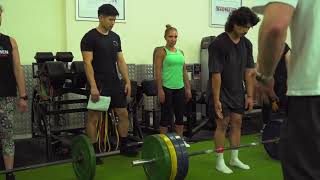
Mark Ottobre coaches deadlift technique at Elite Results Bootcamp, emphasizing hand position over foot placement and posterior pelvic tilt. He uses cues like "sternum up" instead of "chest up" for thoracic stability, and a micro-pause technique—lifting a millimeter off the floor and pausing two seconds—to refine motor patterns.
Chapters
So look at his setup.
Something paramount that he does in his setup that's fundamental to the way he moves— actually, Patrick, stay there, right? Just go into the same position. All right, what do we notice about this? I don't think it's a front lift either if you're going to be upright. Yep, even more foundational than that. Foot placement. Foot placement. All right, what do we notice about their foot placement? Yeah, you can relax for a sec. Okay, so the thing with the deadlift is that your hand position and you've got a beautiful setup, your hand position always takes precedent over your foot position. So here, what's happening is— can you set up for us? Set up, grab the bar. Your knees are actually knocking into your arms, right? So it's inefficient. So what I'm going to get you to do from the get-go, because when we see this, the first thing we're going to do, we're going to get to narrow that stance because we don't want to be— the knees should— they're not going to— you're not forcing the knees out on a deadlift. But you can see that in this stance, the knees are hitting the arms, which is going to create inefficiencies when the load starts to get heavy. So go ahead and do a couple reps, just do 3 reps. That's a lot better. We see that a lot being more efficient. So I'm going to refer to the lift as inefficient and efficient. So the lift, you can already see from that small change that we've made, you see how the lift is more efficient now. That was a very small change, change of foot placement, and she's already looking a lot better. All right, can we put 100 kilos on the bar, please?
All right.
Yeah, that's fine.
What's your max?
It was like a while ago, before the surgery, it was 195. Let's grab him a yellow. Can you grab 2 yellows? I've got another yellow. Let's go 130. All right, let's work on this deadlift while they do that.
Let's do another rep.
Give, give me 2 reps. All right, so perfect. We talk about the lift in terms of efficiency and inefficient. What are some things that could be improved? What are we noticing about this deadlift? We'll go heavier in a minute so we can see more of it, but can anyone see what's happening in this deadlift? Because that's an elite deadlift. It's a good deadlift. It's not an elite deadlift. Just one more rep. So I'm going to look at what she's doing. You do your rep so they can see the difference. That is one rep. What's the difference? When she's going here, her knees are tipping forward to support her. Her knees are tipping forward. What's that another way to say? It's another way to say that. Losing—
correct.
Yes, it's going to come out. Look at the efficiency. Don't lift, just set up.
Set something.
See the tightness? Do you see the tightness that he gets in? Okay, elongated arms. His hips— so I was saying to you two about before, his arms feel elongated, so he has to force himself into position. He's pushing up from his sternum, so his lower back is nice and contracted. You can feel it shaking. He's rounded through his thoracic, right, which is perfect. And his hips, for his levers— and this is where the debate comes in, do you need to lift this vertical machine? I don't think you need to lift necessarily to build a perfect vertical machine, especially on setup. It can't help, but it's more about that hip position and those hamstrings being pulled back to be able to exert force. And you can see in his position when he sets up, there is no— there's no energy leak in his setup, if that makes sense. Everything is stable, he's not— everything is purposeful. He reaches for the bar, he extends his hips, he's not breaking his arms and then lifting. And as a consequence, when he lifts, his center of mass— the bar moves into his center of mass, so it lifts very efficiently. If you look over here, we're not getting as stable. So when the bar lifts, it's creating— not quite, because if we go up, you'll definitely see it— it's creating a little bit of an S momentum, as in she lifts, but if this is her body, the bar comes out, then it comes in. You're not seeing it because the weight is light, she's getting away with it. She's lifting on a vertical vector. He's lifting the bar into his center of mass and moving the bar backwards if that makes sense. So if he goes onto this bar and he's pulling and it's not calibrated, the weight is going to shift forward, then it's going to move back, which creates inefficiency. Instead, the way you see him set up, he gets all the carriages elongated, he pulls the slack out of the bar, then he lifts.
Let's do one more.
Oh, great.
Just one rep. Great.
Spot on. Beautiful. Okay, what did you see differently? Is it A? Is it What does he do at the start of the swing? He doesn't roll his shoulder blades back, he does activate his lats. Because rolling your shoulders back would be this, that'd be thoracic extension, which is the opposite of here. So do what you do because I want to talk him through it. Yeah, just do it, you don't have to explain. So what he's doing is just perfect, pause every second. He's pointing, he sets up exactly like that. Wrong. He's pointing down, right? Everyone just try that. Everyone just point down to the floor as hard as you can. Point down to the floor. Stand up. Don't be leaning on something to do this. Point down. Okay, some of you don't, uh, doing it quite— so what I want you to do, give me a deadlift stand. Stand your deadlift stance. Okay, so fundamentals of deadlifting. And if you want to step back so you're not partway into what we're saying, you want to get yourself in Depth of stance. So what did we say before? What was it? The one tweak I gave before? Okay, right. So we're setting up and you're not a sumo— we're not doing sumo at the moment, so I respect that some of you have sumo lifted, which is fine. I'm not doing sumo, so just entertain the conventional lift for a second. I want it in line with your pelvis. Your pelvis ain't that wide, dude. Close it.
Yeah, right.
So Okay, ground your feet. Now I just want you to close your eyes for a second and just rock back and forth. Close your eyes, rock back and forth. Alright, feel your heels, put all the weight on your heels, feel what it feels like. Rock forward, put all the weight on top of your, on the balls of your feet and find the center point. Great, now that you've found the center point, I want you to dig your heels into the floor. I can't do that. Okay, great, you can open your eyes. Now look where I go with this. Posterior pelvic tilt. Can everyone do that? Posterior pelvic tilt. Push your hips out as far as you can. Stick your ass back. Stick your ass back as far as you can. Pull your hips in as hard as you can. Push your ass back. Some of you guys are doing this. It's your hips. Yeah, swivel your hips. Ass back, tuck the tailbone under. Just your ass back, tuck the tailbone under. Can I just grab you on the floor for a second? Yeah, you. Skeletal picture. Right, get into a plank position. I just want to show the folks. Some of you are looking at me with blank faces. Uh, wide on your legs, thanks. Okay.
Anterior—
oh, sorry, posterior. We want our hips to be here. The way you're going to find this position is like this. So here's $1,000 in his butt cheeks. I want you to squeeze your butt cheeks as hard as you can. Does this feel like a different plane? This is where your hips should be. Lock your legs out. Lock your legs out. So this, if he sticks his ass out— do the other way— that is wrong, incorrect. We don't want to be there. We want to be here, right? Flex your ass cheeks. Imagine there's $1,000 in your ass cheeks. You find it? Now, the stability aspect, if I do this, you shouldn't move. Don't move.
Don't move.
Move. Don't move. Move.
Up a little higher.
Don't move. Right.
Move around a bit.
Watch the way he sets up. Just set up, don't even lift. Don't move. Watch the way he sets up. Okay, beautiful. Do we see some correlations between the plank and the hip thrust? Right, so when we talk about primers, a plank can definitely be a primer for a deadlift because on— as you just felt then with your demo, you felt how you just tapped in the ribs. Now we've got that, that's the posterior pelvic tilt. Now bring that in to hold it, and then he's pulling his armpits pointing to the ground as hard as he can. He points that up, we're stacking the pelvis, stacking the ribs, stretching it, and when he grabs it, see his hamstrings now elongating as well. We're getting the body ready and primed to be in the right position to lift maximum load. Is it making sense? So now when we transverse it over to deadlift B, if you can do another lift for me so the guys can have a refresh on just one single rep.
Do you do you?
Getting to the coaching aspect of it. So, and this is a deadlift that a lot of places will go, this is great, you know, I don't know how to coach any further than this. And it is a great deadlift, as I said, but we're here for elite results. So I really do thank you for playing full out and then he can coach you, right? Use an example because we can, we can use a lot with this because this is the standard of deadlift you would go, this is great. So what do we do? All right, first thing I'm going to do here, I'm going to get you on the floor and we do a plank, right? So I'm going to prime the position that I want her to be in, so I'm going to do the plank, right? So that position again is I want you to rotate your hips this way as much as you can, right? So do the opposite for me, so stick your butt out, now do the opposite.
As much as you can.
Imagine there's $1,000 in your butt cheeks, I'm trying to pull it out from you. Wider with your legs, wider with your legs, wider with your arms.
Bring that down a bit for me, right? More, more, more.
Where do you feel this?
My glutes.
I want to put a little bit of pressure on you, yeah?
So don't let me move you, don't let me move you, don't let me move you, don't let me move you.
Keep holding it. 10 more seconds. 10, 9, 8, 7, 6, 5, 4, 3, 2, 1. Let's give a round of applause. That's primal 1. Step 2, I'm gonna just coach you through now, is I want you to stand up nice and tall. Right, and I'm going to teach you to stack the ribs. So I want you to— so what we just did then, right, I want you to pull the pelvis up. I want you to pull the rib cage down. All right, now that's beautiful. I want you to point as hard to the floor as you can.
That's beautiful. That—
feel that? Hold it for 10 seconds. Starting now. 10, 9, 8, 7, 6, 5, 4, 3, 2, 1. Now, the reason why I'm poking here is I'm poking what? Relax. Now do that. Actually, relax for a sec. See how I can rotate it? Rotate the spine. Get in position. Do that thing. What does the spine do? Yes, remember, the spine got pubic mobility. We can't rotate it when she does that. We have 3 types of mobility, one is in the spine. When I deadlift, what do we want to do? Stabilize the what? And what else do we want to stabilize?
Balance.
So you can see now how we're stacking these things. Something that's benign like a plank, now I'm stacking it with another skill. Point your fingers down. This is how to not only engage your pelvis, not only engage your core, but now this point down to remove any rotation. Do we want rotation in a deadlift? Hell no, right? If you want to tear something or do something bad, that's rotation of hip. We don't want any rotation of hip. By her pointing down nice and aggressively— and when you point down, I want you to point down aggressively. That's the word I'm going to use purposely. I want it to be an aggressive point.
Yeah.
Ben, point down aggressively. I don't want there to be any rotation. Her spine is stacked, her ribs are stacked, she's in a nice safe position. Now I want you to do all those things. Let's stack all the skills. Do that again. No, no, just standing up. Now I want you to see your sternum. I want you to push your sternum up as you can. Yeah, right. So just for the demo, actually, I'll do it with you. Do everything, do that position, just sit there. But I want you to lift up. I just want to show you, show the guys. Lift up from your chest, all those things. Lift up from the chest. Don't lift the bottom. So no, no, don't lift it up. Um, actually, start with a standing position. Push up from your chest, push up from your sternum. You can see the difference. I'm such a slow walker, but there is a difference. He pushes up, then I'm gonna jump on your chest. But if I cue chest up, what does that lift? You do this, right? He goes through thoracic extension. We don't want thoracics, we want sternum. When he comes up from sternum, it's keeping his lower back tight while enabling that thoracic to come forward. So when you're cueing, if you're thinking about this, it's not chest up, it's sternum up. Yeah, he did so many things well, so many things well. Um, really does a lot of things well. So you can see his setup where he pulls himself into the bar. So the question is, is he pulling— like, he's— yes, he's pulling the bar up, but he pulls the bar so close into his center of mass that it efficiently activates the right part. If he— if that bar was even like a millimeter out, you wouldn't see the efficiency that it has. This is a little heavier, so just one rep. Do all the things we spoke about. Get that pelvis tucked in, point down nice and hard, move the bar in so you shoot as close as you can. I've done 7. You've done 7, we're at 6, hun. Does that feel a lot easier than— Yeah, so we're already getting— okay, so in terms of coaching elements, it's not perfect, but it's— we're on our way to perfect. It's going to be a lot of skill acquisition stuff that we're going to need to work through. So we're going to do 2 reps. Because there still is that leniency when she sets up to lean the bar forward, There's two ways we can combat this with, right? I think the way we're going to go in correction, I'll tell you both the ways. We can do it as a slow pull, so she comes in slowly, pulls off the floor, and then comes up. Or we can simply do it as she comes up and she pauses, just hold it 2 seconds, then stand up. We're going to use pauses. And the purpose for the pauses, I want you to lift off, and I want there to be a millimeter. So when you lift, I want you to lift a millimeter off the floor, I'm going to count 2, 1, then you're going to stand up all the way. The reason why this is a very efficient or effective tool in terms of coaching or re-coaching skill patterns, your body's going to find the right position very quickly, if that makes sense. Because is it easy to hold a deadlift with the bar out here, or is it you're going to bring it in pretty quickly? You're naturally going to bring it in pretty quickly, and you'll notice it will shut, shut, shut position itself. I don't have to say anything. Pause a millimeter off the floor every rep. You're going to do 3 reps.
Yep, same setup.
2, 1. Get up, get up, get up.
Last rep.
Ah, start again. Millimeter off the floor. 2, 1, get up, get up, get up, get up, get up. Good. So sumo and conventional have pros and cons. You know, online there's a great debate, sumo's cheap. Sumo's not cheap. Certainly not cheating. Conventional deadlifting, you can be much more aggressive. Sumo deadlifting is actually the opposite. It is way more technical, way more technical. So, you know, a lot of guys will amp themselves up for a conventional. Sumo, you need to be in the right position. If you're not in the right position, you're not going to get off the ball. So it's that kind of perfect hybrid of a push-pull. You are using your hamstrings, but also it's part of that quad drive. So you need to get that center of mass and that balance where you're at in the sumo needs to be spot on. You want to demonstrate your sumo? You normally lift sumo, right? You normally lift sumo. The reason why he's a good conventional deadlifter is because technically he's proficient at sumo.
I'd say 3 to 4, 3 to 4. I'll see if you can see it anymore.
Two, one. Beautiful. Two, one. Everyone see that millimeter of flowing. Millimeter of flowing. 2, 1, beautiful. Get up, get up, get up, get up.
Let's give her a hand.
Now that should be pretty obvious what she's doing wrong. Someone tell me what she's doing wrong, because she fixed herself every single rep. Not quite about it. Set up position. She sets up in the wrong position every single time. I just wanted just to demonstrate. Just pass me the stick, Jason, if you like.
Yeah.
I was just demonstrating. So if you just grab this so I can demonstrate, just get into the desert position, which is the way she was. Not sumo, just conventional, where she was. That's quite up. So go reach down, bring the thing close to your body. So bring this down, down, down, down, down, down, down. So her hips were— go higher with hips, just exaggerate. So it's not perfect, but you get the idea, right? Her hips— actually, no, she was lower when she did it. Her hips were there, and then when she broke force, what happened? Her hips shot up, and then she lifted it, right? So to compensate this, go back into position. So hips need to be set up a bit higher so she's not breaking from the hips the minute she— so again, remember what I said about the lowers, right? The train example. What's happening is when she gets forced, she's buckling. She needs to— the difference between the two is you're pushing it into the center of mass before you lift, whereas you pull and exert force, and that's buckling your body. Make sense? Yeah. So you need to Thank you very much. Give him a round of applause. We need to, we need to coach this one a little bit differently. So what we're going to use as a combo next set is we're going to do slow off the floor, pause a millimeter off the floor, and then— all right, let's go back to the sumo. Go through your sumo setup, we'll just do it slowly. So with a sumo, with a sumo, one of the big differences is, is you are going to be using a lot more force. That's kind of the problem. You do, you do, you're able to use a lot more force. The other thing is you are leveraged-wise in a better position to lift. And again, it does depend on your levers and it does depend on your lifting style. So again, with conventional deadlift, you can be a lot more aggressive. You can do a few things, you know, not quite as good and get away with it, I'm assuming that you're going to do everything pretty well. Okay, getting to the black spike, you can see that really good position, really leveraged, looking, leaning back into that. Lift when you're ready. And you can also see that that thoracic is rounded as well. It's a nice rounded position. That lumbar spine is very well protected. You can also see when he lifts, the bar is a bit like it's there's no distance between him and the bar, right? He's pulling everything into his center of mass, so when he lifts, the bar isn't just moving straight, the bar is moving back into the center of mass. Nothing really to coach. So let's give him a round of applause. Let's have a look.
Slow.
Slow and slow, a millimeter force. Only push through. So plant the feet a bit closer. Pointing toes against the floor at the corner. Point, point. Squeeze, squeeze, squeeze, squeeze, squeeze.
Chin up, chin up.
That's really good. Right arm. Reach down, reach down, reach down. Get nice and tight, nice and tight, nice and tight, nice and tight. That's the position. That's good. And up, stand them up, stand them up, stand them up. Bring it into the center of mass.
The other one.
Dead, dead, up, stand. Beautiful. Do exactly like that again. Up, sternum, sternum, sternum.
Dead.
2, 1, up. Good. That was the lead.
Yeah, everyone see it?
That was the lead deadlift. That was fucking awesome. A+. So we took an okay deadlift to an elite deadlift. I'm happy. Thank you. Give Mark Ottobre a round of applause.










