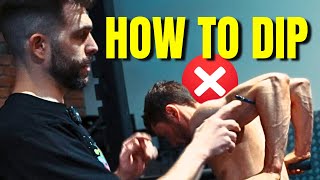
Learn proper dip form to build your chest, triceps, and shoulders. Wider grip targets chest, narrower grip hits triceps. If you can't do a full dip yet, progress through push-up variations first, or use a pen to check your elbow depth.
Chapters
How to do dips and also what to do if you're unable to do dips. But we're going to be covering what the perfect range is along with what the perfect dip is and all of its variations. People ask how low should you be going. So I've got this pen here, I'm going to put in his elbow, right? And what you're going to see is if you can hold it, that's, that's where you want to go. So often a winged scap can be because of a weak serratus anterior. So here's a little hack that you can do on a dip. If Jason jumps up Right at the end of your dip, what you want to be doing is really getting into that protracted position. So more, more, more, more, really getting to protract. So that serratus anterior is really working. Now go through your dip as you would, right? And then at the end point and back up, get— pull, pull, pull, protract, protract. And again, to really get that serratus anterior working. Am I doing dips more for my chest or am I doing dips for the tricep? Now traditionally, if your arms are closer, you are going to be using more triceps. The problem with this line of thought is if you are a little wider in the shoulders or a bit bulkier in the shoulders, it can create a lot of torsion into that shoulder as well, which is going to limit range. So Jason, just do a couple of reps if you haven't got the range of motion. Now Jason's got fantastic range of motion, so he's able to go quite low, but even if you are going to go closer about there, so you're going to be using both, but traditionally, you know, the wider out you go, you are going to use a little bit more pec, and especially if you want to really get that pec involved, go into that protracted. Now I did say, what do we do if we cannot do a dip? And we might not be able to do it. Maybe, maybe you have the strength to do a dip, but maybe we're getting shoulder pain at the front of our shoulder, which is an indicator of that bicep tendon that's running through. So start with push-ups. So we've set up push-ups here. Again, you might not be able to do a full push-up. You could do push-ups on your knees. So as we do this push-up, we're going to do the variation that's going to start to build our strength. So we're going to push away and get that serratus anterior involved. We can elevate, which what that's going to do is allow us an extended range of motion. This can start to prepare us for a dip. Now he's going to do his push-ups here. So if you can do a push-up like this, you're probably ready to do a dip. You can go from push-ups on knees, push-ups, push-ups with an extended range of motion, push-ups where you're elevated, making sure you're getting that serratus anterior piece where you're going through full protraction as well. And then we're at the dips. The reason I like to use kettlebells as the weight on either a chin-up or a dip is because it's a standard implement. And really push away, really push away, really push away, really push away. That's it, excellent, excellent. <LYRICS>And my body gonna keep on rollin', gonna keep up the hustle till I see the low.</LYRICS>