How I Train a World-Class Jiu-Jitsu Athlete (Full Session)
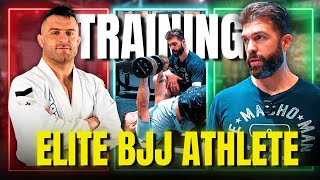
Mark Ottobre works through shoulder and upper-body injuries with elite jiu-jitsu athlete Chris Trio, using movement screens to find glute activation and core stability problems. The fix: a twice-weekly program of bridge presses, Y-raises, external rotations, and planks, each tied directly to rolling performance.
Chapters
In this video, I'm going to show you how I train a world-class Brazilian jiu-jitsu athlete. Hi, my name is Mark Ottobre. I'm the owner and founder of Enterprise Fitness. I've trained Commonwealth Games gold medalists, world champions, thousands of head-turning results, as well as hundreds of competitors to winning championship gold on the stage. Before we get started in this video, 90% of you watching haven't subscribed to my channel, and it would go a long way in building this channel if you just took one moment, hit subscribe, It's completely free, folks, and I promise I'm going to keep delivering super high-quality information so you can build your superhuman inside the gym and out. Now let's get to the video.
Hey guys, it's Chris Trio here. I'm a jiu-jitsu athlete with a few injuries, so I've got a torn bicep, I've got a torn pec, I've dislocated my elbow in the past, currently my shoulder's wrecked. I'm going to come see Mark and he's going to guide me through a workout that's going to help my jiu-jitsu out.
Can you do a bodyweight squat for me? Yep, great range of motion. All right, great. Can you go any more than that? Nah, you're a bit stiff through there. It's not too bad at all.
The only tightness I feel is like right there in your mid-back.
Yeah, yeah. Keep the leg lower, lower. 5, 4, 3, 2, 1. When you do that bodyweight squat, there's a little bit of ab weakness, a little bit in terms of the— your butt winks towards the end. It's, it's minor. You move a lot from your back, right? So your hips, by default, because every, every time I get people to do like, you know, reach down, touch your toes, right? People think I'm looking at flexibility. I'm never looking at flexibility. I'm actually looking at how you get there.
Okay.
So the way you get there is you're rounding and using all back.
Yeah, right.
So I know in jiu-jitsu, a lot of time spent on the floor, but the default of, you know, in athletics, everything really comes from the hips. So getting more glute engagement, especially because you do spend a lot of time on the floor, that's something I want to look at for you. So you default to using your back over your hips. So I'm going to look at some glute exercises for you. The upper— mobility-wise with the upper body, looks pretty good. So your overhead squat test was, was pretty good. Someone with a bad shoulder, it's pretty good. But you said you felt it in mid-back and thoracic extension as well, so I'm going to show you some stuff there. The hop forward, there was a— like, you jumped and it looks like adduction, but it may just be coming from your glute. It's probably coming from your glute because everything else is kind of tied into everything that I've said here. All right, so let's have a little look at your upper body now. But from a challenge test perspective, your lower body looks pretty good. The only— the real deficiencies I see is the glutes and the core. Now, what's something that would cause pain for you in that shoulder? What about a press with dumbbells?
Yeah, like that.
Yeah, that. Okay, perfect. Show me.
It's like a real sharp there.
So that is probably your supraspinatus. So if I In here, we saw. Yeah, right in there. That's really sore.
It feels like it's a bit deeper than that, but that's like the start of that. That would—
oh yeah, right in there, right?
Whatever that is.
Super smart. It's been in there, it's not sore at all. So I can really get in there, it's fine. Okay, so we're going to do another exercise. So you bring it up and then you bring it down slow. So you don't crack the ice. Don't crack the ice. Peel, peel, peel, peel, peel. Excellent. Hold and relax. How'd that feel?
Again, a lot harder, but that felt great. Really good on the shoulders.
Yep.
All along the back. Like, yeah, that feels nice.
All right. Can we just have a look at, you know, how you did that before? Yeah.
Yeah.
Because what I do here is I use it as a control test, right? Yeah.
That feels much better.
What was the pain?
Like right here at the front of the shoulder. Yeah. But like, I know it's still there, but it's not as—
What did it go from? So sit up. So what was the pain at and what is it at now?
So after those first few reps, maybe like a 5, 6.
Now it's like a 1. All right, so we went from 5, 6.
I couldn't do the rep before. It's like I'm pushing through something bad.
So the reason why I like doing like this is it tells us and informs us and saying, yes, we're on the right track. So when I'm doing the bridge pressing, there's a lot of things that really like for you, I think they're going to be quite complementary to jiu-jitsu. So number one, you spend a lot of time on the floor in jiu-jitsu, right? So we're going to be lying straight down. Number two is when we get into this position here, like a lot of people who complain about, say, like elbow pain on their bench press, it's usually coming from that external rotation position. But a lot of people try and get their external rotation stronger, but they still feel the elbow pain. And that's because if we couple the thoracic extension. So in this position on the bridge press, I have to get into a very, very deep or end range of thoracic extension. Thoracic extension is always coupled with external rotation. So for you, again, that external rotation part for you is not very strong, or it's not stable. So I shouldn't say strong, it's stable. So we need to be here. So when you're doing this, I want you to focus more on this and less on this. Good, good, excellent. Oh yeah.
Everything from here hurts. That's in nicely.
Everything from where?
Like in this whole middle section, like all abs, glutes. Yeah, lower back, not as much as that first set when I was asking you about it, right?
So you're probably getting too extended through the lumbar. Everything we do needs to be done with the thought of, well, this needs to relate to something that I do when I roll. If this doesn't directly relate to my improvement there, then the question is, why the fuck am I doing it? So how does this relate? Is you want to get that upper back stronger. When we get this upper back and lats stronger, it's going to take some of the pressure off that shoulder. Yeah, cool. Pull, pull yourself up higher, higher, higher, higher, higher, higher. Good. And slowly down. You feel that mid-back?
Yeah. Yep.
That's it. That's what I want. What I see the biggest difficulty right now is you maintaining glutes and maintaining extension.
That, that sort of—
Correct. These two things coupled, you can do one by itself and then obviously you're pressing as well. So I think, Chris, your progress will probably be a bit like— right, if that makes sense— is that there'll be this messy part which kind of feels like nothing is happening, and then all of a sudden everything just becomes easier. Yeah, it's because we've got a new— the right pattern that you can actually improve your strength upon. Let's move to the external rotation. In that position, pull all that down. Now do the external rotation. And more. More, more, more, more, more, more, more, more, more, more. There. Is that all we got? Yep. Wow. There's no external rotation. There's no external rotation. This is where we need to start. Pull it. Pull, pull. Five and slow.
All right.
Beautiful.
Horrible shoulders.
Beautiful. Well, this is answering some of the questions as to why it's so jacked up there, because this is what, two kilos? Oh, man. Right. And you're not. You're not able to get that range.
Yeah, I'll stick to 2 kilos. Yeah, 100%.
100%. Again, we found your kryptonite, right? So this is what I said about like 80% of your program is actually on stuff like this. So see how what I'm doing here is I'm— see, I'm packing you, right? Like, I pull— is there any pain when I do this?
I don't know, I'm just— I don't know how to stay there.
I'm packing you. I'm packing the lat down.
Yeah.
I'm pulling the lat down into your underpants, and I'm pulling the underpants up to your lat, right? So that position there with the lat now, see how the flex that is? Yeah, that's nice. So now in that position, we're stable. Now I want you to rotate. Look at that, that's beautiful. And when I say it's beautiful, it is. Look at that, it's fantastic. Back, back, back. That's it, done. Put that back on the rack. Questions on this?
No, just the burning started to feel—
where?
I know, like in the shoulders, but— and wrist.
That's not— well, the wrist is a direct reflection of the shoulder strength. Yeah, so if I'm getting you to— that's why I got you the offset grip, so the wrist had to flex up, stabilizes to the elbow, stabilizes to the shoulder. It's a hack. That's why I always get people to go offset grip when we do external rotation stuff. Too much, too much, too much. Just here. Now we want these to be over your ears. So see, right? No pain, no pain, no pain. Just hold it, hold it. 6, push up, push up. 2, 1, slowly down. And again, there's no pain in the shoulder? No pain in the pec?
Nope.
I'm going to push you up a bit higher this time, okay? All through here, burning, I'm guessing.
That's all good.
And contract. More, more, more, more, more, more, more. Okay, now go. I was, I was, I was, I was— now go up. Pull, pull, pull, pull, pull, pull. There we go. Yeah. 6, 5, high, higher. 4, 3, 2, 1. Slowly down, slowly down, slowly down. Excellent. That's a Y-raise.
That's 1 kilo.
How did that feel?
Feels good now. Yeah, feels good now.
So your warm-ups will consist of your back bends, right, which we showed you, and then pair it with the hip hinge. And again, that's more that neuromuscular. One's going to help alleviation of that lower back, the other one's going to help with that pattern of getting you into that hip, nice hip extension. Then you've got the big 3 on the floor. Yes. 10, 10, 10. Then you're going to pair that with the— oh, sorry, this one, which is the fingers, wrists, elbows, and pulling everything up. That should really light up your shoulders and your back, which feel really good. Then your plank paired with the Y-raise on the floor, and you're going to hold that. So 60 seconds paired with— it'd probably be 30 to 60 seconds on the Y-raise, right? Somewhere between that. 3 rounds. Then you've got your bridge press, 5 sets, paired with your neutral chin-ups, 5 sets.
Yep.
2 reps on your chin-ups, 8 to 10 reps on your bridge press. Then the fun which is external rotation and Y raises. Yes, it's actually pretty simple, right? Yeah, twice a week. And the reason why you say, okay, could we do more? Well, it's time. There's actually quite a lot of work in that. It's, it's time for you to do all those, so that needs to be respected. The other thing is, if we do this well, then it's going to set up really good for the next phase, which is then when we would add more of the pressing work. Yeah, right now I don't really think— if we're going to do more, I'd add more sets of your pressing. So essentially you'd go from 5 sets to 8 sets or 6 sets. I'd actually keep the exercises the same.
Yep.
But just add more volume. Okay, you do more of it, right? I'd rather really keep it simple for you and also respect the fact that you're rolling every day. I'd rather start conservative. And again, it's like the opposite of what like people think— start conservative and then we can ramp up as your body starts to feel better. How are your shoulders and back feeling?
They feel great right now. Yeah, yeah, like now I feel loose, very, very loose. Yeah, I feel good. Cool, easy done.
Done.
Awesome. Thank you very much. Yes.
If you've enjoyed this video, click here or here.










