How to Assess a New Client (Live PT Assessment)
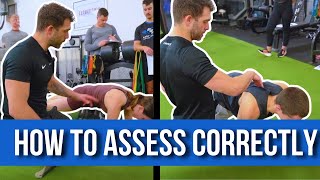
A personal trainer demonstrates how to assess new clients by testing core and scapular stability through planks, cat-cow, and push-ups. He identifies three stability hubs—pelvis, spine, and scapula—and shows how weaknesses in each affect deadlifts, squats, and bench presses. The serratus anterior prevents scapular winging and improves shoulder function for pressing.
Chapters
I've helped thousands of clients transform their physiques and bulletproof their joints. In this video, what you're going to discover is my screening and assessment tools to identifying issues that may be limiting your clients to achieve that next level results. Enjoy. All right, so do we like this plank? No. Who likes this plank? You do? One person. Who likes the plank? Who likes the plank? I didn't think it was too bad. You didn't think it was too bad? All right. No, we don't like this plank for a few reasons. So what is a plank about? Well, if you just relax for a second, there's what you'd call kind of like gymnast position. Gymnast positions, we all know, like retraction, right? And most of the time when we do stuff in the gym, we're retracted. But retraction is really a very small portion of movement because we also need the ability to protract. But as trainers, often we see protraction as a negative. But protraction isn't an issue. Protraction and being in a projected position is actually a very strong position. And when I get into like a squat or a deadlift, actually moving into protraction, right? Because that's a strong position for my spine. But in the plank, we also want, as I said before, the gymnast position. So in the plank, we want to be in a nice protracted position. We want to create as much external stability as possible. So the hips, when we're in that protracted position, we don't want to be shifted out or anterior. We want to be posteriorly tilted. So from the hips in the plank position, because what we want to do is we want to be engaging the abs. So we need to be— we need to stack our ribs on top of our pelvis. So I move my ribs on top and then I'm going to move my hips and tuck them under, tuck my tailbone under. So everyone, as you're standing there right now, I just want you to practice that. 'Cause when we move into the plank, it's gonna become real. And Mia's done it straight away 'cause she has a ballerina background and she picks up movements like that. But everyone else, get into this position here. And again, ballet is another example of a very, very complicated language. And if you have clients who come from that background, it's much easier to train them because they already understand a more complicated language than simple addition of adding load to the bar. So getting to the plank position, The next thing we want to do is we don't want to be like that because that actually makes it easier. We want her out. Grab— you can make a big fist. So she's pretty good. Lock the quads out as hard as you can. Now what I'm going to get you to do is just do it wrong for a second. Just stick your hips out, hips, but stick your butt out, right? That's the anterior. We don't want to be anterior. So again, hide your hips, tilt them in. Perfect. All right. You see the difference? It's very obvious on her. That's where we want to be. Lock your legs out. Now, this is one of the first things I like to teach a client because this— you feeling this in your abs? Quads and my forearms. Flex your quads. Yep, flex, flex. So, so if I move her, see if she's soft. I don't want you to move, right? You shouldn't move at all. So I'm going to put a little bit of pressure on her because what I'm trying to do here is teach her— oops, that— stay still. Don't move, don't move, don't move, don't move. Resist the force. You're feeling this in your abs now. Bit more, bit more, bit more, bit more, bit more. Really? Tuck, tuck, tuck, tuck, tuck, tuck, tuck, tuck, tuck, tuck, tuck. Flex the quads. Flex the quads. Flex the quads. See, this is soft. I don't want this to be soft. Squeeze your butt as hard as you can. Imagine this thousand bucks in your bum cheeks. I'm trying to pull it out. You're trying to keep it in, right? Thousand bucks. Don't lose it, don't lose it. Squeeze. Feel this more in your abs. Yeah. All right, now we're on. She wasn't squeezing, right? So what this is doing, right, let's give her a round of applause. What you want to keep in mind with this, right, is there's three hubs of stability. You have your pelvis, which we saw, which part of that she, she wasn't engaging through her pelvis, wasn't stabilizing her pelvis, but she wasn't switching on her glutes. So there's your pelvis, there's your spine, and then there's your scap. So if we look at those 3 hubs of stability, we want to basically create as much stability in those hubs or begin to teach our clients how do we create stability in those hubs so that we can then use that stability in terms of that athletic endeavor, whether it be a bench press or throw or whatever it may be. Kick, um, we need to create stability. So the plank is an excellent exercise to begin to teach that to clients. And again, what to watch out for is most clients will lift the hips up or they simply won't rotate down. This, what I just showed you there, which is super, super simple, this marries, uh, and goes a long way. So if I show you, right, if I'm setting up for a deadlift, I'm not here, I'm here. I'm stacked, I'm elongated as I approach the bar. I'm keeping everything tight, I'm keeping my back protected, and now I'm lifting. I need to be in that position on a deadlift. If I'm going to squat, it's the same thing. I'm here, I'm stacked, I'm bringing everything down. I don't want any movement in the spine. I'm in that plank position. Bench press is a little bit different, so we'll explain a bench press. I need a volunteer. Yeah, we'll get him. He, he— so jump on the floor. So we're going to talk about scapular health now. So on the floor. Not to me. All right. On the floor. On the third time's the charm. Like this. Like this. Let's go like this. All right. So I'm going to start with a base. Have you ever done a cat-cow before? Okay. So I want you here, right? And you're going to push up all the way and you're going to retract. We want to get the scapula now engaged. So don't move anything else and then push up all the way. Push up all the way. Push up all the way. But just see how here I can grab this. I shouldn't be able to grab this on a proper crap cow. So more and more. Push, push, push, push, push, push, push, push, push, push, push, push, push, push, push, push, push, push, push. Now retract. Don't move your arms, don't move your arms. It's just the scap. I just want you to move this. Now push away. See, I can grab your scap. Shouldn't be able to grab your scap. Shouldn't be able to grab your scap. Shouldn't be able to grab your scap. More, more, more, more, more, more, more. Now retract. So this is now the articulation of the scap. Right, reticulating, and down. Now push. So this is a very, very remedial way to— and this could also be for someone who, who can't get into that end range position, a simple starting point to start to teach them. Keep that straight. Keep your hands a bit closer, just make it a bit easier for you. So I just want him to start to utilize his scap. More, more, more. Yes, now he's got it. And Yep. And again. Good. Beautiful. All right, now we're getting to push-up position. Uh, yep, full push-up position. Now I want you to do the same thing. More, more, more, more, more, more, more. Get that end range, get that end range. I can still, I can still grab this. Get your hands underneath your body a bit more. You're a bit too far out. Yeah, so I really want you to push away, push away, push away without moving this. So with— I just want your scap to move. So I can grab this, push away. Now I'm teaching how to protract, but with low. Right, so protract, protract, protract, protract. More, more, more, more, more, more, more, more, more, more, more, more. Push away, push away, push away. I can still grab your scap. I can still grab your scap. There we go. Right, that's. That's end now. Now dip. More, more, more, more. Pull this down. Now protract. Good. More, more, more. He's shaking. I can still grab this. I can still grab this. I can still grab this. Imagine this for if you've got a thrower, someone who balls and. Yeah, throwing. You need to have the articulation of your scap to be able to do that. Right? This is still. He's still not where we want it to be. This is struggle for him. Again, back down. See how much he's struggling. Back down, back down. And push away, push away, push away, push away, push away, push away, push away, push away. He's shaking. More, more, more, more, more, more, more. Come on. And push away, push away, push away, push away, push. It's a simple exercise. Yeah. This is beginner, this is a warm-up, right? But let's give him a round of applause. Would you take off your shirt for a sec? I just want to show them. And face— stand there. He's like, I've been waiting for this moment the whole time. Stand here for me. Stand here, stand here, stand here. No, no, face that way. Right, can I get you to bring your arm to the back of your body? Yep, just— and relax. Just bring it down. Yep, and relax this one and bring it down. Go the other side, do the same thing. All right, uh, do the other one. Yeah, it's not too bad. So what we're looking at here, so you understand, is we're looking for a winged scap, right? And I kind of, from him doing that, I was kind of suspecting that maybe he had a winged scap. But assessing him now, I mean, these— he's a little bit off from left to right, tiny bit. Go one more time. But it's not huge. He's— go again, go again, go again. Relax. This is pretty stable. Yeah, it's pretty stable. It's not super winged. He's fairly good. This one, you can see this. He's not a winged scap, as in like it comes off, right? This one is more prominent. There's folks that they do it and— can I get you? Because I reckon you have Issues here. You look like you get a winged scap. Take off your top again. Go, go. Hand behind your back. Further. He just has issues with external rotation. Other side. Ah, there we go. There's your winged scap. Right. So you can see here. Is it the same on both sides? No. Well, go, go the other side again. He does have an issue on this side. The shoulder is not letting him go further. So there's an issue with getting into shoulder extension for him. Yeah. So we've got two different issues from left to right on each scap, but he's a great example. But you can see here how his scap hasn't moved. Go the other side. I can pull that, right? This is an example of a winged scap for everyone to see. Can you, with your shirt off, can you get into the push-ups like you did? Just so I can show people the example of So then. Yep. And then come. Come all the way. Come all the way out. Come all the way out. So start here. Push, push away. Push away. Protract, protract, protract, protract, protract, protract. Now protract, protract, protract, protract. More, more, more, more, more, more, more, more, more. Push. More, more, more. See, I can still feel you. Don't. More, more, more. Push, push, push, push, push, push, push, push, push, push, push, push, push. Now dip it, dip it, dip it, dip it, dip it, dip it, dip it. No, no, no, you're not pushing up. You're just moving from the scap. The arms don't move in this. Dip. Now push up. Keep the abs on, keep the abs on, keep the abs on, keep the abs on. Push, push away, push away, push away. I can still grab this. Push away, push away, push away, push away, push away. I can still grab this. Push away, push away, push away, push away. More, more. And retract. So this is, this is scap, this is basic scapular articulation. Right. Basic scapular articulation. This would correct his issue. Not completely. Well, okay, let's give him a round of applause. We're on the right track. So the thing about scaps, right, is— I'll just use an example. So serratus anterior, right, from your serratus anterior inserts and then from here into your scap. So often the winging of the scap can be because the serratus anterior isn't engaged and keeping the scap, the inferior border of the scap in place. So by doing what you see there, getting into protraction when he's here in this position, we are actually loading up the serratus anterior. So is it going to fix these issues completely? What you saw with both of these gentlemen is kind of like their bodies don't go there often. They don't go into end range protraction. So they haven't developed, one, the neural pattern of going there, and two, they just haven't developed strength there. So will it fix these issues? Completely. He had a whole other shoulder thing that I just need to do a few more things to assess, but it looks like it's almost like from his lat and tricep as well, the way he was presenting. But I got to do more things to assess. But again, from serratus anterior, that's what we're training, and that's what will help alleviate some of these issues. On that issue there you saw specifically, I don't think we're going to get a hole-in-one for both of them. They just need more reps. So in saying that, we, we're talking about the end range of the scap. So end range of the scap I'll just use you as an example, right? Can you extend through the thoracic and see how that moves? So even more so when he's on the bench press here, it's moving in through there, which is pulling everything down, which is drawing, which is creating a nice stable base for him to bench press from. Thank you. Let's give him a round of applause. So when we piece all this together, it starts to make more of a— makes more sense, right? We start to implement movements for our scapula. This could be a starting point, but we also then need to consider depression. So what the lat's doing. So are we able to depress the lats down? We also need to consider thoracic extension and then also considering that external rotation factor. But again, with external rotation, if we move through thoracic extension, we're going to achieve external rotation at the same point. And then you've also got the scap, which could be part of the weakness as to why people have that winging of the scap as well.










