How to Assess a Squat (Live Client Breakdown)
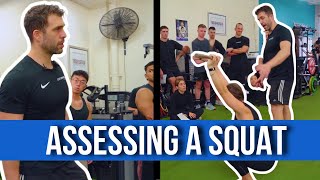
A coach screens a live client's squat, identifying a butt-wink from core weakness rather than strength limits. He runs challenge tests (single-leg stance, toe-touch, overhead squat) to pinpoint glute and upper-back deficits, then builds a plan: unilateral work, pauses, rowing, and core warm-ups.
Chapters
I've coached thousands of clients to achieve head-turning results as well as trained world champions and Commonwealth Games gold medalists. In this video, you're going to get my exact screening systems to helping clients achieve a perfect squat each and every time. You're going to get the breakdown of how people move and what are the exercises I use to correct that in real time. This was taken from an internship program that I ran with trainers from all around Australia. Enjoy. So I'm going to get you to do a bodyweight squat again. Now, you're a great person to pick on. Let's do it again, and I want you to go even lower, lower, lower, lower, lower, lower. Beautiful. Okay, come back up. What do we observe straight away? Yes, Mary. Okay, so let's look at things. There's a, there's a global cue and there's a local cue. What you just gave now isn't necessarily incorrect, but it's a local cue. There's something much bigger that's going on that if you address that is going to address that. Let's just do this. Yeah, yeah, perfect. Go 45. There, there. No, no, not sideways. 45. There, perfect. Yep. Now squat. Perfect. Yes, good man. Do you want to say it a little louder for everyone else? Yeah, like pretty, pretty strong butt wink. Shifting of the hips. Yeah, everyone get that? Now, what is a butt wink? What is it? If we get more to the point, it's an inefficiency or a deficiency of someone utilizing their core. So you might also say she has a weak core. She might say, but I do a lot of Pilates and I do a lot of sit-ups. Sure, you have a strong core, but in relation to the neural chain of how her core functions in relation to as she progresses through a motion, it does not stabilize. So this is where like glutes are a really great example. You have a lot of girls who do like glute bridge after glute bridge after glute bridge. Jana fits in this category and they develop great glutes, but you test them functionally and they're shit house because they're not doing anything standing. They don't actually have the ability neuromuscular to stabilize the glutes in through a squat. The femurs still rotate in even despite that they have hypertrophied their glute, for example. So it's a bit like this. People can do a lot of sit-ups and abs, But if it's not integrated into a movement, into the chain, people's abs will not turn on. And I probably assume that's what's happening here a little bit, is her abs aren't engaging and integrated into a proper open chain movement. So the way we're going to start to correct this is just do one more time bodyweight squat for me. All right. So let's continue. So we need to get her to use her core more. So what we're going to do is we're going to get her this kettlebell. You're going to hold it upside down. You're going to push it away from you. Hold it there. Hold it there. Now I want you to do the same thing. Squat down. Lock out your arms when you do it too. And push it away. Push it away. Push it away. Did that improve her butt wink? Can you just go on that 45-degree axis for us? And even let's take a little bit wider. Yeah, that's nice. All right, now go. Now just do a little bit slower. Slow it down. Slow it down. Slow it down. Slow it down. Beautiful. Okay, so I'll take this away again. Did it improve a butt wink? Do we understand why? Core's engaged a lot more, right? Why is her core engaged? Because it has to be. If her core wasn't engaged, she'd fall flat on her face. Understand? So we put this out in front of her, she now has to activate her core. Questions before we move on? All right, now we are going to assess her lower body again. Before you're doing this, this is called the clat test. You need to be standing in front of her when you do this test. You don't get closer so everyone can see, right? But if you're behind her or you're on the side of her, you can't assess, right? You can't assess. You really need to be in front of them. So this is called the clat test. Traditionally, it's done off a block. So she would be up here, she'd be on a block, and she would jump down. And would assess. That's traditionally how it's done. Now, I've modified the test for our purposes as personal trainers because that's how you do it with a basketball or elite athlete. The problem is the majority of clients you're dealing with aren't basketballers or elite athletes and they will have some form of dysfunction. So we have regressed the test as a protocol and it allows a few different opportunities for us to assess her feet, assess her knees, and assess her hips. So we can assess 3 joints in 1 on this test. So the first thing I'm going to get you to do is stand on one leg, hands out like this, right? Now, really going to work this. So toe up. Okay. All right. Now I'm just going to get you to do a slight knee bend and— slight knee bend. Yep. Slight knee bend and come up and come up. All right. Do the other leg. Slight knee bend. All right. Now just take one step back. I want you to do the same thing, and I just want you to hop forward. So stand on one leg. Yep. And just do a hop. Okay. And do the other leg. Okay. Everyone see that? It's all right if you say no, because to me it was very obvious. So this, this leg— what are we, left leg— is definitely more of an issue than her right leg. It's not massive. It's not massive, um, in the sense of it's not necessarily going to prevent anything from what we're going to do. But I am again collecting data right now. So the two things I saw, particularly on her left leg, was that as she moved and shifted forward, the femur rotated in and then she came out. Right. So basically, if I was doing slow motion, she went like this. I'm exaggerating, but the femur rotated in as she— and then she landed and then she came in again. What, what, what happened? What does a muscle move towards? What does a joint, rather, or the bone, what does it move towards? Always moves towards our strength. It moves away from weakness. So she's moving towards her VN, her quad, and she's moving away. The femur's moving away from her glute, which would indicate what? Were you about to say tight? Were you about to say tight? Is it tight or is it weak? Weak. Yeah, people mistake the word tight for weak all the time. She's not tight. Weak, or again, neurally in the chain. So the glutes are not functioning as well as they could be. They're not stabilizing that endpoint. So I'm thinking in my head, potentially glute. All right, this one you can assess— really is best assessed on the side or at 45-degree angle. You stay where you— oh, actually, yeah, do that, do that. It's perfect. All the only instruction I'm going to give is reach down and touch toes. All right, we're not assessing— she thought we were assessing her range of motion like most of your clients think. When we give them that test, they will think we're assessing range of motion. We're not assessing range of motion. We're assessing whether they use their lower back or whether they use their hips. She passes. She uses her hips. Right. And that's why the only instruction I give is reach down, touch your toes, because I want to see what you naturally do. Right. Again, this isn't necessarily going to be— I'm going to make a decision from this test alone. But if this test also correlates to other things I see, it's helpful information for me because the next test is going to be the backward flexion test where put your hands on your hips. She did it before. She's going to lean back, just do it a couple of times and just— yeah, she pretty much passes straight away. I'll tell you the considerations on that one is for the lower back. So particularly for deadlifting and also overhead pressing. But she's clear on both. Last test. Now there are more than 5 tests. Yes. But these are the 5 that I use every single time. And then from there I'll use others if needed. But you get really good at these 5 tests, you'll get most of what you need. Okay. And all of these tests that we're doing right now are challenge tests. What are they? Right. They're not passive tests, which is what a lot of physios will do, which isn't really that helpful when you're running, jumping, lifting weights. That's why we want challenge tests. Hands up overhead. So she's using a biocromial grip. So hands straight. Perfect. She's going to stay in that position. Yep. That's it. Straight overhead. Straight ahead. Yep. Stay in that position. Now we're going to get a squat all the way down. Tom, what do we see? Her shoulders came forward as she came down. Okay. So what Tom's correctly pointing out is if you look at the line from her bicep, her bicep should be covering her ear, which in this position it is. Now for her to get into this extended position, it's actually really nice. She's not getting through to the lumbar extension like she's not doing. Just sway really back for me like this. She's not doing this. So in other words, her hands aren't here and she's using her lower back to get into the position. She's able to bring your ribs down. She's able to keep that straight upwards, which is really, really nice. So she gets a pass there. But as she moves through space and time, so rather just space, Let's go through. Down. That comes forward. Her abs rounds, which then indicates weakness in the upper back and specifically thoracic extension. Come back up. All right, let's give her a round of applause. So I, I right now I have enough information. Well, I need to talk to her about her goals. I haven't talked to her about her goals. I've simply assessed her just for the purposes of this demonstration. I'm just going to assume her goals are that she wants to get 100 kilo deadlift and be able to do a chin-up. Let's just say that's your goal, right? And maybe there's some body comp stuff in there because there always is, but I have enough information to go ahead and write her program. She doesn't need that much considerations, but I will start her, depending how much time I have, probably a little bit more conservatively, meaning that I'll probably start phase 1 with unilateral work, then move into bilateral work. I'm going to include a lot of pauses, and I'm definitely going to include a lot of rowing. For her. Also going to instruct her to change her footwear and not wear that footwear inside of a gym. Probably when we squat, I'm also going to instruct to get a band around her knees so she uses her glutes. And also as part of her M series, which is the warm-ups that we do, it's going to be pretty core-focused. So she's going to be doing planks, she's going to be doing the counterbalance squats, and I'm probably going to give her a lot of upper back, uh, specific mobility. So like










