How to Assess Shoulder Mobility (Live Client Assessment)
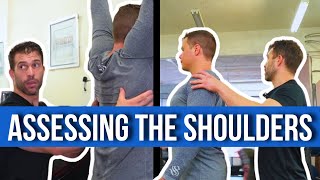
Mark Ottobre assesses a client's shoulder mobility using a pen-cross test and overhead squat, finding excessive forward shoulders and weak lats. He prescribes active hangs and one-arm kneeling rows to fix the imbalance, emphasizing that "acceleration without brakes" describes the injury risk of unbalanced pushing and pulling strength.
Chapters
I've helped thousands of clients transform their physique while getting Hercules strong. My name is Mark Ottobre, and I'm the owner and founder of Enterprise Fitness. In this video, you're going to watch a live assessment that I did at a recent internship program that I ran with trainers from all over the country. In this video, I'm going to show you the methods that I use, screening assessment tools to assessing shoulder health and practical exercises that you can implement to helping alleviate some of those issues. Enjoy. Just stand natural, face the front, shake it off. Okay, I'm just gonna put these pens in your hands. Just keep your hands where they are. All right, see how the pens cross? Pens shouldn't cross. That's a telltale sign of pronation, and he's actually got pretty severe— like, he's naturally in a very pronated position. We see how far forward his shoulder is, how tight— like, he's got a lot of muscle mass in his pecs, so his pecs are strong. I'm guessing he's got a pretty good bench press. Right? But this is all pulled forward, which means he needs to be doubly strong through his row work. So is he at risk of a shoulder injury? Yes. Well, that's because he's all— he's all acceleration and no brakes. And to have a world-class race car, you need to have world-class acceleration and you need to have world-class brakes. So this is a case of someone who doesn't have the stability to match his output. So say, for example, if he was— if his chest and just the muscles on acceleration were was to throw as hard as he could, he would tear all the muscles in his external rotator because they're just not strong enough to match what's happening here. Again, we need to understand the relationship between protagonist-antagonist body parts. So one of the things we want to do here is we want to pull everything back. So actively, this is going to feel very weird for him because he's not used to getting this position. But if I can get you to pull your lats in more, right? Pull, pull, pull, pull, pull, and depress. So don't go into traps. Say we want to go straight because these traps are strong. It's the lats that we want to get down. Now remember, if the traps are on, the lats won't be on. If the lats are on, the traps won't be on. He's very trap dominant. Now where he's sitting there, look where the pens are. What was the cue that I gave him? To pull his lats. Has that fixed some of our problem? Now he probably thinks he's walking around the wanker position, but at the same time, this is where his shoulders should sit. I almost feel his lats are shaking right now, but that's a better position. So let's look at this and I'll show you, because you probably see it on this as well. So you'll probably see this straight away, right? Let's do an overhead squat. For you, and you'll see. Go on a 45-degree angle, so just face it out. Now immediately— yeah, that's fine. Good. I'm going to let him get away with this for the first one, but what do you see straight away? All right, if someone's going to tweak him, what's the first thing you're going to correct? Don't do another one. Don't do another one. Don't do another one. What's the first thing? Always, always, always— he's going to hate me for this, right? He's going to absolutely fucking hate me, but he's going to do it because that's how the test is standardized. Knowing it doesn't matter how big he is, whatever, that's how the test is standardized. So it's bichromial. That's where he needs to be. This makes it far easier and we see a lot less, but our goal is to see as much as possible. So even right now as we speak, he really doesn't want to get into that position, right? So that's where we want to be. Now go. Keep your arms. We gotta lock our arms out, right? So what are we seeing? Don't do a squat. What are we seeing? Yeah, we're seeing him to get into this position, he's actually getting into lumbar extension. Like, he's fighting here. So when I said like his upper back is weak, it is weak in comparison to everything that's happening at the front. Now when I say his upper back is weak, he could be doing, you know, the 50s on a one-arm dumbbell row, 60s, it doesn't matter. It's weak in comparison to what's happening in relationship to his ecosystem of his body. That's when I say weak. It's not that he is weak. It's, it's weak in comparison to what's happening to everything else. Right. Go ahead. Oh, we're not in the right position. Yeah, there. That's where I want to be. Yeah. Lock, lock, lock, lock, lock. Okay. Now you can move out from your feet a bit if you like. Go wider with your stance. Keep your heels on the floor. Keep your heels on the floor. Whatever. If you ever need to fall forward, you fall forward. Like, as in the body falls forward. I want those heels on the floor. Right, beautiful. Look at that. That's amazing. That's a great assessment. And now stop, stop, don't move. Go back into position. Look where his arms are, right? He's really struggling in that position. So are we accurate in saying his lower back— his upper back is weak? I can grab it. You're good. Thoracic extension is weak. It'd make him a bad bench presser, right? Or if he's bench pressing, at least he's leaving a lot of weight on the table because he's not getting into the good thoracic extension position. It's not a good external rotation. So there's a lot to work on that could help his shoulder health. So when I see a pattern like that, my first— and we can go into this now, which is the active hang. And the reason why I like the active hang is because shoulders are one of those things that it can be quite complex, because the fact is it could be the tricep, it could be the bicep, could be one of the external rotators, it could be the lats, it could be the trap, it could be the pec, because a lot of things run into that shoulder capsule as well as a lot of things can be affected by— like the trap could be affecting the shoulder capsule as well. So this is where the good news is that there are a lot of exercises that you can do. If you do the right exercise correctly from the beginning, you'll address most shoulder dysfunction. So again, the first thing is he struggles to maintain that position from the get-go, and that's because the lats as well need to be strengthened. So this is where your active hang— because he's loading in a full hang position, and as you saw before, he doesn't straighten his arms. In an active hang, he has to straighten his arms. Let's demonstrate the active hang by just going over here on this chin-up bar. I'm going to do it the wrong way to begin with. So just hang out. So this is, this is the wrong way to do it. This is a very passive way to do it. Active hang, as the name suggests, you want to be active into it. So he's going to put his rib cage on top of his pelvis. And then also as the trainer, I'm going to give him a bit of a shove forward, right? So I want him to— and you can see his lats now actually popping out because his lats are probably in this position, I'm guessing, burning a little bit. But you can see how his arms are nice, perfectly straight. This is the position ideally that we want him in at that end range position when we're doing the So this, for him, 3 sets of this every, every day before his workout would be gold. Working up to 60 seconds every single time that he does it. Ideally, he wouldn't be touching the floor, so he'd actually be pointing his feet with his feet together, loading it as much. So that bar over there that we have is what I'd get him on, where he can be in that full stretch position the whole time. Okay, come, let's go over here for a sec so I can show you perfectly. So I'm in a passive hang here. The only difference is I'm going to pull. So I'm pulling forward. And see, I'm pulling my pelvis in and pointing my feet down. So yes, you do want that pelvis here. You don't want to be out and pushing down at the same time. You want to basically be in that gymnast, gymnast position. Makes sense. So the starting point with this work would be a one-arm cable row. So we're going to go down here. So what we're going to do, we need a little bit of weight for this. Is we're going to do one-arm kneeling row. So grab this, you're going into one arm. All right, so just do a one-arm row for us. All right, so he rowed up to here and he elevated instead of depressed. So what we want to be teaching is again that thoracic extension. We want to also be teaching depression because you want to couple those things, particularly for the bench press and other pressing movements. So I'm going to get him into the row again. Now I'm going to do some coaching. So I want you to imagine I've put a concrete center block on your elbow. Your elbow can no longer move. Okay. The only thing that can move is your scap. So what I want you to do is depress first of all. So depress, pull down, pull down, pull down. So you don't. So you're rotating right now. Let's just sinew straight up. Straighten up a little bit. Depress down, depress down. There you go. Now I want you to pull this into your spine. Pull in, pull in, pull in, pull in, pull in, pull in, pull in, pull in, pull in, pull in. Without moving your arm. Don't move your arm. And now release. Release it altogether. Now go again. Don't move your arm. So you can see as we start to do this, he's coupled elbow flexion with the row. I just want there to be retraction and extension. And see how a lot of other things are moving. It's not isolated. So we're trying to isolate just that scap from moving, right? So go again. And there isn't a whole great deal of movement here yet. More, more, more, more, more. All right, I'm gonna get you to relax for just one sec. I'm just going to show you because it just might help you with a visual demonstration. So what I want— show you this, um, so all you can see this as well. But you see how I'm in this position here? I'm all the way out, I'm fully protracted. Now I'm not going to move my arm, I'm pulling back and pulling down. I'll show you again. See the movement difference? So I'm forward, back, really going to squeeze that in and pack. See, I'm packing my lat down into my underpants and I'm pulling my scap in this towards the center of my spine. What I'm trying to accomplish with James is to teach him scapular articulation. Like we articulate our words, I want him to articulate his joints. And you can see the— can you see the difference in the movement of quality of the scap that's happening in my upper back compared to where James is at the moment. Right. So again, I'm not expecting him to, to magically go, okay, now I can do it. It's new to him, but we've got to start doing the work here. So off you go, James. Let's go again. Again, elbow, we want to keep it straight. We want to get his scap moving independently and pull, pull, pull, pull, pull, pull. Go to that end range. Go there. Extend, extend, extend. Yep. Go 5 of this. 1. And as you come out, don't— don't see what I've noticed every time when he comes out, he comes out like this. He actually elevates instead of coming through. Don't elevate as you come through. So to explain this, if we interlock hands right now, he's a big guy. Okay? Now, if we get into an arm wrestle and I just try and use my arm strength against him, just resist me, resist me. And I just use my arm strength. I'm not going to move. He's big. He's bigger than me, right? So I've just got my arm strength. But now if we interlock hands, place the same amount of pressure, right? You see where my scap is? So I'm very easy. I can use my scap. So I've retracted, I've pulled. I'm using two joints. Well, not even— I'm using more muscles, but I'm also using two joints. I'm using my scap, the firepower of my scap, which I can pull through. And I'm also in a much more stable position to row him in, to pull him in, if that makes sense. Yeah. So Think about that when you're rowing. Think about that when you're bench pressing. So I say this position of being able to do that, articulate the joint, you're going to be a hell of a lot more stronger in that row position than if you're just trying to use your bicep.










