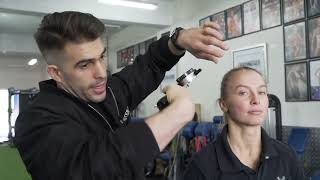
In this instructional segment, the instructor demonstrates the correct technique for measuring the cheek skinfold using calipers. He explains how to locate the precise anatomical landmark—the line from the outer corner of the eye to the corner of the mouth—by aligning the flat edge of the calipers with the eye corner and using his index finger to point to the mouth corner. He stresses avoiding guesswork and using the caliper’s edge as a guide. The demonstration includes proper hand positioning on a sagittal plane, ensuring the calipers are horizontal, and the importance of having the subject place one knee forward to align heights, especially when the subject is taller than the measurer. The instructor walks through the pinch‑and‑read process, emphasizing a firm but not overly tight pinch, opening the hands wide, and reading the caliper without releasing the fold. He notes that leaner individuals are easier to measure, while higher body‑fat subjects present more difficulty. The segment concludes by transitioning to the next measurement site.
Chapters
So the next measurement is the cheek. Now the easiest way to do the cheek is using the calipers, and it will depend on whether someone is shorter or taller than you. So I'm gonna do it on Jade. She's shorter, and I'm gonna show you the way to do it if someone is taller than you. So the way I'm gonna do it, if I was actually measuring Jade at this height, so it's the corner that the measurement is the corner of the eye and the corner of the lip. So I see a lot of people who are new to this and they're trying to guess and they put it there, which is, I mean, that's a pretty good guess for me, but at the same time, I don't like to use anything to guesswork. So what I do is, this is a flat edge. I'm gonna use the calipers to my advantage. I'm gonna put the calipers smack dang at the corner of her eye and get my index finger, and I'm just gonna point to where her, basically, so you can see the corner of her mouth. That's exactly where the corner of her mouth is, and that's where the sight is. It's exactly where the sight. Now, what I said is you find the sight. Now you aim for where the sight is. So I could be standing here, I'm gonna put my calipers there. Now I always need to move into position. Now this one, the calipers are exactly horizontal on a sagittal plane, opening my hands wide as always and pulling towards the sagittal plane. So this is directly straight out towards me, I've got my measurement. Now you can see here, I can just read the calipers, but this is not an ideal position. If Jade was taller than me, the calipers would be up here and I couldn't read that and my hands aren't gonna be exactly right. So what you do is, Jade, can you just take one knee forward for me, pretty much as a standard protocol, you wanna get your clients when doing a cheek measurement, get them on one knee. It just does make sense. Obviously in Jade's example, being a fair bit shorter than me, I'm able to do it. But for most of your clients, this is the position where you wanna take the cheek in. So now you can see, I can see directly above the calipers, hand is open wide. I'm pulling it together, taking my pinch, not releasing completely. There's my, there's my, and again, when you can see here, I don't, once I've taken the pinch, I open up wide, I pull it away and grab it. Don't roughly pull anything away. It will take you some time to get good at grabbing people. The leaner someone is, the easier it will be to measure. The more body fat someone has, the harder it will be to measure, no doubt about that. So now let's move into the next one.