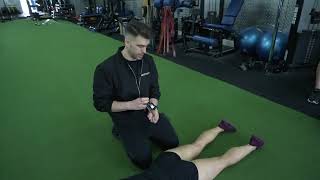
In this instructional video, Mark Ottobre demonstrates how to accurately take a hamstring skinfold measurement as part of a 12‑site body composition assessment. He explains the importance of client attire (shorts preferred) and positioning (prone, face‑down). Mark advises giving the client a slight “one‑legged wedgie” to expose the area and notes that right‑handed practitioners typically measure the right side, while left‑handed ones use the left. He details how to locate the glute fold by feeling for the top bump or palpating the line at the bottom of the glute, describing the triangular pocket of fat that indicates the correct site. The tutorial emphasizes using a firm grip on the calipers because hamstring fat can be stubborn, lifting the leg to reveal the fold line, applying broad hand contact, and then positioning the calipers to capture the fold. Mark repeats the steps slowly, highlighting the sequence: bring calipers to the bump, bend the knee, lift the leg, identify the fat pocket line, apply broad contact, and take the measurement.
Chapters
So the last site of your measurements is the hamstring, and obviously if a client doesn't come in wearing shorts, it can be a little bit challenging obviously to do if they've got like leggings or skins. So ideally the client is wearing shorts. They're obviously going to be laying face down for this. So what you're going to need to do regardless of whether the client is wearing shorts or not is I always give the instruction, Jade, can you just give yourself like a little bit of a one-legged wedgie on this side? So again, I've done all the measurements on the right side because I am right-handed. If you're left-handed, you're going to do on the left side. So this is perfect. You can see the glute folds. So there's a line there. What you do— a few ways you can find the glute fold is you can run the calipers up exactly where you hit the bump. That's where you're going to take it. That's where the glute fold is. The other way to do it is I like to put my calipers straight in to where the bottom of the glute, and you can see if you palpate, you can see basically the, the line of the glute fold in which you're going to be actually measuring. So in that saying, if you do ever get a competitor you do see there's almost a triangular pocket of fat, that's exactly where you need to take it. So I'm gonna do it the way, the easiest way to do it, which is for most people, which is to find that essentially bump at the top and get into the glute fold. So then what you're gonna do, and also for this one, you need to have the most firmest grip for the hamstring because they are reason, 'cause it is quite, I suppose, stubborn fat for people to grab. Lifting your leg up, as Jade lifts up, you can see that line that's created there as well. That's where the glute fold is. And again, I'm halfway between the hamstring, put my hand broad contact, pulling it all together. And that's where the glute fold is there. And that's a, that's a perfect measurement there. That's how to do it. I'll explain it one more time, just a little bit slower. Bringing the caliper straight up, you hit the bump, you come up, you bend the knee up, you bring it up above, you can see that line Well, maybe on camera you can't see, but there's a line below, there's a line above. That's the pocket of fat I want to measure. So as you see, I put my calipers in, it makes a line. Now I'm having broad contact, I'm pushing up, bringing it away, and bringing the calipers in to take the fold. And that's exactly how you take the hamstring measurement.