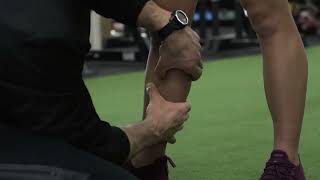
In this instructional segment, Mark Ottobre demonstrates the proper technique for measuring the calf skinfold using calipers. He explains how to position the client—straightening the knee and shifting weight onto the measured leg—to expose the calf. He then describes palpating the junction where the calf muscle meets the tibia to locate the start of the calf in a side‑ward plane. By feeling the maximal muscle belly (the most muscular part of the calf), he identifies the exact spot for caliper placement. Mark shows how to grasp the muscle, pull it together, and place the calipers on the identified point, noting that skinfold thickness varies: thin‑skinned individuals may have low values, while overweight clients can see measurements in the 20 mm range, with a typical good calf measurement around 3 mm. Throughout, he emphasizes client safety, proper anatomical landmarks, and the importance of consistent technique for reliable results.
Chapters
So point 10 is the calf, and again, the calf is, again, I'd say a relatively easy site to navigate and do once you know a little bit of tricks. But again, a lot of people do this one wrong and end up hurting the client. So this is the easiest way to do it that I find is get the client to straighten their knee and put all your weight on this leg. So this leg comes a little bit further out, so now I get direct access to the calf. So what you want to do here is I like to palpate and find basically where the calf and the tibia meet. So where the, essentially the bony part of the tibia, where that finishes. So not the direct front, but the end of it. So there I've got my thumb in where the start of the calf is in terms of a sideward plane and the end, which is here. So I can grab that, I can palpate, and I can see the most, the head of the muscle belly when I do that. And the head of the muscle belly is here. Again, there are ways you can do to measure this using a tape measure, Although for me, I find it just easier 'cause I've done this for so long that I can see when I palpate the biggest muscle belly for Jade is right here. So that's where my fingers are gonna meet. So as you can see here, I'm grabbing it, I'm pulling it all together, and that's directly the fattest, well, when I say fattest, it's not really the fattest, it's the most muscular part of Jade's calf. So now I put the calipers on that and I take the measurement. Now, some people have very, very thin skin on their calves and it's very, very easy to measure. Some people obviously are more overweight and you'll find that the calf measurement is in the 20s. So a good calf measurement is 3. And again, I'll just run through again how I did that with Jade. You can see here, I've got my thumb right in where her calf from the side again, we're not talking origins and insertions here, but where her calf, where the bone finishes, the bone is here, this is where the calf begins. So I've got my thumb in there and I wrap my thumb all the way around. I palpate just a little bit and I'm able to see exactly where I'm supposed to finish that up, which is the, When I say fattest part of Jade's calf, what I'm really saying is the most muscular part of the muscle belly, which is usually directly in between, halfway between her calf.