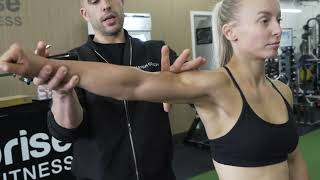
Mark Ottobre demonstrates how to measure the triceps skinfold by locating the midpoint between the acromion process and elbow, then pinching the fat layer while the arm is flexed. He emphasizes finding the correct anatomical landmarks, avoiding muscle tissue, and using tactile feedback to separate fat from muscle.
Chapters
This is point number 4. This is the triceps. So the first thing we do when measuring a client is you get them to face to the, to the rear. So Jade in this case is gonna face to the wall and we are gonna start by finding half of her triceps. So first thing you wanna know when you are looking at sites, regardless whether it's the chin, the cheek, the pec, whatever it is, you always wanna find anatomical markers. So the anatomical marker for the tricep is the acromion process, which is this bony part of Jade's shoulder, which you can really see on Jade because she's very, very lean at this point. So regardless Regardless of whether Jade, you know, got to— she put on 50 kilos of weight or she was, you know, lean like she is now, this bone will not change on Jade. So we always want to find basically anatomical markers to verify where the points are. So here it's chromioprocessus, this bony part of the muscle. Usually if you see an experienced measurement taker like myself do it, I won't even measure it up because I know exactly what it is. I know how much my hands are in measurement. I know halfway point is roughly around where my thumb is. But anyway, because I know there's a bunch of people people who are watching this for the first time. I'm going to show you how to get it done exactly. So first point is we get Jade to bend her arm, and you can use a different tape measure, obviously one that is a little bit more flexible. In this case, we're just going to use this one. But we've got half of her arm, or her full arm is, is 34 centimeters. So half of that, what are we, around 17? So there it is, there's half her arm right there. So normally I'd have a pin or you can if you're new to this, you get a pen. So I'll just mark it. That's where, that's where the measurement point is. So you want half, halfway mark between the acromion process and her elbow is there. So you can measure it up. Then again, I'm going to put my hand on right around her tricep. So it is very firm that you put your hand all the way around the tricep. So now I'm going to get Jade to straighten her arm. She's going to come up from here. Now in this position, Jade has to flex her tricep. Or I'm going to instruct Jade to flex her tricep. Now, as she comes down, I'm going to make the grab. So Jade's going to come down, relax. Now I've got the grab. And you can see here, I've gone to a C, which is exactly what we want— or sorry, an O, not a C. And I've taken the grab. So I'm just going to review that to make it even more clear for all of you watching this on the video. All right, so to reiterate all that, make it nice and simple for everyone. She's facing the wall, you're directly behind your client. You're gonna— you want the halfway point of the tricep. So we're gonna— we need to measure where the halfway point is. And again, we need to be not too— mistakes that people make is they measure the tricep to basically what that would be in anterior and to posterior. It really does need to be in the middle part. And the best way to line it up is with that acromion process here. So if I can put my arm there and the acromion process, that does give me usually the midpoint of the tricep. So as I said, here she's bent her arm arm, I can see exactly the halfway mark of her tricep. That is approximately 33, 34. So again, half of that, we're looking at 17. So let me put that there. Struggling to juggle everything, but I'm going to point to where it is. That's where it is. Now I can remove my tape measure, whack that one on the floor, just below my finger. So I've marked her up. There it is. There's the halfway point. Now again, Some things that are just easy hacks to do. And again, if I was doing this with my hands, I find it exactly, it's exactly there. So now I've got that, I can take a step away. I open my hands up as wide as I can, get the webbing, all of that, grabbing Jade's arm, completely wrapping it around. Now I'm gonna instruct her to lift her arm up. The reason why I get her to lift her arm up, 'cause when she comes down, it separates the fat from the muscle. So in this position, Jade, can you flex your arm for me? She flexes her hands, she brings it down, and as she does that, I take the grab. So some significant things with this, this one, obviously I can take the grab, take the pinch, that's it. But I should be able to move her arm in that position. So if Jade flexes, flex for me, Jade, I should still be able to keep my grip. Obviously with Jade, it's a little harder because she's leaner. But if you've got someone who does have a considerable more amount of tricep fat, you should be able to feel that and essentially move them along the way. If you grab them, say like that, where I am here, and again, this is something you need to go by feel. You know, you've got to be aware not to grab muscle. Obviously, if they flex the tricep, the muscle is going to break away from your hand. So again, the way you know that is by grabbing, and you should be able to, you know, loosely move their, their arm around from their tricep fat.