How to Improve Back Pain from BJJ - What Causes it?
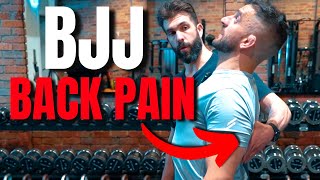
BJJ athlete Chris Trio gets assessed by strength coach Mark Ottobre and reveals limited thoracic extension, weak glutes that force his lumbar spine to compensate, and restricted shoulder external rotation from past injuries. Mark's fix: external rotation drills, thoracic mobility work, and glute activation to unlock better movement and less pain.
Chapters
Hey guys, it's Chris Trio here. Now, the other video you would have seen me rolling with Mark, smashing him on the mats. Now I'm here at Enterprise Fitness where he's going to return the favor and smash me.
Are you ready for your workout, Chris? Ready to train?
Jokes aside, I've actually come here to see him because I'm a jiu-jitsu athlete with a few injuries. So I've got a torn bicep, I've got a torn pec, dislocated my elbow in the past, currently my shoulder's wrecked. So I thought instead of just going to the gym and just trying to smash workouts, I'm going to come see Mark and he's going to guide me through a workout that's going to help my jiu-jitsu out.
In this video, I'm going to show you how I train a world-class Brazilian jiu-jitsu athlete. Hi, my name is Mark Ottobre. I'm the owner and founder of Enterprise Fitness. I've trained Commonwealth Games gold medalists, world champions, thousands of head-turning results, as well as hundreds competitors to winning championship gold on the stage. Before we get started in this video, 90% of you watching haven't subscribed to my channel, and it would go a long way in building this channel if you just took one moment, hit subscribe. It's completely free, folks, and I promise I'm going to keep delivering super high quality information so you can build your superhuman inside the gym and out. Hey, that's pretty good. Now let's get to the video. So what we're going to do today, Chris, is I'm going to basically do assessment on you, see where you're at physically, what limitations are, what your limitations are with your rolling and jiu-jitsu, and train you. Sweet. Cool.
So body's falling apart. Torn bicep, torn pec, currently an injured shoulder. I've dislocated my elbow so it doesn't straighten as much.
When you say currently injured shoulder, can we just backtrack on that and tell me what that is?
I'm not sure what it is, but like, uh, it was probably from jiu-jitsu, but then it just started to hurt. As in pushing motions are killing me at the moment.
Okay.
And sleeping is hard, as in like rolling over, not finding a comfortable spot, but I've never really checked it out.
Anything else?
Uh, not currently.
So bicep, pec, shoulder?
Yes. These don't bother me now. These don't bother me, just the shoulder's currently bothering me. But these I'm sure are limiting something. Yeah.
All right, well, let's just do an initial screening and see where your mobility's at. First thing I'll get you to do is take your socks and shoes off so I can see your feet as well. I'm gonna grab one of these sticks. I want to make some notes as we go. Can you do a bodyweight squat for me? Yeah, great range of motion. Cool. Let's do one more time. Yep. And back up. Okay, cool. So here, and I just want you to hop like that towards me and land.
Oh, yep, yep, yep. So just here?
Yep. Okay, do the other leg. Okay, cool. Reach down, touch your toes. All right, great. Put your hands on your hips and do a backbend for me. Just keep— stiffen up your legs and just move from your back. So you don't have to break any records, but just come up, come up. And just— you can move— do it in a couple times. So just want to see how you Yeah, it's not bad. Do it one more time for me. Can you go any more than that? Nah, you're a bit stiff. How's the back?
Stiff. Every morning stiff.
Grab this bar, uh, hands here, put it up over your head, and I need you to do a body squat in that position as well. So you can bring your feet wider if you like. Oh yeah, too bad actually. But that goes super wide. But yeah, now it's just here. Yeah. Shoulder pain?
No.
Okay, come back up and just do one more. It's not too bad at all.
The only tightness I feel is like right there in your mid-back.
Yeah, yeah, that's right. I want you to bridge, and then staying in that position, I want you to bring one leg up, bring one leg down. Bridge. You're gonna hold it for 5. 5, 4, 3, 2, 1, and bring it back down. Okay, so under— yep, bridge, bridge, bridge, bridge, bridge. Yep, now go. So leg a little bit lower, so keep it in line. That's it. 5, 4, 3, 2, 1. Yep. And another one. Bridge. Oh wait, wait, come back down. Come here. And bridge really high, high, high, high. Now go. Keep the leg lower, lower. 5, 4, 3, 2, 1. Come back down. When you do that bodyweight squat, there's a little bit of ab weakness, a little bit in terms of the— your butt winks towards the end. It's, it's minor. You move a lot from your back, right? So your hips, by default— because every, every time I get people to do like, you know, reach down, touch your toes, right? People think I'm looking at flexibility. I'm never looking at flexibility. I'm actually looking at how you get there. Okay, so the way get there is you're rounding and using all back. Yeah, right. So I know in jiu-jitsu, a lot of time spent on the floor, but the default of, you know, in athletics, everything really comes from the hips. So getting more glute engagement, especially because you do spend a lot of time on the floor, that's something I want to look at for you. So you default to using your back over your hips. So I'm going to look at some glute exercises for you. The upper— mobility-wise with the upper body, looked pretty good. So your overhead squat test was, was pretty good. Someone with a bad shoulder, it's pretty good. But you said you felt it in mid-back and thoracic extension as well, so I'm going to show you some stuff there. The hop forward, there was a— like, you jumped and it looks like adduction, but it may just be coming from your glute. It's probably coming from your glute because everything else is kind of tied into everything that I've said here. All right, so let's have a little look at your upper body now. But from a challenge test perspective, your lower body looks pretty good. The only— the real deficiencies I see is the glutes and the core. Bring your arm here for me. I'm just going to see what your external rotation is like. So come up nice and tall. So that's it, it's perfect. All right, and relax this arm into me. Keep up nice and tall. That's pretty good there. Let's go.
Oh, this one won't touch the floor. Oh, when I lie down, yeah.
Yeah, it feels pretty, pretty stiff through here. Yeah, but really nice through. Keep it, keep it up tall, keep up tall, keep up tall. Right, if we bring it around here, keep this down depressed, keep yourself depressed, keep yourself— you're struggling even with that. Bring your arm into mine. So it's up tall, that's it. That's not bad, it's not bad. When we go internal, let me check your external on this side. Bring this down. So I really want to get that lat pulled down into there, right? So It's a big difference. Do you feel that? Yeah. Do you feel the difference from this side? Yeah. Like the other side, you're coming all the way down. Here you're pretty, pretty banged up, um, which is somewhat— is there tension there?
No, I just feel stuck.
Yeah. Uh, and we have more room here on external rotation. So when we bring you back, we have more room, but we have less room through here, right? Uh, bring it down, bring it down. This one, this one's a sore one, right? This one's overworking. Okay, the theory of constraints. Everything operates on the theory of constraints. So in physical performance, if we look at you for example, yes, we could get you stronger, get you fitter, more cardiovascular, but at the moment, to me, the obvious thing that's going to limit your ability rolling is the fact that your shoulder hurts. So for me, I would gear then 80% of your training to be solving that shoulder injury, to get your shoulder and upper upper back feeling better and give you back mobility so things aren't hurting, that's going to make— that's going to have the biggest impact on, on your sport. Yes, of course it'd be nice to get stronger, and you will get stronger through doing these exercises, but if you have a limitation— like, the thing that takes out athletes is always injury and illness, so the two worst things. So we need to be working towards removing any injuries. So for me, the program to begin with for you would be one that orientates really around your external rotation. Thoracic extension, and then getting your glutes stronger. Because it's not that they're a weakness, but you don't use from the hips. Like, in your sport, they're going to be masked because you're not running, right? You're not jumping. But it will be masked to the fact that when you go for a bridge, you're probably sufficiently strong, but it's still not as good as it could be in terms of movement if you're using actually your pelvis. So I think if we unlock those things, it would make the biggest impact in the shortest amount of time on your training, but also long term. It will just make your feel better, which then you're going to be able to roll injury-free. So that's what I'd be looking for. So I'm going to show you exercises today. So it's not going to be like— we will do a little bit of conditioning stuff maybe towards the end just to show you how I would do that. But a lot of the things I'm going to show you is more based on how do we solve this shoulder injury ongoing and how can we bring strength back in these things. The other thing I just want to touch on is flexibility is having the range of motion. Mobility is having strength through range of motion. So, so for that shoulder, it's really jammed up. It does— you don't have any flexibility, but you also don't have any strength either. In, in no parts really do you have the flexibility and mobility. So we want to, we want to bring back flexibility and mobility, especially to that rotation. Uh, questions?
Now I'm assuming that, because I was saying before, like most mornings I wake up with just— I gotta crawl out of bed with severe back pain. Yeah, I'm assuming that's got to do with weak glutes.
Can Yeah. Yeah. So if we look at your spine, so if you hop up again, right, and you put your hands on your hips, do the backbend. So what you see, it's not, it's not like horrible, right? It's not like, oh my God, this guy's, you know, going to break his back. Bring your feet a little bit wider. But at the same time, come back. Do it again. Oh yeah. There isn't really much movement through the lumbar. When you say your back pain, where does your back pain begin from?
Right there.
In your lumbar, right? So you're getting all of the extension through your thoracic, right? This isn't really— it's pretty stiff. The other thing is this is also a strong muscle for you because if you look at also the way you pick things up, you pick things up like this with your back by rounding and probably your day to day, you're not using enough hips, which is then causing that, exacerbating that. So that's the reason why it's sore is because it's a good muscle, right? So muscles function as teams in the sense that let's say, for example, me, you in the video, we all go and Shaneo, we all like, basically, you and I say, let's just go and have— go to— let's go to the beach and let's play video games all day, and we leave him doing all the work. Well, he's going to be overworked. You and I are going to be quite rested. But then let's say, you know, the boss comes and he yells at the person who is tired. So the yells— yeah, who's tired, who's doing all the work. No, really, the boss should be yelling at the people who aren't doing the work, right? So in that case, you and I, right? So if you think of muscles like this as functioning as teams, is your back is a good muscle, right? It's, it's where your body goes to because it's a strength. It does the work. We don't want to punish the back anymore. We want to punish the glutes. We want to get the glutes active. So we're going to look at some exercises. So in this video, we assess Chris's areas of strengths and weaknesses as a Brazilian jiu-jitsu athlete. Tune in to the next video as we delve into flexibility and activation exercises to improve Chris's performance. If you've enjoyed this video, click here or here.










