How to Lunge Correctly (Form Tips and Variations)
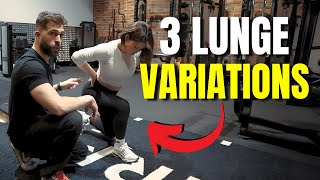
Coach Michael Towbury and athlete Manami demonstrate lunge mechanics and variations, from bodyweight to barbell. Key points: shin angle determines whether quads or glutes dominate, and keeping your torso tall prevents forward lean. They progress through goblet holds, dumbbells, and loaded positions, with cues for common faults.
Chapters
In this video, I'm going to be breaking down the lunge and all of its variations. Hi, my name is Michael Towbury, and I have trained Olympic athletes, Commonwealth Games gold medalists, world champions, hundreds of winners in physique sports, and tens of thousands of head-turning transformations. Today I'm here with Manami, and we're going to show you a heap of different lunge variations. So firstly, let's look at a very basic lunge. Manami, if you just want to take a space here and just perform a lunge for me, just a static lunge. So stepping out and lunge. Now, some of the considerations that— just give me like 2, 3 reps. Some of the considerations that we want to look at first and foremost on a lunge is the shin position. So the shin position is going to determine whether we are working more quad or whether we are working more glute. The more the knee drives over the toe, the more the shin is on a diagonal, the more quad we are going to be working. The more— if you can do a lunge, stand up for me, do a lunge for me, but don't let your knee come over your toe. So as she pulls down, we are now in a position where she's going to be using a lot more glute. Go a little wider with your stance. So in this position, really keep that knee as far back as possible and you'll feel it a lot more in your glute now. So you can control the lunge in terms of what you want to be working or what you want to be enhancing, whether it's the glute or whether it's the quad. So that's the first consideration. The second consideration is our body position. Manami is naturally leaning very far forward. So one of the things that I like to do with people when they lunge is go back into that lunge position. Is I want you to be as up tall as possible. So there we go. So now we are stretching out the opposing hip flexor. So it's not quite becoming a split squat because a split squat, her leg would be much further back. But we do want to take a consideration for her position of her upper back. Now, the lunge primarily is a supplementary exercise. It's leading towards something. It's unilateral, which We want to work towards a bilateral exercise because it's in bilateral exercises that we're going to express the most power. Take a rest for just a sec. So in saying that, we're going to start with the most remedial type of lunge in terms of teaching someone a good position, and that we're going to use a wrestler bag. A wrestler bag is inexpensive, it's easy to use, you can throw it on the floor, and it's also comfortable. So what I'm going to use this as a tool is you're going to hold it like a front squat. So I'm going to get you to hold it nice and close in that goblet squat position. So kind of give it a cuddle if you will, turn around and face this way. Now in this position, what I want to teach is a few things. So Manami, what I want you to do is I want you to stack your ribs on top of your pelvis, want you to bring your pelvis up and high, so almost like you're hiding your tailbone. And now I want you to go perform that lunge. So we've created— in doing that, we've created stiffness through her lumbar spine. So do the lunge. Now then I can take considerations for where I want her knee to be. Do I want to be enhancing the quad in this position, or do I want to be enhancing the glute? Well, it depends upon her and her training goals, and obviously then her screening and assessment and her deficiencies. So come up nice and tall. I'm going to show you what a more quad dominant will look like. Just take a wider stance for me. Yep, that's it. Now I want you to really drive that knee forward as you do the lunge. And that's a really nice— it's a nice looking lunge. That, that's already switching on. You can see her now working a lot harder in doing it. And that's a pretty basic lunge, but very, very, very effective for multiple reasons. Okay, take a rest for just a second. Now, some principles that we can layer in that are true with every single lunge is the static lunge is always going to be easier. And the way you want to do it primarily is you want to do one leg, then move to the other leg. The other way to do it to make it a little bit harder is you create some dynamic movement. And what that's going to look like— assume the same position. And what she's going to do on this is she's going to step forward and then step back. So step forward and step back. And we're going to do the same leg. So do all of your reps on that leg, rest a little, then do reps on the other leg. Now, in creating some dynamic movement, you can see that Manabi's body now is moving as well, which is not what we want. We want her to be up nice and tight, so crunching in that position, cuddle the bag, don't move anything at all. So now step nice and wide and push back, step a little bit further, step a little bit further and push back. So this is going to be harder because now we need force. And again, she's moving her body forward. The way to correct that is I'll put my hand here so that way her body doesn't move forward. So if I put my hand here, she now she moves straight. That becomes a lot harder because now she's up nice and tall. And rest. So we want to make it harder again. We won't do it with the wrestler bag. She's looking— we'll do it with the dumbbells. So to make it harder again, again, we can use different implements. So what you've seen is a static lunge, we've seen a dynamic alternative lunge. We're going to do a drop lunge. I'm going to demonstrate this with the dumbbells. And again, you could use this with the wrestler bag, you could do this with a barbell, you could do this— we're going to do it with dumbbells. So I'm going to get you to grab dumbbells. They're only the 5 kilos, so nice and light for you. But this is a drop lunge, which creates a deficit in the movement. So she's starting on a block, step a little bit further, she's going to drop into position and then come back straight back up. So this requires more strength. All the way, push straight back up, a little wider in your stance. So take a little bit more of a step when you do it, take a bit more of a step. And again, you're moving forward. So let's get nice and tight, nice and tight. We want to look at these things as coaches. Get up on that back toe nice and high. And again, imagine my hands there, right? Don't come into my hand. There you go. That's better. Don't let your body drop. Drop into it and push. So you can see on that push, it requires a lot more power and strength to get herself into that position. So this does make it significantly harder, although it does reduce tension over the whole muscle. So if your goal is hypertrophy, you're probably not looking so much at this variation. You're probably looking at the static variation. Take a rest. Take a rest. Okay, take a rest. Now we want to make it even harder still. We're going to move to a barbell, and don't worry, we're not going to do drop lunges with the barbell, but let's have a look at the bar on your back. There you go. And stepping forward and lunging. So, yep, perfect. So you can do static, yep, you can do alternative. So just, just do a demonstration of the alternative. Legs are getting a bit sore now, so that's the alternate. But remember, we're going to do— when we're doing alternative, we're going to do one leg, rest, then the other leg. We're not going to do 1, 1, 1, 1, because then it would be a bit more like a cluster set if we do it that way, right? Then also, if you rack it back in This is one of my favorite ways of doing for a more advanced lifter because it corrects so many things when they do an exercise, and that is the front racked position lunge. So grab it like a front squat, give me 3 reps just for the purposes of the demo, and you'll see— and you saw before how Manami was moving forward when she did this. Watch her body position when she does this lunge now. Beautiful. Straight. So if I was programming for Manami, this is one of the exercises that I would give her. Go into a static position. Don't do alternative. Just step one foot out, step one foot out, step it out, and then just come straight down. Come straight down and straight back up. One. That's it. So this position, she is beautifully up nice and tall. She's keeping all those things. She's not rocking forward at all. This would be a good position for her. 'cause it addresses the forward lean, which she was doing before on some of the other, those other implements. So that's really great. All right, and you can rack it back in. So that's another way you can come at the lunge with. So there's a lot of variations there that we've discussed today. We've got the goblet variation, we've got the static variation, we've got the alternative, we've got the drop lunge with dumbbells, you can do drop lunge with a wrestler bag, you can do it with a barbell. And then also you can go to the barbell, put it on your back, or also go into that front squat position, which is going to correct that forward lean. If you've enjoyed this video, want to know more about exercise selection, the business of fitness, consider subscribing to my channel. Want more videos to learn how to build your superhuman? Click here or here.










