How to Squat Without Back or Knee Pain (Complete Guide)
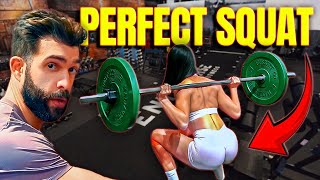
Mark Ottobre coaches Lauren through squat fixes: removing shoes, tightening lat tension, and using a resistance band below the knees to stop knee clicking and back pain. He then walks through low-bar and front squat variations, each with specific cues for glute activation and injury prevention.
Chapters
In this video, I'm going to be teaching Lauren the finer points of the squat and figuring out what is the best way for her to squat. So watch this video, we're going to go through low bar, high bar, and even the front squat. My name is Mark Ottobre, I am the owner and founder of Enterprise Fitness. I've trained thousands of people to head-turning results— world champions, world leaders, Commonwealth Games gold medalists. Let's get into today's video. So Lauren, let's have a look at how you squat, how you would set up, how you do everything. And you just squat. So her hands are pretty wide, feet are pretty wide. She's not really depressed, she's using a high bar position. And you can hear her knees clicking as well. You can see her knees a little bit there, they're moving in just a tiny bit, and we are losing a lot of stability through her upper back. And I'm going to do some tweaking of Lauren's technique to make this more effective. I'm going to get her to take off her shoes and I'm going to get her to elevate her feet. That's better. Her upper back is a lot more tight. Her lats are down, much more engaged, which is going to be a lot more stable for her as she squats. I'm going to help walk you out. I've lost some height from the shoes. It's all right, I'll help you on and off. Get your feet just a tiny bit closer together. All right, go there. Yep. All right, already we can hear no noise from her, her knees, which is a good thing. All right, so that immediately changing Lauren's upper back position did quite considerably change the mechanics of the squat. But still at the bottom, I feel there's a lot of energy dissipated. So we're gonna do one other thing that's going to help Lauren out. So what I'm going to get you to do is just pop that on below your knees. We'll do it with a blank bar, but we will put some weight on. But I want to compare apples with apples, so we're going to do it with an empty bar. That looks good. So what the band does in this position is it offers sensory feedback. So she has to splay her knees out. So you can see now she's splaying her knees out a lot more. And as a result, she's a lot more stable at her pelvis, a lot more stable. That looks a lot better. So we haven't changed all that much for Lauren, but what we have changed is we've put the elevation, we've put some sensory feedback at her knees, and we've changed this position, which is what it's done. It's created a lot more of a stable base for Lauren to squat against. Technique is only as good as when it gets tested. So we need to make it a little bit challenging. We're not going to go too nuts, but we'll put on a little bit of weight for Lauren just to see what she does and what her body does and how stable she's able to stay. So hands pretty tight, pretty close. The upper back is nice and engaged. Good. 3. Excellent. Just a couple of points on what we've done, right? So really, the main things that we've done for Lauren right here is we've increased stability. The way we've done that specifically is bringing her hands in tighter so she's not losing any energy. She's much more stable through the spine, bringing the hands in tighter and depressing through the lats. The other stability piece is the band around her knees that's forcing her to externally rotate from the pelvis and stay stable using the glutes, offering that sensory feedback. And the other thing that we've done is we have elevated the heel. Now Lauren has the range of motion to do it without elevating the heel. She absolutely does. But by also elevating the heel, we shift the center of mass forward, which makes it more advantageous and easier to get into that end range position, and for most people just feels comfortable. I do consider a slight elevation neutral because think of it as using a lifter's shoe. A lifter's shoe has a slight elevation. Let's look at the low bar squat. What the low bar position does also, for the folks who are new to it, is the high bar is further away from our center of mass. The low bar is closer to our center of mass. It's a more mechanically advantageous position to lift load, and the low bar position is easier because it's closer into our center of mass. So as your knees drive forward, you your hips drive back. And what that looks like is this. See how my hips are driving out, my knees are driving forward. They're both happening at the same time, so I get a nice stable base. Put that in the low bar position, and I'll just guide you where low bar is. Just a little higher, a little higher. There, do you feel that? Just in there, right? Now you're going to need to— as you unrack this, you need— exactly, elbows need to come a little bit further back, right? And if you need to, your hands can go a little wider if it does feel a little bit more comfortable and helps you sit in that position. That's a nice position. And hips, hips, hips and knees, and back up. Good. Hips and knees and back up. Excellent. That's actually a really nice position for Lauren for squatting. Now, you saw a couple of things there. That band for Lauren, I think for the next couple of weeks in her training, will probably be key because she still does rotate the femurs in, which then is leading that she wants to use her quads more than she wants to use her glutes. And one of her goals right now is to maximize glute development for competing. So have you ever front squatted before? No. Oh, you've never front squatted before? Or two. So the front squat, what it really enables is we need depression of the lat, so we need to be down. We need extension of our thoracic. And then also, to do a front squat really nicely, we need nice ankle mobility and able to get into deep knee extension. So what we'll use is we use a female bar that feels already a bit more comfortable. Yeah. So this position right now for Lauren is unfamiliar. It's not that it's bad, it's just unfamiliar right now. I will get you to bring your feet a little bit closer together. Spread your knees, spread your knees, spread your knees, spread your knees. So the biggest constraint here that you see with Lauren is that upper back position, and I'm going to say that's mainly due to weakness, not due to mobility, because she does have great mobility. All right, the way we'll test this theory is I'm going to elevate your heels. This will change the center of mass. So face that way, do the exactly same thing, and spread the knees, spread the knees, spread the knees. And Lauren right now is still holding all of that in her arms. Where do you mainly feel that? I feel more just in my arms because I'm trying to hold up. So for someone who doesn't have that range of motion yet and getting used to it, you can use straps. So you're going to get this position and you're going to be holding like that. So this is a much better approach than using that, because if we use the cross arm approach, it's not going to activate and engage our upper back, whereas this will engage the upper back and help with our thoracic extension, which is super, super important as part of the front squat. So one of the most important things is elbows up as high as you can. There you go. So you can see now her position where her elbows are, because she can't maintain that position due to the weakness through her back. That's where she needs to be. Yep, perfect. You get it nice into your clavicle, get it nice up into— yep, that's it, that's it there. As you squat now, bring those elbows up. So squat through and bring those elbows up. Good, that's a nice front squat there. You can still see though there's a gap between the bar and her that shouldn't exist. And again, that's just her getting used to it, right? And I like using the front squat for multiple reasons. You can really see the knee flexion, how you're able to get into that deep range. The abs are certainly working, core's certainly working, and we've got that thoracic extension. So for female competitors particularly who are, you know, needing this upper back development, the front squat's going to give you development in your upper back that other exercise won't. Let's go one more, but really keep that up, right? That's where you need to be. That's where you need to be. Up nice and tall, up nice and tall, up nice and tall. Come on. All right, rack it in.










