I Fixed This Beginner's Squat in 20 Minutes (Watch the Difference)
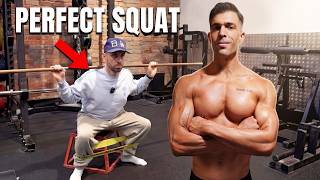
Trainer Mark coaches Jamie through knee pain and clicking during squats using stance adjustments, glute activation drills, and verbal cues. After 20 minutes, Jamie's clicking reduces and pain drops to 1-2/10. Mark prescribes twice-weekly leg work with strict form checks to lock in the pattern.
Chapters
Hide your balls. Show your balls. Spread the glutes. Spread the glutes. Spread the glutes. Spread the glutes. Ass out. Ass out. Ass out. Ass out. Ass out.
One more.
One more. One more. One more.
Right where my finger is. There? Yes. Right there.
Yes. You're not using your glutes enough. Welcome to week 3 of Jamie's 10-week transformation. Last week we hit upper body and this week we're hitting everyone's favorite legs. Oh no, I'm worried. Let's have a look at your bodyweight squat.
I hardly train my legs.
Let's have a look at your bodyweight squat. So what I'm doing now is I'm just seeing how Jamie moves. And where the discrepancies are in his squat. You hurt it on a decline press, like the—
what's the one where you're like laying back and you—
Leg press. Leg press.
Clearly I don't do legs. I couldn't even think of the name of the machine. I avoid legs like a plague. I've never had legs. I guess I kind of assumed I'm never going to get legs, so I'll work on the other parts.
How long ago was that?
About maybe a year and a half, 2 years ago.
Okay, yep. So it would be recovered. So it's a pattern issue. So I immediately identify that this is a pattern issue for Jamie because there's been some time that's passed since he did the injury and to now in a few years. So really what I'm looking for is the way he moves and why this pattern is creating pain for him. What do you do for your legs right now?
At the moment I do like the— what are those?
Leg extension?
Leg extension and calf raises, and that's about it.
You don't do any squatting?
No, because every time I do squats, my knee ends up having issues again.
Let's have a look at this. We're going to do it really slowly and only with what you're comfortable with, right? Sure. I want you standing here. I'm going to put a band around your knees in a moment. I want your arms out in front of you and I want you squatting down slowly, slowly, slowly, slowly, slowly. Slowly and all the way back up. Um, actually, I think you take off those shoes because they're not good shoes to squat in. So that's a common thing, people come in with really trendy fashionable shoes, but the footwear is not good for their feet or for their knees. It's like squatting in a big pillow, their feet are moving around. We really want to make sure we have a stable base anytime that we're squatting. Wider with our feet. Okay, I want you to point your toes out as well. Point your toes out, point your toes out. All right, now show me, and just slowly, slowly, slowly. Slowly, and, and back up.
I'm low-key embarrassed right now because I'm squatting body weight. I mean, I'm not even adding weight to the squat. It's just me and my knees. Like, I do not like this.
Okay, out of 1 to 10, how does it— how, like, how would you describe it in terms of pain?
In terms of pain, it's probably like a, like a 1 to 2.
And instead of the elevation is I want you here. I'm going to put my hand in front and I want you to Go wider with your stance and then stand up. Point your toes out. Yeah, a little wider, a little wider, a little wider. Yep. Now do a squat for me. Sitting in and standing up. What I'm doing right now is testing variations of the squat to get Jamie to squat pain-free. Okay, so we're on the right thread then. Imagine you've got a string here, I'm pulling your knees forward, and I've got a string here, I'm pulling your hips back. I want those things happening at the same time. What it looks like the pain is coming from is when he moves his knee forward, and what we really need to do is get him to use his hips more. So stick your ass back. ass out, ass out, and spread your knees. Now go. Spread your knees. Spread your knees. Spread, spread, spread, spread, spread, spread, spread, spread, spread. Stand up.
There you go.
Now hands up in front of you. 4. Good.
I feel like the tiniest still, but nothing like the other six.
Go a little wider with your foot.
Okay, There you go.
So what's happening with Jamie is as he squats his femur, that long bone in your leg is moving and rotating in, which which is causing pain on his knee. So what I'm doing now is training his glutes because the glutes stabilize that and keeps the leg out, which keeps the pain— there is no pain once that knee is out. It keeps the right muscles working to reduce any pain that's happening on his knee. So we're moving to that glute, that hip thrust, to activate his glutes. And now I'm going to see how it affects his pattern and if the pain goes away. Come up, pull that back. I want you to squish the pad with your thighs. Yep. And then Extend. Squish the pad. Kind of like hide your balls, show your balls. Hide your balls, show your balls. The reason why I like to use obscene cues like hide your balls, show your balls is because instantly people get it. They remember.
This is that one exercise I've seen in the gym, thought I am never doing that one in public. Here I am doing it on the internet.
Hide your balls, show your balls. One, really work the glutes. One.
9, 10.
2 more, 2 more, 2 more, 2 more, 2 more. 1. Last one, last one, last one. Squeeze your ass, squeeze your ass, squeeze your ass, and push it forward. How's that?
Yeah, that was good. But I'm definitely feeling it in my butt. I've never worked my glutes before, so I'm feeling this at this point. This is not a feeling I'm used to feeling right now.
Anything in your back or glutes?
Which one? I felt it in my ass. Yeah, come with me and we're going We're going to do squats.
All right, you're going to put this stick on your back. Yep, hands nice and close as if it was a bar. I like to start clients off with a stick because a stick is going to be representative of once they progress to putting a bar on their back. Now, if there's any pain with the stick on their back, obviously they're not ready to put a barbell on their back, which is something that most people just go to straight away. They just put the barbell and assume they're going to be fine. But if you can't do the movement pattern with a stick, well then there's going to be problems. Elbows back, elbows back, elbows back. Now chest up, pull the ribs down. Okay, I want you to maintain that. Two things I want you to do. Don't look around. Up nice and tall from here, almost from your stomach. Yep. Up nice and tall. No, no, don't lean back. Here, right. Now stick your ass out and squat for me. Stick your ass out. Spread your gooch as you squat. Spread your gooch harder. Again with the dirty cues. Reason being, if I just simply say spread your feet, what happens with people's feet is they move their feet out and it's the wrong movement. Really what I want is for people to spread from their pelvis that creates more stability. Once we have more stability, we get more mobility, and obviously from that place we have more strength. You know what I mean when I say that? Yeah, yeah. Spread harder, spread harder. Any knee pain? Spread the glute harder.
There you go.
4. Spread the glute, spread the glute. 11, 12. All right, relax. How'd that feel?
Good.
Knee pain?
No. Zero?
Gone?
Yep.
Completely?
Maybe like a 1.
Okay, we can do 1 because you need to start bringing strength into it and getting exposed to that. Yeah. Your problem— yeah, you move forward like this. Yep. Right, so your femur as you do it rotates. Now what's responsible for that rotation? Why are you causing knee pain? Your glute. The reason why I've put that there is to anchor that you want to be this way. You don't want to be this way. When you go into here, that's when you hurt your knee. Ah, right. So hide your balls. Show your balls. One. I can really see here there's so many things that Jamie is really quite struggling with. In fact, all of this I think is really quite foreign to Jamie. So getting him to ground his feet into the floor, open up and splay, and then thrust forward, even with the squat, making sure that when he squats he pulls everything. I think what Jamie's been doing for his training history is using a lot of machines and kind of just like disconnecting when he's training. And really, when you're training, like when I get him to stack his rib cage on top of his pelvis, when I get him tense up through his abs and really tense everything up to go through the movement. It's about creating as much stability as possible to protect your body, and that's what you want to do when you train. You want to make sure you create internal stability so you can perform with maximum effort.
There you go. Cool, that felt good. All right, I'm getting the hang of this. I think we're on the right track. We started off, I wasn't really able to do anything because of my knee, and now we're, we're making some progress. And moving forward, we're rehabbing this problem that I've been avoiding rehabbing for quite some time.
So right now, you know, the bar is not So just bring it up overhead, bring it up overhead, bring it up overhead. Okay, now I want your hands to be perfectly positioned. So what we're going to do is going to put our thumb here, yeah, as a measuring tool, and then we're going to wrap. Absolute pet peeve of mine is when trainers do not pay attention to where their clients put their hands. And simplest thing is like when the bar isn't even on a client's back, it's obviously going to change the movement completely and make it unsafe. I want your upper back squished, squished, squished. That's nice. Okay, so ribs, crunch them down, down, down, down, down, down. Forward. There. So if I'm going to punch in the stomach, I want this on. Okay, feel that? Yeah, this stiffness. That's where we want our upper body to be at all times. You remember how to squat? This is 8 kilos on the bar. So that was terrible.
Yeah.
Do you know why it was terrible?
Why?
You had no consciousness of what you were doing. You just sat down and went down and hoped for the best.
Legs, it's just not my comfort zone. It's been something I've been avoiding for so long, and now I'm just— I'm having to push through, but I am getting a little bit frustrated. I feel so much more confident when I'm training the upper But I'm not going to get to where I want to be if I only focus on my upper. So I've got to push through, got to finally do legs.
Go wider, step out, step out.
There, there, there, there, there.
Now turn. Ah, ah, too much, too much. Here, here. Now spread the gooch. Remember that, the cue.
There you go.
This can be done slowly. You don't have to do this all at once, right? One. Slowly down, fast up. Slowly down. Spread the gooch, spread the gooch, spread the gooch, spread the gooch.
That's it.
I'm going to call that one.
Okay.
You feel the difference? Yeah. Okay, 2. And I want you to spread even more. Spread even more. Spread even more. 3. How's the knee?
I feel like a sort of like a click that goes from there to like a sort of like a muscle spasm that goes up back of the leg. Does that make sense? No.
Okay, tell me more. When a client tells me that something's off, I Tend to like to feel around so I can feel the exact muscle, because sometimes people will say my calf is what's hurting, but actually it's their hamstring. So when I put my hand into it, I can actually feel what is tight and maybe even do some release work like I do with Jamie.
Around— yeah, around there.
Abductor magnets.
I have no idea.
Yeah, yeah, you through here?
Uh, a little lower, so like right where— right where my finger is. There? Yes, right there.
Yes, that's it. You're not using— you're not using your glutes? So don't take anything for granted. Be conscious about every rep. Stick your ass out more. Stick your ass out and spread the goods. Stick your ass out. Ass out. Ass out. Ass out. Ass out. Ass out. Ass out. More, more, more, more, more, more. It's not enough. Spread, spread. That's it. Spread, spread, spread, spread, spread, spread, spread. Ass back.
Ass back.
Ass back. Ass back. Okay, that's too fast. Before you start moving, uh-uh. Oh, stick your bum out. So what I really need Jamie to do is, is this, is like stick his butt out, right? But what he keeps doing is this, it keeps moving forward, and that's why he keeps feeling it in his knee. I just want to grab him and pull the hips back so he uses his bum. I know what to do. This way down, this will be your favorite. Yep, here we go. Is this sore? Yeah. You sore?
Yeah.
Yeah. So I'm doing some soft tissue release work with Jamie right now, and what I found was that the soft tissue work didn't really change the pain. So what it really was, it went back down to the first thing that I saw and diagnosed, which was it was his movement pattern, making sure that when he did the exercises, he moves from his glutes and initiated with his hips rather than the knee because he just kept bringing that knee in and that's where he felt the pain. Oh yeah. Feel that?
Yeah.
See that release? Yep. Feel it in my hands.
I'm trying my hardest to keep a straight face because I know I'm being filmed, but I'm definitely feeling this right now.
You know the good thing about me?
What?
I've got really big hands. You know the other good thing about me? I've got really strong hands. Oh, I felt it again. Feel that one?
Oh yeah, I felt a massive, like, click.
Has it eased off a little bit or is it still— because I feel exactly where it is.
Yeah, it feels about the same, to be honest.
Yeah, I'm thinking now maybe I should have released his calf.
It just doesn't want to go away. It seems like we're making progress and then my knee's like, nope, I'm just going to keep clicking.
Everything is just weak and tight.
Yep.
What causes it? Weakness, tightness. 2, 3, 4, 5. And all right, let's do a squat again. Bring your feet a little bit wider, turn out your feet again, because I'm not convinced that's the best method just given your knee. So, so try it, try again for me. Squat.
It's way worse like that. Way worse?
Way worse on your knee?
Yeah.
One of the interventions that I made with this squat didn't work quite the way I wanted to. I thought it would alleviate all of his knee pain. What I found is it didn't. So I worked back in a more heels-elevated squat, but again, it made his squat worse. So now I was thinking, how do I approach this to make sure we get rid of all of his knee pain? Step up. So when you do it, I want you to shift into your ass and stand up. I don't want you to be here and stand up. I want you to be here. So then what I realized with Jamie is the knee pain wasn't going to be overcome with simple squats, is I needed to move him and regress him back to a step-up to really get him to shift into his glutes, because the movement again was quite foreign. He's been using a lot of machines, and he's also not that experienced in squatting correctly. So using what we call a unilateral approach, whereas one leg at a time, I moved him to a step-up and really getting him to move forward so he used more of his glutes and his bum, which was the weak area that he needs to work on. That way. So see, I'm like stacking. Now stand up. One. Here, stand up, feet together when you stand. Okay. 1, ass back, ass back. See, you took that a little bit grounded. I want you to shift this back each time, right? This is a new pattern for you. He really doesn't want to use his glutes. Everything we're doing is he's shooting that knee straight and forward. Load through the hips, load through the hips. Here, 4. Feel the difference?
Yep.
This is where we need to start. 3. This feels better? Way better. So I'm not gonna lie, I was frustrated because I wasn't getting the exact exercise that I needed to get rid of his knee pain, but eventually Eventually we got there, which was the step up, but really getting him to push those hips back and getting him to practice that movement. Because again, Jamie just wants to bring that knee forward, which is making his knee pain so much worse. And what we needed to do was train that glute to make sure it took all the pressure off his knee and put it into his hips.
I still feel it, but not as bad.
8. Just be conscious, got 2 more. Spread the knee, spread the knee, spread. There, see that one has come in? Yeah, that did that. Yeah, yeah, don't let it do that, right? You've got to keep it out.
So my knee, because it's so weak, it keeps wanting to go in, and I I keep having to correct that.
So what Jamie's experiencing right now is super common for people coming to the gym. Most people might think that coming to the gym you have to be completely perfect, and I can tell you through 20 years of running a studio that that is completely false. Most people who come in through our doors have some form of dysfunction. It's actually quite normal that people have joint pain, and understanding the science of training— it's not voodoo magic getting someone out of pain, it's understanding which muscles are underperforming performing, getting them strong, and creating a plan that's going to get those joints pain-free. No, see how you're shifting it forward? Your knee doesn't shift forward, right? Your hips shift back. Okay, so stick your ass out there. Now stand. One. Stick your ass out. No, your knee's still shifting forward. Ass back. Stick it—
there you go.
So you're gonna have to tilt forward a little bit, right? 10. Good. And if you notice on this side, when you step down, your whole leg is rotated that way, which indicates there is something going on through your abductor, which is what you felt. Stick your ass back towards me. No, no, knee's still shifting forward. I don't want it forward. Uh, your foot doesn't move, right? All right, what happens is that— so see how I'm sticking your ass out? So show me your glute, show me your bum. 1, Control. Show me your bump. Show me your bump before you lift. 2. Show me your bump before you lift. That's better. Okay, you see how your knee's not clicking now?
Yeah. Oh wow, my knee's actually not clicking. I'm actually getting through this motion without that painful clicking feeling in my knee. I'm feeling it. I'm lifting a very minimal amount of weight, but I'm actually feeling like I'm getting through this process with out the usual clicking pain. So we're on to something.
So for you, your leg workout, the A's that we need is we need to start with step-ups, right? That's where we're going to start. We'll go back and do one more of the glutes, then one more here.
That was a really bad joke. You can edit that one out.
You want me to look at your bum? Sore?
Oh yeah, super sore.
You can see his face, and it took me a little while to click, and I'm like, well, if it's adductor magnus then it has to be his glute. It's also coming from his calf as well. So everything— then everything started to make sense, is I really need to attack Jamie's glutes and get his glutes as strong as possible, because that's what's the key going to be to getting him out of knee pain.
This is really hurting right now. I'm struggling to keep a straight face, but it is hurting, and I'm, I'm just being stubborn. I'm like, nah, no, that's all right, that's all right.
That's cool. Just mean that you're here.
Ah, you're like, you're like, I need to get at least one reaction out of you. Oh, that's like the pressure point.
It's like, it's trigger point.
That's bringing me back to primary school when people used to do pressure points. Do you remember that? I have some traumatic childhood memories. Or was it just my school where kids would go around and sneak up on you and they would pinch you right on the shoulders, right on the pressure point, and you'd just scream, and it was the okay thing to do because kids back then were psychopaths.
Except my trigger points would give you more range of motion. After doing the release work with Jamie, he's moving so much better, which shows me 100% I'm on the right track with the right exercises that we need to be doing and what's tight and weak. 4, 5. How'd it feel?
Yeah, I felt that. Good, but I felt it.
Yeah, glutes.
Yeah, I feel like I'm not going to be able to walk tomorrow.
Oh, you'll be fine. Last one over here. Push the heel down into the floor. You're down to the floor. Go.
One.
Heel down. Okay, slow it down. I'm not gonna count that one. I'm all for positive reinforcement, but I'm also for negative reinforcement. If a client doesn't do a rep correctly, I don't count it. Slow it down. One more, one more, one more. And slow down.
That's it.
Switch. Push your heel into the floor. Stick your ass back. Should know you just stuck your knee forward.
1.
More. 8. You felt that when it came in? Yeah. Focus on what you're doing. Heels down, heels down. 9. 10, 2 more, 1 more. Push that, push that, push that towards me. Push that, push that, push that. There you go, done. That was good. Um, questions on it?
I still felt a little bit of clicking, but not like before.
Yeah, there is still a little bit of clicking, but you would have noticed some reps there was no clicking.
Yes.
And some reps—
and what I did notice, the reps where it started to move in a little bit. That's where I felt the click.
So Jamie just affirmed exactly my hypothesis around his knee issues. He said when I've got my knee in the right position, there is absolutely no clicking. And that's why when I got him to do the step-up, I put my hand on his knee, because every time he did it incorrectly, I felt the click. And when he did it right, there was no click. So it's really just a matter of him grinding in that movement and making sure every rep is performed exactly the way it should be, and he'll be on his road to recovery in no time. Again, it's not— there's anything wrong with this position, it's just that your body's prepared in this position, right? And when you do this, what happens is you go to here, right? So what we're going to do, we're trying to train a stronger pattern for you. And that pattern that's going to get you stronger, and also it's because your glutes are weak, is you're trying to extend your bum back and get you to stand up like that, right? So you're using a lot more ass. Now for you, that's not natural. No, that's a foreign movement. But that is also where you're weak, and there's also where your knee and your bone position of your femur is going to be a lot stronger. So if here constantly. We're just drumming in a really bad pattern.
So something that Mark keeps drumming into my head that makes a lot of sense is some things will feel abnormal, and just because something feels abnormal doesn't mean that it's not right. It just means that it's not familiar. And I think we get in the habit of doing things a certain way, and then when those habits are being broken, it can feel really uncomfortable at the time, but it's something that we have to push through to be able to create that new normal that will allow us to create a higher ceiling when we're training or doing anything in life where we want to grow.
So right now it's teach people how to move, teach people how to lift, then train them hard. You need to learn how to move. You're not moving correctly to be loaded, so you won't be going heavier. We're not going to be pushing through anything. I want This needs to be second nature. You need lots and lots of reps. When I say he needs to do lots and lots of reps, what I'm really saying is he needs to do this twice a week, and we need at minimum 4 to 5 sets and at least 10 to 12 reps. 3, 4. Up high, up high, up high. This way. Good man. All right, that's it for today.
Thank you very much. Thanks for a great session.
Hope you got a lot out of this, how to work with knee issues. Like and subscribe to see the next episode.










