I Get My Friend Shredded in 10 Weeks
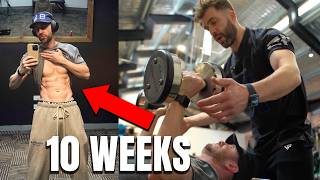
In this YouTube episode, personal trainer Mark Ottobre continues the 10‑week body‑transformation series with his friend Jamie, a 1.6 M‑subscriber YouTuber. The session, covering weeks 4‑6, begins with a weight check confirming a 1 % weekly loss, then moves through a full‑body workout focusing on lat pulldowns, chin‑ups, bench press, rows, and accessory work. Mark addresses Jamie’s recurring wrist pain by swapping to MagGrips and demonstrates specific wrist‑rehab drills borrowed from Olympic gymnastics. He repeatedly cues scapular retraction, chest‑up posture, and proper elbow mechanics to rebuild Jamie’s mind‑muscle connection for lats and improve overall posture. Throughout the workout Mark emphasizes breaking bad movement patterns via isolation drills (single‑arm cable row), using the mantra “fail with grace,” and rejecting “bad reps.” He frames movement as a language, stressing repetition, exposure, and coaching feedback (“show me”) as essential for lasting change. Jamie reports growing confidence, better posture, and the ability to internalize Mark’s cues when training alone. The episode ends with a reminder to subscribe and watch previous weeks.
Chapters
Ah, what was that? That one doesn't count. Come on, do it properly. This is my friend Jamie. He has over 1.6 million followers on YouTube, and over the next 10 weeks, I'll be taking him on a transformational journey to help him achieve his dream body. We're now in week 4. If you haven't already seen the first 3 weeks, I'll leave a link in the description so you can catch those up. In this episode, we take Jamie through the next 3 weeks of his transformation. He had the last 3 weeks to get settled. Time to start turning up the heat. Let's have a look at where your weight is. Take those socks, shoes, clothes. We want to be consistent with how we weigh you. Fantastic. Relax. Never thought I'd be down on one knee. We're at 14. We're at 14.8. You were at 15.7 last week. He was at 15.7, now he's at 14.8. That is a good drop. We want to drop around 1% per week. That means we are on track, and Jamie certainly was on track at this point. I'm Mark Ottobre, and I'm the founder of Enterprise Fitness. I've trained hundreds of first-place winners at fitness competitions, Olympic athletes, and Commonwealth Games gold medalists. So I'm happy. We're not going to change anything. We're moving in the right direction. Just 10 reps. Everything stays aligned. Yep, which is good. Put it back. Grab me the 12s. Do another set. We are doing incline press, very simple, and lat pulldown. And we're going to do shoulder press and seated row. Push your chest up, push your chest up, up. Push my hand away, push my hand away. So keep this chest up, push your chest up against my hands. There you go. Chest up, chest up, chest up. Good. All right, put them back.
My bottleneck with these is always my, uh, My left wrist gives in before my arms.
Uh, right there. Hmm, okay.
A few months ago, I took a boxing class and I didn't wrap my hands. I wasn't told to wrap my hands. I was feeling a little bit of pain while I was going, but I thought, "Look, let's keep going." Next day, my wrist was a little bit sore. Next day, my wrist was also a little bit sore. Months and months later, Wrist still a little bit sore. Lesson learned: wrap your hands when you do boxing.
We are going to bypass your wrist issues completely. So what I did here was I changed the grip from a straight bar to using one of the MagGrips. The MagGrips are a lot nicer on the wrists and the hands and also allows for more of a scapular articulation. So people are really able to retract and depress and really use that— all their scapula without really using much forearm strength at all. So I think it was a lot nicer Jamie.
When I first started training with Mark, I was really struggling with the lat pulldowns because I wasn't able to get that mind-muscle connection with my lats, and I was getting really frustrated because I was so used to doing it a completely different way. A change that we made made a world of difference to the way I exercise my back.
What I'm getting you to do is move— see my elbows, see how much movement I get without moving my elbows. What I'm doing here is I'm teaching this pattern to Jamie so he does it correctly, so we move to something like a chin up, he has much more power. When you're ready, 15s. Power up. 1, that's beautiful. Where you are now is beautiful. This absolutely will change your posture, and if you've got shoulder pain, you never see anyone with shoulder pain in external rotation, always in internal rotation. So try it at home. And you see now when Jamie's pressing, you can see he's in this position. His lats are down, his chest is up, he's nice and proud, he's nice and tall, his shoulders are stable in this position, and he's pressing really well. Forward, uh-uh, uh-uh. Forward, stretch those lats out. Now retract, pull yourself up. Good, excellent. That was a better rep even though you got less range of motion.
And building my back up in this way is gonna help my posture as well, right?
Correct.
So I'm a video editor, so naturally my posture's bad. And something that I have noticed since I've been training my back a lot more is my posture actually has gotten better and people have actually commented on the fact that my posture is getting better, and I guess I'm a little bit more aware of it now as well.
Chin up. You would have seen then I actually physically put my hands on Jamie's back and I pull him down. As a personal trainer, you've got to really feel the kinesthetics of how a client's moving and guide them into the right position. This is so much better. Obvious, bro. Chest up, chest up, chest up. 9. On your own pace, I'm not going to force any reps. Whatever you're comfortable with. Good. Keep this up, keep this up. Good. And you're done, you're done. Great, great work. It's like my wrist just gets to that point where it's— yeah, yeah, yeah, that's fine, that's fine. Every set was an improvement. Can I show you a wrist drill? I learned this from the US Olympic gymnastics coach Christopher Summers. Put your hands here. Yep. Now turn it this way. What we're doing here with Jamie is we're exposing his wrists to the end range, stretching out the ligaments, the muscles, and strengthening it very slowly. It doesn't have to be anything extreme that hurts and causes pain. It can just simply be that exposure of end range. Rock all the way forward and we're going to change position again. We're going to bring it inverted. Jamie's really bending his elbows with this. You see he's struggling a bit. There's a bit of pain there, so he's going to have to do a lot of this over time. Remember these cues where I stuck your ass out? No, no, no. Stick your ass out to me. Stick your ass out to me. Stick your ass out to me.
So at this point, I'm still thinking, gotta do this, gotta do that, gotta do that. Like, I'm trying to envision all the different things I need to do at once to get one seamless motion.
So remember what I said about keeping your hips back, retract, pull. So what I'm doing with Jamie is I need to break his habits. I need to break his pattern because this is a pattern, this is a pattern that most people run. So what I'm getting him to do is I'm putting my hand on his shoulders and teaching him that the first part where we initiate for in the row is we pull down and around. We want to do almost 50% of the without bending our elbows. And that just simply is a pattern that he's not used to. So we need to continue to repeat the pattern over and over again so that his default position is instead of— head back, head back for me, head back.
Power.
Done, done, done, done, done, done. Ass back to me, ass back to me. Lean forward, lean forward, lean forward. Now go.
So at this point, I'm cursing Mark out in my head. I'm like, dude, just leave me alone.
I'm cooked.
I'm, I'm ready to go home. But realistically, I'm the type of person, when I train with somebody, I don't want to look forward to training with you. I want to come to the gym feeling like I need to be pushed to that point because that's how I'm going to grow.
Good, stand him up the whole time, stand him up the whole— this is your last set. Stand up the whole time, stand him up the whole time. There you go, my man. So you can see here with Jamie, like, I've physically got my chest into his back, I've pulled his hips back, my hands, I'm cueing him, I'm getting him to move exactly the way he needs to move and exactly the way I want him to move. I don't give him an inch to make a mistake because I know if I do, he'll continue that bad pattern, and I want to eliminate that pattern and make sure he moves correctly from now on. So we're going going to warm up with 40 because I'm not happy with anything that you're doing. All right, yeah, I knew that. Even the way you're wearing your hat needs work. That's even worse for the bench. Bring your feet in front of your body, not behind. Now if you saw there, very quickly I put my feet behind my body. That's actually how I bench press, and that's how a lot of powerlifters will bench press too. For Jamie, I don't want that stress and strain going through his back because he's relatively new to this setup of bench press. So it's not that the legs behind are bad, it's that depending on your experience is where you set up with your feet. 6 reps up now. Lower, chest up, chest up, chest up. There you go. Power. 1. Good. Keep your chest up. 5, 4, 3, 2, 1. Power. Good. Uh-uh. And touch the bar with your chest. Touch. There you go. Full stretch, full stretch, full stretch, full stretch. So Jamie's not doing exactly what I want him to be doing on either the bench press or the chin-up. And that's okay. I don't expect perfection from day one, but that's what we strive to. So you can still see when Jamie's doing that chin-up, he's still a little bit rounded, but the intent is there. And this is where we don't need perfection, we need progress. And if you look at Jamie's training from where he started to where he is now, he was only doing lat pulldown when we started. Now he's doing a full chin-up, and he is getting into that end range. And we're just going to build upon those patterns week after week.
Yeah, I've never done, uh, chin-ups like that before.
Yeah, I hear that all the time. So what you're doing Right, this is what you should be doing. What you're doing is this. Okay, does that make sense? Yes. Like you're going into the chin-up like that. Yeah, it's using all bicep. You need to be—
yeah, because I've always thought of the chin-up as just, uh, well, mainly a bicep exercise.
That's why you suck at chin-ups.
I've never done chin-ups like this before. Every time I'd done chin-ups, it was just like straight bicep exercise.
So you go like this. The problem with that is the minute you pull it off, you start bringing it down. Don't do that, it's not safe. Okay, so instead what I want you to do, position, like make sure you're set, then begin. Okay, right, pull the bar off and go straight into it.
Yeah, so this made a big difference for me. Previously I've had a few shoulder injuries from doing bench press and I didn't really understand why, and I was just sort of grabbing it off the rack and I would feel that initial pinch and I just kind of felt like that was part of bench pressing. And now I use my legs, I have my shoulders in the right position, my chest up, and I slowly take it off the rack and then lower it on the first set. And I've just found that that's made a huge difference, and I haven't had any more shoulder injuries from bench press ever since. Not saying that I won't in the future because you never know. But I would say that this made a massive difference for me with my lifting.
So full hang, full hang, always lock your arms. Every chin-up needs to be here. Most people want to stop here. So when I give the cue, lock the arms, I want that full extension so people can get that full retraction. And pull, pull, pull, pull, pull. There you go. Chest up nice and high. Chest up. Push, push, push. No, no, don't push yourself like that. Just push from your back. There you go, that's it. Now don't tell Jamie this, but Jamie's one of those classic guys that comes in and loves bench press and he does it and he's doing it completely wrong. So you can see here, right, as I'm tightening— think of it like I'm tightening the screws— as I'm tightening the screws of my body, this gives me a base to be able to explode from. If you want to perform in the gym, you need to have a stable base. And what I'm doing with Jamie's setup is I'm teaching him how to have a stable base to he can exert as much power as possible. You can't fire a cannon out of a canoe.
Makes sense.
All right, here we go. Cool. 1, control down, extend into it, extend into it like that. Exactly. 3. And you can see here from Jamie's first rep to his second and third, he's improving. More, more, more, more, more. There you go. Good, that's what I wanted. Stick your chest up to it. 5, 4, 3, 2, 1. I was still counting. Slow it down. 5, 4. If you watch Jamie throughout this workout, the movements are getting better and better. He's getting more comfortable with the pattern. He's able to get in those end range of motions. And also, it's just he's not familiar with it. The more he does it, the more familiar he becomes, and the more second nature it becomes. And the more he realizes that the— actually, the tighter he gets, the more stable he is, and the more he can actually lift. 1. Good, good, good, good. See if we can get one more. Even when you watch Jamie's tempos From the first set to this last set, he's nailing his tempos now. Lock out, lock out everything, lock out. There you go. Yeah, hit it, hit it, hit it. 3, good. Lock it, lock it, lock it, lock it, lock it. More, more, more. See, this is good. This is where the work is. This is where the work is. This is where the work is.
Oh, I'm feeling this one. That's brutal. Chest all the way to the bar.
That's rough.
Good though.
1. Ass back, ass back. Here, now stick your chest up, stick your chest up. 2. The single arm cable row is really exposing Jamie's inefficiencies with his pattern. So the reason why I picked this exercise is really just to put him in isolation where he has to practice that pattern over and over and over and over again until it just clicks. And the thing is, a lot of people don't start because they suck, but of course you're going to suck if you don't start. And having the open-mindedness to an acceptance that you're going to suck, you're going to practice, it's not going to feel very good for a little while, but it's going to click eventually. And it's that exposure. And that's what we're doing here with Jamie. I'm not expecting perfection here. I'm not expecting A+. I'm just expecting 10 bad reps and for him to get familiar with it, where I'm going to coach him and we're going to progress set after set. Chest up, chest up, chest up. There you go, my man. All right.
Sometimes you need to break down your bad habits in order to improve them going forward. And at this point, I was just— I was really frustrated. But now my habits have improved, and I'm actually seeing the results that I wanted, and I'm glad that I stuck with it. But the breaking point is definitely the hard part because you feel in your mind like you're regressing rather than progressing, but you need to regress in order to progress.
Yeah, good man. Excellent. How are you finding this exercise?
This one, I'm still thinking and processing while I'm doing it.
Movement is a language. When you go to school, you don't assume that, you know, the 5-year-old kid is going to know mathematics the day they walk into the classroom. It takes practice, it takes repetition, takes exposure. And if you've never been to the gym before, you're just starting training, it's exactly the same thing. You're going to be exposed to new movements, you're going to practice those new They're going to be simple, but over time, boom, you're just going to get it. You're going to get the concepts. What's multiplication? What's division? What's addition? What's subtraction? It's the same thing here. What's retraction? What's depression? What's extension? What's flexion? It is a language, and when you get exposed to that, the beautiful thing is once you learn it, it can be so much fun to practice. And the benefits of practicing it is that your physique, your body, your health, your energy only improves. So if you're new to training, I'd encourage you to start learning the language. Start learning the language of movement in the gym. It's very, very safe, it's very, very efficient. And get a coach to help you on your journey so you can learn it and articulate it. We talk about language as we articulate our words, we articulate our joints. It's no different, and it's just that practice and guidance that makes all the difference. 10, there you go. See, well done, man.
Week 6, I'm feeling a lot more confident. Things are starting to feel more natural. I'm finally starting to get out of my head, and getting out of my head is helping me focus on just going through the motions.
8 reps only. 7. More, more, more, more, more, more, more, more, more. Jamie is moving so much better from set 1 this week. It is quite remarkable. If you go back weeks before, or when he started, the movement was all arms arms. Now you can really see on even on that first set, he's getting it, he's getting it, he's getting retraction, he's getting the extension on the way up, he's getting keeping his chest and sternum up. It's really great to see as his coach. 4, don't overthink it. 5, this is good, Jamie. 6, chest up, chest up, chest up. Up. Hey, slow it down. Relax your neck. Good boy.
All right, look, it definitely helps having somebody there for you, pushing you and correcting your technique, drilling it in to the point that when you go to the gym on your own, you're hearing that in your head, and then that helps you to push yourself harder as well. And that's something that I found from this whole process.
Stretch forward. Boobies up, boobies up, boobies up, boobies up. Good man. Slow. Now, how many more could you have done?
Oh, half.
So you're pretty much there.
I reckon I was pretty much cool.
Okay, great. Push my hand away, push my hand away. There you go. 4, that's it.
So at this point, I feel like my technique is getting better, and I'm definitely noticing Mark is pushing me a lot harder, which is what I wanted. And I'm really feeling these workouts. I'm feeling the burn going home, and I'm feeling absolutely sore the next day. The workouts are just getting better and better.
Good, excellent. More chest up, boobies up, boobies up, boobies up, boobies up, boobies up, boobies up. If in doubt on a lat pulldown or seated row, just think more boobies. 5. Good. Chest up. 6. Stay with it, Jamie. Chest up, chest up, chest up, chest up, chest up. Go. Good. One more. Let's see if we can get it. If you don't, don't change technique. Try for it, try for it, try for it, try for it. I'm not going to spot you.
That's when you know when you've reached true failure. Your arms are shaking, just like, one more. No, I was cooked.
Beautiful, that's where exactly where I wanted you to be. A lot of times what you see in the gym is the minute someone fails, the trainer, the gym bro, whoever it is, comes over and helps them. It's wrong. What I want to do is I want my client to really struggle, to fight against the resistance. I want them to fail with grace. And it's a key phrase that I use with so many clients is fail with grace. And what does that mean is when you hit that sticking point, you don't just flop, you push against it, you give Everything you've got. Sometimes you'll get it, sometimes you won't. It's okay. The point is you learn how to struggle. And that's why the stability piece and practicing getting stable under the bar and the dumbbells is so, so important so that we can aim at failing with grace. And when we do fail, we fail safely. Flex the triceps. There you go. And lean a little forward. Lean a little forward. Lean a little forward with your body. There you go. 2. Hey, you can see that wrist really working hard. Ah, what was that? That one doesn't count. Come on, do it properly. That's the other thing you'll see with my coaching that may be a little bit different than what most people do, is I say directly to my clients, is that doesn't count. I do not reward bad reps. I eliminate them from the record book. And it's training. It's, hey dude, your brain went on vacation just then. You know what you did, and I was seeing it. You ain't getting away with You go do that again. One more, one more, one more, one more, one more, one more, one more. Oh, look at that wrist. Beautiful. How'd that feel? Yeah, good. This wrist? Yeah. This is the weak one. Yep.
Yep.
See, failing. Yeah, I could feel it failing.
It's funny, I think in life we need to push ourselves to failure, but failing never feels great aside from at the gym. It's the one time failure actually feels good when you successfully fail. I've done this one before, but I feel like I always get it wrong.
Show me. Rather than a client explaining to me, or Jamie in this case is trying to explain to me what he's doing, I just say, hey, show me. Because the instant he shows me, then I can say, yes, this is correct, or no, hey, this needs some tweaking. Two favorite words in coaching: show me. So always we start at the top. Start there. Yep. Okay, now you're going to begin. How's this weight? You just do you and how you think. Okay, so I want you to aim the head of this into your shoulder. Okay, and bring the elbows back. That's one.
The dumbbell version of skull crushers, you feel them in your triceps so much. Like, absolute game changer. Absolutely love these now.
9. One more, Jamie. Now you're done. That's it, that's it. All right, grab them more from the center next time. Forward. Remember what I said, like, hide your boobies, hide your boobies. There you go.
Yeah. Oh yeah, you feel it way more.
Hide your boobies more. Hide your boobies more. Here, here, here. Hide them, hide them, hide them. My wrist. Yes, your wrist. Stay there, stay there, stay there. And keep going, keep going, keep going. Hide your boobies, hide your boobies. Ah, slow down. Come on, cock the wrist back, cock the wrist back. Focus. There you go. Yeah, good man. And slow it down, slow it down, slow it down. Look at that wrist work. Beautiful movement. 4. This is nice. You just do you, you do you, you've got it now. It's the struggle that makes you strong. Up, up, up, up. Done, done, done, done, done, done. I felt that session. Good, well done. I'm happy. I feel wrecked today.
But I definitely feel like that was the best session that we had, and I feel like my confidence is getting better and better with my lifts. I'm also finding when I'm training on my own, I'm hearing Mark in my head. If you're a skinny guy, get into the gym. It is a longer process, but it's worth it, and you're going to enjoy the journey.
Thanks for watching. Make sure you subscribe for all the rest of the episodes, and if you've enjoyed this, make sure you check back our previous episodes.










