I Transformed A YouTuber From Dad-Bod To Shredded
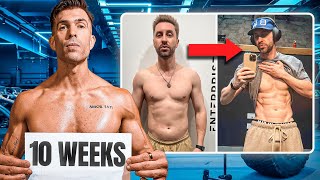
In the opening session of a 10‑week transformation series, fitness coach (Speaker A) meets Jamie, a 1.6 million‑subscriber YouTuber and father of two. Jamie explains his long‑term health goals—being energetic for his daughters and regaining a six‑pack—and shares his recent attempt at a self‑designed diet generated by ChatGPT, which over‑estimated calories and left him short on protein. The coach conducts a rapid dietary audit, emphasizes hitting protein targets, and creates a flexible meal plan. A 12‑site BioSignature skinfold test is performed to establish Jamie’s current body‑fat baseline. A movement screen reveals knee discomfort linked to hip/glute weakness, shoulder dysfunction, and poor thoracic posture. The coach demonstrates and corrects Jamie’s bench‑press form, teaching a “chest‑up” cue to protect the shoulders. Additional corrective work includes daily shoulder‑stabilization drills (the “Lock Big 3”), thoracic extension, and scapular retraction exercises. The session concludes with a plan to update Jamie’s diet, repeat body‑fat testing, and schedule more intensive training in subsequent weeks, inviting viewers to follow the transformation.
Chapters
Lock 'em, lock 'em, lock 'em. There you go, that's one. This is my friend Jamie. He has over 1.6 million followers on YouTube, and over the next 10 weeks, I'll be taking him on a transformational journey to help him achieve his dream body. Where do you want to be in the next 12 weeks, 12 months, 12 years with your health and fitness?
12 years, that's a long time. I mean, obviously I want to be healthier. I'm getting older. I want to be the healthiest version of myself because I've got young girls. Yeah, facts. I've got two beautiful young daughters and I want to run around after them. They've got a lot of energy and I need a lot of energy to be able to keep up with them. And that's the goal with this. I'm going to be the best version of me for me and for them. Looking after my health is a big part of that picture. Best version of myself is happy, he's energetic, he's got stamina to do stuff.
What are some objective measures that What's something you can't do now that you would like to do in, say, a 12-month period, or have, whether it's body composition, lifting goals?
Honestly, I would like to see myself with a six-pack again. I haven't seen myself with a six-pack since I was 20.
In terms of what I could do for you today, what, what would make you walk out of this and go, yeah, this was an hour well spent?
Yeah, I'd like some advice on my diet and how I can improve my goals through my eating, how I can eat better, how I can be more consistent with that and not have to overthink it as much. So I set a goal to go one week without sugar. Or processed food. And after that week was up and I didn't cheat, which was a surprise to me and my kids because I absolutely love junk food, I said, go, I'll get a six-pack in 6 weeks. I saw all these like online transformation videos and I'm like, if they can do it, I can do it too. So I told my kids, I'm on a diet. In 6 weeks' time, I'm going to have a six-pack. I started using ChatGPT. I started going to the gym consistently, started focusing on my eating. And after those 6 weeks were up and the kids were like, "All right, Dad, you can start eating dessert with us again." I was like, "But I don't have the six-pack." And they're like, "But you said 6 weeks." I was like, "But I don't have the six-pack." And in that moment, I thought I need to teach the girls that if you set a goal and then by your target time you don't reach that goal, that doesn't mean you just stop with the goal. It just means the goalpost got a little bit further and you keep pushing forward. You realize that the goal wasn't as easy as you thought it was. And I feel like that was a life lesson that I was not only able to teach myself, but I was able to teach the girls in persistence.
All right, so what I hear is probably the best thing we could do right now is I could do your body fat, map out your diet, what you're currently doing, figure out your macros for you, and then give you some timelines of where I think you'll hit the goals. Okay. Then take you to the floor, do a bit of a screening and assessment on you, and probably train you a little bit, just show you a couple of things to enhance. today because I think the diet stuff will take up a bit of time. And, um, but I'll try and be really efficient with every— everything and just show you some stuff, have more of a workout next time.
I literally, for the last couple of months, have been eating the exact same thing every single day, and I'm trying to figure out what I need to change.
So Jamie told me that he just ChatGPT'd his diet, and that's what he was following, and ChatGPT completely overestimated his calories.
I struggle with counting calories. The whole idea of tracking my food every day, tracking different foods, trying to figure out if this is good or not. So I just decided I'm going to eat the same thing every single day to simplify it.
Any additional feel like snacks and stuff?
So the snacks, I will either have a Musashi protein bar or protein shake.
So that's it? Yep. Are you adding in anything else? Not really. Juices?
No, I only drink water at the moment.
Jamie wasn't hitting his protein goals, so that was the first thing we did, make sure he hits protein goals. I just kept things super simple because, as he said, he's on the road, he's got kids, he's doing lots of different things. So really the goal here was to create a food plan and a flexible food plan at that, so he was able to interchange different foods. 65.2. Now I'm going to take skinfolds all from your body. I'm going to start with your face, okay? Then I'm going to work the right-hand side. I'm going to do your pec Okay, uh, your tricep through here, your upper back, your stomach. Eventually I'll work down to your legs and finally through here. Okay, so just face me. So this is a 12-site skinfold test known as the BioSignature, and really what it is about getting a measure of where Jamie is at currently. And I love the skinfolds because obviously I can do it and I can measure what I got today versus where he's going to be in the next 12 weeks, and allows me to very easily compare. And when I put my intervention in place, I can see the effects of the intervention by redoing the test. 6. Yeah, 20 points. 20.2. 5 points. 4.
Okay, I feel like I'm at the doctor and I'm waiting to potentially get bad news. Come back with a negative result, please.
I will just take a photo and I'm done. And I always take photos of clients because I have a saying: I'm never going to piss on your leg and tell you it's rain. Last one. Beautiful. So what I'm going to do with you now is I'm going to do a bit of a screening, see where you're at physically, and then I'll give you some ideas in terms of what to do, and then we'll come for a round 2 and give you more of a workout. Okay, any pain?
I can feel it a little bit in my left knee.
I do—
and not pain pain, just aware.
Out of 1 to 10?
Oh, like a 1.
I can immediately tell Jamie has some problems with his knee. He doesn't squat well, and when he goes into that squat, he favors one of his knees. Hop forward for me. What's wrong with that one? Did that hurt?
Uh, it just feels a bit funny. No, it's okay.
When Jamie did this test, it immediately tells me that he has something going on with his knee that's coming from his hip, his glute, and that's why I did this test. And yeah, it was, it was pretty straightforward. Keeping this position, yeah, I want you to extend this leg off the floor. Oh, oh, go lower a little. Yeah, keep it, just flex it out. Okay, and let's do the other leg up higher. No, not with that leg. Yep, and do the other one, other side. This is pretty common. Jamie's, you're not too uncommon. A lot of people have dysfunctions. So here, definitely Jamie's knee, his abs, he's protracted forward. So there's a lot of remedial exercises. It's the boring work, but doing the boring work will completely change the way Jamie moves. So all in all, we need to get your glutes stronger. I think we really need to just get your overall technique on things up to par. No major red flags, but there's, there's things definitely that can be enhanced. All right, what are your go-to exercises?
Bench press.
All right, let's have a look at your bench press. I'm not going to give you any suggestions, I just want to see what you do.
I got this, it's a bench press. Who doesn't know how to do a bench press, right?
So anytime I'm looking at someone's movement, I'm always setting them up for long-term success. So immediately I saw when Jamie went on the bench press that he's just using all of his and that's going to jack up his shoulders, then that is going to create problems in and of itself, and it's going to limit how much he can bench press. So immediately I'm really getting into that bench press that's going to allow him to lift much heavier numbers. My hand is on your chest. My hand is poison, right? The only thing you can do to get rid of my hand is push your chest up. This is your thoracic spine here where I'm putting my hand. I'm getting you to push this up as high as you can. So if I put my hand here, I want you to push. There you go, right? So we create this nice arc. Do you feel that? Yep. There is nothing comfortable about a bench press. Okay, now in that position, I want you to do your bench press. Now I want you to be sticking your chest up the whole time. Higher. So instead of bringing the bar down, I want you to think about sticking your chest up. Relax that neck. It feels weird. Sorry. Don't overthink it. Chest up to the bar.
This just doesn't feel natural. I mean, bench press is something that I've gone to the gym and done a million times over, and it just seems straightforward. And now I'm trying to retrain my brain to do something unnatural.
The way Jamie's bench pressing is the exact reason why his shoulders are so jacked up, and that's exactly why I needed to spend so much time correcting his technique. That's better. Feel that? Yeah. So this is what comes up. So when I say chest up to the bar, that's what comes up. That's all you need to do. So as you lower, bring it towards the— in line with the stick. In line with the stick, in line with the stick, and then push it towards me, towards me. Oh yeah, exactly. Now towards the stick, lower it towards the stick, lower it towards the stick, lower it towards the stick, and push it back towards me.
There you go.
Towards the stick, towards the stick, full grip, full grip, towards me. Power! There you go. Come on, and here. Yeah, and back up.
One. Okay, yeah, so not a full rotation. This is really challenging, a lot more challenging than I anticipated it being. It just, it didn't feel natural. I'm thinking, all right, chest up, and I'm lifting a light weight, but I'm just like, this feels so different to how I normally do it.
One more, one more, one more, one more. 5, excellent. I can put them back on the rack. All right, it's not too bad, but I'm going to change some things.
Okay.
I want you just outside of shoulder width, so you're going to be about here. I don't want you to go super wide.
Yep.
I want your feet to be straight on the floor. If anything, shove your hips a little bit back. I always want you— the end position is here, the start position is here. Do you see how I'm fully elongated?
Yep.
Right now I want you to initiate by tucking your armpits into your underpants, and then You're going to pull, keeping your armpits down. So that would be one. Shove your hips back towards me. Hips back, hips in it. Right back. Oh yeah.
Forward.
That's your start position. That's your end position. Now you're going to—
uh-uh.
Nope. First you're going to stack.
It's just so much thinking. I'm the type of person, I think about what I'm doing and do it at the same time, which is why I can't dance. When I try and dance I'm thinking about the beat, I'm thinking about what to do with my feet or my hands, and by the time the rhythm is there, my feet and my hands are in a whole other place. Kind of feels like the same thing. I'm thinking, all right, I need to do this, then this, then this, and I'm— it's a lot to process.
So many people struggle with this, and it's just a simple understanding of of understanding how to pull your lats down before bending your elbows. So taking Jamie through this is, is a very common scenario in reteaching people how to move correctly. Yeah, we're moving now.
This is good.
And give me 3 more like that, and then you're going to do a pull. 1. This is money for you, right? This is going to be a game changer for your shoulder. See how this one moves really well? This one's a bit stiff. Yeah, so this one is hardly moving at all, but the trick is you want to maintain this, right? So go again. That's 1. And forward. So I can see here Jamie is completely in his head, so I just physically cue him. I move him where I want him to be, I push his scapula down, I put my hand on his elbow so he can't move, so he gets out of his head and into his body. Give me one more. There you go, relax.
Yeah, I definitely felt that way more than I've ever felt.
Where are you feeling it? Okay, so it's still not where we want it. We want more here and through mid-back, right? What's preventing us is we're here. So I'm going to show you one more exercise that you need to do pretty much every day, but it'll help to start alleviate this shoulder issue for you and help you get these scapulas back. It's called the Lock Big 3.
So I've been having issues with my left shoulder. I think it's from lifting a little bit too heavy and, and pushing myself a little bit too heavy. And so I'm trying to figure out how to push weights without further damaging that left shoulder and somewhat rehabbing it without stopping working out completely.
All right, so what I'm going to get you to do— this is the last exercise I'll show you— is you're going to put your face down on the floor here. You're going to grab the dumbbells out from the sides.
Yep.
You're going to go into a T, like going to a crucifix position. Yep, that's it. Um, just put your nose on the floor so it's straight down. Now I want you to lift these up as high as you can off the floor, except keep them in line. Keep them in line. T, T, T. We don't want to go back behind our bodies. T is here, right? That's T. And bring it back down. So that's 1. Come back up. Now I want you to imagine you're on a thin sheet of ice. You don't want to break the ice, right? So you lift up and then you slowly bring it down. That's 2. Lift up, slowly bring it down. 3. All right, now bring your hands to your sides in that position. Yep, exactly. Hands flat on the floor. Now I want you to do another 12. 1, keeping your triceps straight. So lock out your arms as much as you get. That's it. So what I'm doing here is I'm filming it to show Jamie what he's doing wrong. He was actually bending his arms quite a bit, and what I wanted him to do was really straighten his arms to really get that tricep as part, because it actually works as part of a shoulder stabilizer. 3, straighten, straighten, straighten, straighten. 3, that's it. 4, straighten, straighten, straighten. 5, 11, 12. Excellent. And the 1 kilo dumbbells, done.
They hurt more than you would think they would.
Yep, you can put them away.
Cool.
They hurt because that's where you're weak. Yep, that's— it's, it's somewhat dysfunctional in your shoulder, and that's why you're getting some pain there. Thanks, bro. Um, so that needs to be done every day. That will help you. After you're able to get some strength there, we'll progress it You need to get some thoracic extension happening because you're quite bunched up through here and you're not able to depress the lat. Yeah, more I can— I'll show you next time. So if you look at Jamie's posture just in this frame here, you can see that his shoulders are somewhat rotated forward and he's bunched up in terms of his traps. So really what we're trying to accomplish is to opening him up, is to pull his lats down, open up his chest, bring his scapula together so he comes from this position. And that will— you never see anyone in shoulder pain when they're in this position. Everyone in shoulder pain is always in is pronated position and you're elevated through their traps. So what we're trying to do is really open Jamie up so that when he goes into his exercises, he feels amazing. The press technique, I think I wouldn't go to barbell for you right now.
I would keep it to dumbbells.
Stick to the dumbbells. That, work on all that pulldown, keep everything else the same. Obviously, next time you come back, we'll update your diet, do your body fat again, and then we'll spend more time training. Okay, cool. Yeah, here's a present.
Thank you so much. You're welcome, man. I really appreciate it. I've learned so much in such a short amount of time.
Yeah, good. More— lots more to come. Subscribe to see week 2 of Jamie's transformation.










