I Watched 1,000 Gym Fails — Here's What They All Have in Common
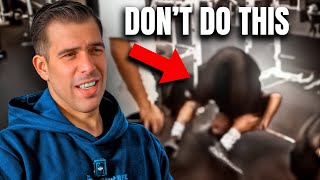
In this 30‑minute commentary, the presenter reviews a montage of gym‑fail videos and uses each clip as a teaching moment. He systematically dissects the biomechanics, grip, stance, and leverage of a wide range of exercises—bench press, cable preacher curls, improvised cable rows, reverse‑bench press rehab, ab crunches, rear‑deltoid cables, seated rows, leg press vs. hack‑squat, deadlifts, reverse‑hyper, and high‑bar vs. low‑bar squats. For each movement he points out the specific error that caused the failure (e.g., improper shoulder‑blade positioning, uncontrolled tempo, poor bar path, inadequate ankle flexion) and then delivers a concise, step‑by‑step cue set to correct it. He repeatedly emphasizes safety principles such as maintaining a stable torso, using consistent technique under load, avoiding hyper‑extension, and respecting leverage. Interspersed throughout is promotion of his “Fitness User Manual,” a free guide containing nutrition plans and macro calculations. The overall message is that watching failures can teach proper form, and that disciplined, biomechanically‑sound technique prevents injury and improves performance.
Chapters
Oh no, oh no, oh no, oh, that's— oh, lucky there's a spotter there, man. His clavicle's gone. You don't want to be that guy, so to save you from embarrassment, let me show you the right way to do it. The bench press— I can't, I can't drum this point home enough. If you compare a deadlift to a bench press, a deadlift you can have aggression, you can kind of psych yourself up, it doesn't require as much precision. On a bench press, it's not a meathead lift, it's not a lift where you're gonna like grab the bar and just try and— it requires accuracy in terms of where the bar followers each time. You want to have a groove in which you get into when you bench so that you're hitting— the bar is hitting your chest in exactly the same position, especially on a barbell. Because if you're hitting— if you want to be trained more like a meathead and just like throw weights around, you're better off using dumbbells. It's much safer. But on a bench press, when you start approaching your heaviest loads and your maximal loads, so 1, 2, or 3 reps, that's where things go wrong. Some things on the bench press to keep in mind: hand position. Generally speaking, where the lines on the bar are is for most males or guys with normally sized shoulders, that's going to be a good position. Once you start approaching further than that, you really get into more of a powerlifting technique. Any closer, you're getting into kind of more of that biachromial slash athletic type of setup. But as a general setup, we want to bring our shoulder blades, our armpits down into our underpants. I kind of think of it as an X. So this armpit goes to this hip, this armpit goes to this hip. That way everything is pulled down and that creates nice stability. Now you can see even on a bar, I'm pulling and lowering the bar towards me, so I'm bringing my chest up to the bar as I lower it. That enables me to keep a solid position. You can see where I am, and that for sure— you saw in that video, the guy putting it in his face— if I failed like that, I'd fail at my chest, right? It's nice and safe. And never change your technique under load. That's the other thing is don't start freaking out and changing shit. This is the whole point of training is you create a pattern in which you default to under stress. This guy doesn't tear his bicep. I hate watching this shit. Oh, he hit himself in the face. So this exercise is the cable preacher curl. A lot of people, when they get into the preacher bench, is they arc over. We don't want to arc over. We want to elongate the bicep as much as we can. So you can see here where I'm, I'm not not in this position. I'm sitting up nice and tall, which makes it a hell of a lot harder. I can get into that full stretch position. The other thing that I like people to do on a preacher bench is to pull the wrists back. See the top? Not here with my wrists, I'm pulling them back. So I'm allowing the forearm flexors to stretch completely and up through the bicep. This changes the resistance profile when we use a cable. So the problem is with a barbell, we have most resistance from here to there. With a cable, we have most resistance from at the top of the range. So this does change the resistance profile of the movement. This is a great one, but you want to do it under conditions of control. And certainly you don't want to do this fast because you can snap a bicep very, very, or tear a bicep very, very easily in this position. I'm just waiting for the guy that gets injured. Oh, this guy's having a jolly old time, better than the pub. What's better than suspending yourself from cable machines and thrusting upwards in front of the gym? I don't know if I'm gonna be able to do this because this is like— that's not enough weight. So I don't really know what the fuck this guy was trying to do in this video, but I tell you what, right, like, you gotta hand it to him. He sat there and he figured out the exact amount of weight that would lower him. See, that's still not heavy enough because that's not really pulling me up like You gotta hand it to this guy, he got his weight exactly right. There we go. And go, go gadget. Almost, almost, almost. Come on, come on. Oh yes, man, that's hard. The fuck, man. I got no idea what the guy was trying to do, but you know, could we make something from this? I don't know, kneeling lat pulldown, maybe. Maybe. Oh, this is pretty good. We could do a row, maybe like that. Maybe that's what he was trying to do. Full stretch. Maybe he's made up a variation. That doesn't feel too bad, right? Like, really feel it in my lats. It's like a mermaid row. You know, you got the mermaid press where you don't use any legs. Maybe, maybe that's what he's trying to do, the mermaid row. Or maybe he was trying to do like reverse bench press. The only problem with that is I need to do it on a bench because my elbows obviously hit the floor. But that's actually a great exercise. The reverse bench press is, you know, you set up a bench here. Actually, I'll show you guys that one because it's actually fantastic at rehabbing shoulders. So there is a counterbalance component to this. Obviously you've got a bench press, but then you've got all the muscles on the back side of your body that control the bench press that are often neglected by bros who like to bench. Now if you have a shoulder injury, this is a phenomenal exercise. So what you're doing is the exact setup as a bench press and you pull it down. And when you pull it down, it can't be to here. You have to, have to, have to touch the bottom of your sternum. The other thing is you're not pulling it down like a row, right? That's, that's wrong. If you do it like this, I mean, you're going to get some benefit from it, but it's not really what we want. What we want is we want to push our boobies up to the bar. So what does that look like, right? Instead of me rowing down, say I'm pulling my chest up. I'm pulling my body up to the bench. I'm not rolling it down. Pull my body up. When you do that, you will feel your lats light up. They pull down into your armpits, so your lats come down. You get that extension through the thoracic. That's just a fancy way of me saying I'm sticking my tits out. And when I do that, my lats go down and I get that lat activation. Thoracic extension. When I have that thoracic extension and my titties are up, my external rotation is now nice and protected, and that is going to help the pattern of me bench pressing. Okay, that one's kind of funny where he's like, what the fuck is this guy doing? He's trying to do some version of a sit-up. We don't want necessarily our legs to be completely vertical on this, to bring our feet in this L-shaped position. The other thing I'm going to do is I'm going to bring my toes together to disengage the hip flexors. So if we bring our feet straight, we can rely on hip flexors to get us up and shorten through our pelvis. I'm going to pull my feet together to disengage. One thing I cue people to do is put their tongue on the roof of their mouth to stabilize and help them— people have neck issues, help stabilize the neck. Then I'm going to be coming up and I'm going to instruct, try and get your elbows to touch your knees. You can see here I'm getting quite a full crunch and having my feet situated on the ball, it does allow— and with my toes pointing towards each other, it does allow my abs to crunch and contract fairly hard. This is a very nice contraction, especially it gives you something to aim for, bringing your elbows, whether you bring your knees forward a little bit, don't bring it too much. You really want to get up there. You can see how I'm aiming— my elbows are aiming for my knees. If I do a little bit of this where I bring my knees forward, that's not too bad either because I'm still getting that intense contraction. This is a far better exercise if we're working our abs, which I'm guessing the gentleman in the video was trying to work. I get it, most of the time people don't know what to eat, and that's exactly why I've put together my Fitness User Manual, which is packed full of shopping lists, macros, and how to lay out your plan once and for all. I've used this exact manual with thousands of clients, including champion athletes, and I want to give it to you for free. Stay tuned to the end of this video. And this guy just has no fucking idea, so we can enjoy this one because he's not going to get injured, but he looks like he's masturbating. So when we do readouts, again, it's opposite hand to opposite cable. Now we want to get into position where, again, my first thing I'm going to move is my hips. So I'm going to draw my hips back and out. I took a little step back because what I want is I want these cables— see this cable? This is in line as I bend over. This is in line with my rear delt. So when I come up, not completely in line, but just that line of pull. Because when I say not completely in line, as I come up, I'm actually going to come forward towards my ears. I'm here in line with my ears. Most people make a mistake when they do the rear delt is they pull it really far back. When you really you pull it really far back, you run the risk of really just getting the upper back to do the work, which isn't really what you want. You want the rear delt to do the work. So this is my rear delt, and I always like and instruct people to do a little pause at the top so you're really getting that peak contraction. So if I'm here, nice and stretched, elongated, and I hold— 1, 2, 3. Now if I want to move it into a pronated position, I can do it with these, that's fine. See my hands? This is a pronated position where I'm showing you my knuckles. That's a fancy way of saying pronation. Now this is really working rear delt. Once I move into this pronated position, it's nothing but rear delt. Pronated, it's a great position. You can use the rope, or you can do what I just did with the cable, either or. But that's a far more effective way. You're going to use a lot less weight. If you look at the size of the rear delt and also the lever arm of how far away the load is from your center of mass and from your body. It's all about levers and leverage. If the weight is here and I do a rear delt, I don't need— I can use a lot of weight, right? But the minute I bring my hand away and now I hold it, you don't need a lot of weight for that because the lever arm is so far away from the body where the load becomes inconsequential. The leverage you have from a small amount of load is exponential because it's so far away from the muscle. That's how I would instruct you to do your lateral delts. What's this girl doing? This is gonna be bad. Ah, she fell over. She fell forward. The girl in this video would have saved herself a lot of embarrassment if she simply put a step. Once I'll go neutral for you guys, but now in this position, see, I've got the full hang where you saw the— now I'm in position my arms are locked, and I'm pulling my armpits down into my underpants. Now again, we can talk about grip position. I've got a whole bunch of videos on this. If you check out my tutorial playlist, you'll see that where I talk about the different grips and why I use different grips. The biggest thing with the chin-up is we want to get— we want to always start our chin-up with locked elbows. The elbows have to absolutely be locked, and at the top, our chin has to be over the bar. Oh no, this is not seated row. Here we go. All right, abs off. It's just lonely gentlemen's club stuff here. On a seated row, the biggest mistake people make is not considering the vector lines of pull. Now, it's just a fancy way of saying how my muscles relate to this machine. So if you can see here, my— if my hips are forward, then I've offset the weight on the machine. If I pull my hips back, now you can see this load is pulling me forward, there's more tension through my upper back. So if I go here, this becomes very, very easy because I've counterbalanced the weight. And that's— you go to a commercial gym on a Friday night, that's how you see most people do it. It's kind of like trying to lift as much load, and obviously that's just me offsetting the weight, or the person offsetting the weight. And the heavier you are as a person, the more load you're going to be able to offset, the more you're going to be able to counterbalance. You're using your body in this position as a counterbalance. Now, I don't want to do that at all. I mean, putting your feet on the floor is probably a little bit extreme because you want to be locked into the machine. So instead, what I advise is pull your bum hole back on the machine, and that's a cue that you always remember. If you pull your asshole back, now I'm up tall, now there's no counterbalance. So as I pull, it's all through my upper back and the intended muscle groups. Now there's option 1, option 2. If I really want to hit my lats, I'm going to pull it low. If I want to hit my upper back I'm going to pull it to my sternum. So upper back, lats. And really, I mean, this is the most simple way of teaching someone how to do a lat pull, uh, a seated row rather. And I don't want to lean back, right? I want to keep my spine in line with my hips. I don't want to go beyond. So I'm not going to do that, for example, but I am going to go forward. I'm going to treat it like a rowboat. So that's your seated row. Oh no, leg press. Oh God, look away, look away. He's going to pop his knees. Oh God, no. Oh no, he's going to fuck himself. Here we go. Oh no, just warrior. Thought this was an injury. So what you saw in that video was a leg press. Here at Enterprise, we have the Atlantis hack squat, which also turns into a reverse leg press. I actually prefer this more than a leg press. And I'll tell you what, it's safer than a leg press. It's an inverted leg press, basically. So on a normal leg press, your body is here and the plate is here, which means that this is the thing that you're pushing away. The reason why I like this better is because look what I just did, right? This is beautiful. My lumbar spine is completely locked in. Now, as I push, if I get really, really deep, my lumbar spine is still really locked in. On a leg press, as I get into that bottom position, one that ends up happening with everyone is their back goes flexion, and that's where you herniate a disc. So in terms of safety and in terms of protecting your back, this is a far better piece of equipment. I'm locked in position. You can see my lumbar spine is nice and tight. I'm pulling everything down, spreading the knees. I can get nice and deep in this position and then exploding away, pushing through the heels. Great alternative. And again, you want to do this with a nice cadence. You get into the machine and you push, and as I'm doing it, I'm thinking about my heels pushing the earth away through my heels, right? That's where you want to be. That's the type of cadence. That's the kind of control. The other thing that's super, super important is at the top, we don't want to be hyperextending our knees. Now I know this is for a lot of folks who have pretty good range of motion, pretty flexible, but they want to go to the top and they want to extend their knees. That's not a good habit. So you can see at the top, I'm soft through my knees as I do this. So as I come down again, I'm allowing my back to be as tight as possible. And again, in this version of the leg press. When I get to this position, I really start to feel that tightness through the hamstring, and I naturally want to come up. To go any lower than that, like, if I go any lower than that, I'm really struggling. Like, my belly's on my thighs, or I'm not really able to go any lower than that unless I change my foot position. And that's, again, it's nice and safe for the back to get into that position. So keeping soft knees. And again, if I want to string some together, let's say for example with no lockout, this is a nice cadence as well. So I can press like this and no pause and string my set together like that. That's Warrior. This is an injury. That's also good. Oh, there we go. So for most people, when they do the deadlift, this is how we want to set up. Feet under my pelvis, hands— I'm stretching. Now in this position, you don't bend down and grab the bar. That's a mistake. You want to reach for the bar like you're loading an elastic band. So I'm stretching, stretching, stretching, stretching, stretching, and I don't want to— I'm I'm getting as tight as possible. So I've reached for the bar. Now I'm in position. Now I can stand. So you can see that elastic energy that I'm getting. I'm loading up my hamstrings. Now this is a posterior chain movement, right? So it means the backside of my body should be doing the work, not the front side of my body. So I shouldn't be rocking forward into the lift. So some keys that I like to cue people is firstly, set up. Don't pick up the bar, reach for the bar. The next thing is I want to load my heels. And the third and final thing that I tell people to do that fixes a lot of problems is lift up from the sternum. So again, reach, reach, reach, reach, reach, reach, reach. That's the initiation point. I'm loading up my heels, and then from here I'm pulling up my sternum, and then I'm standing up. For a lot of folks, that's going to really help improve their deadlift. That setup, that initiation point, reaching for the bar, pulling up the sternum. It may mean short term you need to use less weight, but practice these habits and you'll help your deadlift. A bit of glute action there, lower back. This is a reverse hyper, right? I've got this little seat belt over my ankles here. You can see I'm gonna grab and extend my arms through, and I'm pulling up. So you can see in this position, as I pull up my legs, if I just take this off, as I do this, right, what's working? What's bringing my legs up from here in this position? So I'm all relaxed, Now for me to bring this leg up or both legs up, my glutes have to work. It has to contract, right? My glutes and lower back, but mainly glutes. So this is a phenomenal— I mean, this has been referred to as the booty builder bench, but it's also, it's a reverse hyper. Louie Simmons from Westside Barbell Method used this to help rehab his lower back when he broke it squatting. Phenomenal piece of equipment. But to me it seemed like that's what he was trying to achieve by doing that exercise. Much, much more effective for the glutes and lower back. Oh, poor kid, dude. 100— is that 150 kilos? Oh God, shit. Here we go. So barbell squat, there's really two popular ways that one can barbell squat. One is a high bar barbell squat, the other is a low bar barbell squat. He was doing a high bar, but he initiated the movement like he was doing a low bar. When we do a high bar squat, we want our— on both of the lifts, we want our body to be tight. I would suggest— see these thumbs? Put them where the knurling ends, or this smooth part. Then you grab the bar. That way you're not at risk of getting into that thoracic extension. So high bar, just as the name suggests, is a higher position on the trap. Generally, this movement, when I'm doing it, is I'm going to initiate the movement from the knees. So you can see here how my knees are the first thing that moves. So I'm moving forward, forward, forward, forward, forward, and you could see my heels lifted up a little bit. The reason why my heels lifted up a little bit on that was because I'm used to using on a high bar lifters. So what are lifters? They're the shoe that lifts a little bit, and you can click this video here about my gym accessories. So while I'm not going to change my shoes, I'm just going to put this rubber mat here, which is going to emulate basically a lift in my heel. And what that does is just shifts my center of mass forward to allow my knees to go over my ankles freely. Most injuries, lower leg injuries, knee injuries specifically, are due to poor ankle flexion. Shouldn't say they're all due to poor ankle flexion, but certainly poor ankle flexion across the board. The more ankle flexion you have, the less likely you are to tear something in the lower leg. Obviously, if you play soccer and someone kicks you in the leg, that's not going to help you. But other than that, having good range of motion through the ankle is going to allow your knees, as you can see, to go right over your toes. So you see, this is a high bar position, right? You can see here everything is nice up and tall. My spine is nice and tall. Everything is tall, right? That's where we want to be on the high bar position. The mistake that this gentleman made in the video where he fell forward is his head position. The load, center of gravity, center of mass went forward. And obviously when you go forward, the weight goes forward with you. This is where when we talk about squatting, you want the bar to be aligned with your midfoot. So the bar, when you saw that as I was squatting, that bar's in line with my midfoot. We're doing low bar, we don't want to be elevating the heels unless you've got really, really, really bad, poor ankle mechanics. Low bar is closer to my center of mass, which means I'm going to be able to squat more, right? This is why you always find guys who've got a good high bar will have a good low bar. But the reverse is not always true, right? If you've got a good low bar, it does not mean you will have a good high bar. So your high bar squat is kind of your universal Generally speaking, with a low bar squat, you're going to have a little bit of a wider stance, right? You're not going to go as narrow as you would on a high bar. On a high bar, our initiation was our knees, right? The first thing that moved on that high bar was my knees. On the low bar, it's not my knees. I think about my hips and my knees simultaneously. So what that looks like is boom, right? Instead of that, I'm going here. So my ass comes out You can see how I push my ass out. The same time as I push my ass out, I bend at the knees. So these two things are happening at once. So if I bring that into real time, ass out, ass out, knees forward, ass out, knees forward. And that's where I stop. And now I power up, right? So I'm loading through the heels. So I'm really getting my backside, my glutes involved when I do a low bar. When I do a high bar, it's going to be more quads. So again, if you look at that video, the gentleman in the video used a high bar position that initiated from the hips. It's not the worst thing in the world. Probably could have helped him if he had an elevation on his heels. Probably would have balanced a lot better, but it was too much weight for him to begin with. And again, the key thing there was that bar went over his midfoot. The minute it went over his midfoot, he lost it completely. So we want to bring this load in line with that foot. I hope you use these tips so you're not that guy in the gym. Now, as promised, download my user manual here. Make sure you subscribe to this channel for more great information.










