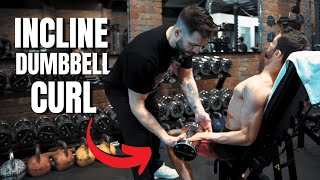
Jason demonstrates the incline dumbbell curl with focus on biomechanics: wrist extension (the Spider-Man cue) isolates the biceps, a 4-second eccentric tempo maximizes range of motion, and mechanical drop-sets shift between harder and easier positions for bigger gains.
Chapters
In this video, we're going to show you the correct way to do an incline dumbbell curl. We've got Jason here, he's getting ready for a comp, so he's going to be our anatomy chart where we can see how this exercise works. Jason, if you want to show the folks how to do an incline dumbbell curl, I'm going to talk through the points, the finer points of this exercise, and what you need to pay attention to. So Jason's set up in this position now. What this— this— the incline— now let's first talk about the incline. The further the incline is on an angle, the more strength you're going to need at that end range of shoulder flexion because you're gonna put a lot of tension on that tendon. And if you do have shoulder issues, it's a particularly good exercise. However, because that bicep tendon does run through the shoulder, however, you do need to pay some attention. You don't wanna overextend yourself too early if you haven't developed the strength. Now, let's talk about what Jason's doing and how to maximize what he's doing. So you can see his wrists here, okay? His wrists are like the way most people do it. What I want you to do, Jason, is I want you to be like, think like Spider-Man and like, pshew, Up, up and away, Webb! Shazam! Go, go, go, Webb, go! Keep those wrists bent back. What this does is it extends the forearm flexors and really puts a lot more load and tension in that bicep. So kind of think of it as when you're doing a leg curl, if you're in plantarflex or dorsiflex, if you're in a dorsiflex position, you're using the gastroc. If you're in a plantarflex position, which is foot down, you're removing that gastrocnemius, which creates a lot more tension on that hamstring. Same principles here when we're doing the bicep curl, You wanna pull those wrists right back, remove the forearm involvement and really just get that bicep working. All right, I'll give Jason a little break because what I wanna do is I wanna demonstrate. So this is the nicest variation. So if you're new to this exercise and you don't have that end range of strength in that bicep tendon, this is where I'll start people as a very gentle incline dumbbell curl. Now Jason's not a beginner and he does have feel, and not to say that beginners have to necessarily, 'cause you can be training a long time, but if you're quite jacked and your biceps shorten, you have shoulder issues, you probably will have to start with that forward. However, I much prefer the dumbbell incline curl on a more aggressive angle when people can do it, because we're also on that angle, we're taking people through a much longer range of motion, which is also better for the shoulder, and it's also better for that bicep tendon, which I really think is part of the big value here when you're doing this exercise specifically. So Jason, if you can demonstrate this one for us, and obviously you can do this with a hammer curl, which is going to be a bit more bicep brachialis, as well. You can use that variation too. So some other cues— so he's going to do the wrists, and he's already doing it right. So he's packing and he's pulling his shoulder blades down to really create that tension in through his biceps. So as he curls up, you can see this is a little longer range of motion, and you can see he's almost immediately got a pump from this range of motion as well because it is a lot more targeted in the bicep. He can't move in this position, he's pinned back, and the only thing that he's moving moving right now is his biceps, which is perfectly designed of how we want this exercise done. So this is good, just really crank on those wrists. And another thing is, instead of going so wide with it, let's just keep it a little more narrow with your hands, a little more narrow. And as with all exercise, what I really like is a up nice and, nice and powerfully, and I'm going to come with a 4-second down tempo. 4, 3, 2, 1, all the way. Another mistake that people make— Jason, can you make the mistake where people don't go all the way down? So they kind of stop there and then they come straight back up. That is a mistake. We don't want to see that in your training. And a way around that is if we come down, I want you to flex the tricep, flex the tricep, that way we get to the end range, then come all the way up. And we make sure it's end range. You can see these veins really coming out of Jason right now. So all the way down, let's do a few more. Flex that tricep, flex that tricep and squeeze, squeeze. Good, these veins are coming. Let's do one more, Jason. Let's get those veins out. Flex the tricep, flex the tricep, and squeeze, squeeze, squeeze, squeeze. And that's fail, we'll let that go. Now, here's the beauty of this, right? So sit forward for me, sit forward for me. If we want to extend the set, we can make a mechanical drop set. Do a couple more for me. And you'll see immediately he's able to get a couple more reps. Why? Because that's a mechanically disadvantaged position. Now he's mechanically advantaged, he's still fatigued. Now, to show you this even one further, stand up for me, Jason, stand up. Do it, he'll get a couple more this way because now he's in a mechanical advantage position. And you can also swing a little bit, which is completely fine. And we can see the veins really coming out. So this is one of those techniques that's really good. Yes, yes, yes. And lean forward, lean forward, lean forward. Good. Do one more, do one more. We can see his veins coming out. Go and squeeze, squeeze. Excellent, excellent, excellent. Good. Awesome. Amazing. All right, chuck him down. Jason, for people to follow you and your anatomy chart, can they hit you up from? Yeah, they can hit me at, um, coachjasonmassie.pt. Awesome. If you've enjoyed this video, consider subscribing to our channel.