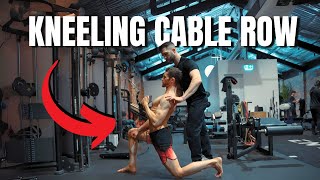
A kneeling cable row that targets your lats instead of your traps. The key is aggressive lat depression into your spine, then a two-part pull: depress first, then extend. This setup also improves your bench press by building shoulder external rotation.
Chapters
In this video, we're going to show you how to do a kneeling cable row. I have Jason here. Jason, if you want to show the folks how a kneeling cable row, the way you normally do it. So I'm just going to talk you through some of these setup points as well as he goes through. So it's always opposite leg to opposite hand, as Jason has beautifully demonstrated here. Now, as Jason does this, you can see how he retracts, he depresses and pulls in. Now, the way Jason is doing it is very, very lat dominant, which is completely fine. It's a perfectly acceptable way to do it. I'll show you another variation in a sec, but I do I do want to spend some time on this just to explain why this works so well. So a simple axiom is if the trap is off, the lat is on, and if the lat is on, the trap is off. So what I'm going to get Jason to do is just a bad version of this exercise. So you can see he's come up into his trap. As he's up into his trap, you can see that there's really no lat engagement as he's really up nice and high in his trap. And he actually pulled it down a little bit. Do a really bad one. There you go. Now he's really into his trap and it's very minimal. There's lots of shoulders, the internal rotation. We don't want to be doing like that. It's complete opposite. All right, so go back into position. Let's show the folks how to do it. So you can see the lat, which is this muscle, triangular, kind of like the Dorito chip muscle. He's going to depress that down into his underpants. And when I do this with clients, I really put my hands here to depress as aggressively as possible all the way into his underpants, into the center of his spine. Now in this position, he's going to pull himself up and row. So you can see this has changed the variation a tiny bit. Before, he had a bit of a lean into the lat. So I prefer this with most clients because most clients do sit in a protracted position most of the time. And what I want to be doing is training that retraction. So I like to do it in two parts. Do another rep. I'll give some teaching cues in a sec, but do one more rep like that, Jason. All right, so some teaching cues for this, right? And I'm going to do it as if Jason's not who Jason is and he's a beginner. Is what I do with clients is I put my hand on their elbow and I tell them to do this in two parts for a simple reason, right? So Jason, I want you to pull and articulate that scap down, and then I want you to extend this as much as possible. And I want you to find that position again. So I want them to do this and release again. And I want— I put my arm there because most people will bend at that arm. I don't want the arm to bend at all because we want to teach how to get that nice depression of the lat and that thoracic extension, because it's the depression of the lat, thoracic extension that helps us get into that nice external rotation position on a bench press. So again, I'm going to be grabbing Jason's elbow Depress for me, and now extend. Now in that position, I want you to hold it. I want you to draw yourself up as you pull down. So draw yourself up. See, I'm cueing him from here. He's drawing himself up. So again, this is helping him getting that nice retracted position. Just do a couple of those so the viewers can see how we do it. Nice stretch forward, stretch it all the way out, stretch that lat out, get into that depressed position, get into that extended position. And again, when we're in this position, when we're depressed And when we're extended, that external rotation piece takes care of itself. This is where you actually want to be set up on a bench press to protect the shoulder. So what I'm doing with the unilateral exercise here is I'm preparing the joints for a nice big bench press by getting him used to thoracic extension, depression of lat being coupled, because again, that creates that nice, safe external rotated position. All right, Jason, relax for a second. Let's do the other arm. Now I'll also show you a variation that I like is using the mag grip, the single mag grips, which are from Prime. So we do get a little bit more range of motion with this handle than, than using a normal handle. So Jason's going to get into position, he's going to do the same thing, and you'll see his back, we're just going to be able to squeeze out a little bit more. So same principles apply using this handle. He's going to depress through the lat, he's going to extend through the thoracic. Now he's going to pull it in and pull himself all the way in as if he was doing a bench press, right? And we do get a little bit more range of motion doing it like this. And again, just run through 3 reps, Jason. And again, what you can see is there's absolutely no involvement of the trap. His trap is nice and soft. And I actually cue both sides when he does this. Up nice and tall, open up that chest, and do one more for me. And depress it down. And excellent. All right, now if we really want to get the lats involved, right, what I'm going to get you to do, Jason, is— because this actually isn't end range of the lat right where we are right now, right? End range of the lat is we want to actually twist over a little bit. So I might need to demo it, but, uh, we can actually extend this range of motion even further by adding a little twist here, because now you can see I'm really stretching out the lat. Now I'm pulling in and stretching out that lat all the way through. So that's actually more of an end range for the lat. Is if we add just a little twist on it. So I'm going to get Jason to demonstrate so we can see the anatomy chart live in full color on YouTube. So, right, so he's going to do that, add that little twist, and you can see here how that's really stretching out the lat. And then he's pulling in Pulling in, pulling in, pulling in. Beautiful. I'm just going to do 2 more like that for the demo. Stretch out that lat, stretch out that lat. Good. And pull it in, pull it in, pull it in. So we're really looking at that end range of motion. Chest up, chest up, chest up. Good. And just do one more stretch through the lat. Pull it in, pull it in, pull it in, pull it in. Good. Excellent. So again, we're really looking at articulating the joints individually rather than using our arms and whole body. We want to articulate the scap, we want to articulate that thoracic extension, and we want to pull everything forward. If you've enjoyed this tutorial in this video, want more in-depth tutorials just like this, consider subscribing to my channel.